BETA

Early Islamic Inscriptions

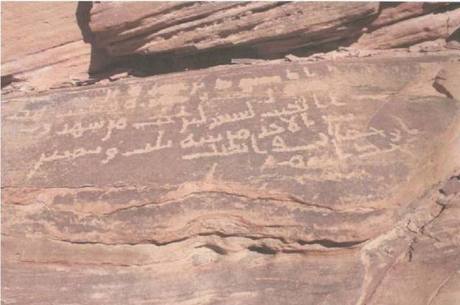
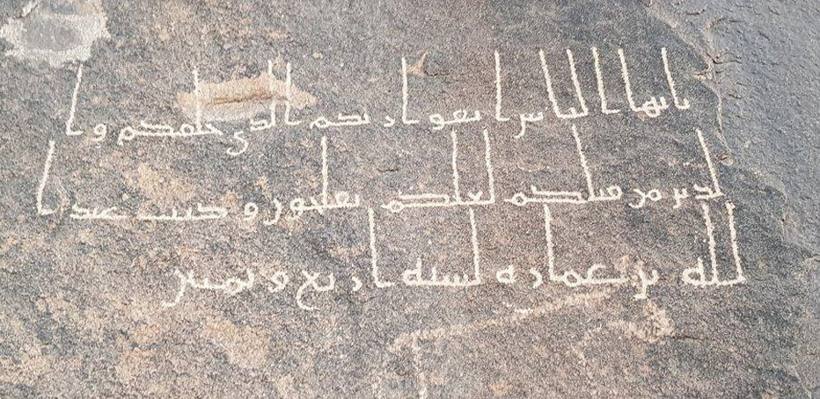
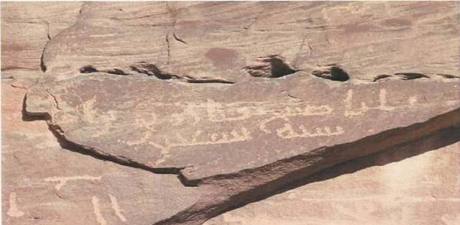
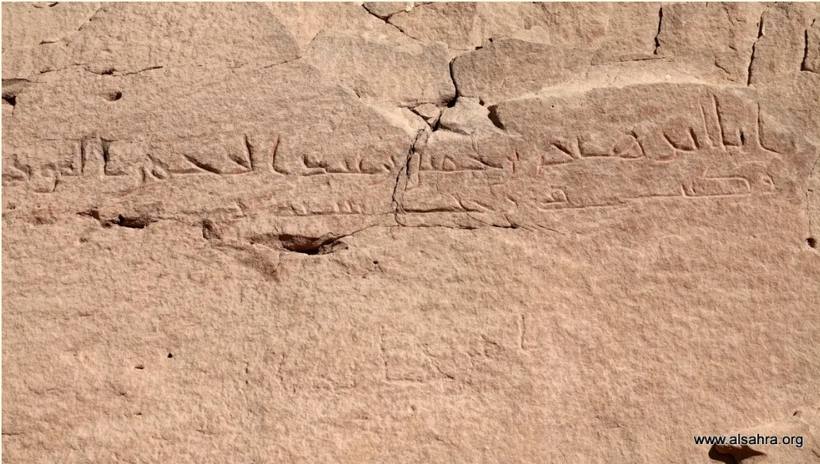
A dated, digital corpus of Arabia's first Islamic-era rock inscriptions and funerary texts — beginning with the earliest known example, carved the year the caliph ʿUmar died, and continuing across the first Islamic century.

وكانوا يجعلون الكتاب حفرًا في الصخور، ونقشًا في الحجارة، وخلقة مركّبة في البنيان، فربّما كان الكتاب هو الناتئ، وربّما كان الكتاب هو الحفر، إذا كان تاريخًا لأمر جسيم، أو عهدًا لأمر عظيم، أو موعظة يرتجى نفعها، أو إحياء شرف يريدون تخليد ذكره.

“They would render writing as an excavation in rock, an engraving in stone, or a form built into a structure — the writing sometimes raised in relief, sometimes cut in — whenever it recorded a weighty matter, a covenant of great consequence, an admonition whose benefit was hoped for, or an honor they wished to immortalize.”

al-Jāḥiẓ, Kitāb al-Ḥayawān, 1/49

Studies

Seven short essays that read the inscriptions together: who wrote them, when, how, and what they say.

The scripts

All 164 inscriptions of the catalog, from two pre-Islamic Paleo-Arabic texts to 132 AH, cut (or, in one case, painted) in Paleo-Arabic or in the early Ḥijāzī, Makkī or Madanī hand of 1st-century Arabia.

Collections

Browse the corpus by what each inscription was written to say.

Reference

Research tools covering the whole corpus at once.
Early Islamic Inscriptions

A digital catalog of 143 dated Islamic inscriptions from the first and second centuries AH (23–132 AH), with nineteen undated early Islamic texts and two pre-Islamic Paleo-Arabic texts

22 AH77 AH132 AH
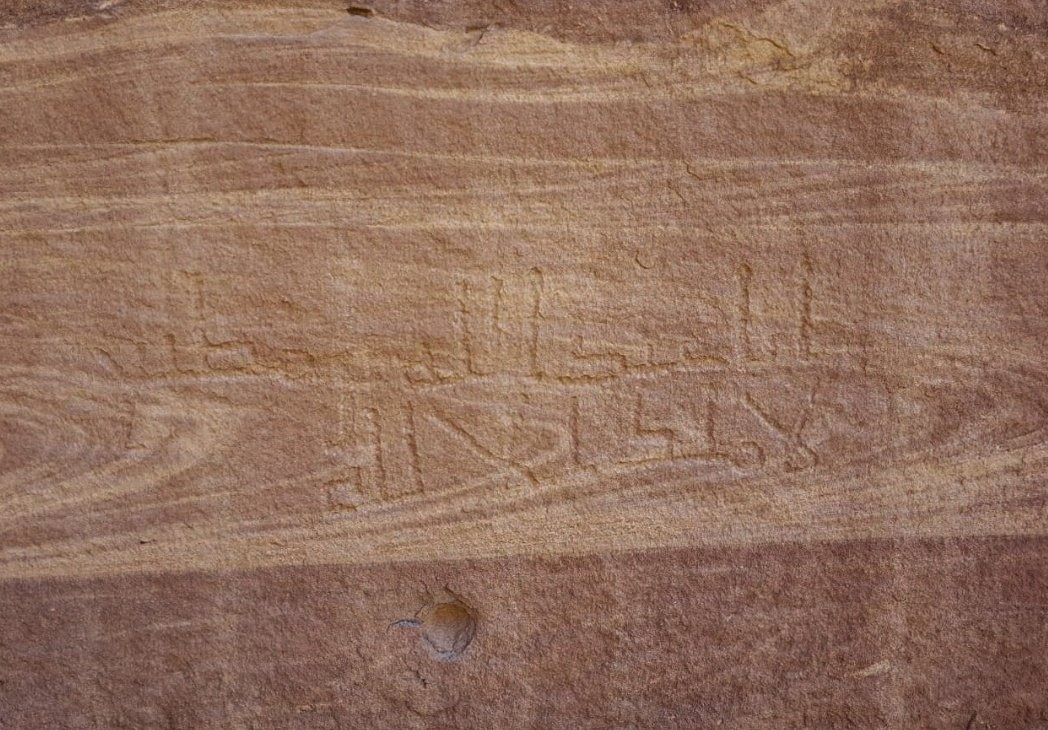
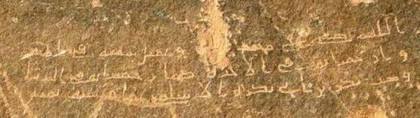
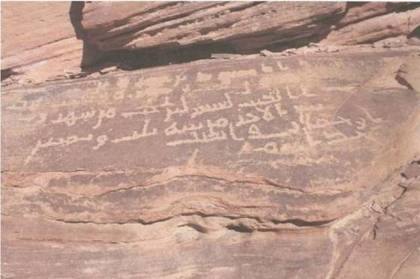
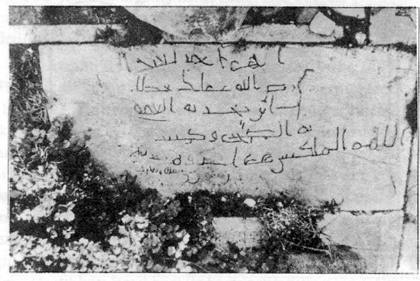
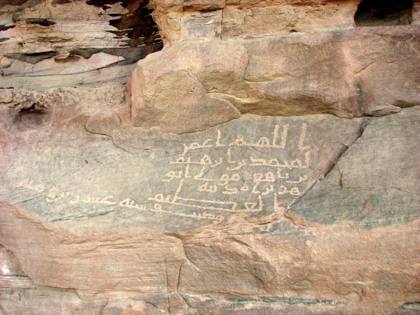
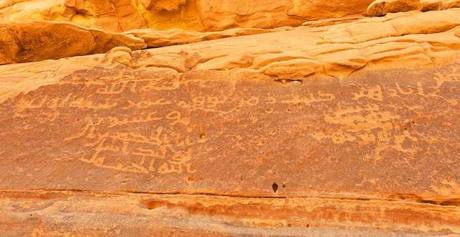
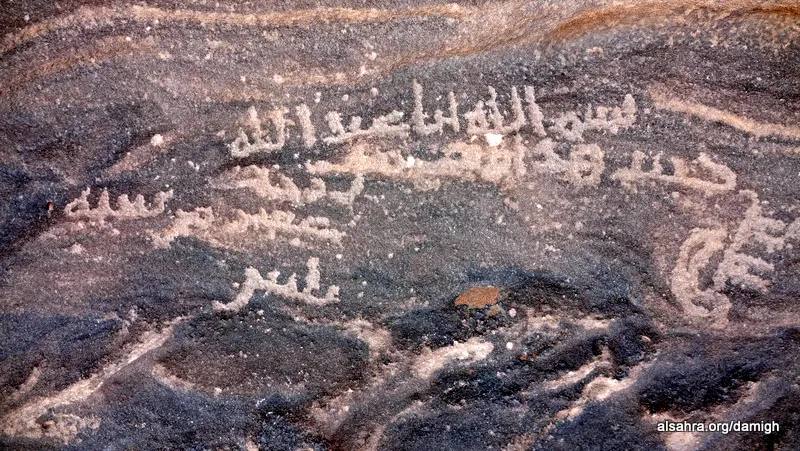
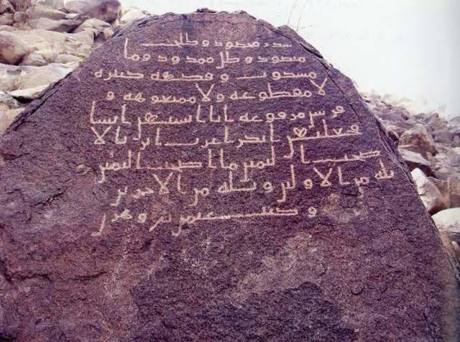
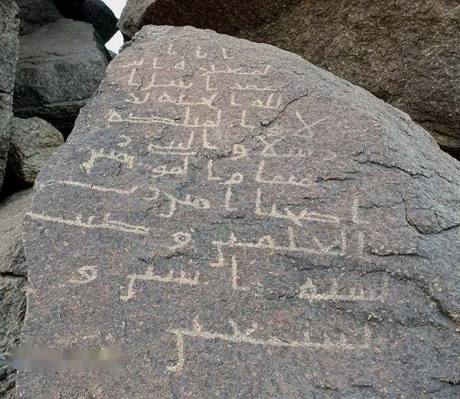
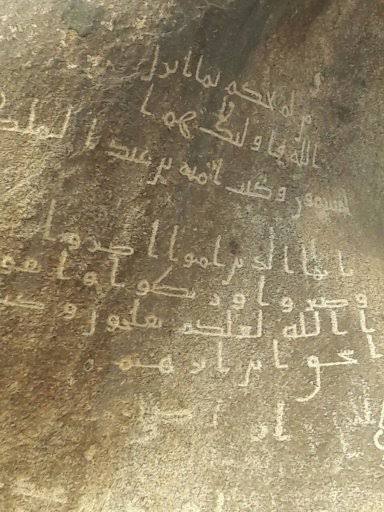
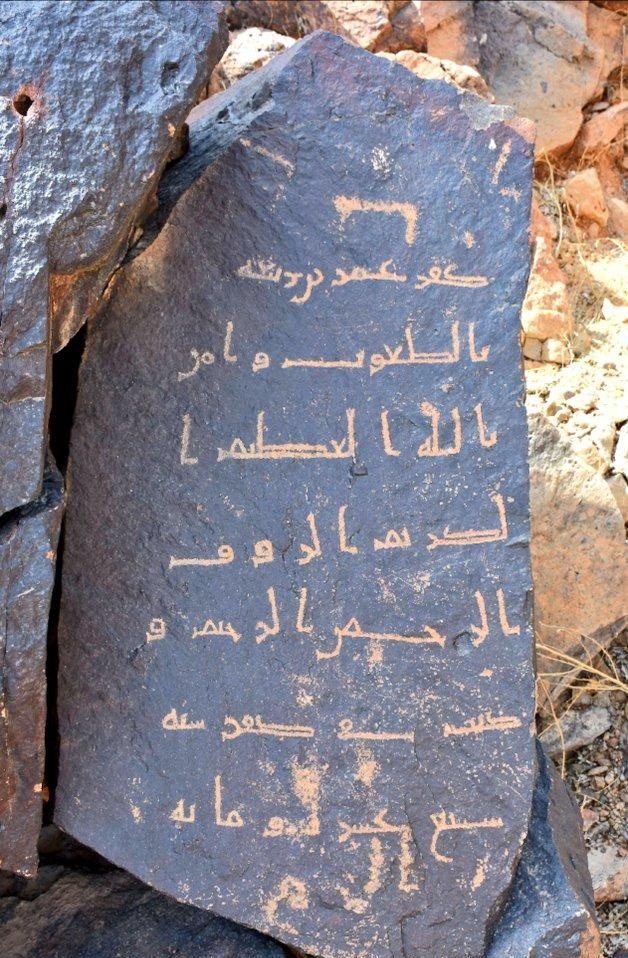
Inscription of Ḥanẓalah
c. 7th ExhortationClear

Inscription of Ḥanẓalah

نقش حنظلة بن عبد عمرو

Karmat ʿAddās al-Naṣrānī, near al-Ṭāʾif
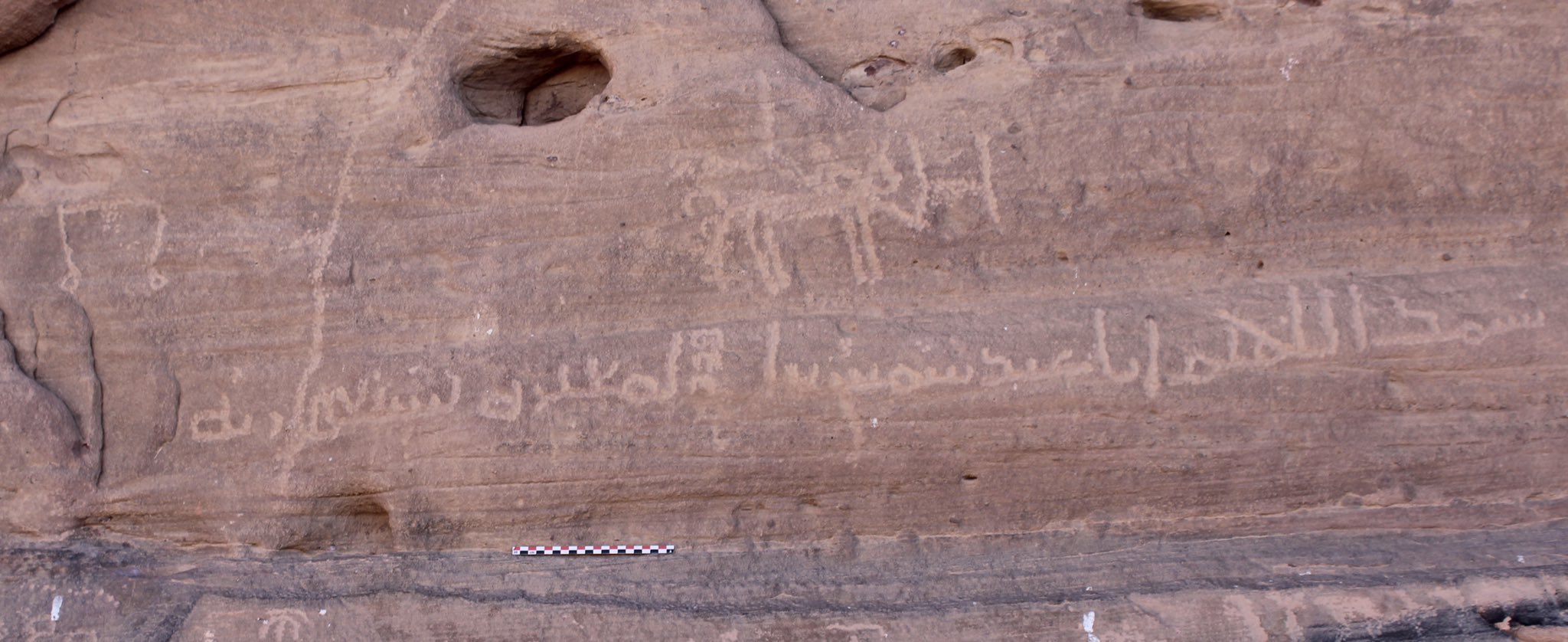
Paleo-Arabic exhortation bismika rabbanā al-Ṭāʾif

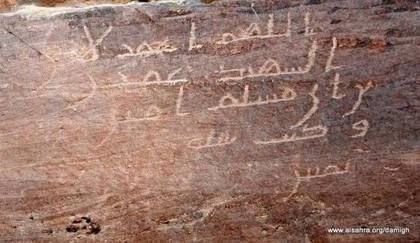
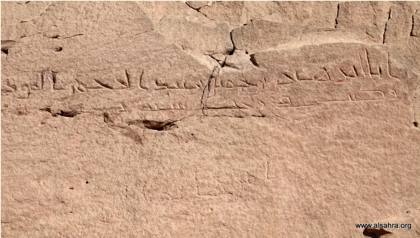
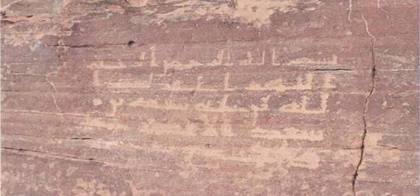
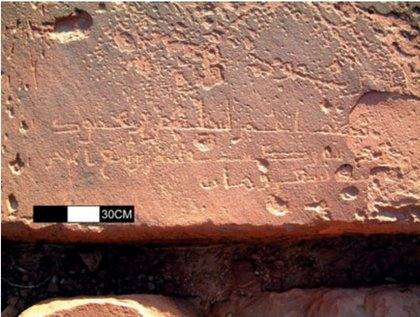
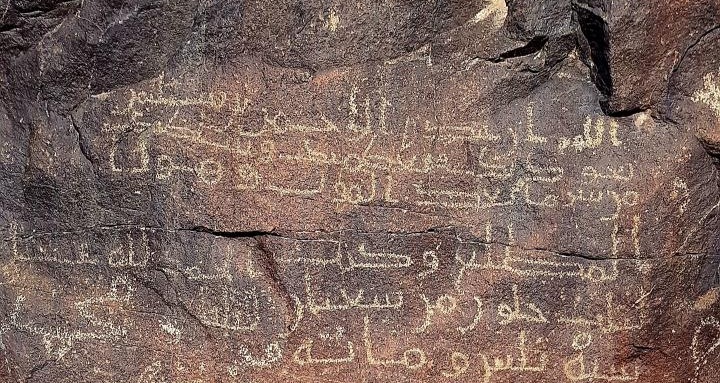
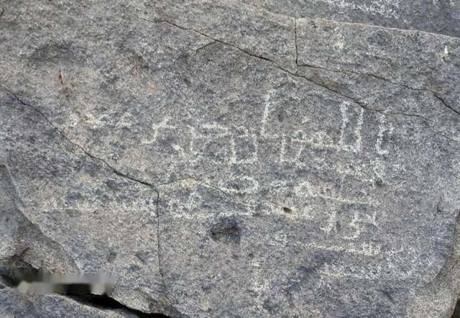
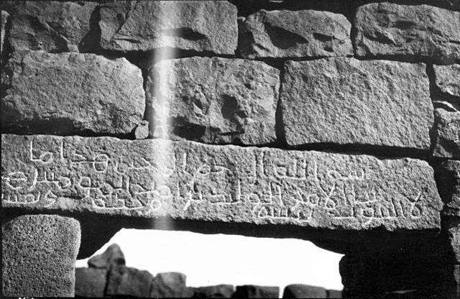
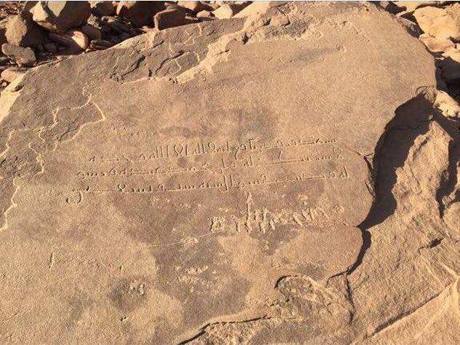
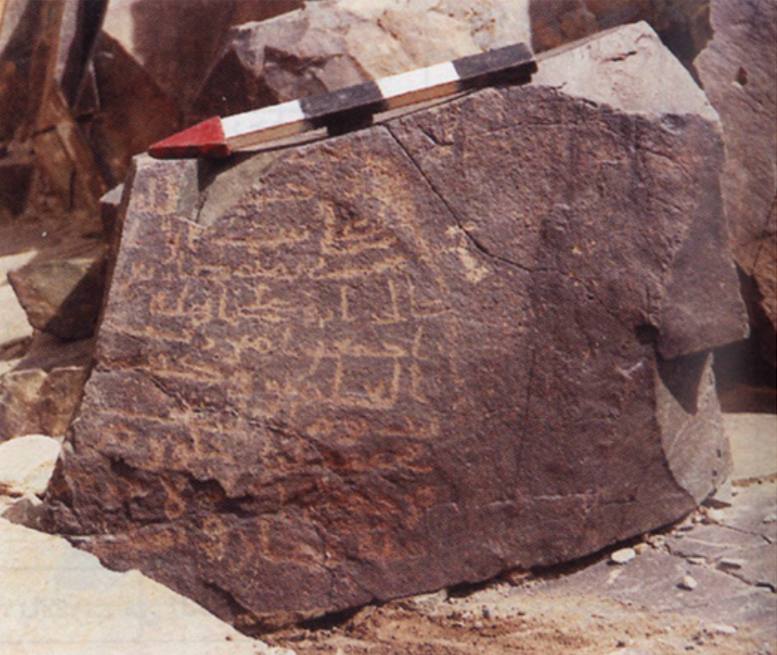
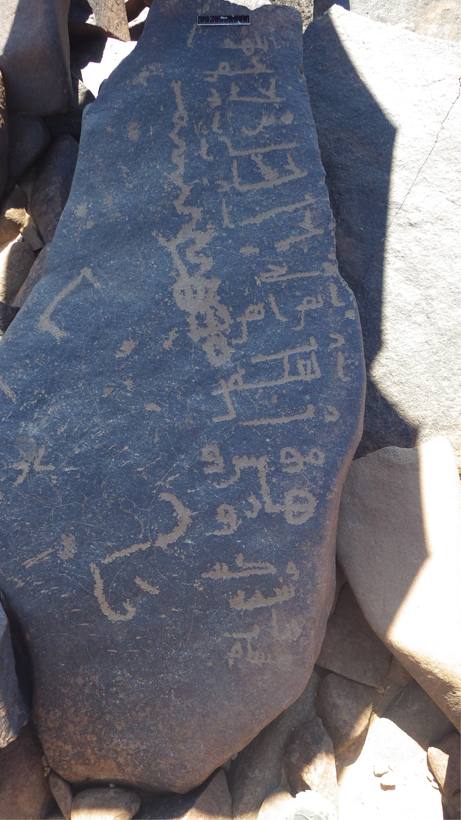
Inscription of ʿAbd Shams b. al-Mughīrah, Ḥismā
Pre-Islamic CommemorativeClear

Inscription of ʿAbd Shams

نقش عبد شمس بن المغيرة

Ḥismā Desert, Tabūk region
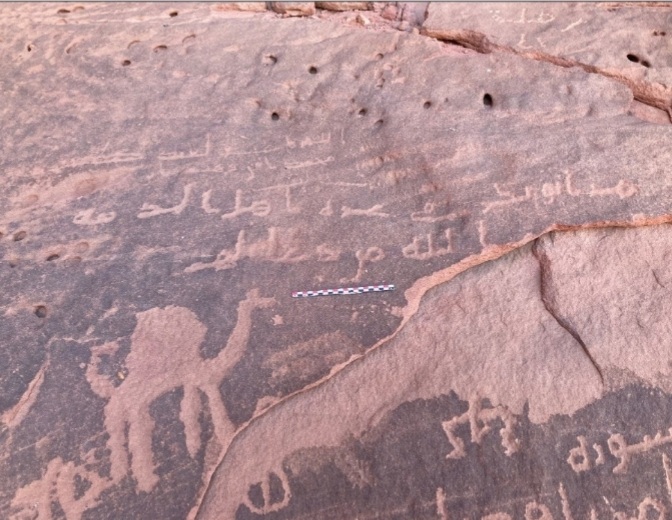
Paleo-Arabic bismika Allāhumma seeking forgiveness Ḥismā Tabūk

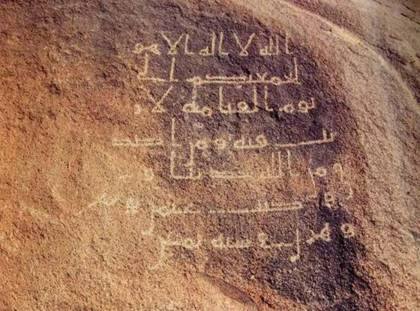
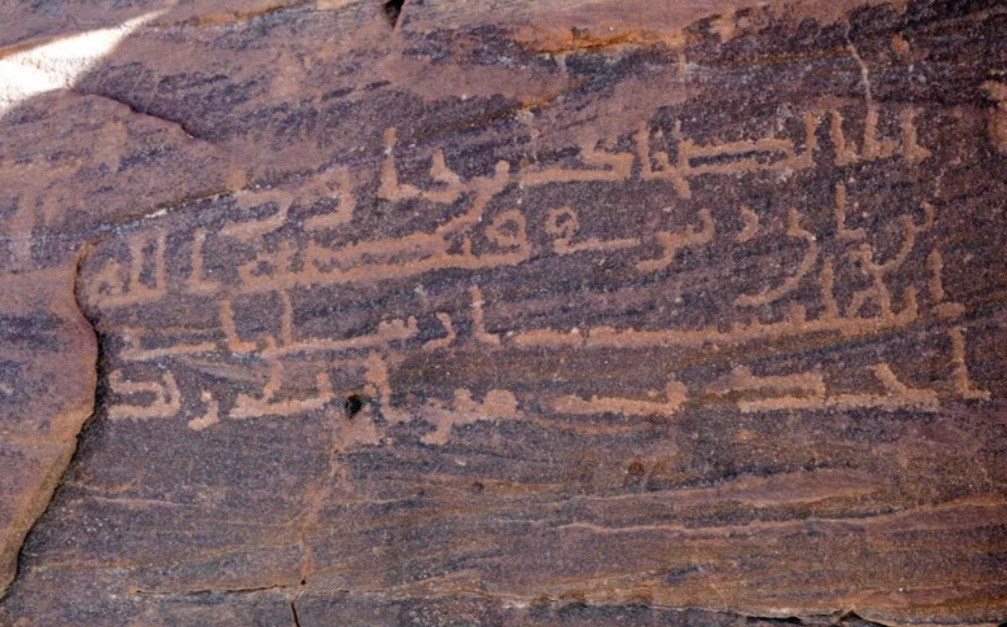
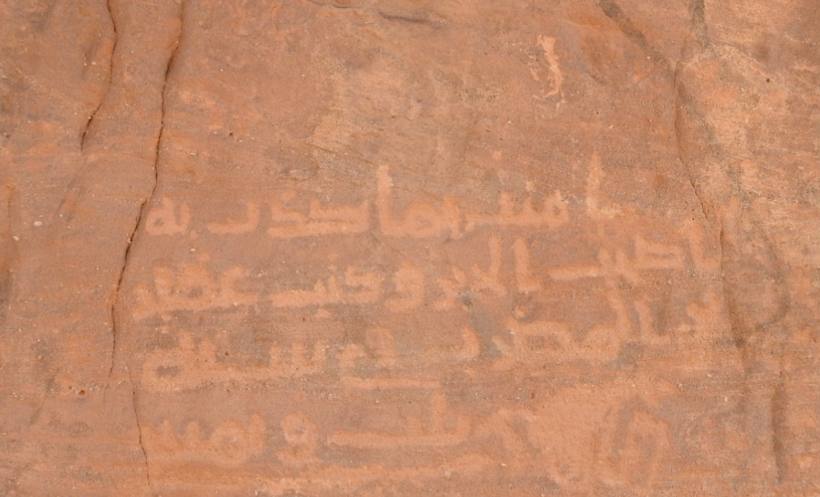
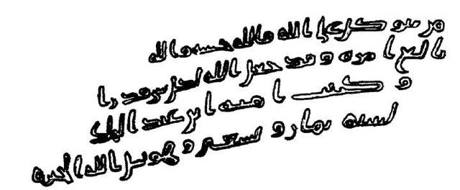
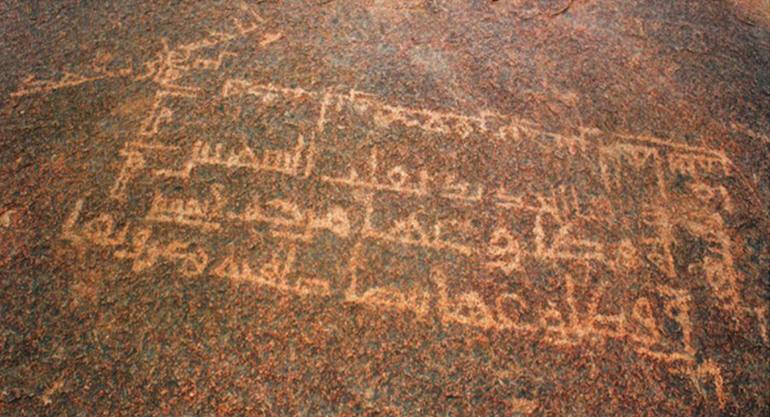
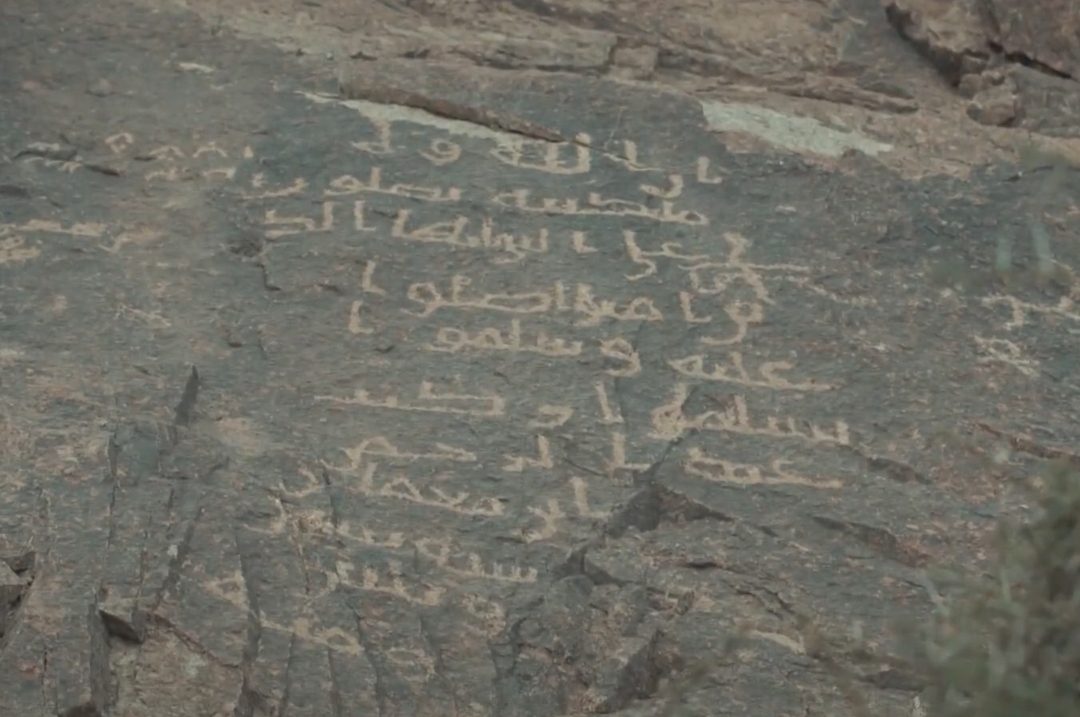
Inscription of Abū Bakr, Ḥismā
c. 9 AH? Prayer for MercyLargely clear

Inscription of Abū Bakr

نقش أبي بكر

al-Qaṭṭār, Ḥismā Desert, Tabūk region
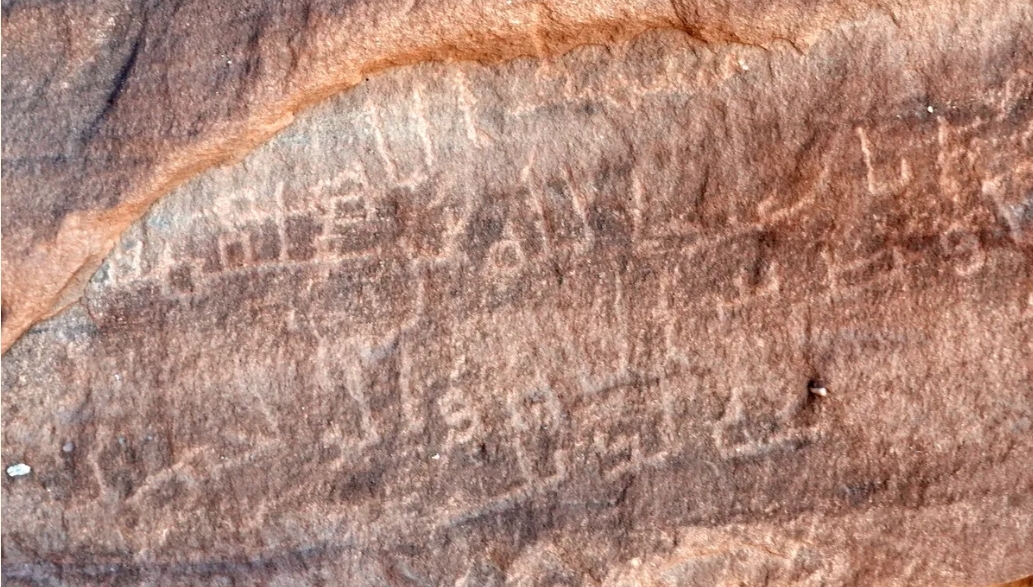
Early Arabic prayer for mercy military expedition Ḥismā Tabūk

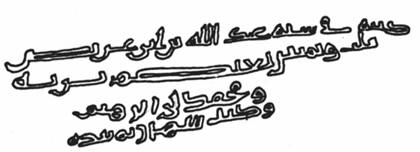
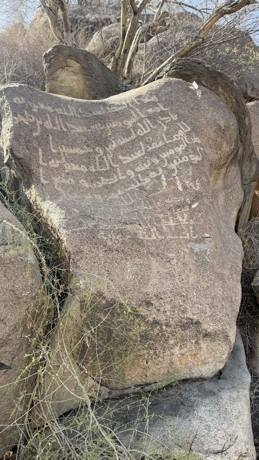
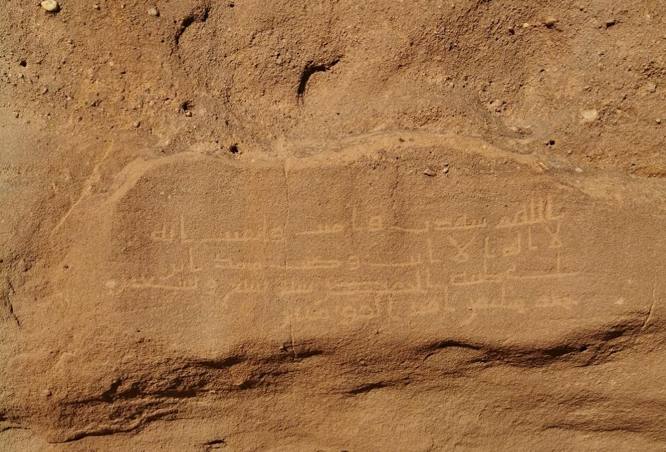
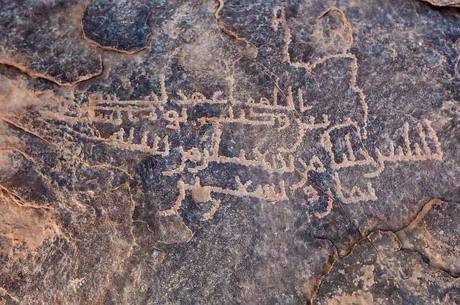
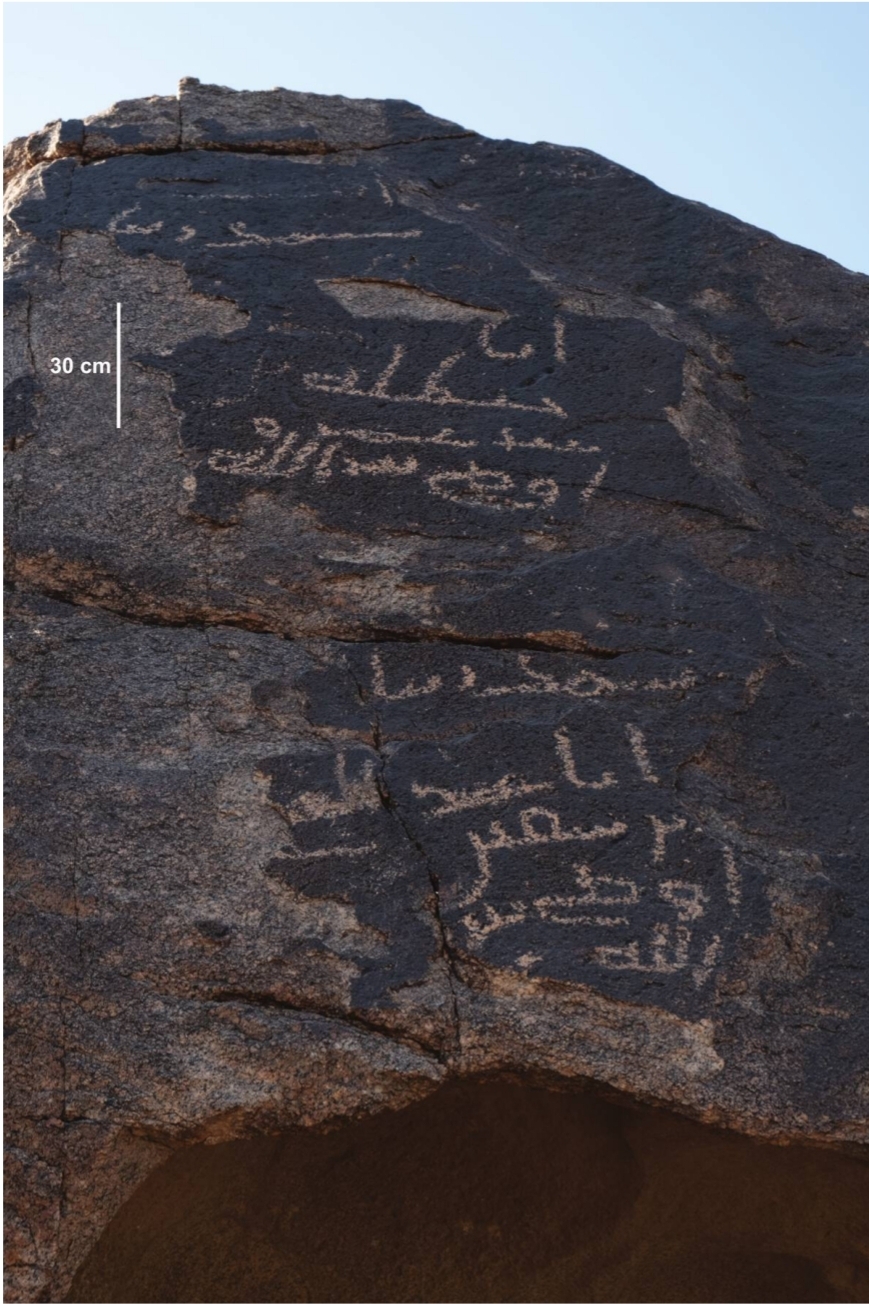
Inscription of ʿAbdallāh ibn ʿAlqamah
Early 1st c. AH ExhortationLargely clear

Inscription of ʿAbdallāh ibn ʿAlqamah

نقش عبد الله بن علقمة

Darb Ḥismā, north-western Arabia
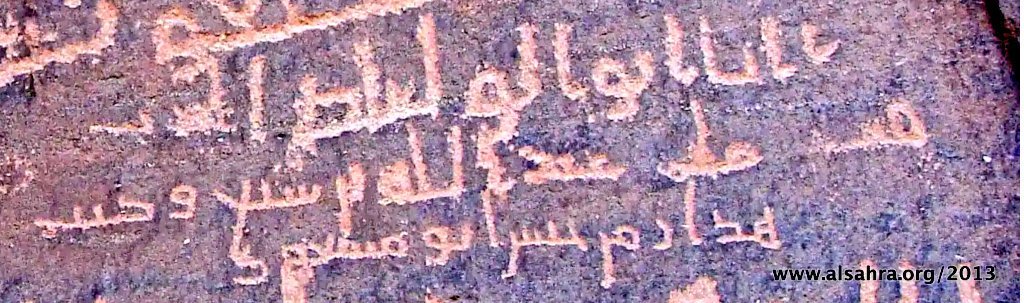
Ḥijāzī bismika Allāhumma waṣiyyah mukhaḍram Quraysh

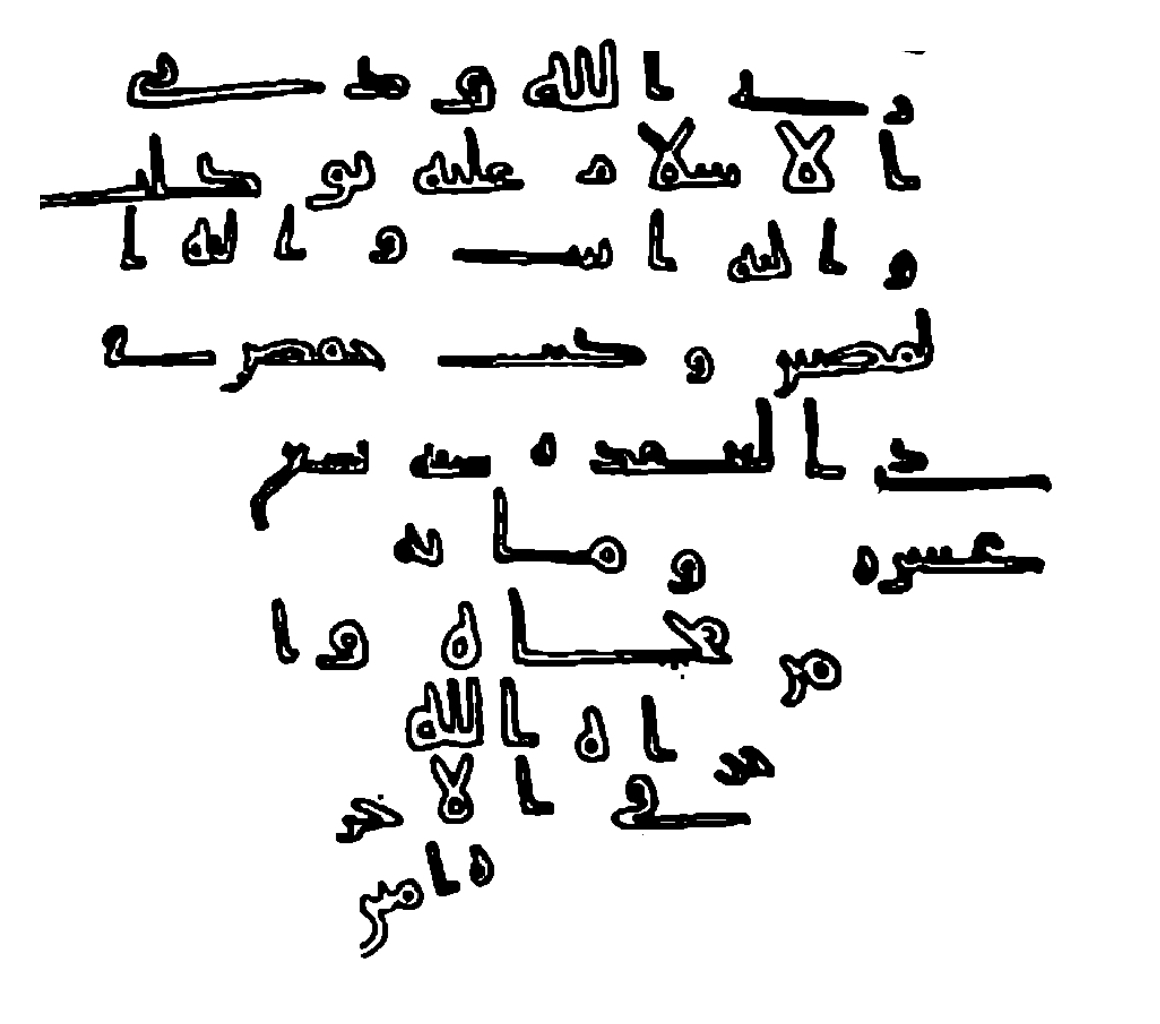
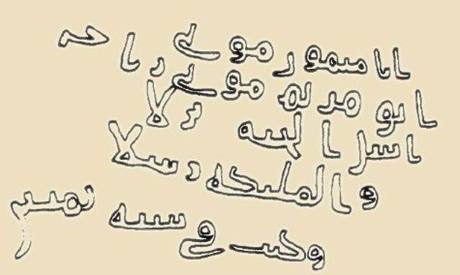
Inscription of al-Ḥārith ibn Būlī: the Time Abū Masʿūd Was Detained
c. 22 AH CommemorativeLargely clear

Inscription of al-Ḥārith ibn Būlī: “the Time Abū Masʿūd Was Detained”

نقش الحارث بن بولي: زمن حُبس أبو مسعود

Darb Ḥismā, north-western Arabia
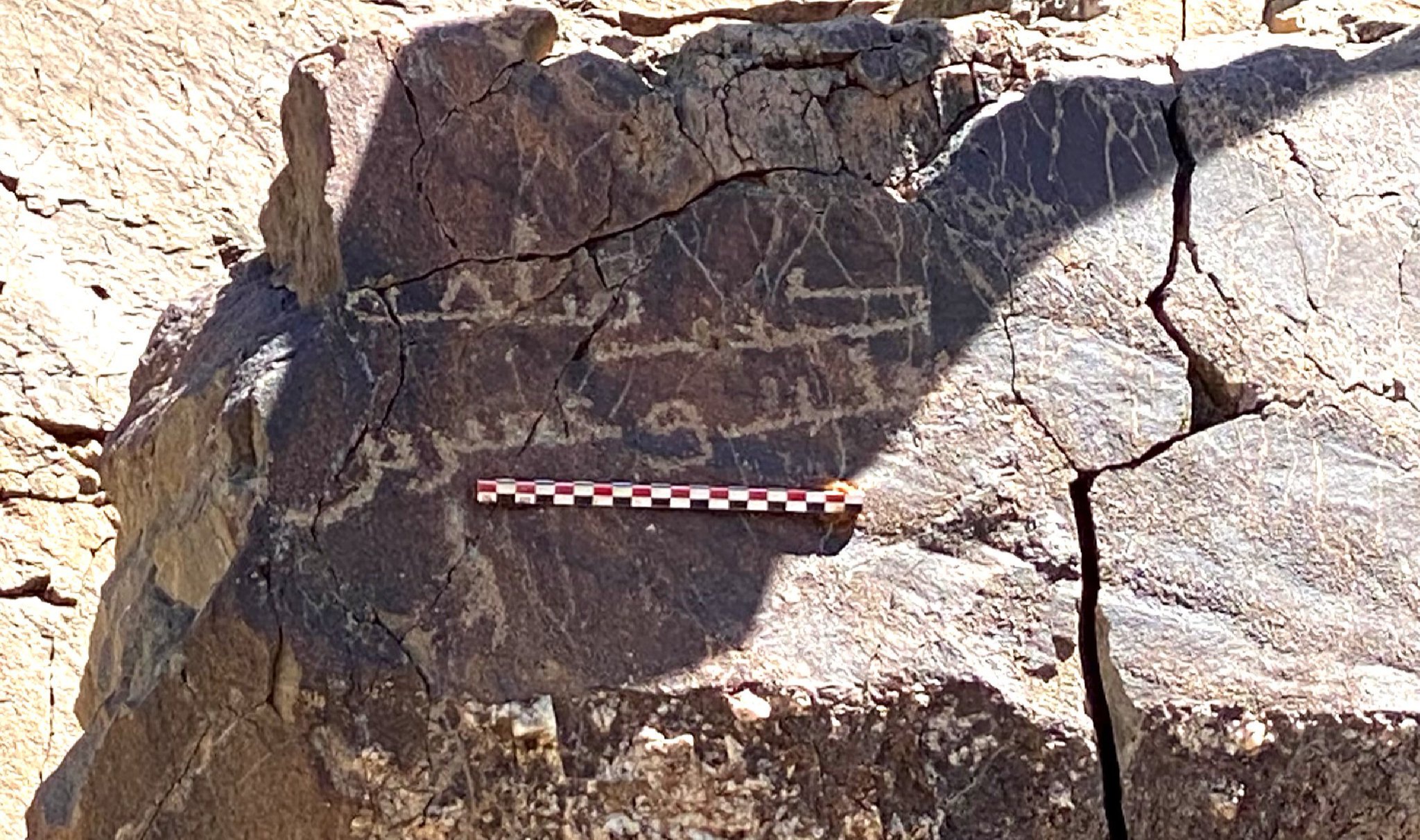
Ḥijāzī dated by event Abū Masʿūd al-Badrī ʿUmar ghulām

Inscription of Salamah
23 AH CommemorativeClear

Inscription of Salamah

نقش سلمة

Yanbuʿ al-Nakhl, Saudi Arabia
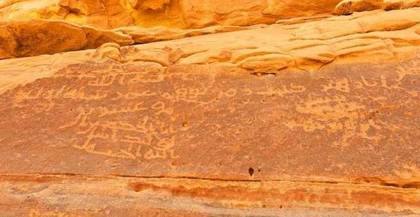
signature dating formula triangular mīm Yanbuʿ

Inscription of Zuhayr
24 AH CommemorativeClear

Inscription of Zuhayr

نقش زهير

Qāʿ al-Muʿtadil, near al-ʿUlā
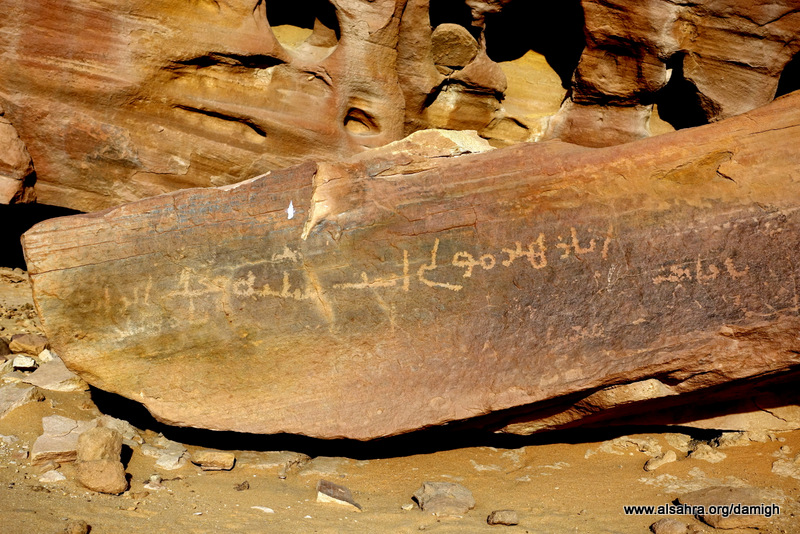
name dated by event Ḥijāzī script earliest dated inscription

Inscription of Zuhayr, Mawlā of the Daughter of Shaybah
c. 24 AH CommemorativeClear

Inscription of Zuhayr, Mawlā of the Daughter of Shaybah

نقش زهير مولى ابنت شيبة

Qāʿ al-Muʿtadil, near al-ʿUlā
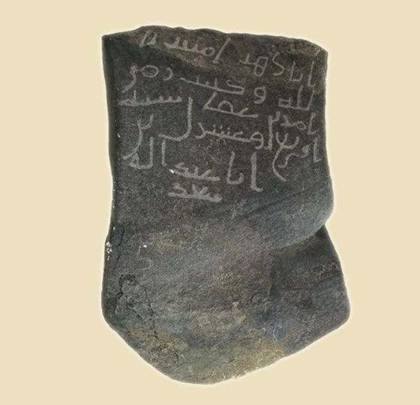
name mawlā Ḥijāzī script

Inscription of ʿUthmān's Appointment
24 AH Profession of FaithClear

Inscription of ʿUthmān's Appointment

نقش تأمير عثمان

Near al-ʿUlyā Palace, Mecca
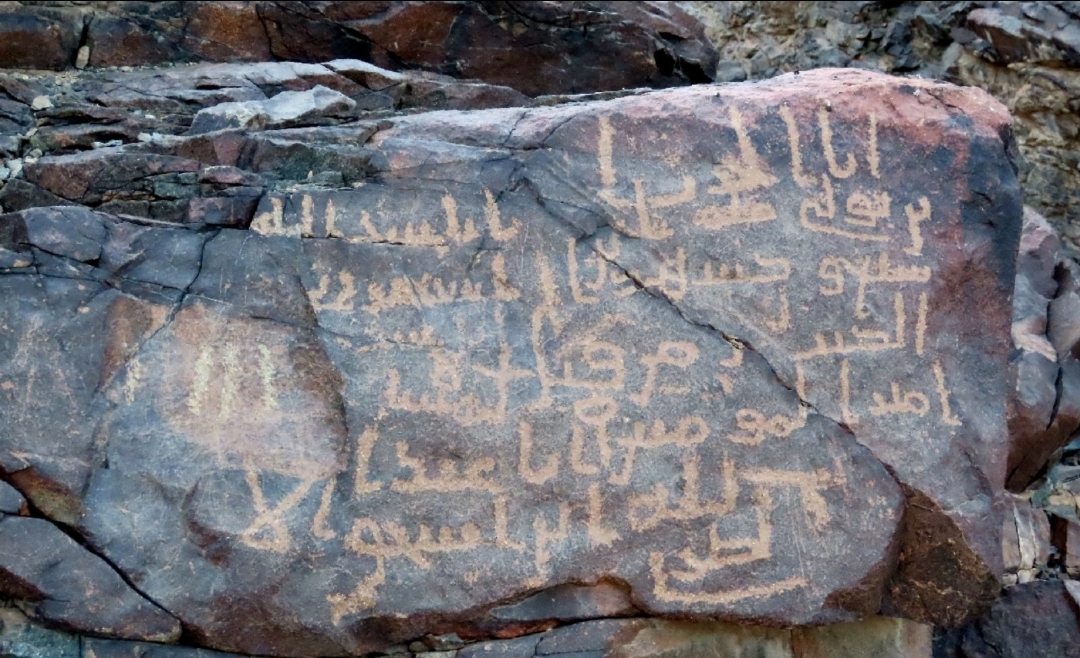
profession of faith dated by event historical event (caliphal appointment) Ḥijāzī script

Inscription of al-Ḥārith ibn Būlī: the Time the Commander of the Faithful Was Killed
c. 24 AH CommemorativeLargely clear

Inscription of al-Ḥārith ibn Būlī: “the Time the Commander of the Faithful Was Killed”

نقش الحارث بن بولي: زمن قُتل أمير المؤمنين

Outskirts of Medina
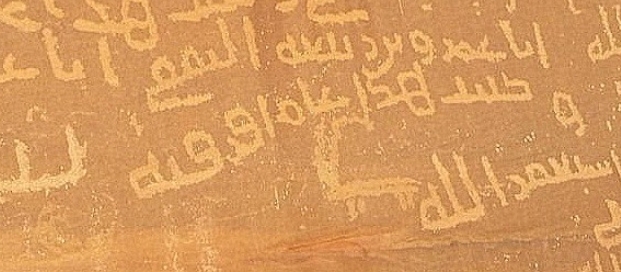
Ḥijāzī dated by event killing of the caliph ʿUmar Medina

Inscription of ʿAmr ibn Rabīʿah al-Thaqafī
c. 27 AH CommemorativeClear

Inscription of ʿAmr ibn Rabīʿah al-Thaqafī: “the Year of Ifrīqiyah”

نقش عمرو بن ربيعة الثقفي: عام إفريقية

Darb Ḥismā, north-western Arabia
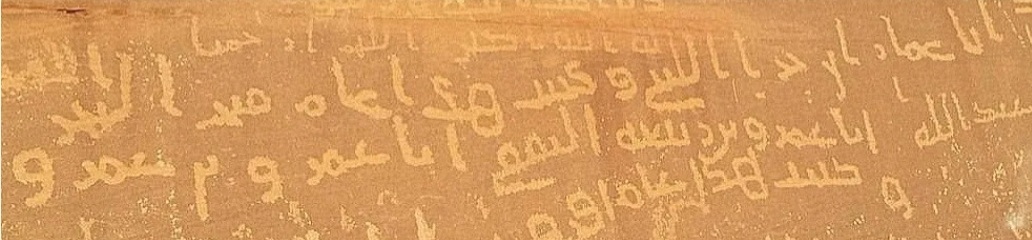
Ḥijāzī dated by event Ifrīqiyah conquests Thaqīf

Inscription of ʿAmmār al-Laythī
c. 28 AH CommemorativeClear

Inscription of ʿAmmār al-Laythī: “the Year of the Conquest of the Sea”

نقش عمار الليثي: عام فتح البحر

Darb Ḥismā, north-western Arabia
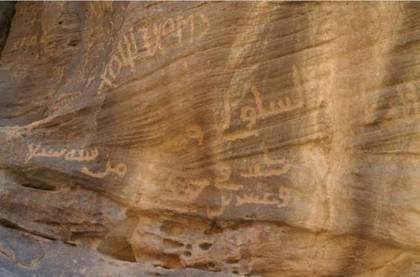
Ḥijāzī dated by event naval campaign Cyprus Banū Layth

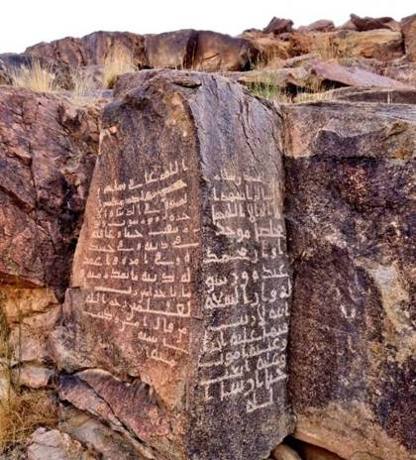
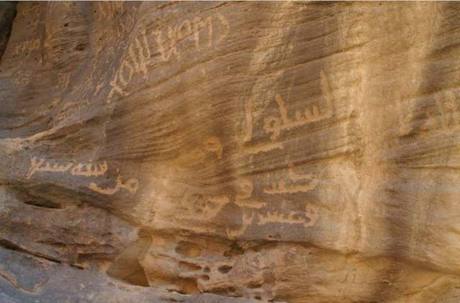
Inscription of Yazīd ibn ʿAbdallāh al-Sulūlī
29 AH Prayer for MercyClear

Inscription of Yazīd ibn ʿAbdallāh al-Sulūlī

نقش يزيد بن عبد الله السلولي

Wādī al-Khushaybah, Najrān region
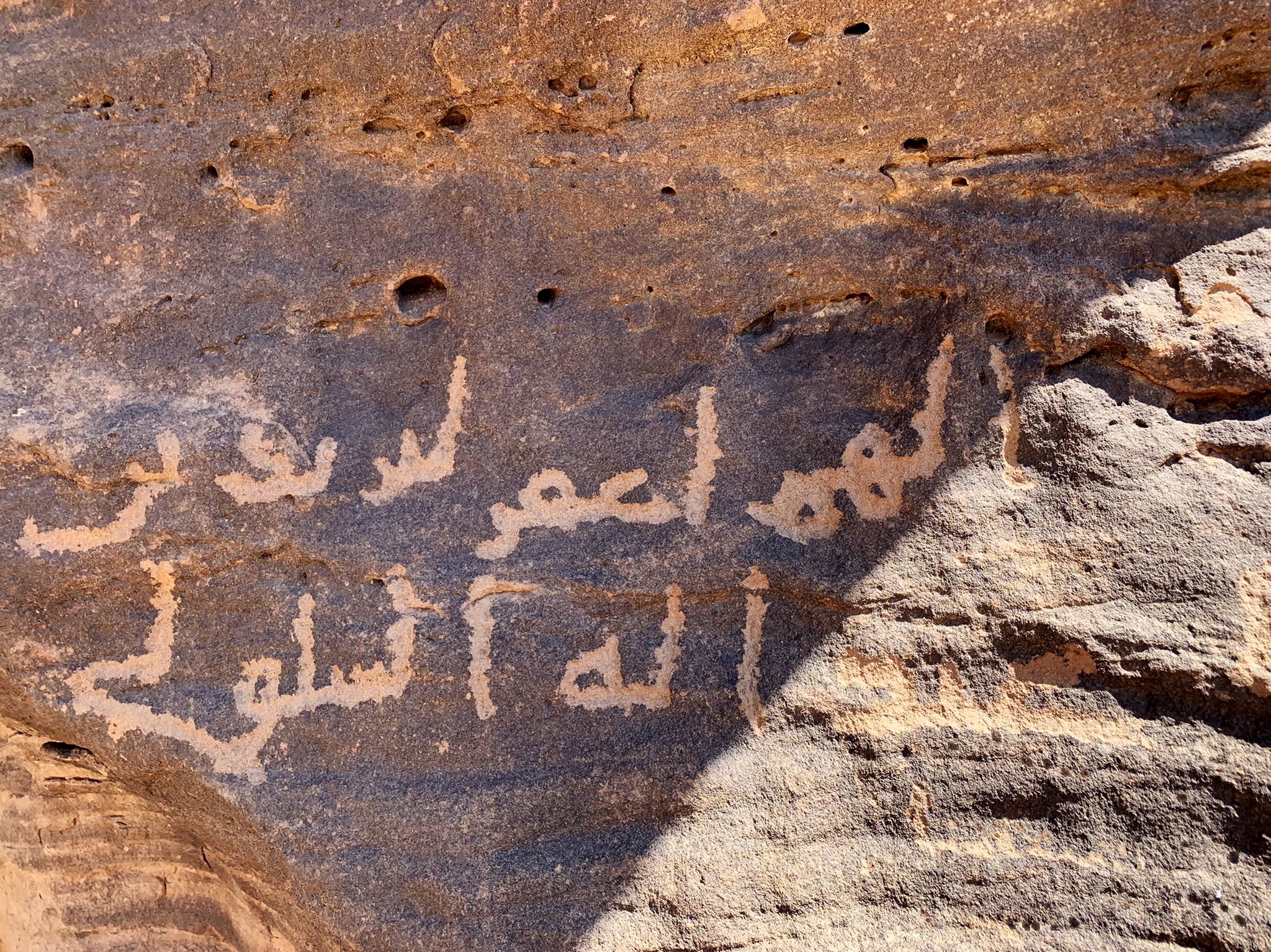
prayer for mercy archaic orthography Ḥijāzī script

Second Inscription of Yazīd ibn ʿAbdallāh al-Sulūlī
c. 29 AH Prayer for ForgivenessClear

Second Inscription of Yazīd ibn ʿAbdallāh al-Sulūlī

النقش الثاني ليزيد بن عبد الله السلولي

Wādī al-Khushaybah, Najrān region
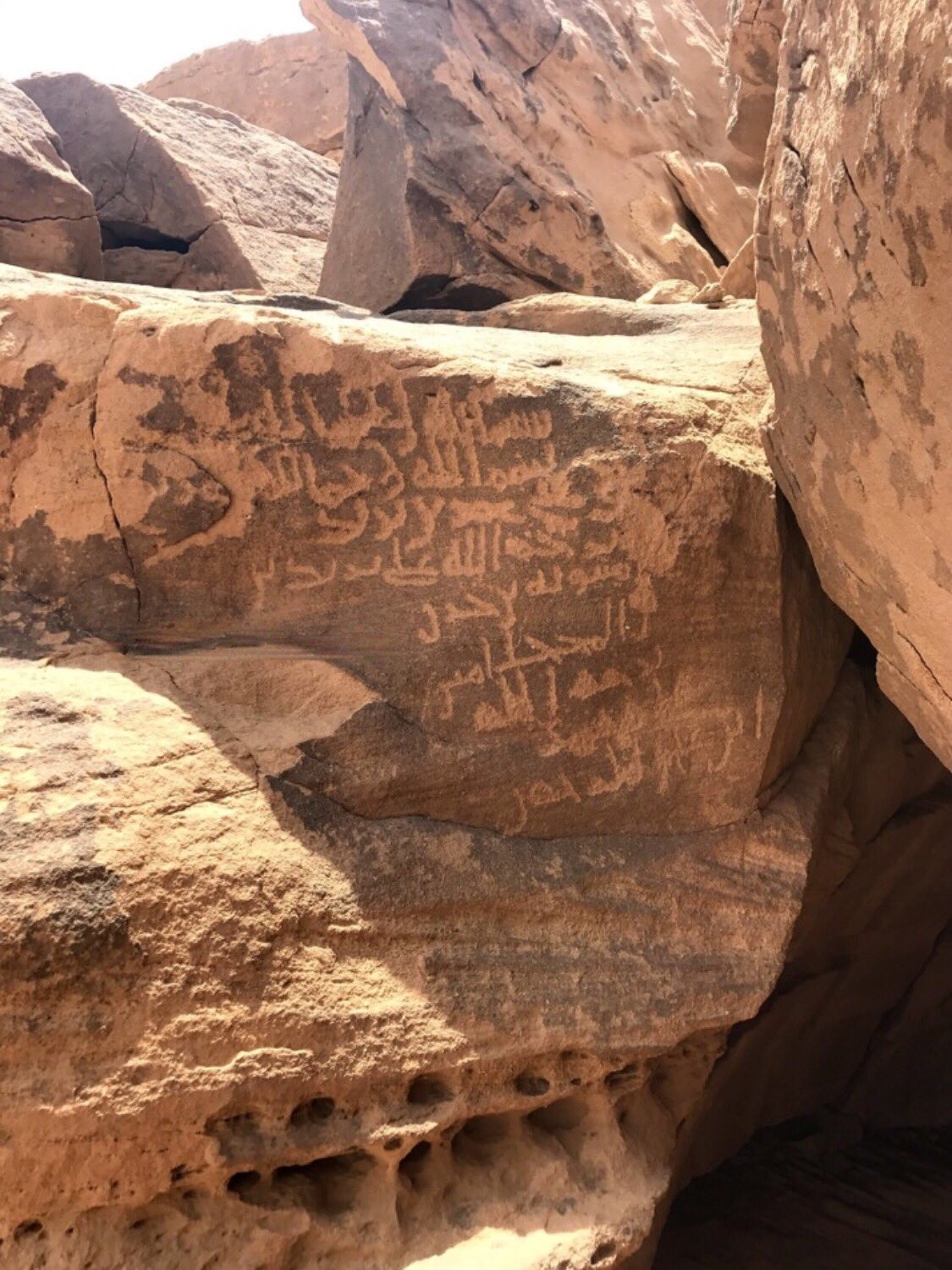
Ḥijāzī prayer for forgiveness archaic orthography Najrān

Prayer for Yazīd ibn al-Muḥajjal
c. 10–60 AH Prayer for MercyClear

Inscription of Yazīd ibn Muʿāwiyah ibn Ḥazn ibn al-Muḥajjal

نقش يزيد بن معاوية بن حزن بن المحجل

Site unrecorded
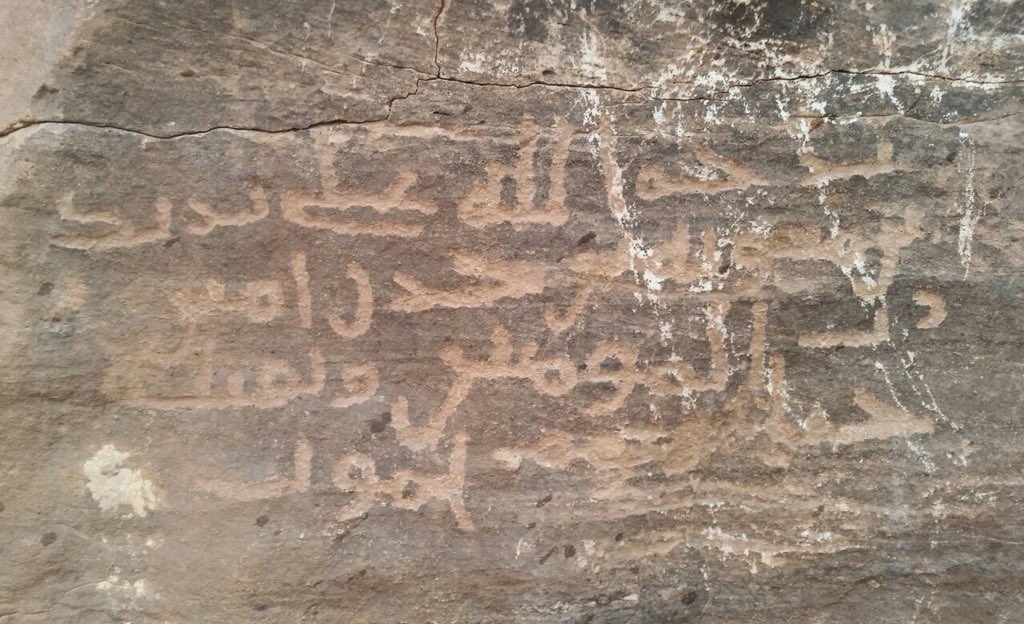
Companion Banū al-Ḥārith ibn Kaʿb Najrān delegation undated

Second prayer for Yazīd ibn Muʿāwiyah ibn Ḥazn, east of Najrān
c. 10–60 AH Prayer for MercyClear

Second Inscription of Yazīd ibn Muʿāwiyah ibn Ḥazn, East of Najrān

النقش الثاني ليزيد بن معاوية بن حزن، شرق نجران

East of Najrān
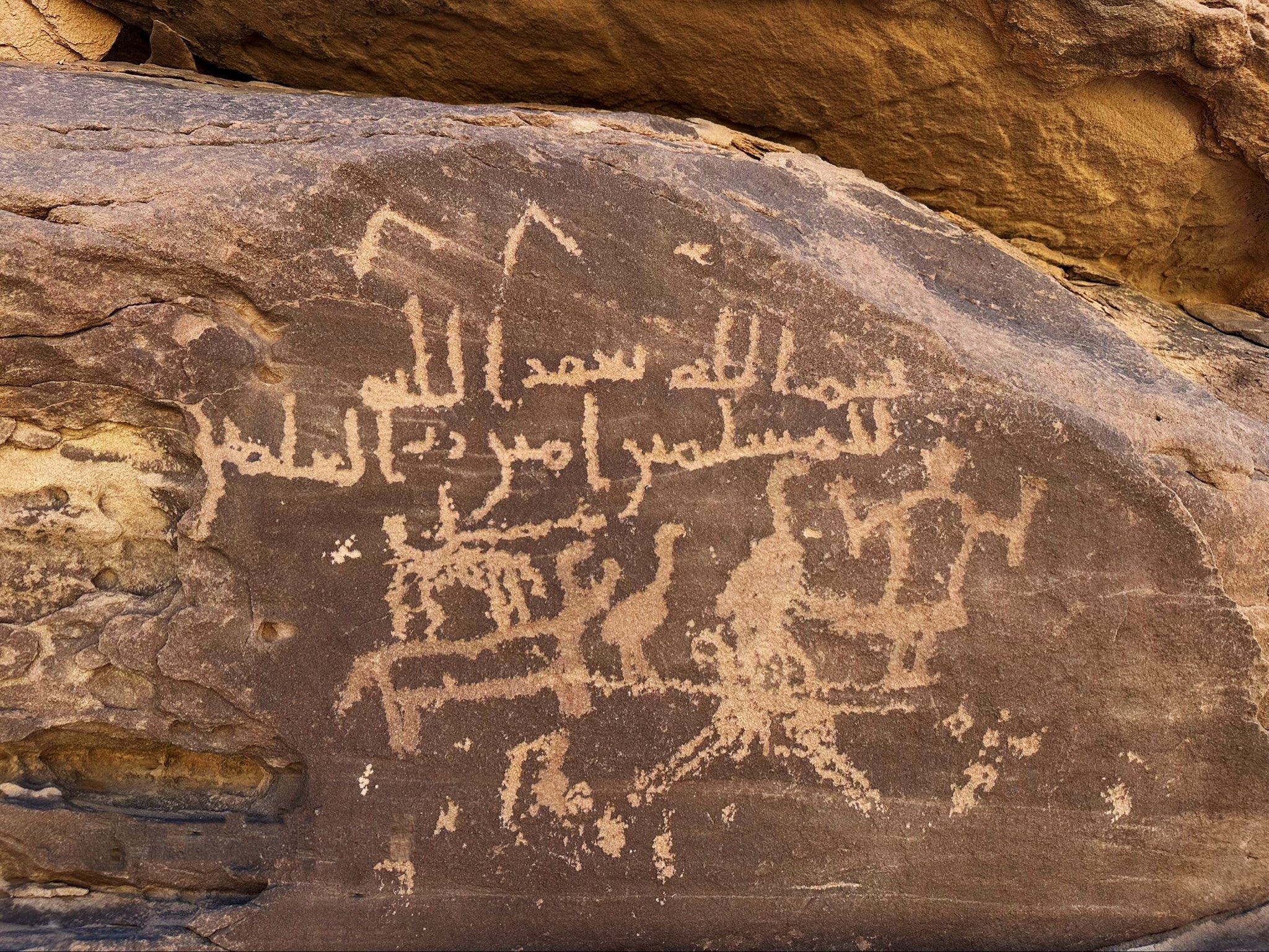
Companion Banū al-Ḥārith ibn Kaʿb Najrān undated

Inscription of Najrān: May God Forgive the Muslims
1st c. AH Prayer for ForgivenessClear

Inscription of Najrān: “May God Forgive the Muslims”

نقش نجران: يغفر الله للمسلمين

Najrān region, Saudi Arabia
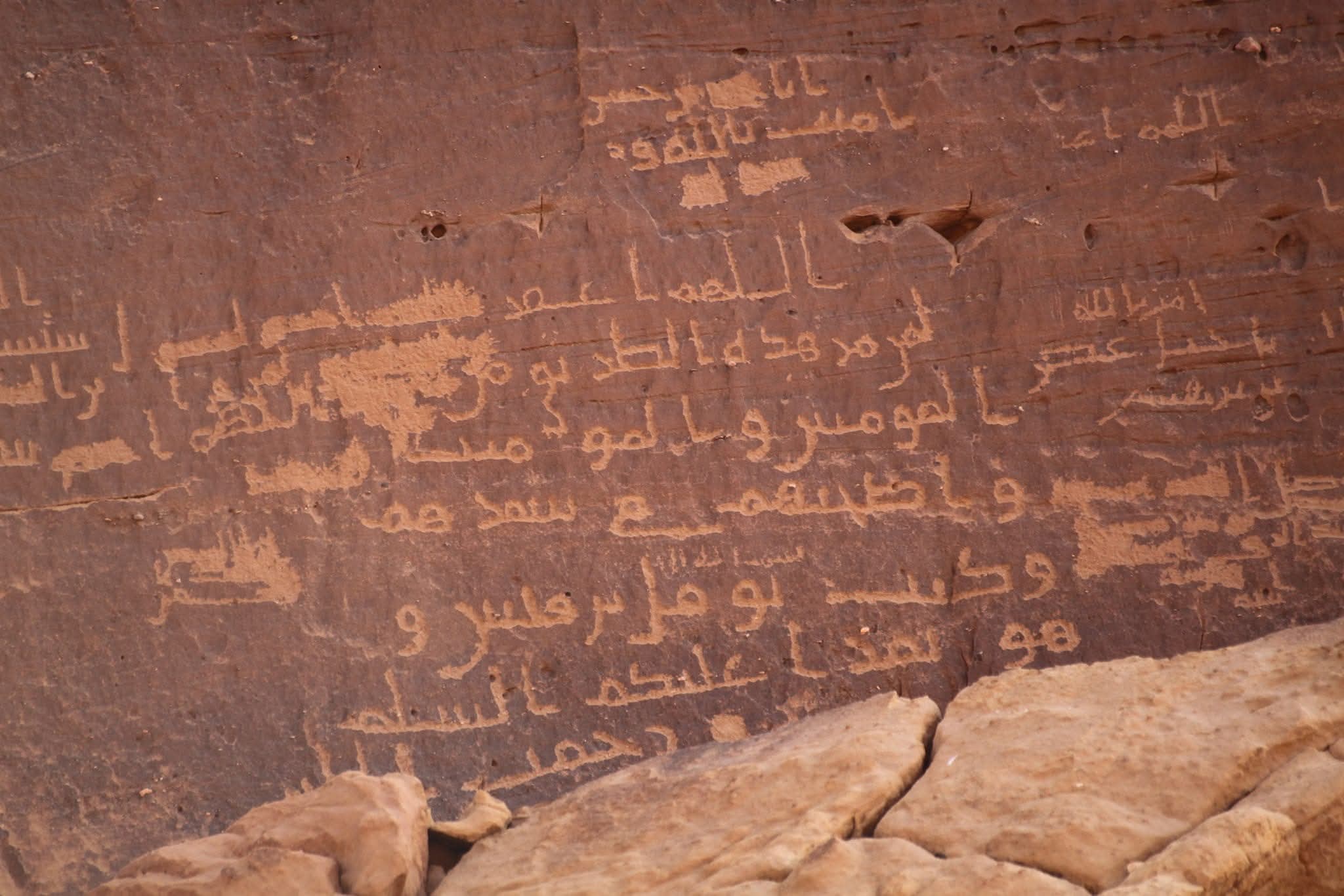
al-muslimūn collective prayer Najrān undated

Inscription of Nawfal ibn Qays, al-ʿUlā
1st–2nd c. AH Prayer for ForgivenessClear

Inscription of Nawfal ibn Qays: a prayer for travellers, al-ʿUlā

نقش نوفل بن قيس: دعاء لمن مر هذه الطريق، العلا

Pilgrim road, al-ʿUlā
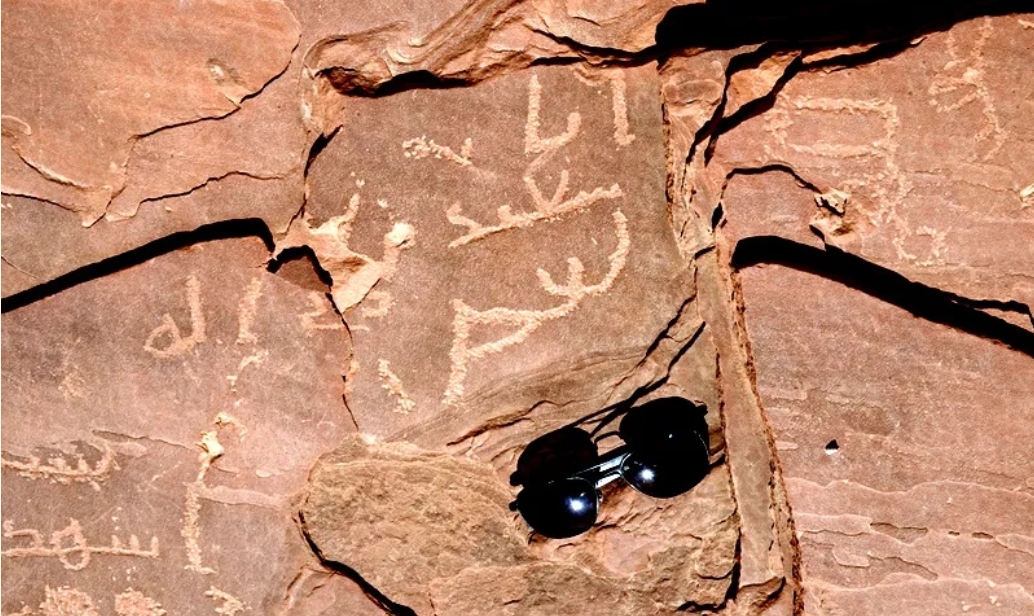
travellers the believers greeting undated

Inscription of Saʿīd ibn al-ʿĀṣ
Before 59 AH Profession of FaithClear

Inscription of Saʿīd ibn al-ʿĀṣ

نقش سعيد بن العاص

Northern Arabia (site unpublished)
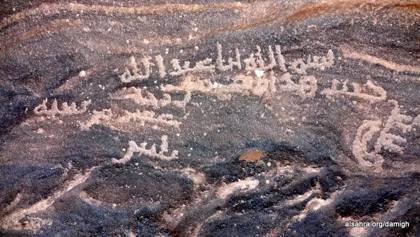
Quraysh single lām Companion undated

Inscription of ʿAbdallāh
30 AH CommemorativeLargely clear

Inscription of ʿAbdallāh

نقش عبد الله

Ḥismā, north-western Arabia
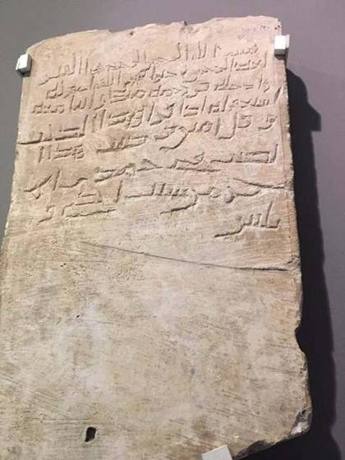
commemorative dated by event dual-dated Ḥijāzī script

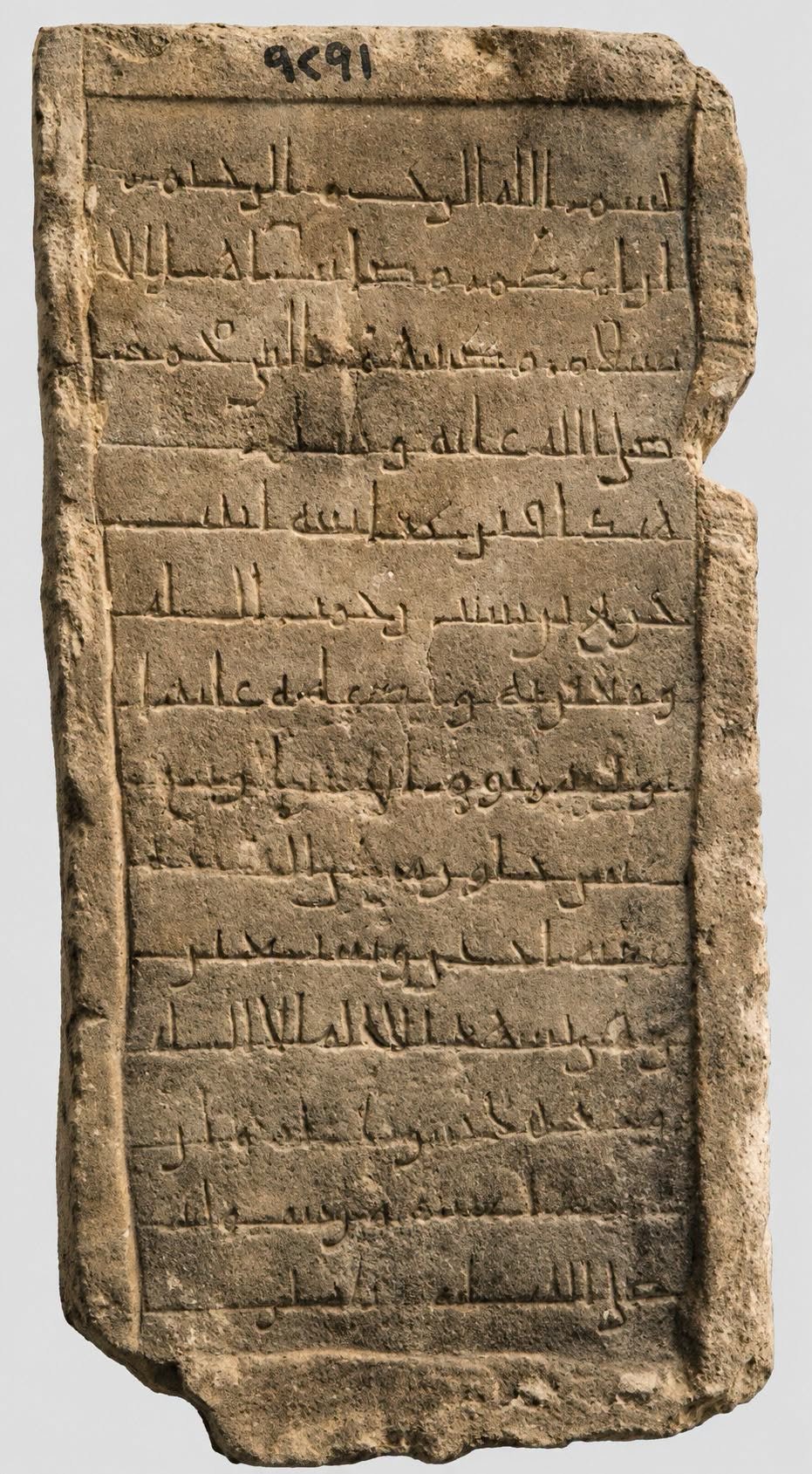
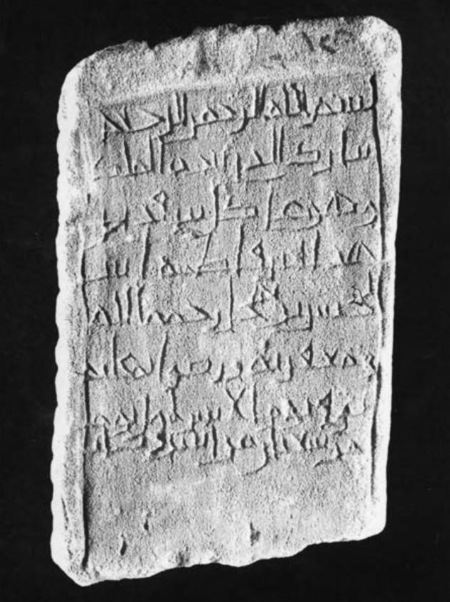
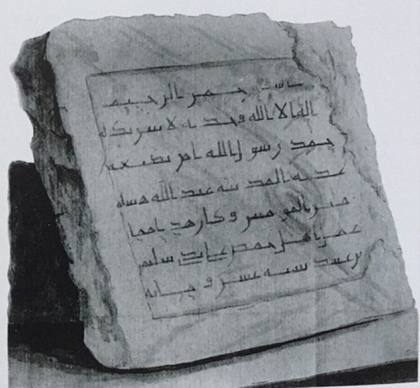
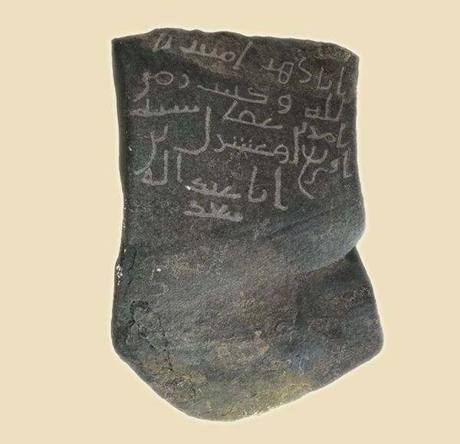
Gravestone of ʿAbd al-Raḥmān ibn Khayr al-Ḥajarī
31 AH Funerary PrayerClear

Gravestone of ʿAbd al-Raḥmān ibn Khayr al-Ḥajarī

شاهد قبر عبد الرحمن بن خير الحجري

Cairo/Aswan cemeteries (findspot); Museum of Islamic Art, Cairo
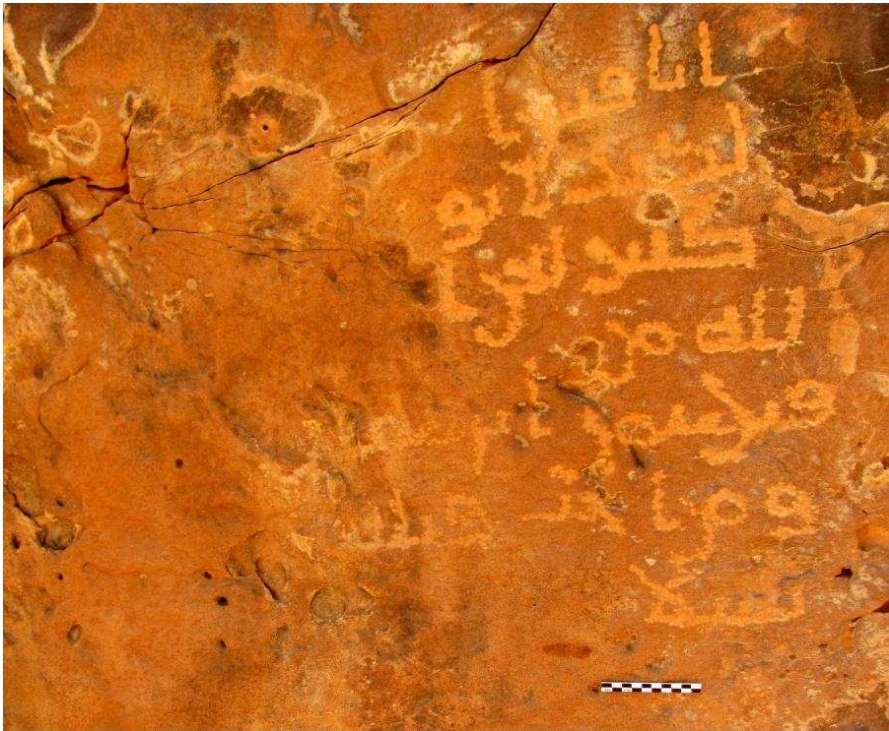
funerary oldest dated tombstone museum piece

Inscription of Qays the scribe, Taymāʾ
After 35 AH CommemorativeClear

Inscription of Qays the Scribe

نقش قيس الكاتب أبو كثير

Taymāʾ, Saudi Arabia
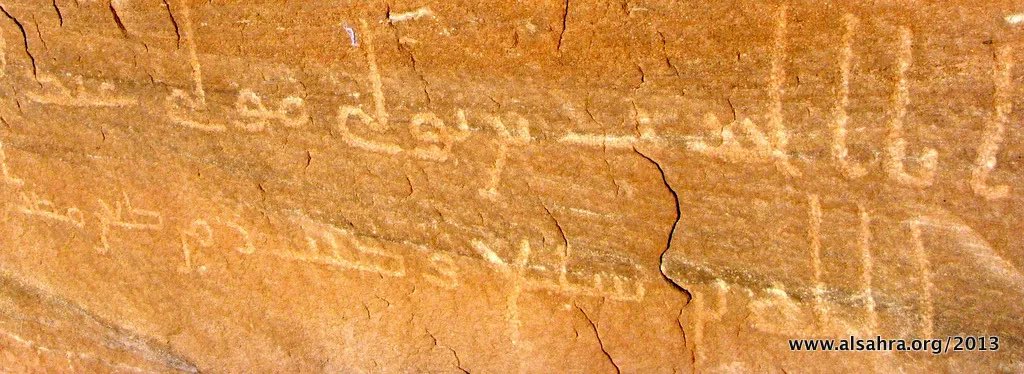
Arabic killing of ʿUthmān curse scribe Taymāʾ

Inscription of al-Ḥārith ibn Būlī: the Time of the Rebellion of Egypt
c. 35 AH CommemorativeClear

Inscription of al-Ḥārith ibn Būlī: “the Time of the Rebellion of Egypt”

نقش الحارث بن بولي: زمن طغي مصر

Darb Ḥismā, north-western Arabia
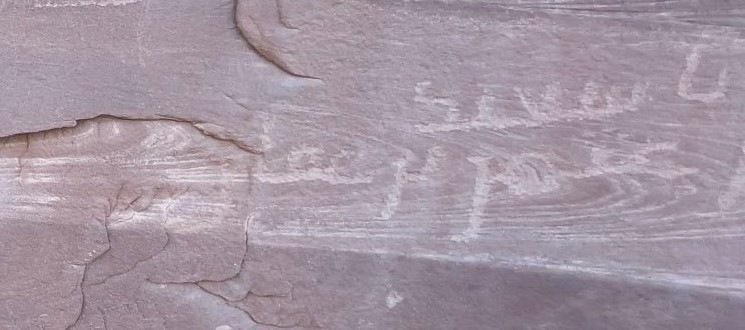
Ḥijāzī dated by event Egypt first civil war mawlā

Inscription of Saʿīd ibn ʿUthmān ibn ʿAffān, Ḥismā
c. 35–61 AH CommemorativeClear

Inscription of Saʿīd ibn ʿUthmān ibn ʿAffān, Ḥismā

نقش سعيد بن عثمان بن عفان، حسمى

Darb Ḥismā, north-western Arabia
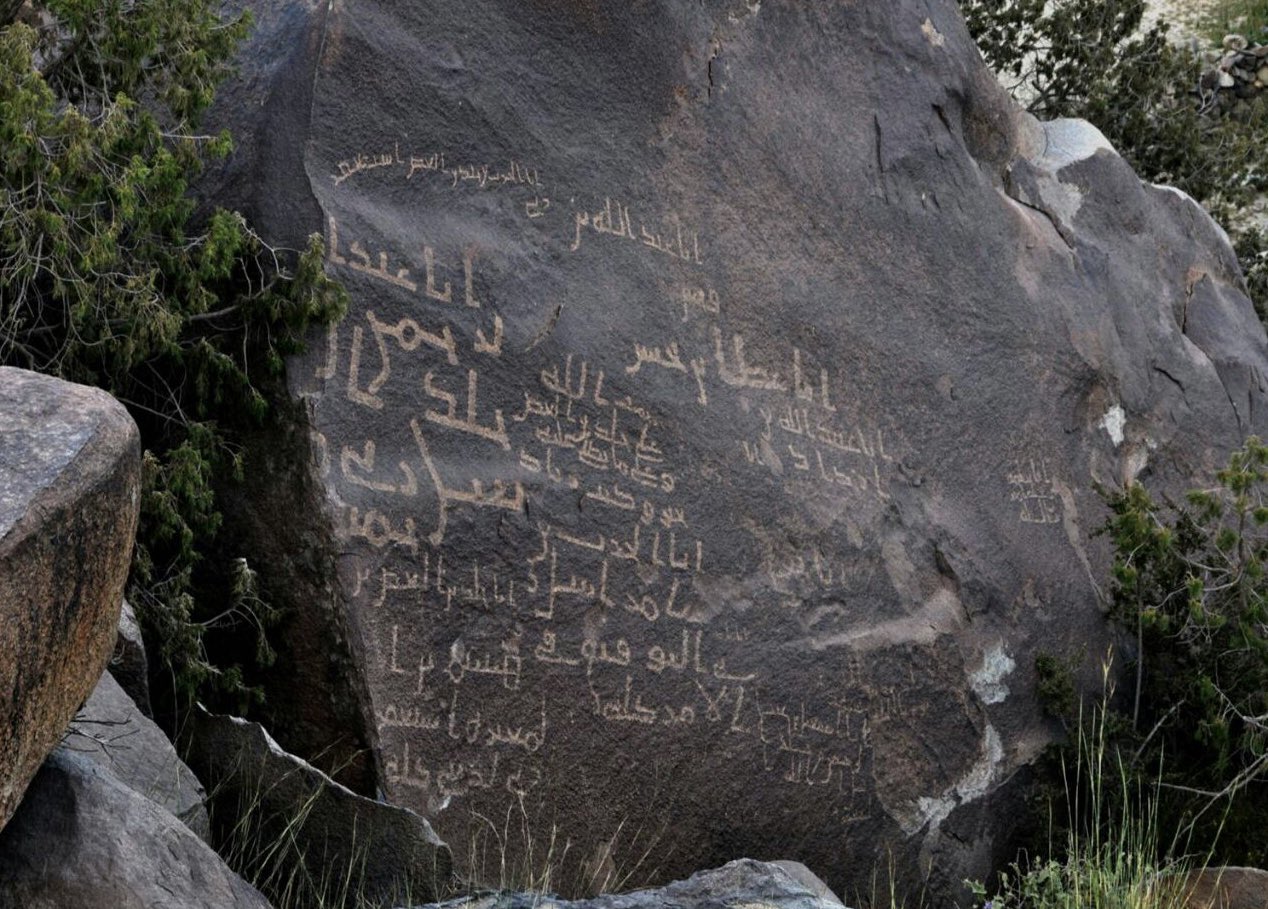
signature son of the caliph ʿUthmān dated by lifetime

Inscription of Khālid ibn al-ʿĀṣ, al-Bāḥah
c. 8–60 AH Prayer for ForgivenessClear

Inscription of Khālid ibn al-ʿĀṣ, al-Bāḥah

نقش خالد بن العاص، الباحة

al-Bāḥah region
Companion Makhzūm governor of Mecca dated by lifetime

Prayer of Ziyād for Khālid ibn al-ʿĀṣ, al-Bāḥah
1st c. AH Prayer for MercyClear

Prayer of Ziyād for Khālid ibn al-ʿĀṣ, al-Bāḥah

دعاء زياد لخالد بن العاص، الباحة

Wādī Khara, al-Bāḥah region
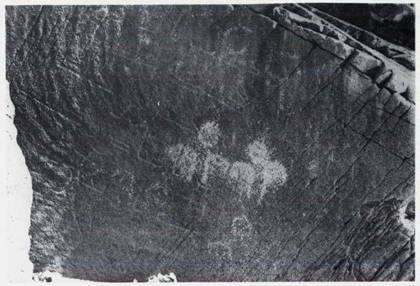
Khālid ibn al-ʿĀṣ Makhzūm prayer for another undated

Inscription of ʿAbd al-Raḥmān ibn Khālid ibn al-ʿĀṣ
40 AH Prayer for ForgivenessClear

Inscription of ʿAbd al-Raḥmān ibn Khālid ibn al-ʿĀṣ

نقش عبد الرحمن بن خالد بن العاص

Wādī al-Shāmiyah (Ṣanq al-Zarqāʾ), ~45 km NE of Mecca
prayer for forgiveness Companion family Ḥijāzī script

Inscription of ʿAbd al-Raḥmān ibn Khālid, al-Bāḥah
mid-1st c. AH Prayer for MercyLargely clear

Inscription of ʿAbd al-Raḥmān ibn Khālid, al-Bāḥah

نقش عبد الرحمن بن خالد، الباحة

Wādī Khara, al-Bāḥah region
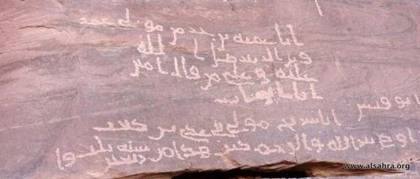
Khālid ibn al-ʿĀṣ Makhzūm Tābiʿī undated

Inscription of Shurayḥ, Mawlā of Banū ʿAdī
43 AH ExhortationClear

Inscription of Shurayḥ, Mawlā of Banū ʿAdī

نقش شريح مولى بني عدي

Darb Ḥismā

exhortation mawlā Darb Ḥismā Ḥijāzī script

Inscription of ʿAbdallāh ibn Muṭīʿ, Ḥismā
Before 73 AH Profession of FaithClear

Inscription of ʿAbdallāh ibn Muṭīʿ, Ḥismā

نقش عبد الله بن مطيع، حسمى

Darb Ḥismā, Tabūk region
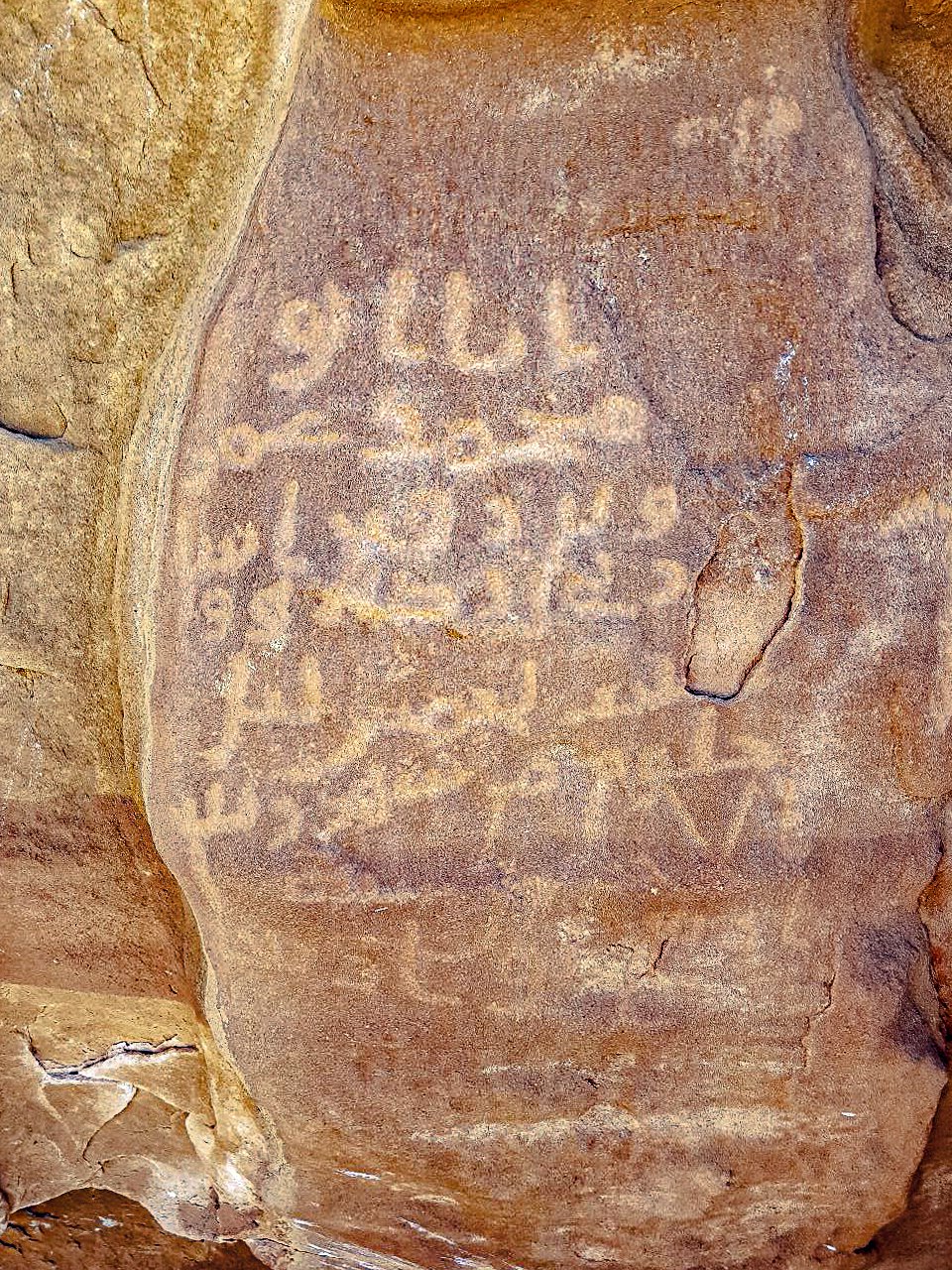
Banū ʿAdī ibn Kaʿb al-Ḥarrah Ḥismā undated

Inscription of Abū Muḥammad ʿAmr ibn Rāfiʿ, 44 AH
44 AH CommemorativeLargely clear

Inscription of Abū Muḥammad ʿAmr ibn Rāfiʿ

نقش أبي محمد عمرو بن رافع

Tabūk region
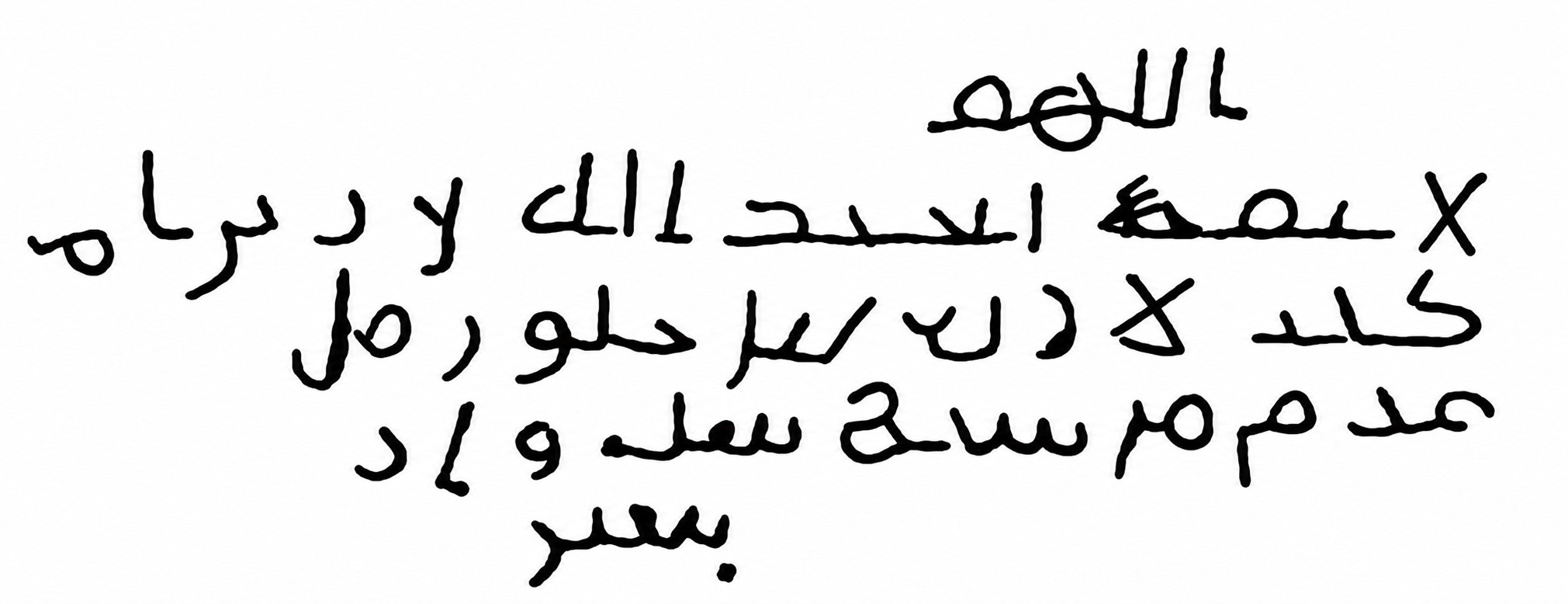
dated to the day kunyah God’s good pleasure Muʿāwiyah’s caliphate

Inscription of ʿAbdallāh ibn Dīrām
46 AH Prayer for ForgivenessClear

Inscription of ʿAbdallāh ibn Dīrām

نقش عبد الله بن ديرام

Wādī al-Sabīl

prayer for forgiveness deliberate defacement archaic orthography

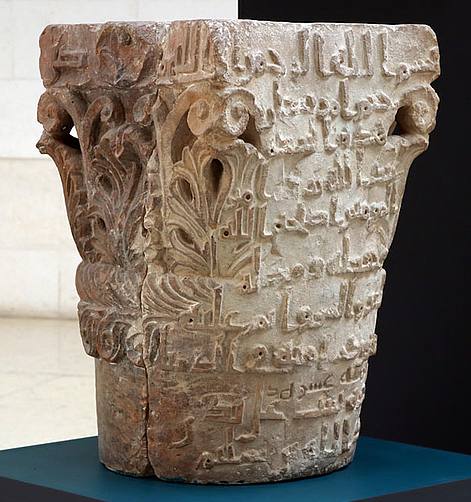
Dam Inscription of Muʿāwiyah, Wādī al-Khunaq
41–60 AH Foundation InscriptionClear

Dam Inscription of Muʿāwiyah, Wādī al-Khunaq

نقش سد معاوية بوادي الخنق

Wādī al-Khunaq, Medina region
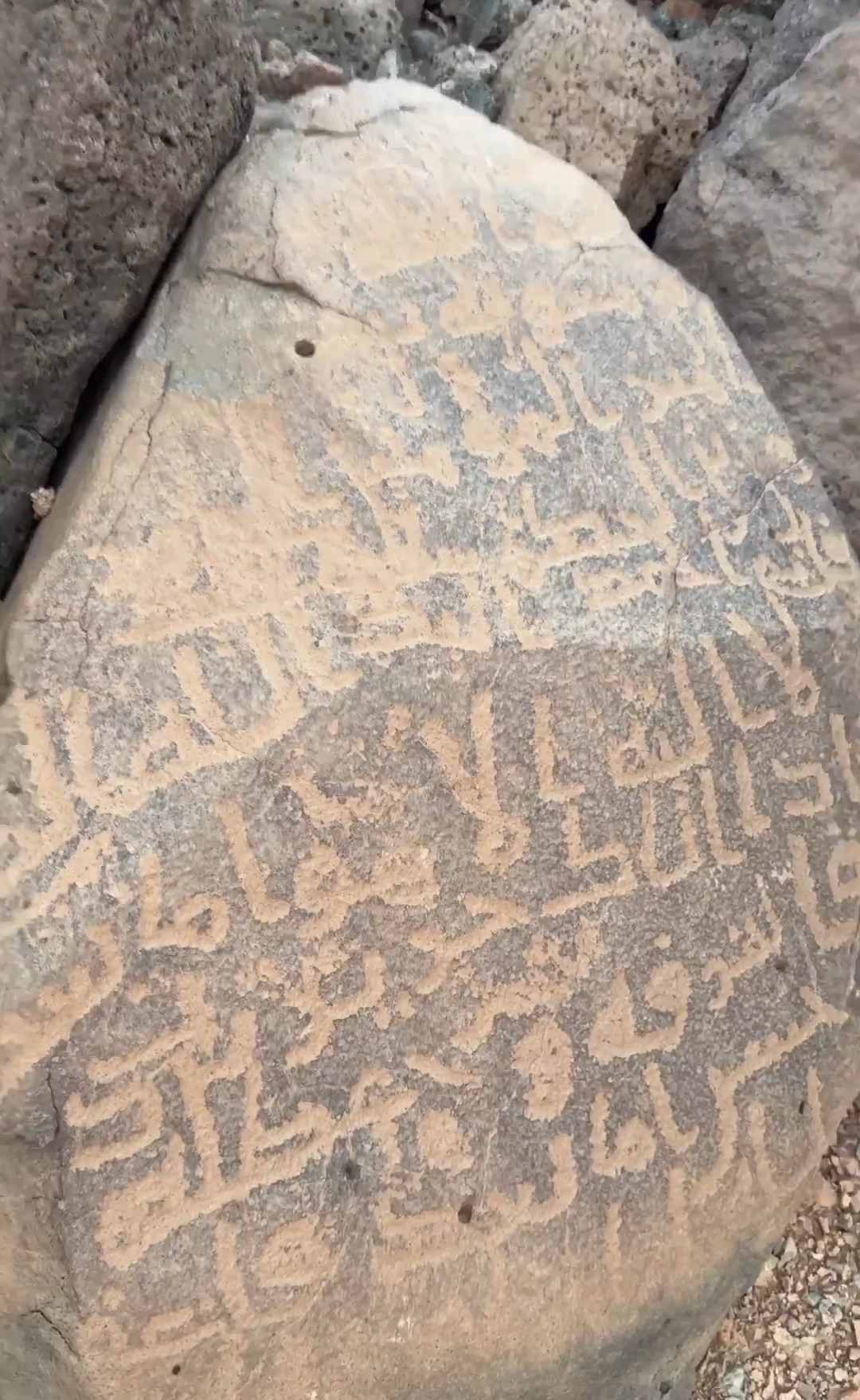
dam Muʿāwiyah Medina basalt mawlā Ibn ʿAbbās

Letter of the Caliph Muʿāwiyah to Marwān ibn al-Ḥakam, al-Ḥanākiyah
c. 42–57 AH CommemorativePartly preserved

Letter of the Caliph Muʿāwiyah to Marwān ibn al-Ḥakam, al-Ḥanākiyah

كتاب معاوية إلى مروان بن الحكم، الحناكية

al-Ḥanākiyah, al-Madīnah region
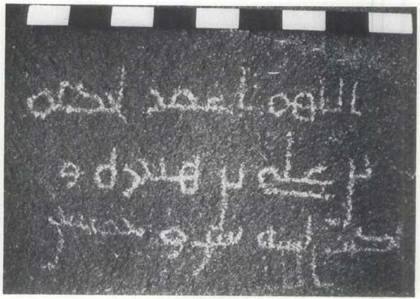
caliphal letter Muʿāwiyah Marwān ibn al-Ḥakam dated by reign

Inscription of Ḥakīm ibn ʿAlī
52 AH Prayer for ForgivenessClear

Inscription of Ḥakīm ibn ʿAlī

نقش حكيم بن علي

Wādī al-Khushanah, on Darb Zubaydah
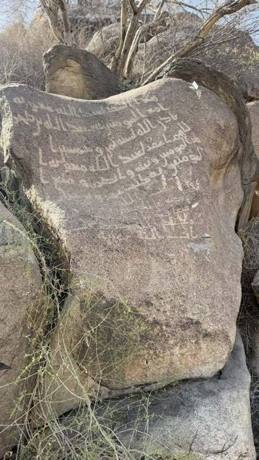
prayer for forgiveness Darb Zubaydah reading variants

Dam of Ṭāʾif Inscription
58 AH Foundation InscriptionClear

Dam of Ṭāʾif Inscription

نقش سد الطائف

Wādī Saysad, near Ṭāʾif
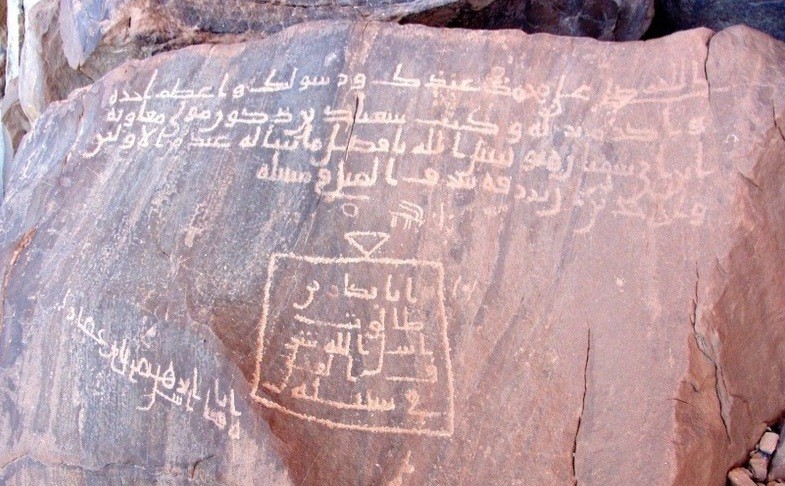
foundation inscription dam Umayyad caliph dated by regnal context

Inscription of Saʿīd ibn Dhakwān
1st c. AH Prayer for MercyClear

Inscription of Saʿīd ibn Dhakwān, Client of Muʿāwiyah ibn Abī Sufyān

نقش سعيد بن ذكوان مولى معاوية بن أبي سفيان

Northwestern Arabia
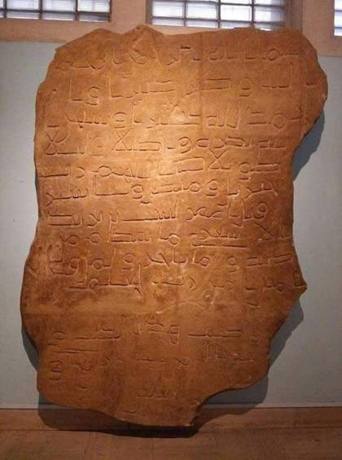
client of Muʿāwiyah blessing on the Prophet undated

Ḥafnat al-Abyaḍ Inscription
64 AH Prayer for ForgivenessClear

Ḥafnat al-Abyaḍ Inscription

نقش حفنة الأبيض

Wādī al-Abyaḍ, near Karbalāʾ, Iraq
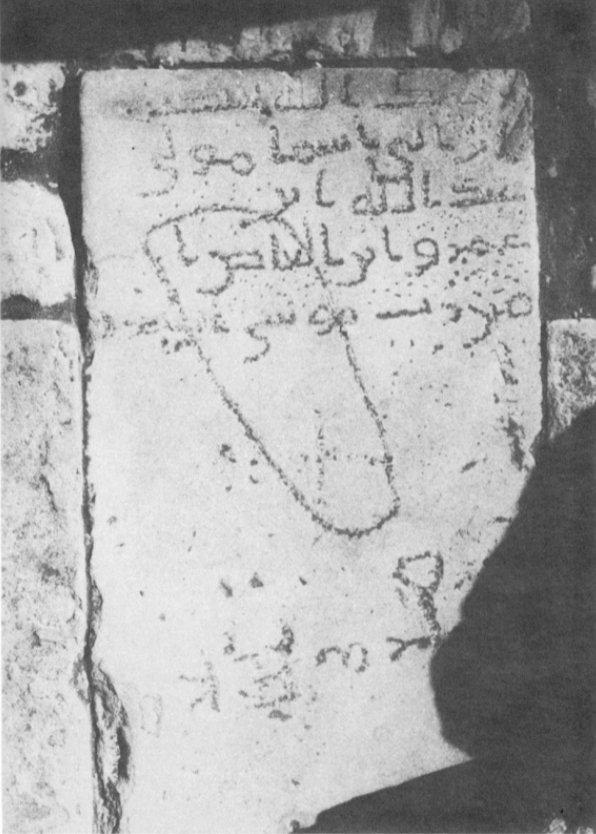
prayer for forgiveness hadith echo Qurʾanic phrasing plaster cast

Inscription of Ḥakīm, Client of ʿAbdallāh ibn ʿAmr
c. 65 AH Prayer for MercyClear

Inscription of Ḥakīm, Client of ʿAbdallāh ibn ʿAmr

نقش حكيم مولى عبد الله بن عمرو بن العاص

Ruḥeibe, Northern Church, al-Naqab
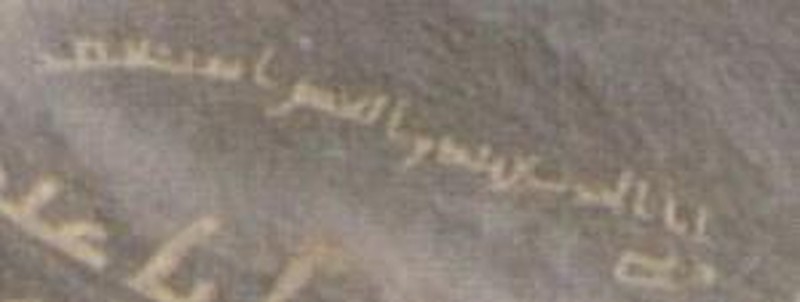
Early Arabic prayer for mercy client (mawlā) church al-Naqab ʿAbdallāh ibn ʿAmr

Inscription of al-Ḥārith ibn Khālid ibn al-ʿĀṣ, al-Bāḥah
before c. 85 AH Prayer for ForgivenessClear

Inscription of al-Ḥārith ibn Khālid ibn al-ʿĀṣ, al-Bāḥah

نقش الحارث بن خالد بن العاص، الباحة

Wādī Khara, al-Bāḥah region
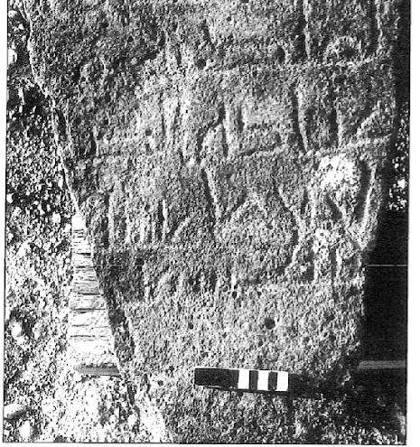
Khālid ibn al-ʿĀṣ Makhzūm single line undated

Inscription of ʿĀʾishah
70 AH Prayer for MercyClear

Inscription of ʿĀʾishah

نقش عائشة

Umm al-Quṭayn, Jordan

prayer for mercy women in early inscriptions Jordan

Gravestone of ʿAbbāsah bint Jurayj, Aswān
71 AH Funerary PrayerClear

Gravestone of ʿAbbāsah bint Jurayj, Aswān

شاهد قبر عباسة بنت جريج، أسوان

Aswān, Egypt
gravestone profession of faith date discussed

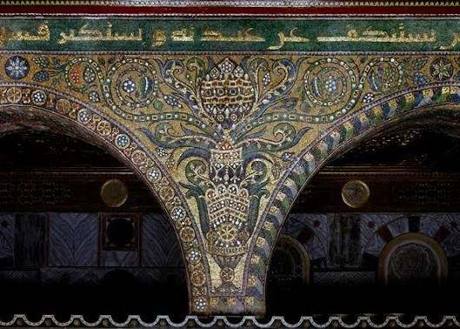
Dome of the Rock Inscription (Inner Octagon)
72 AH Qurʾanic VerseClear

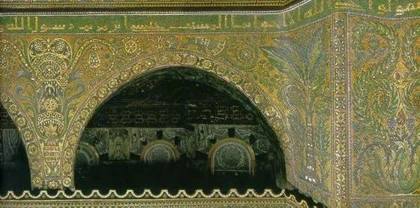
Dome of the Rock Inscription (Inner Octagon)

كتابات قبة الصخرة (المثمن الداخلي)

Dome of the Rock, Jerusalem
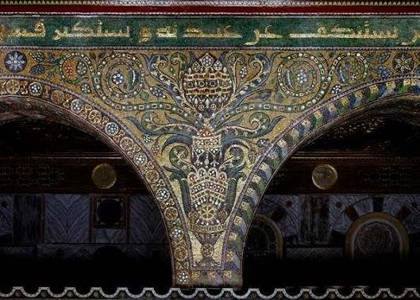
Qurʾanic verses Dome of the Rock Kūfī mosaic Qurʾanic reading variant Christology

Dome of the Rock Inscription (Outer Octagon)
72 AH Qurʾanic VerseLargely clear

Dome of the Rock Inscription (Outer Octagon)

كتابات قبة الصخرة (المثمن الخارجي)

Dome of the Rock, Jerusalem
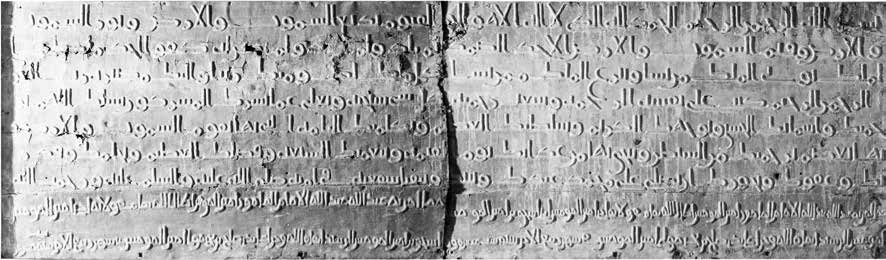
Qurʾanic verses Dome of the Rock Ḥijāzī mosaic al-Maʾmūn political alteration Sūrat al-Ikhlāṣ

Copper Plaque over the East Door of the Dome of the Rock
c. 72 AH Qurʾanic VerseLargely clear

Copper Plaque over the East Door of the Dome of the Rock

اللوحة النحاسية على الباب الشرقي لقبة الصخرة

Dome of the Rock, Jerusalem
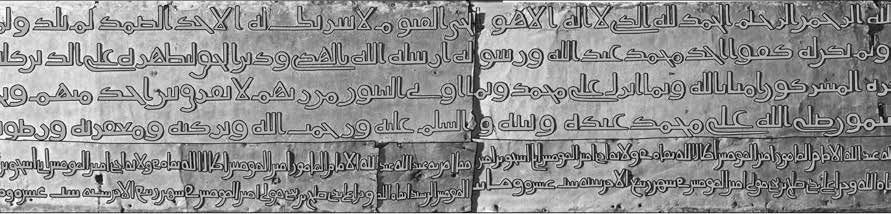
ʿAbd al-Malik al-Maʾmūn Qurʾān

Copper Plaque over the North Door of the Dome of the Rock
c. 72 AH Qurʾanic VerseClear

Copper Plaque over the North Door of the Dome of the Rock

اللوحة النحاسية على الباب الشمالي لقبة الصخرة

Dome of the Rock, Jerusalem
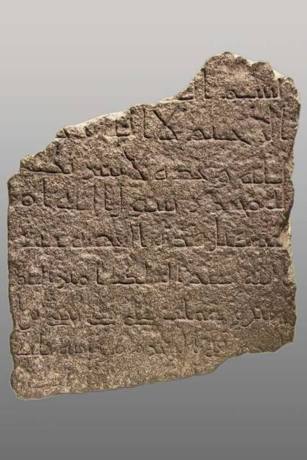
ʿAbd al-Malik al-Maʾmūn Qurʾān

Road Inscription of ʿAbd al-Malik at ʿAqabat Fīq
73 AH Foundation InscriptionClear

Road Inscription of ʿAbd al-Malik at ʿAqabat Fīq

نقش تسهيل عقبة فيق (عبد الملك)

ʿAqabat Fīq, above the Lake Tiberias (Golan)
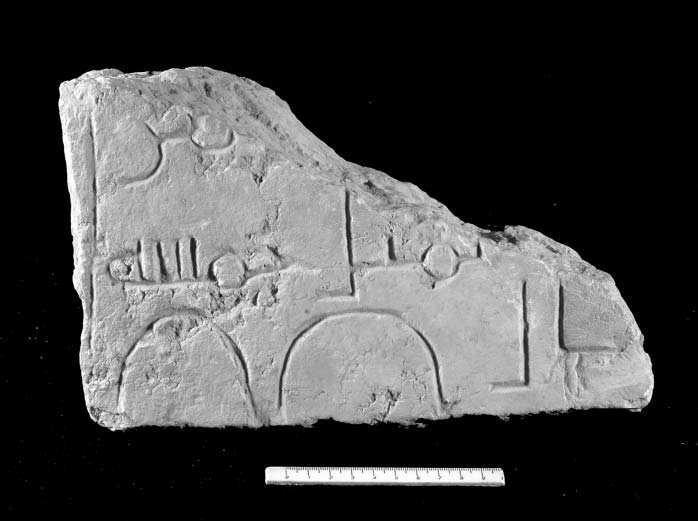
road inscription caliph ʿAbd al-Malik official inscription Golan

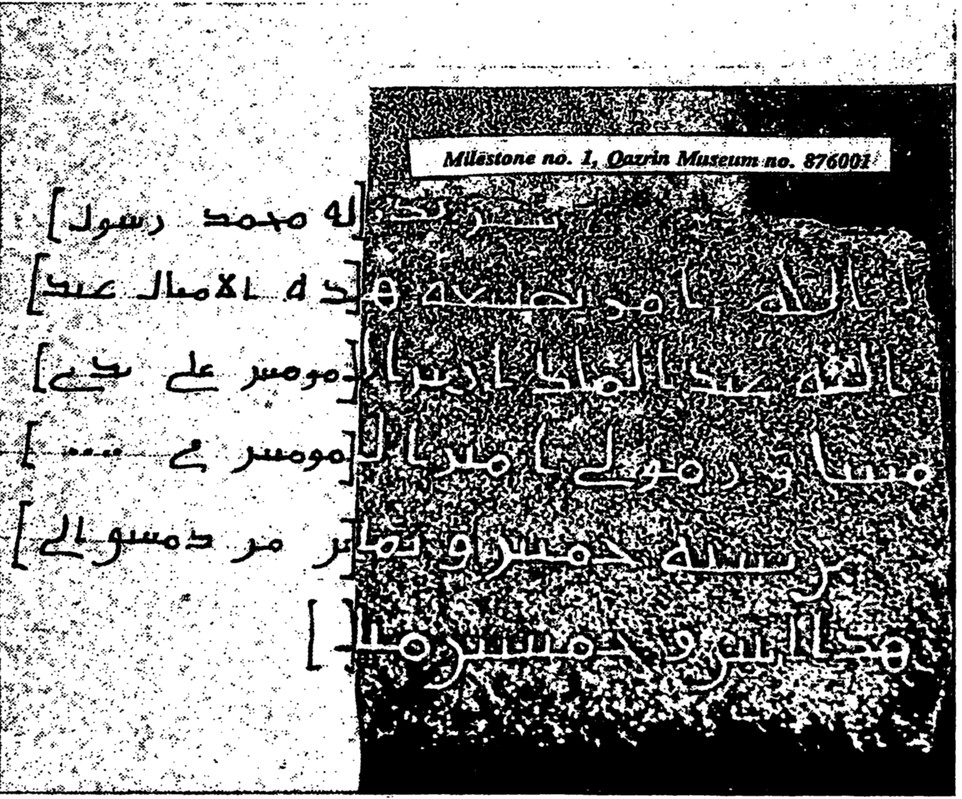
Fragment of the fifth milestone from Jerusalem, Khirbat Iqbālā
65–86 AH Foundation InscriptionFragmentary

Milestone of ʿAbd al-Malik: the fifth mile from Jerusalem, Khirbat Iqbālā

ميل عبد الملك: الميل الخامس من إيلياء، خربة إقبالا

Khirbat Iqbālā (Aqua Bella), west of Jerusalem
milestone caliph ʿAbd al-Malik Jerusalem road

Photograph to be added: Milestone of ʿAbd al-Malik: the seventh mile from Jerusalem, Abū Ghosh
65–86 AH Foundation InscriptionPartly preserved

Milestone of ʿAbd al-Malik: the seventh mile from Jerusalem, Abū Ghosh

ميل عبد الملك: الميل السابع من إيلياء، أبو غوش

Abū Ghosh, west of Jerusalem
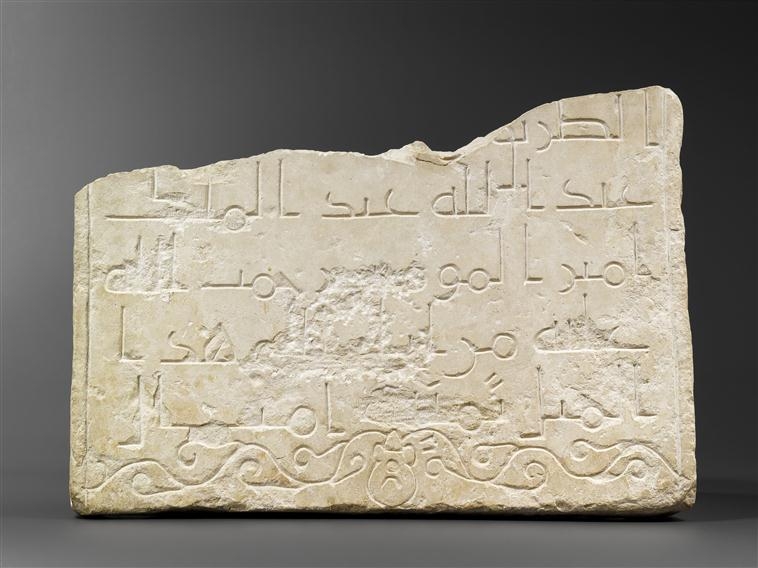
milestone caliph ʿAbd al-Malik Jerusalem road

Milestone of ʿAbd al-Malik from Bāb al-Wād
65–86 AH Foundation InscriptionPartly preserved

Milestone of ʿAbd al-Malik: the eighth mile from Jerusalem, Bāb al-Wād

ميل عبد الملك: الميل الثامن من إيلياء، باب الواد

Bāb al-Wād, on the Jerusalem–Jaffa road

milestone caliph ʿAbd al-Malik Jerusalem road

Photograph to be added: Milestone of ʿAbd al-Malik from Dayr al-Qalṭ
65–86 AH Foundation InscriptionFragmentary

Milestone of ʿAbd al-Malik from Dayr al-Qalṭ

ميل عبد الملك من دير القلط

Dayr al-Qalṭ (Wādī al-Qalṭ), near Jericho
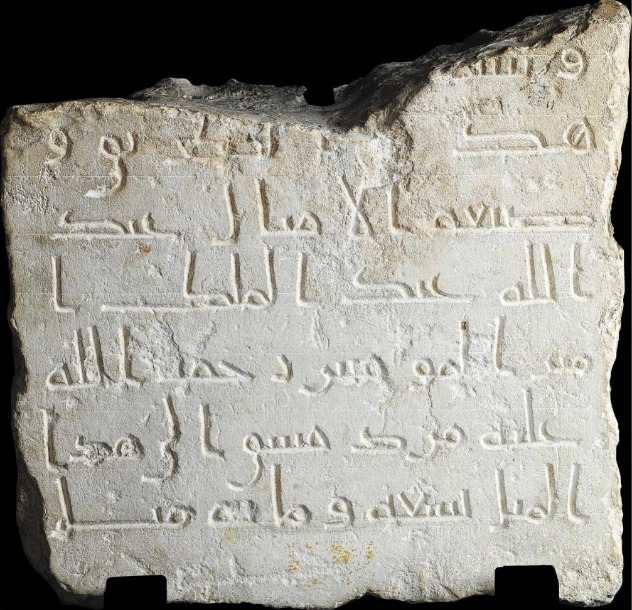
milestone caliph ʿAbd al-Malik Damascus road

Milestone of ʿAbd al-Malik from Khān al-Ḥathrūra
65–86 AH Foundation InscriptionLargely clear

Milestone of ʿAbd al-Malik: 109 miles from Damascus, Khān al-Ḥathrūra

ميل عبد الملك: تسعة ومائة ميل من دمشق، خان الحثرورة

Khān al-Ḥathrūra, on the Jerusalem–Jericho road
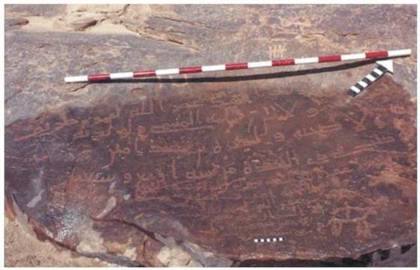
milestone caliph ʿAbd al-Malik Damascus road

Inscription of ʿUmar ibn Ṭarīf
74 AH Prayer for ForgivenessLargely clear

Inscription of ʿUmar ibn Ṭarīf

نقش عمر بن طريف

Wādī al-Abyaḍ

prayer for forgiveness collective prayer reading uncertainty

Inscription of ʿAmr
76 AH Prayer for MercyLargely clear

Inscription of ʿAmr

نقش عمرو

Wādī Malkān

prayer of contentment Wādī Malkān scribe named separately

Inscription of a Friday, 76 AH, al-Madīnah
76 AH CommemorativeClear

Inscription of a Friday, 76 AH, al-Madīnah

نقش يوم الجمعة سنة ست وسبعين، المدينة

al-Madīnah region
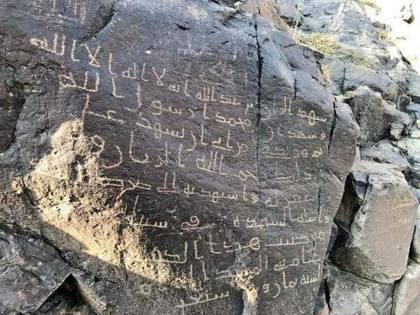
dated day of the week Friday

Inscription of al-Rayyān ibn ʿAbdallāh
78 AH Profession of FaithClear

Inscription of al-Rayyān ibn ʿAbdallāh

نقش الريان بن عبد الله

Ḥimā al-Numūr, Ṭāʾif
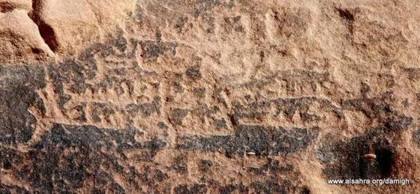
profession of faith Sacred Mosque renovation double dating historical event

Inscription of Ibn al-ʿĀṣ
78 AH Profession of FaithPartly preserved

Inscription of Ibn al-ʿĀṣ

نقش ابن العاص

Qāʿ al-Muʿtadil, Darb al-Ḥajj
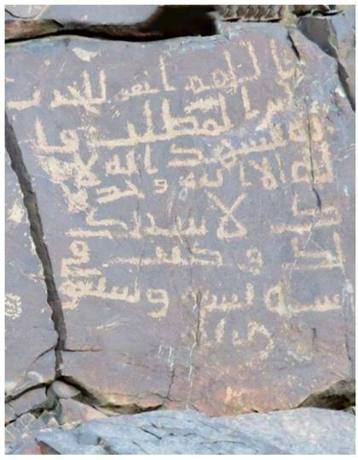
profession of faith eroded text Qinnasrīn Darb al-Ḥajj al-Shāmī

Inscription of al-Ḥārith ibn al-Muṭṭalib
79 AH Prayer for ForgivenessClear

Inscription of al-Ḥārith ibn al-Muṭṭalib

نقش الحارث بن المطلب

Medina

prayer for forgiveness profession of faith Madanī script Medina recent discovery

Inscription of al-Walīd ibn Maʿbad
80 AH Prayer for ForgivenessClear

Inscription of al-Walīd ibn Maʿbad

نقش الوليد بن معبد

Wādī al-Jalīl

prayer for pardon Mecca region word split across lines

Inscription of Ḥabīb ibn Abī Ḥabīb
80 AH Prayer for MercyClear

Inscription of Ḥabīb ibn Abī Ḥabīb

نقش حبيب بن أبي حبيب

Qārat al-Ṣibgh

prayer for martyrdom mawlā orthography tampering

Inscription of Maymūn, Mawlā of Abū Maryam
80 AH Prayer for MercyClear

Inscription of Maymūn, Mawlā of Abū Maryam

نقش ميمون مولى أبو مريم

Wādī al-Ṣānī

prayer for Paradise mawlā chain Wādī al-Ṣānī

Inscription of Bakr ibn Abī Bakrah
80 AH Prayer for MercyClear

Inscription of Bakr ibn Abī Bakrah

نقش بكر بن أبي بكرة

Darb Ḥismā

prayer for intercession Darb Ḥismā Prophet Muḥammad

Inscription of ʿUmayr ibn Abī Muslim
80 AH Prayer for ForgivenessClear

Inscription of ʿUmayr ibn Abī Muslim

نقش عمير بن أبي مسلم

Wādī Malkān

prayer for forgiveness martyr's son Wādī Malkān

First Inscription of ʿUthmān ibn Wahrān
80 AH Qurʾanic VerseClear

First Inscription of ʿUthmān ibn Wahrān

نقش عثمان بن وهران الأول

Wādī al-ʿUsaylah
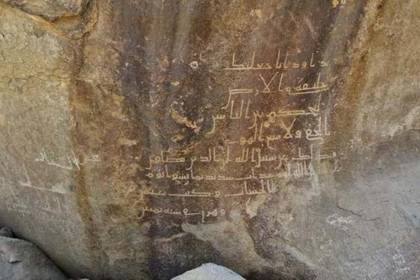
Qurʾanic verse Makkī script reading correction

Second Inscription of ʿUthmān ibn Wahrān
80 AH Qurʾanic VerseClear

Second Inscription of ʿUthmān ibn Wahrān

نقش عثمان بن وهران الثاني

Wādī al-ʿUsaylah
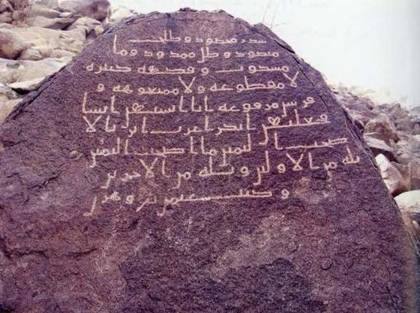
Qurʾanic verse Makkī script khalīfah

Third Inscription of ʿUthmān ibn Wahrān
80 AH Qurʾanic VerseClear

Third Inscription of ʿUthmān ibn Wahrān

نقش عثمان بن وهران الثالث

Wādī al-ʿUsaylah
Qurʾanic verse Ḥijāzī script Paradise description

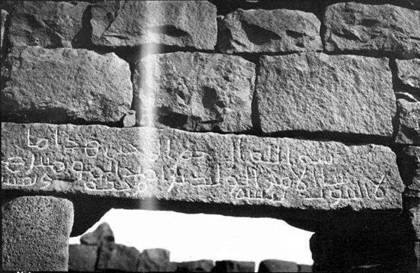
Inscription of Qaṣr al-Burquʿ
81 AH Foundation InscriptionClear

Inscription of Qaṣr al-Burquʿ

نقش قصر البرقع

Qāʿ al-Muʿtadil, Darb al-Ḥajj
foundation inscription Umayyad prince construction

Inscription of Sahm, Mawlā of Abū Zurʿah
82 AH Prayer for ForgivenessClear

Inscription of Sahm, Mawlā of Abū Zurʿah

نقش سهم مولى أبو زرعة

Unrecorded rock face
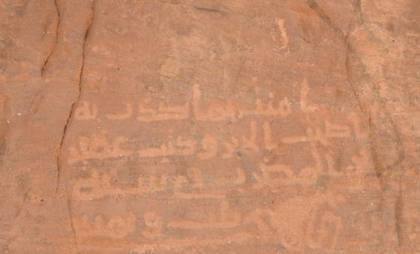
prayer for forgiveness pilgrimage mawlā

Inscription of ʿUfayr ibn al-Muḍārib
83 AH Profession of FaithClear

Inscription of ʿUfayr ibn al-Muḍārib

نقش عفير بن المضارب

Wādī al-Aqraʿ

profession of faith Qurʾanic echo early diacritical dots Thamūd

Inscription of Ibn Abī ʿArīḍ
83 AH Profession of FaithClear

Inscription of Ibn Abī ʿArīḍ

نقش ابن أبي عريض

Wādī Abū ʿŪd

seeking refuge in God secondary endorsement two hands Darb al-Ḥajj al-Shāmī

Memorial Inscription of Suwayd ibn Samurah
83 AH CommemorativePartly preserved

Memorial Inscription of Suwayd ibn Samurah

نقش تذكاري (سويد بن سمرة)

Jabal al-Safīnah
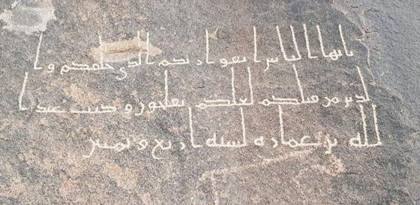
commemorative four-part name reading uncertainty nearby protective prayer

Qurʾanic Inscription of ʿAbdallāh ibn ʿImārah
84 AH Qurʾanic VerseClear

Qurʾanic Inscription of ʿAbdallāh ibn ʿImārah

نقش عبد الله بن عمارة

Wādī al-Ḥurumān
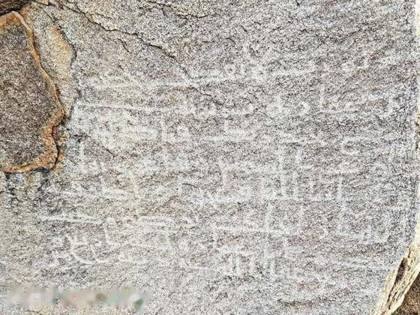
Qurʾanic verse quoted from memory Ḥijāzī script

Inscription of Ḥakīm ibn ʿImārah
84 AH Qurʾanic VerseClear

Inscription of Ḥakīm ibn ʿImārah

نقش حكيم بن عمارة

Wādī al-Ḥurumān

Qurʾanic verse personal plea prayer for forgiveness

Milestone of ʿAbd al-Malik from Fīq, Golan, no. 1 (traced)
85 AH Foundation InscriptionPartly preserved

Milestone of ʿAbd al-Malik from Fīq, Golan: 52 miles from Damascus

ميل عبد الملك من فيق في الجولان: اثنان وخمسون ميلا من دمشق

Fīq, southern Golan
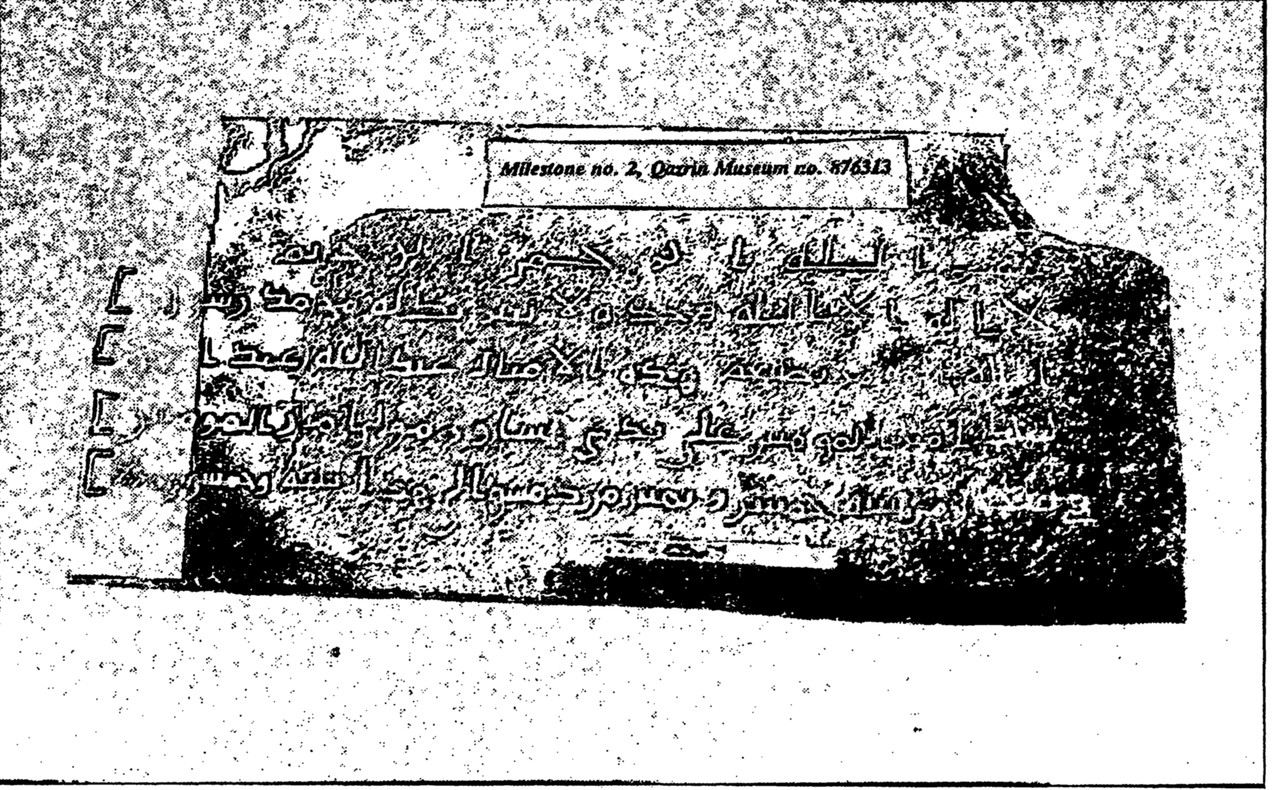
milestone caliph ʿAbd al-Malik Golan Musāwir

Milestone of ʿAbd al-Malik from Fīq, Golan, no. 2 (traced)
85 AH Foundation InscriptionPartly preserved

Milestone of ʿAbd al-Malik from Fīq, Golan: 53 miles from Damascus

ميل عبد الملك من فيق في الجولان: ثلاثة وخمسون ميلا من دمشق

Fīq, southern Golan
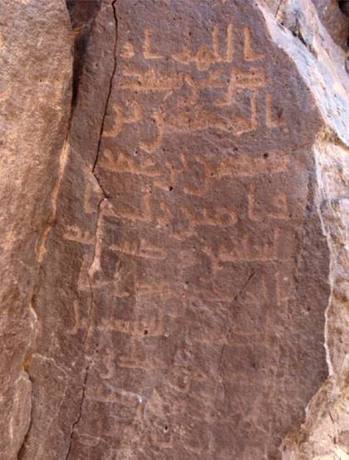
milestone caliph ʿAbd al-Malik Golan Musāwir

Inscription of ʿAbd al-Raḥmān ibn Sufyān ibn ʿAmr
86 AH Prayer for MercyClear

Inscription of ʿAbd al-Raḥmān ibn Sufyān ibn ʿAmr

نقش عبد الرحمن بن سفيان بن عمرو

Qāʿ al-Muʿtadil, Darb al-Ḥajj
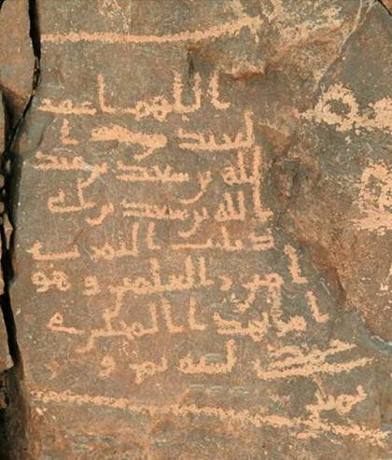
prayer of contentment Darb al-Ḥajj al-Shāmī Qāʿ al-Muʿtadil

Inscription of ʿAbdallāh ibn Saʿd
88 AH Prayer for ForgivenessLargely clear

Inscription of ʿAbdallāh ibn Saʿd

نقش عبد الله بن سعد

Qāʿ al-Muʿtadil, Darb al-Ḥajj
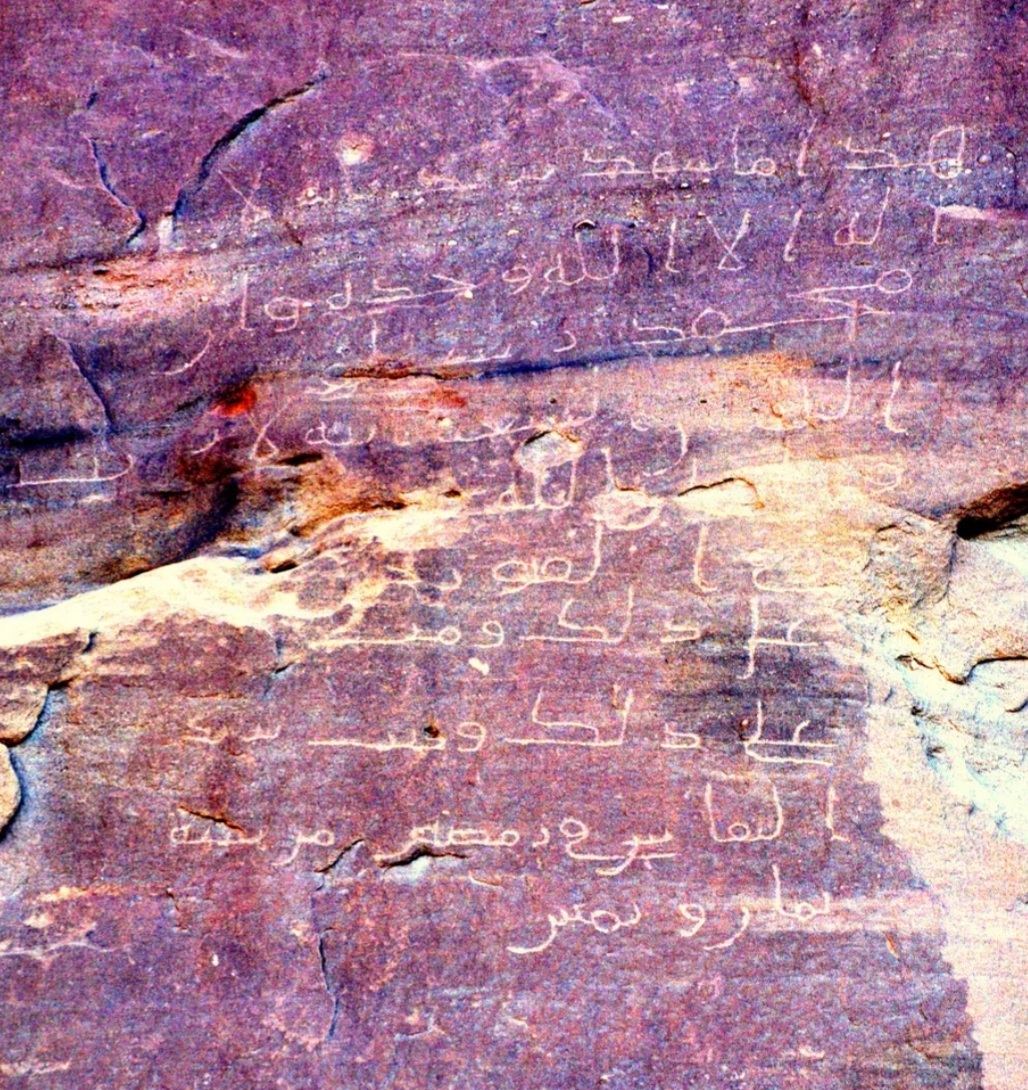
prayer for forgiveness four-generation genealogy majlis Darb al-Ḥajj al-Shāmī

Inscription of Yazīd the Engraver
88 AH Profession of FaithClear

Inscription of Yazīd the Engraver (al-Naqqāsh)

نقش يزيد النقّاش

Syrian Ḥajj route, north-western Arabia
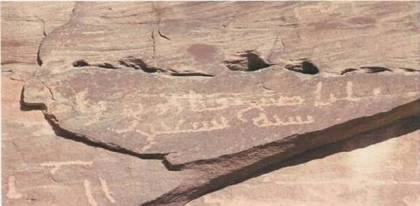
Ḥijāzī shahādah the Hour resurrection Q 22:7 engraver

Inscription of Ṣabīḥ, Client of Razīq
90 AH CommemorativeLargely clear

Inscription of Ṣabīḥ, Client of Razīq

نقش صبيح فتى رزيق

Ṭūr al-Qawwās

commemorative client (fatā) short text

Inscription of Ibrāhīm ibn Jamīl the Muezzin
90 AH ExhortationLargely clear

Inscription of Ibrāhīm ibn Jamīl the Muezzin

نقش إبراهيم بن جميل المؤذن

North-western Arabia (Desert Team survey)
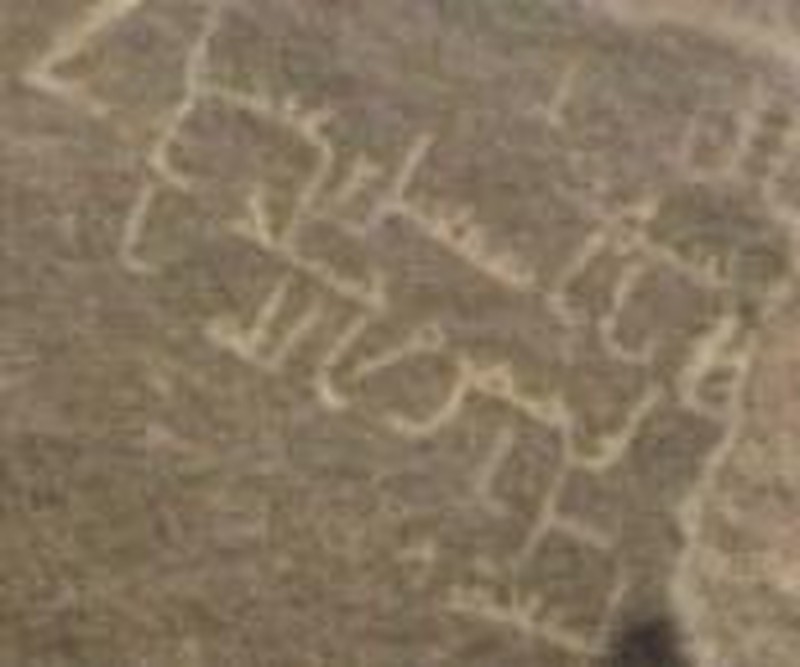
exhortation muezzin ties of kinship year uncertain

First Inscription of Ismāʿīl ibn ʿAbd al-Raḥmān ibn Khālid, al-Bāḥah
before c. 125 AH Prayer for ForgivenessClear

First Inscription of Ismāʿīl ibn ʿAbd al-Raḥmān ibn Khālid, al-Bāḥah

نقش إسماعيل بن عبد الرحمن بن خالد (الأول)، الباحة

Wādī Khara, al-Bāḥah region
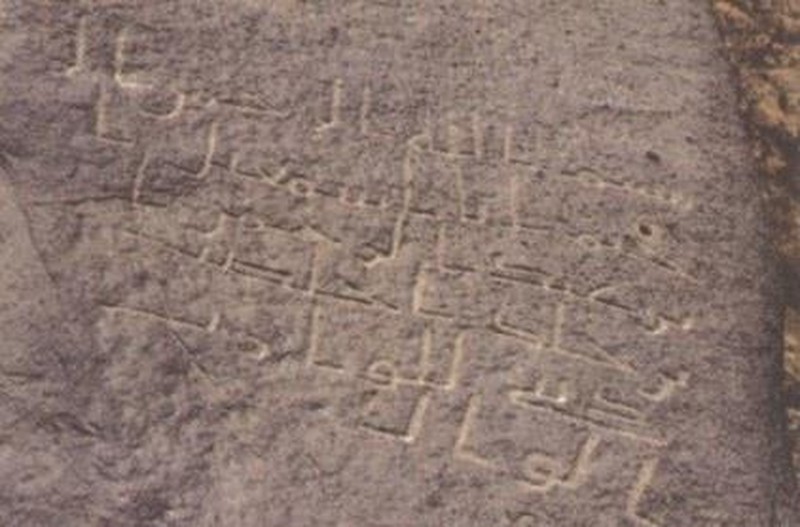
Khālid ibn al-ʿĀṣ Makhzūm grandson undated

Second Inscription of Ismāʿīl ibn ʿAbd al-Raḥmān ibn Khālid, al-Bāḥah
before c. 125 AH Profession of FaithClear

Second Inscription of Ismāʿīl ibn ʿAbd al-Raḥmān ibn Khālid, al-Bāḥah

نقش إسماعيل بن عبد الرحمن بن خالد (الثاني)، الباحة

Shiʿb ʿĀfiyah, Wādī Khara, al-Bāḥah region
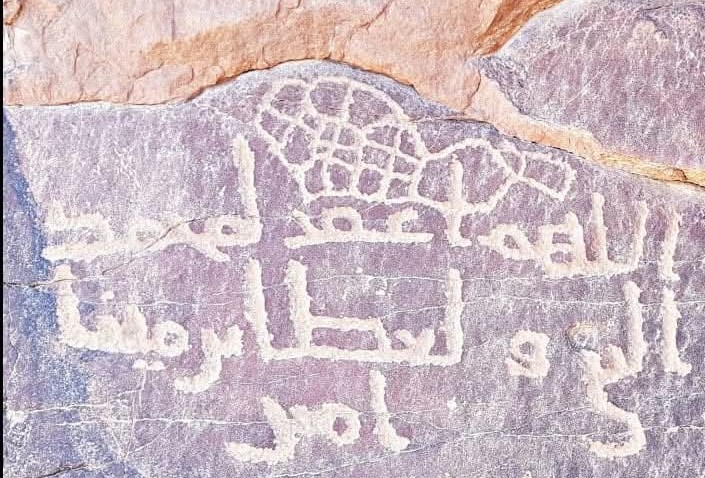
Khālid ibn al-ʿĀṣ basmalah divine names undated

Inscription of ʿAṭāʾ ibn Mīnāʾ
1st c. AH Prayer for ForgivenessClear

Inscription of ʿAṭāʾ ibn Mīnāʾ, Tabūk

نقش عطاء بن ميناء، تبوك

Tabūk region

the Prophet tābiʿī undated

Inscription of al-Ḍaḥḥāk ibn Dāwūd
1st–2nd c. AH CommemorativeClear

Inscription of al-Ḍaḥḥāk ibn Dāwūd: “I Took the Inheritance of Zayd”

نقش الضحاك بن داود: «أخذت ميراث زيد»

Ḥismā, Tabūk region
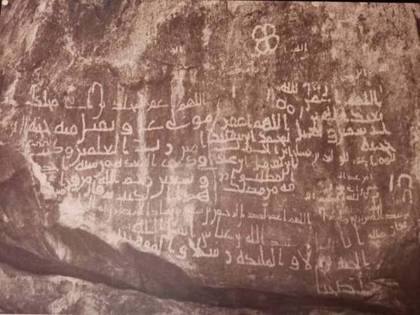
signature inheritance undated

Inscription of Mukhlid ibn Abī Mukhlid
91 AH Prayer for ForgivenessClear

Inscription of Mukhlid ibn Abī Mukhlid

نقش مخلد بن أبي مخلد

Wādī al-Awjarīyah
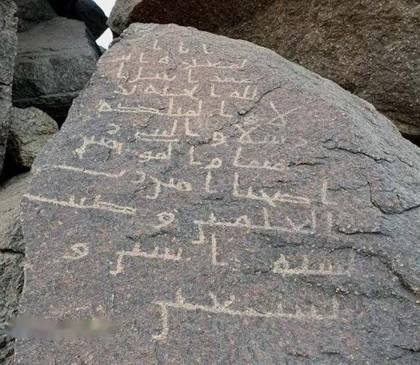
prayer for forgiveness pilgrimage mawlā blessing on the reader

Inscription of al-Mughīrah ibn ʿUmar
92 AH Prayer for MercyClear

Inscription of al-Mughīrah ibn ʿUmar

نقش المغيرة بن عمر

Wādī Malkān

prayer for Paradise recent discovery careful penmanship Wādī Malkān

Inscription of Qaṣr al-Kharrānah
92 AH Prayer for MercyLargely clear

Inscription of Qaṣr al-Kharrānah

نقش قصر الخرّانة

Qaṣr al-Kharrānah, Jordan
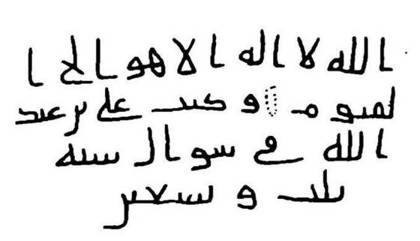
longest inscription Qaṣr al-Kharrānah Jordan painted inscription Nabia Abbott

Inscription of ʿAlī ibn ʿAbdallāh
93 AH Qurʾanic VerseClear

Inscription of ʿAlī ibn ʿAbdallāh

نقش علي بن عبد الله

Jabal Usays, Syria
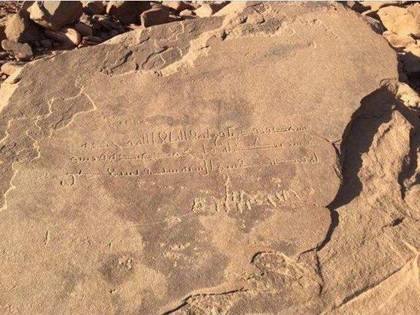
Qurʾanic verse Āyat al-Kursī Jabal Usays Syria

Inscription of Farqad ibn Nāfiʿ
96 AH Profession of FaithClear

Inscription of Farqad ibn Nāfiʿ

نقش فرقد بن نافع

Tabūk

profession of faith two testimonies fine calligraphy

First Inscription of Rabāḥ ibn Ḥafṣ ibn ʿĀṣim
96 AH Prayer for MercyClear

First Inscription of Rabāḥ ibn Ḥafṣ ibn ʿĀṣim

نقش رباح بن حفص بن عاصم (الأول)

Rawāwah, Medina
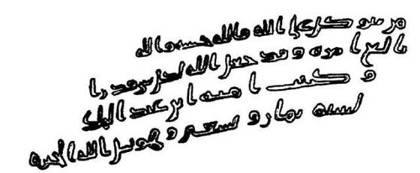
prayer for well-being descendant of ʿUmar ibn al-Khaṭṭāb Rawāwah Medina

Inscription of ʿUmar ibn ʿAbdallāh
96 AH Profession of FaithClear

Inscription of ʿUmar ibn ʿAbdallāh

نقش عمر بن عبد الله

Rawāwah, Medina

profession of faith ʿUrwah ibn al-Zubayr ṭāghūt Rawāwah

Inscription of Muḥammad ibn Abī Ṭaybah al-Ḥimṣī
97 AH Profession of FaithClear

Inscription of Muḥammad ibn Abī Ṭaybah al-Ḥimṣī

نقش محمد بن أبي طيبة الحمصي

North of al-ʿUlā
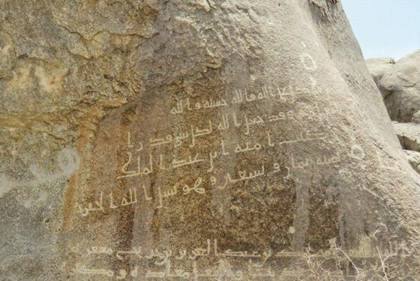
profession of faith caliph's pilgrimage cross-referenced with literary sources

First Inscription of Umayyah ibn ʿAbd al-Malik
98 AH Qurʾanic VerseClear

First Inscription of Umayyah ibn ʿAbd al-Malik

نقش أمية بن عبد الملك (الأول)

Wādī al-ʿUsaylah
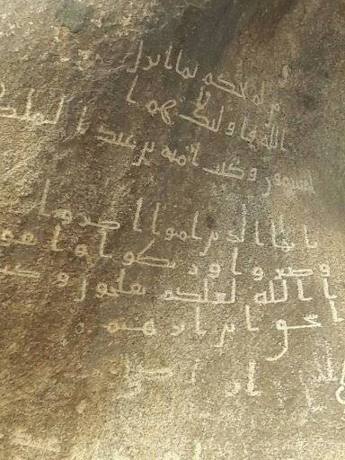
Qurʾanic verse trust in God Wādī al-ʿUsaylah

Second Inscription of Umayyah ibn ʿAbd al-Malik
98 AH Qurʾanic VerseClear

Second Inscription of Umayyah ibn ʿAbd al-Malik

نقش أمية بن عبد الملك (الثاني)

Wādī al-ʿUsaylah
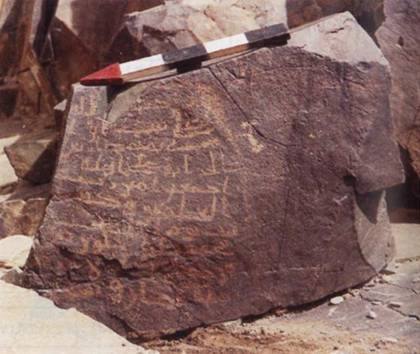
Qurʾanic verse just judgment Wādī al-ʿUsaylah

Inscription of Thābit ibn Abī Tamīm
98 AH Prayer for MercyLargely clear

Inscription of Thābit ibn Abī Tamīm

نقش ثابت بن أبي تميم

Ghayl al-Minḍaj, Ẓahrān al-Janūb
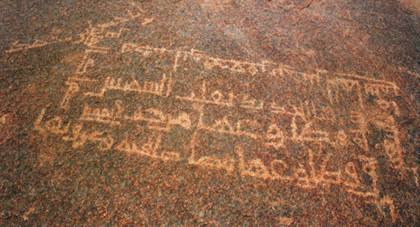
prayer for mercy craftsman occupation recorded Ẓahrān al-Janūb

Poetic Inscription of Abū Jaʿfar ibn Ḥasan al-Hāshimī
98 AH CommemorativeClear

Poetic Inscription of Abū Jaʿfar ibn Ḥasan al-Hāshimī

نقش شعري

Wādī al-Ḥurumān

poetic inscription Hāshimite passage of time rare genre

Inscription of Taymāʾ
98 AH Prayer for ForgivenessClear

Inscription of Taymāʾ

نقش تيماء

Taymāʾ, Tabūk

prayer for forgiveness Taymāʾ precise dating

Inscription of Khaṭṭāb ibn Ḥajar al-ʿAmmī (Cnidus)
98 AH CommemorativePartly preserved

Inscription of Khaṭṭāb ibn Ḥajar al-ʿAmmī (Cnidus)

نقش خطاب بن حجر العمّي (كنيدوس)

Cnidus (Knidos), south-western Turkey
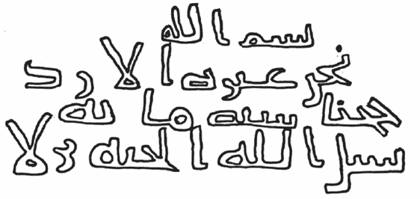
Aegean expedition (ghazwah) siege of Constantinople marble pavement

Inscription of ʿAnazah al-Azd
100 AH Prayer for MercyClear

Inscription of ʿAnazah al-Azd

نقش عنزة الأزد

Wādī Abū Ṭāqah

collective inscription tribal group pilgrimage Azd

Inscription of ʿAbdallāh ibn Abī Saʿīd al-Anṣārī
100 AH Prayer for ForgivenessClear

Inscription of ʿAbdallāh ibn Abī Saʿīd al-Anṣārī

نقش عبد الله بن أبي سعيد الأنصاري

Thulayth
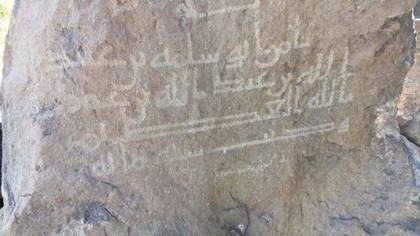
prayer for forgiveness Anṣārī genealogy Thulayth

Inscription of Abū Salamah
100 AH Profession of FaithClear

Inscription of Abū Salamah

نقش أبو سلمة

Rawāwah

profession of faith genealogy Rawāwah

Second Inscription of Rabāḥ ibn Ḥafṣ ibn ʿĀṣim
100 AH Prayer for MercyClear

Second Inscription of Rabāḥ ibn Ḥafṣ ibn ʿĀṣim

نقش رباح بن حفص بن عاصم (الثاني)

Wādī al-Furaysh, Shuʿayb ʿUwayr
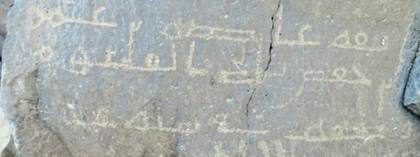
prayer for well-being al-Fārūq reading corrections longest of two inscriptions

Inscription of ʿĀṣim ibn ʿUmar ibn Ḥafṣ
100 AH Profession of FaithClear

Inscription of ʿĀṣim ibn ʿUmar ibn Ḥafṣ

نقش عاصم بن عمر بن حفص

Waḥy al-Ḥijārah
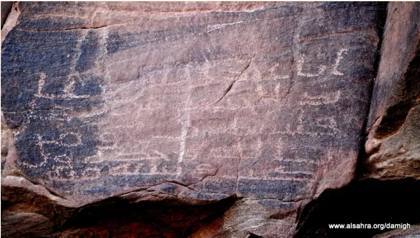
declaration of trust Āyat al-Kursī echo final dated entry possible family connection

Inscription of ʿAbdallāh ibn ʿĀbid al-Khathʿamī
100 AH Profession of FaithClear

Inscription of ʿAbdallāh ibn ʿĀbid al-Khathʿamī

نقش عبد الله بن عابد الخثعمي

Ḥismā, north-western Arabia
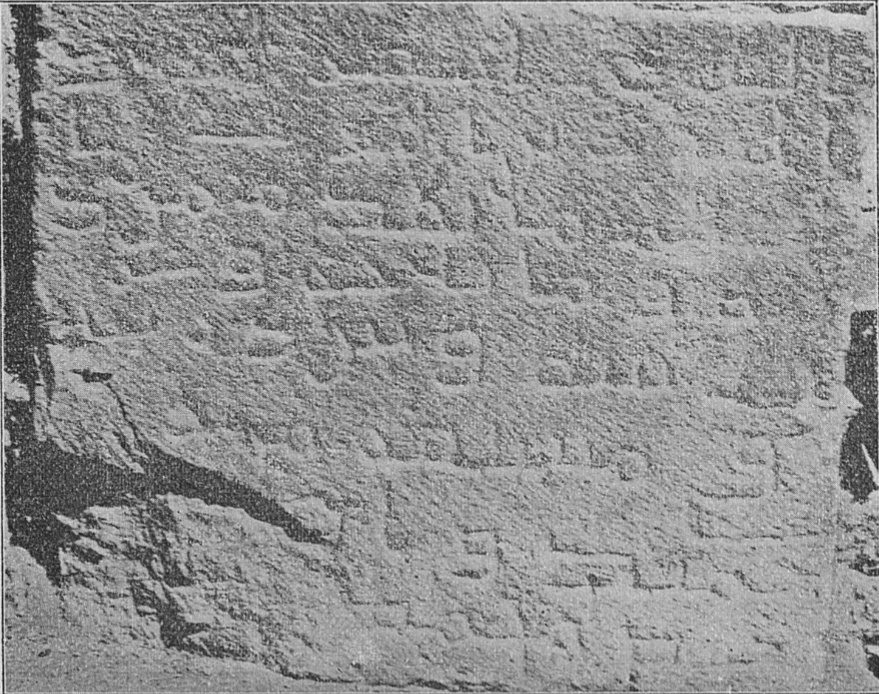
profession of faith people of Palestine Khathʿam Ḥismā

Inscription of ʿAbd al-ʿAzīz ibn al-Ḥārith ibn al-Ḥakam, Khirbat Nitil
c. 100 AH Prayer for ForgivenessLargely clear

Inscription of ʿAbd al-ʿAzīz ibn al-Ḥārith ibn al-Ḥakam, Khirbat Nitil

نقش عبد العزيز بن الحارث بن الحكم، خربة نتل

Khirbat Nitil, south-east of Mādabā, Jordan
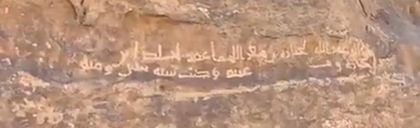
ḥawḍ Umayyad house Balqāʾ Q 48:2

Inscription of Khālid ibn Nuʿaym
102 AH Prayer for ForgivenessClear

Inscription of Khālid ibn Nuʿaym

نقش خالد بن نعيم

Taymāʾ, Tabūk

prayer for forgiveness Taymāʾ dated by year

Gravestone of Fāṭimah bint al-Ḥasan, Aswān
102 AH Funerary PrayerLargely clear

Gravestone of Fāṭimah bint al-Ḥasan, Aswān

شاهد قبر فاطمة بنت الحسن، أسوان

Aswān, Egypt
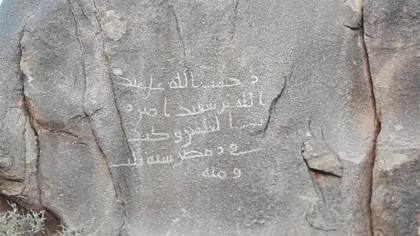
gravestone Qurʾanic verse Aswān

Inscription of ʿAbdallāh ibn Saʿīd
103 AH Prayer for MercyClear

Inscription of ʿAbdallāh ibn Saʿīd

نقش عبد الله بن سعيد

Location unpublished
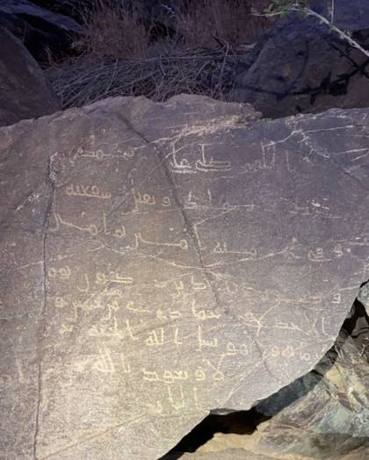
prayer for mercy dated by month Ramaḍān Ḥijāzī script

Inscription of Ziyād ibn Dhakwān
105 AH Prayer for MercyLargely clear

Inscription of Ziyād ibn Dhakwān

نقش زياد بن ذكوان

Tanūmah, ʿAsīr region
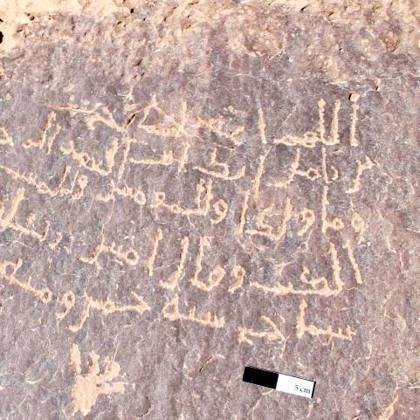
blessing upon the Prophet intercession dated by weekday Ḥijāzī script

Inscription of Sakākā
105 AH Prayer for Forgiveness

Inscription of Sakākā

نقش سكاكا

Sakākā, al-Jawf

prayer for forgiveness reader’s amen al-Jawf

Inscription of the Muwaqqar Capital
105 AH Foundation InscriptionClear

Inscription of the Muwaqqar Capital

نقش تاج الموقر

Qaṣr al-Muwaqqar, south-east of Amman, Jordan
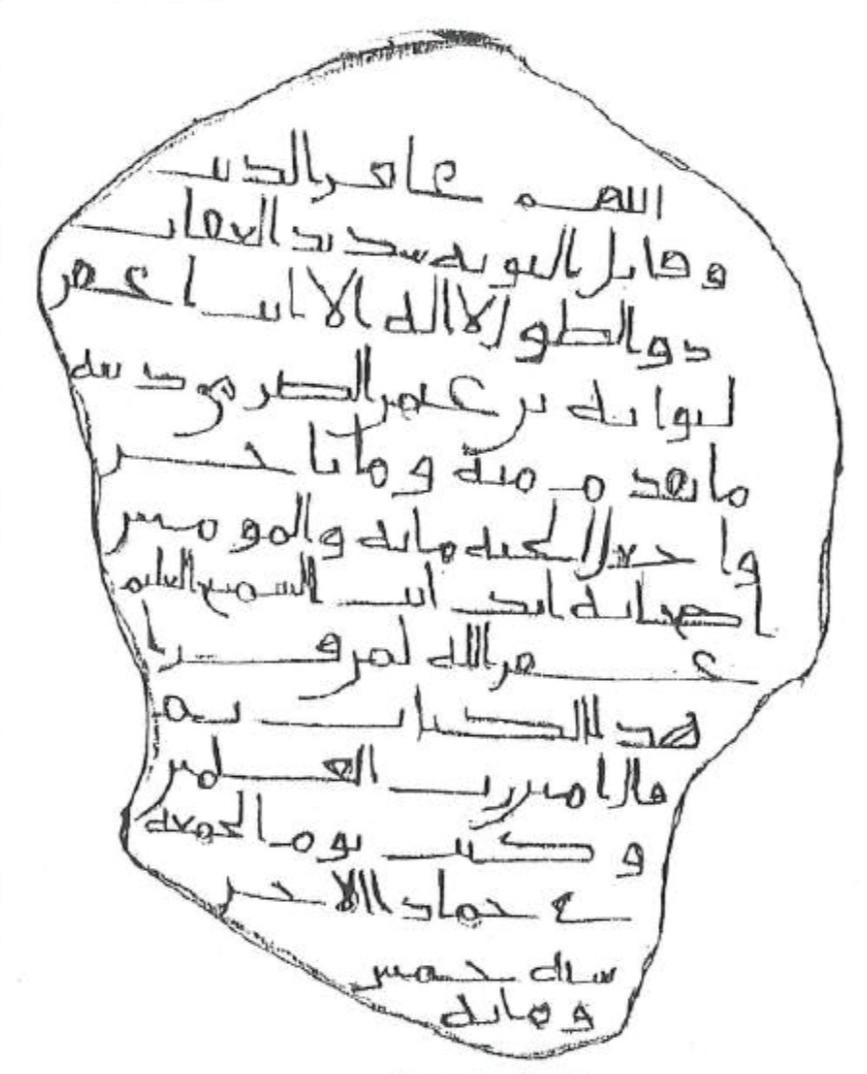
foundation text Yazīd II reservoir column capital

Facsimile of the inscription of Thawābah ibn ʿUthmān, Wādī Salma
105 AH Prayer for ForgivenessClear

Inscription of Thawābah ibn ʿUthmān al-Ṣarmī, Wādī Salma

نقش ثوابة بن عثمان الصرمي، وادي سلمى

Wādī Salma, north-eastern Jordan
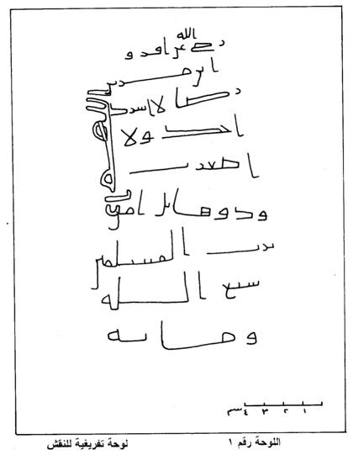
Q 40:3 Friday the believers Jordan

Inscription of Wādī al-Gharra
107 AH Profession of FaithLargely clear

Inscription of Wādī al-Gharra

نقش وادي الغرة

Wādī al-Gharra, Jordan
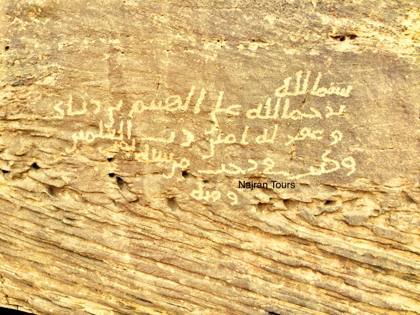
profession of faith Wadd and Hubal facsimile Jordan

Inscription of al-Haytham ibn Ziyād
108 AH Prayer for MercyClear

Inscription of al-Haytham ibn Ziyād

نقش الهيثم بن زياد

Shasʿā, Najrān region
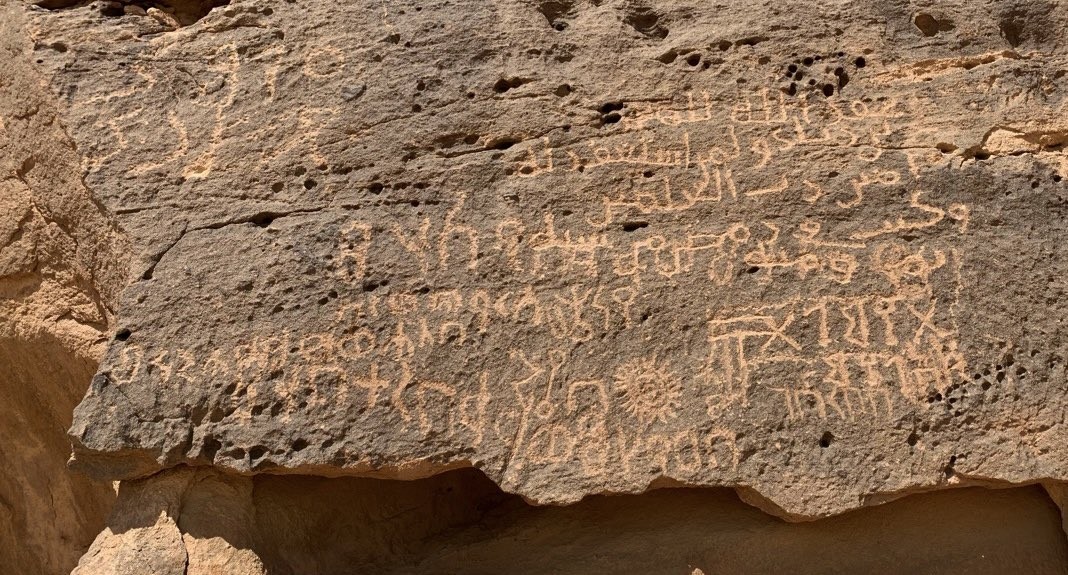
prayer for mercy dated by month Rajab Ḥijāzī script

Second inscription of al-Haytham ibn Ziyād
108 AH Prayer for ForgivenessClear

Second Inscription of al-Haytham ibn Ziyād, Najrān

النقش الثاني للهيثم بن زياد، نجران

Najrān region
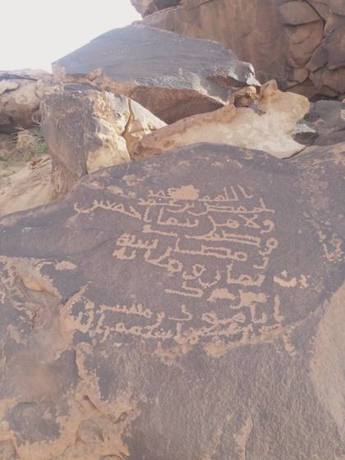
dated by month Ramaḍān Najrān

Inscription of Ḥafṣ ibn ʿUmar
108 AH Prayer for ForgivenessClear

Inscription of Ḥafṣ ibn ʿUmar

نقش حفص بن عمر

Taymāʾ, Tabūk

prayer for forgiveness people of Taymāʾ Ramaḍān Ḥijāzī script

Inscription of Sulaymān ibn Maḥmūd
109 AH Prayer for ForgivenessLargely clear

Inscription of Sulaymān ibn Maḥmūd

نقش سليمان بن محمود

Danqūr al-Khaznah, Petra, southern Jordan
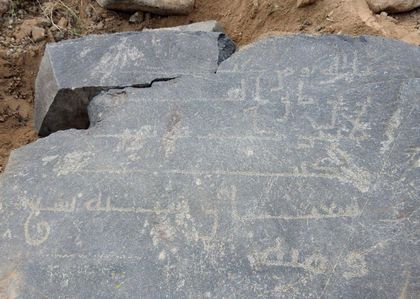
prayer for forgiveness Rabīʿ al-Ākhir Petra quarry

Inscription of Bilād Thumālah
109 AH Profession of FaithPartly preserved

Inscription of Bilād Thumālah

نقش بلاد ثمالة

Bilād Thumālah, south of al-Ṭāʾif
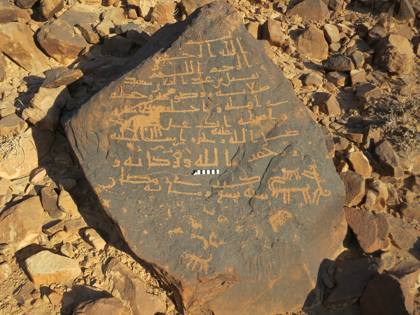
profession of faith Shaʿbān al-Ṭāʾif broken stone

Inscription of Wādī Shīreh
109 AH Prayer for MercyLargely clear

Inscription of Wādī Shīreh

نقش وادي الشيرة

Wādī Shīreh, Ḥismā (Wadi Ramm), southern Jordan
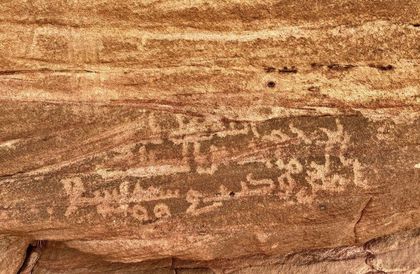
traveller’s prayer prayer and fasting Ramaḍān open-air mosque

First Inscription of al-Rammāḥ ibn al-Ṣalt
109 AH Prayer for MercyClear

First Inscription of al-Rammāḥ ibn al-Ṣalt

نقش الرماح بن الصلت (الأول)

Najrān region
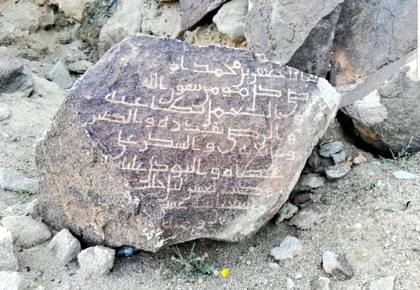
prayer for mercy Najrān dated by year

Inscription of Jaʿfar ibn Muḥammad
110 AH ExhortationClear

Inscription of Jaʿfar ibn Muḥammad

نقش جعفر بن محمد

Mecca region

testament dated by day Shaʿbān Ḥijāzī script

Foundation Inscription of Qaṣr al-Ḥayr al-Sharqī
110 AH Foundation InscriptionLargely clear

Foundation Inscription of Qaṣr al-Ḥayr al-Sharqī

نقش تأسيس قصر الحير الشرقي

Qaṣr al-Ḥayr al-Sharqī, Syrian desert
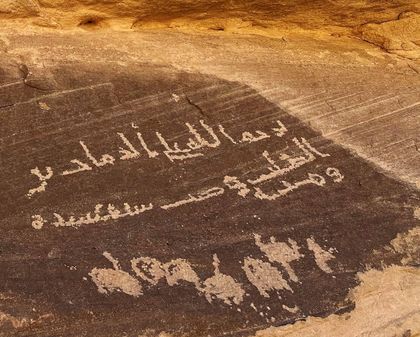
foundation inscription caliph Hishām city or minaret? Syria

Second Inscription of al-Rammāḥ ibn al-Ṣalt
110 AH Prayer for MercyClear

Second Inscription of al-Rammāḥ ibn al-Ṣalt

نقش الرماح بن الصلت (الثاني)

Najrān region
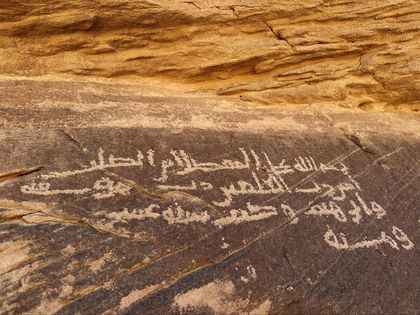
prayer for mercy Najrān camel drawings

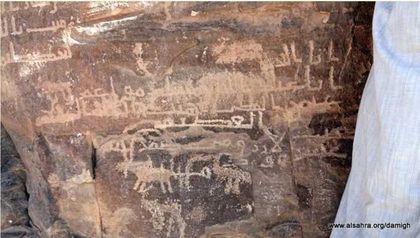
Inscription of al-Mufaḍḍal ibn al-Ṣalt
110 AH Prayer for MercyClear

Inscription of al-Mufaḍḍal ibn al-Ṣalt

نقش المفضل بن الصلت

Najrān region

prayer for mercy Moses and Abraham Najrān

Inscription of ʿAbdallāh ibn Muslim, Ḥismā
110 AH Profession of FaithLargely clear

Inscription of ʿAbdallāh ibn Muslim, Ḥismā

نقش عبد الله بن مسلم

Ḥismā, north-western Arabia
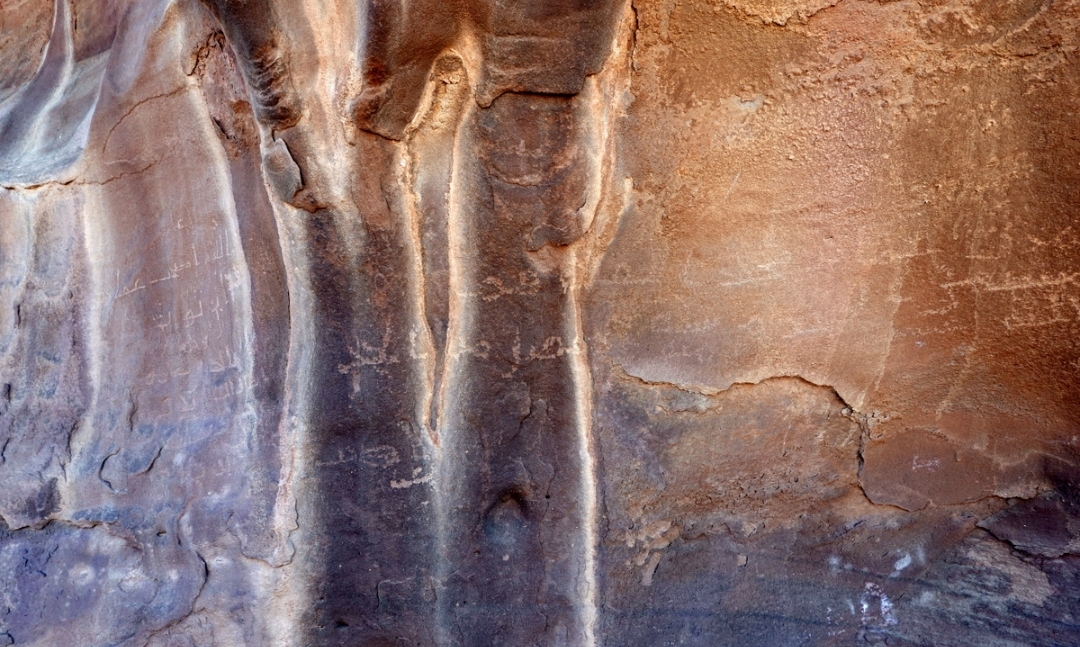
profession of faith Ḥismā dated by year

Inscription of Rāghim ibn Mukhlid: “Returning from the Pilgrimage”
110 AH CommemorativeLargely clear

Inscription of Rāghim ibn Mukhlid: “Returning from the Pilgrimage”

نقش راغم بن مخلد: مقبل من الحج

Ḥismā, north-western Arabia
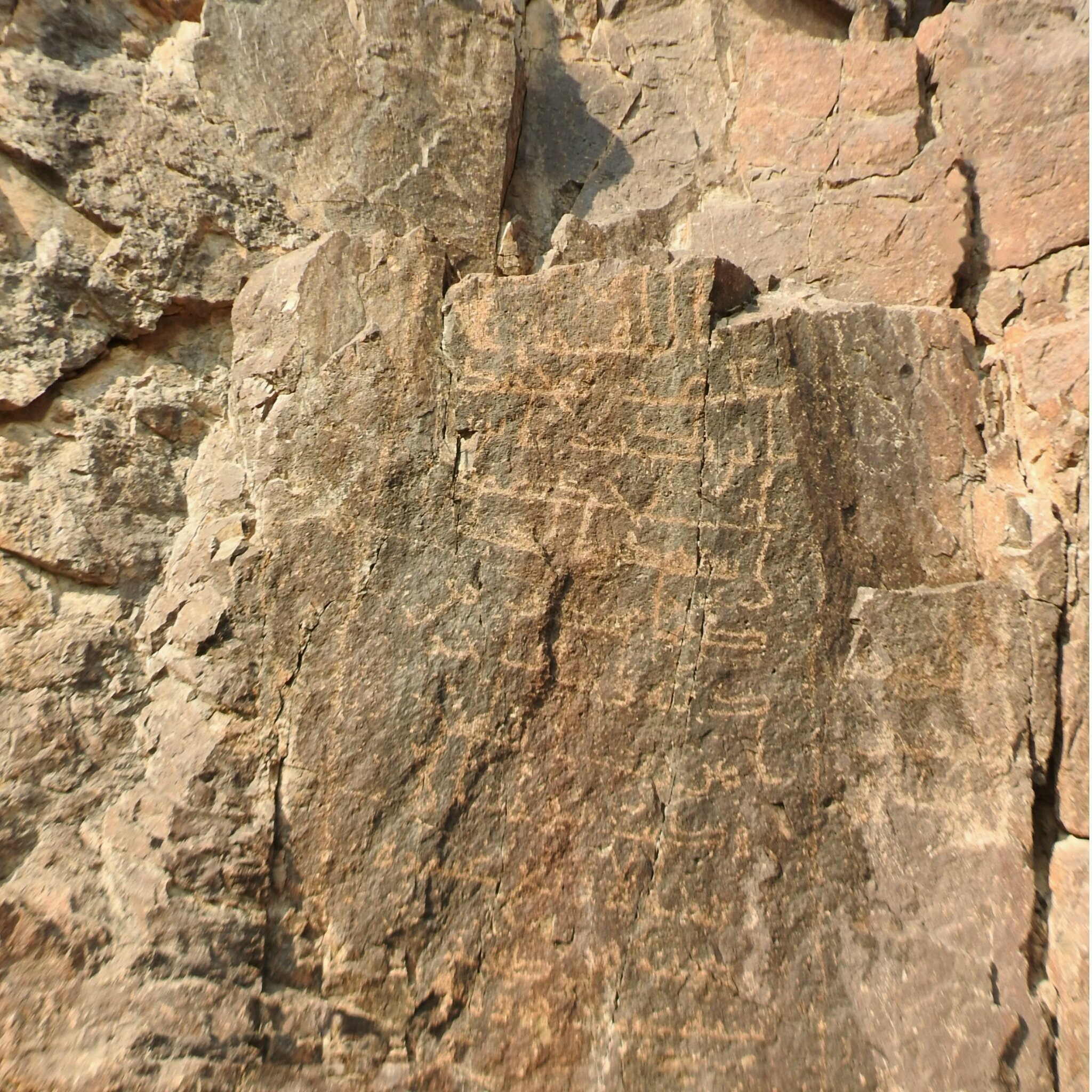
pilgrimage Ḥismā dated by day

Inscription of Muḥammad ibn Kathīr, Mawlā of Saʿīd ibn al-ʿĀṣ
110 AH Prayer for ForgivenessClear

Inscription of Muḥammad ibn Kathīr, Mawlā of Saʿīd ibn al-ʿĀṣ

نقش محمد بن كثير مولى سعيد بن العاص

al-Madīnah region
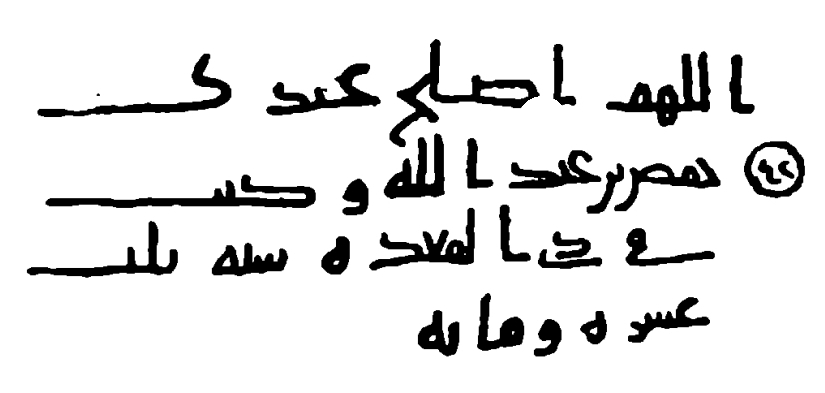
prayer for forgiveness mawlā Medina dated by day

Inscription of Ḥafṣ ibn ʿAbdallāh, Jabal Usays
113 AH Prayer for MercyClear

Inscription of Ḥafṣ ibn ʿAbdallāh, Jabal Usays

نقش حفص بن عبد الله، جبل أسيس

Jabal Usays, Syria
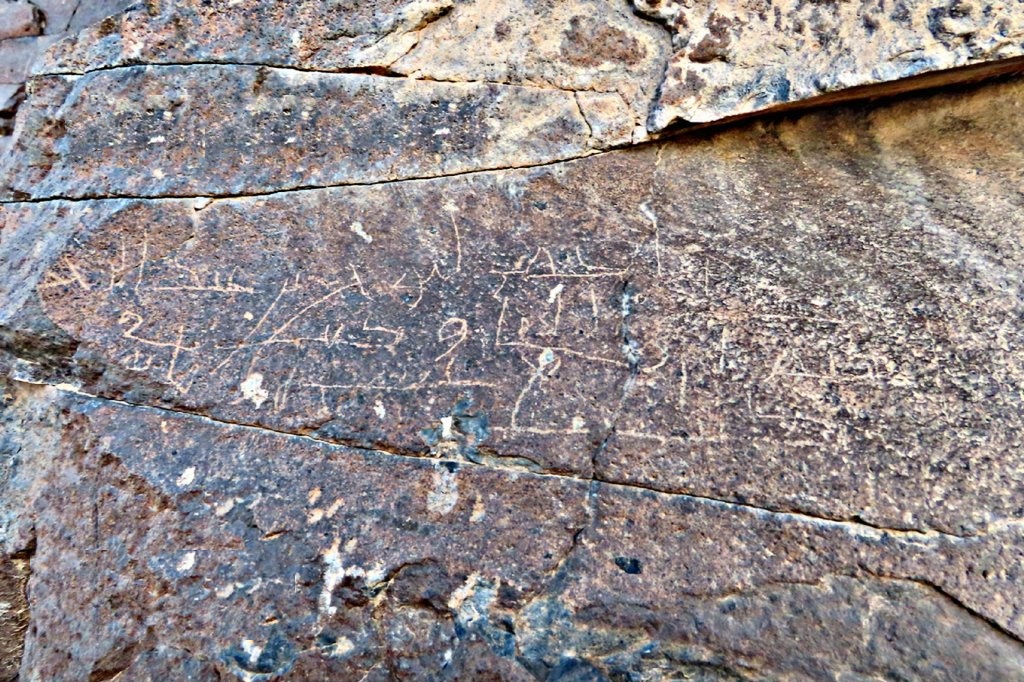
prayer Jabal Usays National Museum, Damascus

Inscription of Nūḥ ibn ʿAbd al-Raḥmān al-Duʾalī
114 AH Prayer for ForgivenessClear

Inscription of Nūḥ ibn ʿAbd al-Raḥmān al-Duʾalī

نقش نوح بن عبد الرحمن الدؤلي

al-Madīnah region
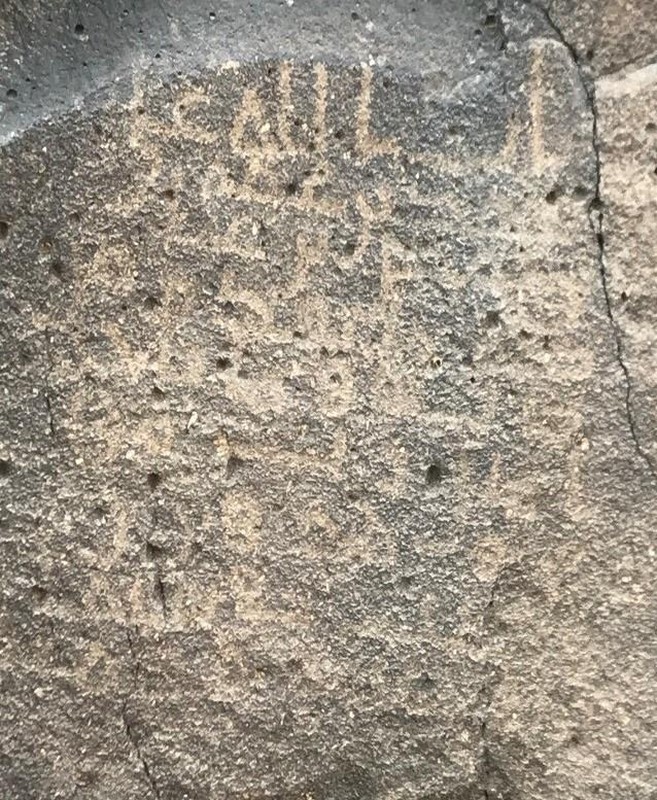
prayer for forgiveness nisbah Medina

Inscription of Muḥammad ibn ʿUmar ibn Ḥafṣ, Rawāwah
114 AH Prayer for ForgivenessPartly preserved

Inscription of Muḥammad ibn ʿUmar ibn Ḥafṣ, Rawāwah

نقش محمد بن عمر بن حفص، رواوة

Rawāwah, al-Madīnah region
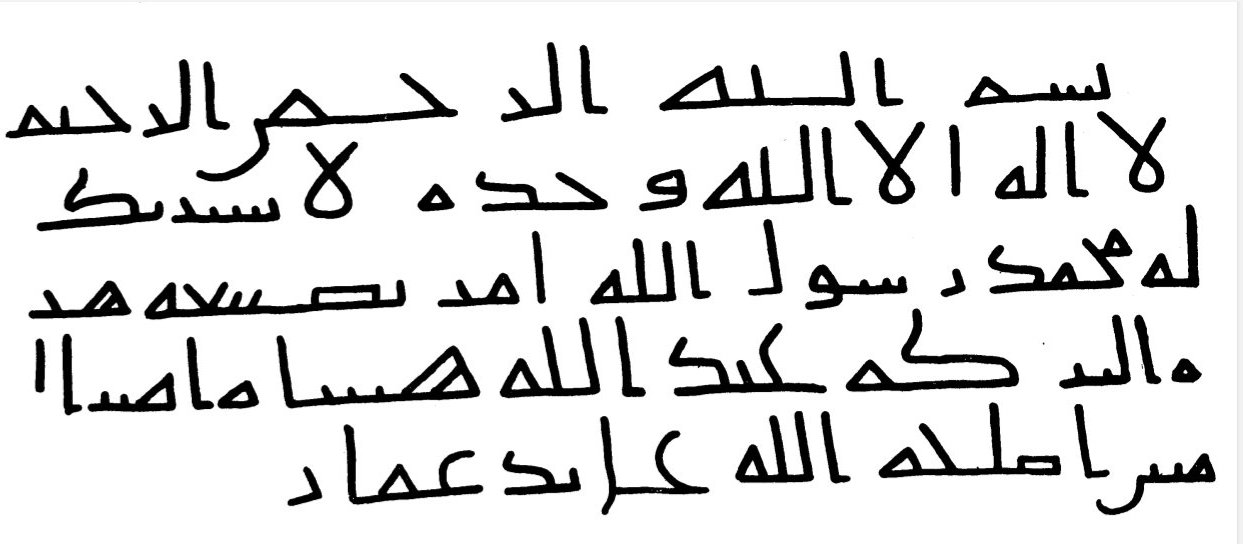
ʿUmar's descendants Lord of Moses and Aaron repentance

Inscription of the Pool of Hishām ibn ʿAbd al-Malik
105–125 AH Foundation InscriptionClear

Inscription of the Pool of Hishām ibn ʿAbd al-Malik

نقش بركة هشام بن عبد الملك

Location unrecorded
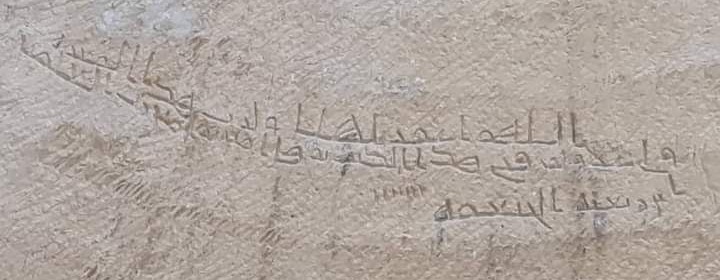
Kūfic foundation inscription pool Hishām ibn ʿAbd al-Malik Commander of the Faithful

Inscription of Bayt Jibrīn: Prayer for Hilāl and the Lord of the House
c. 105–125 AH Prayer for ForgivenessLargely clear

Inscription of Bayt Jibrīn: Prayer for Hilāl and the Lord of the House

نقش بيت جبرين: دعاء لهلال ولرب هذا المنزل

Bayt Jibrīn, Palestine
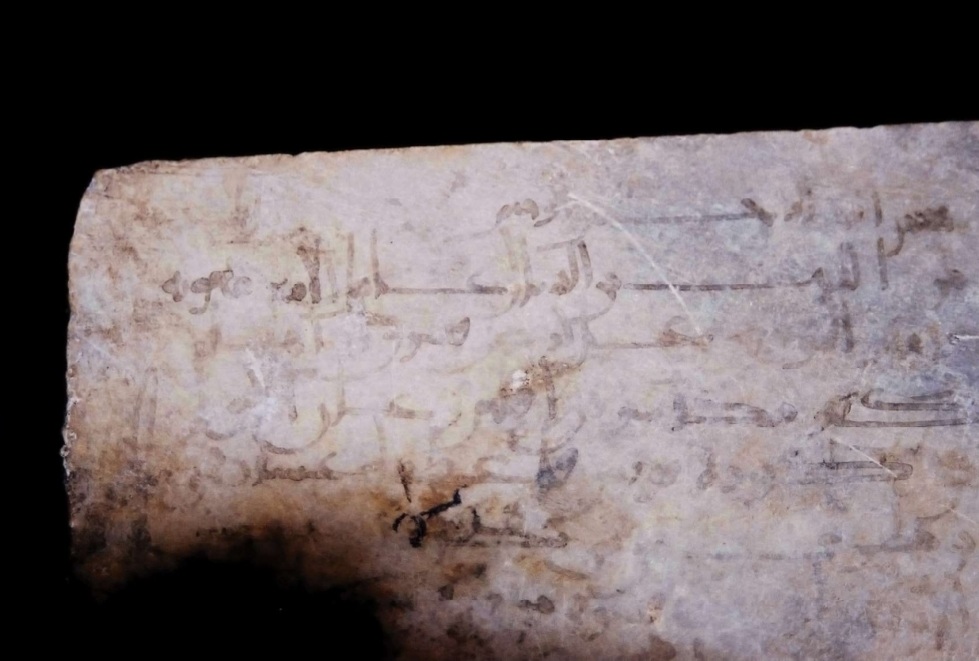
prayer for forgiveness Khathʿam cave house dated by script

Tax Letter of al-Layth ibn al-Dhiyāl, Andarīn
105–125 AH CommemorativeClear

Tax Letter of al-Layth ibn al-Dhiyāl, Andarīn

رسالة الليث بن الذيال في الضرائب، أندرين

Andarīn (Androna), northern Syria
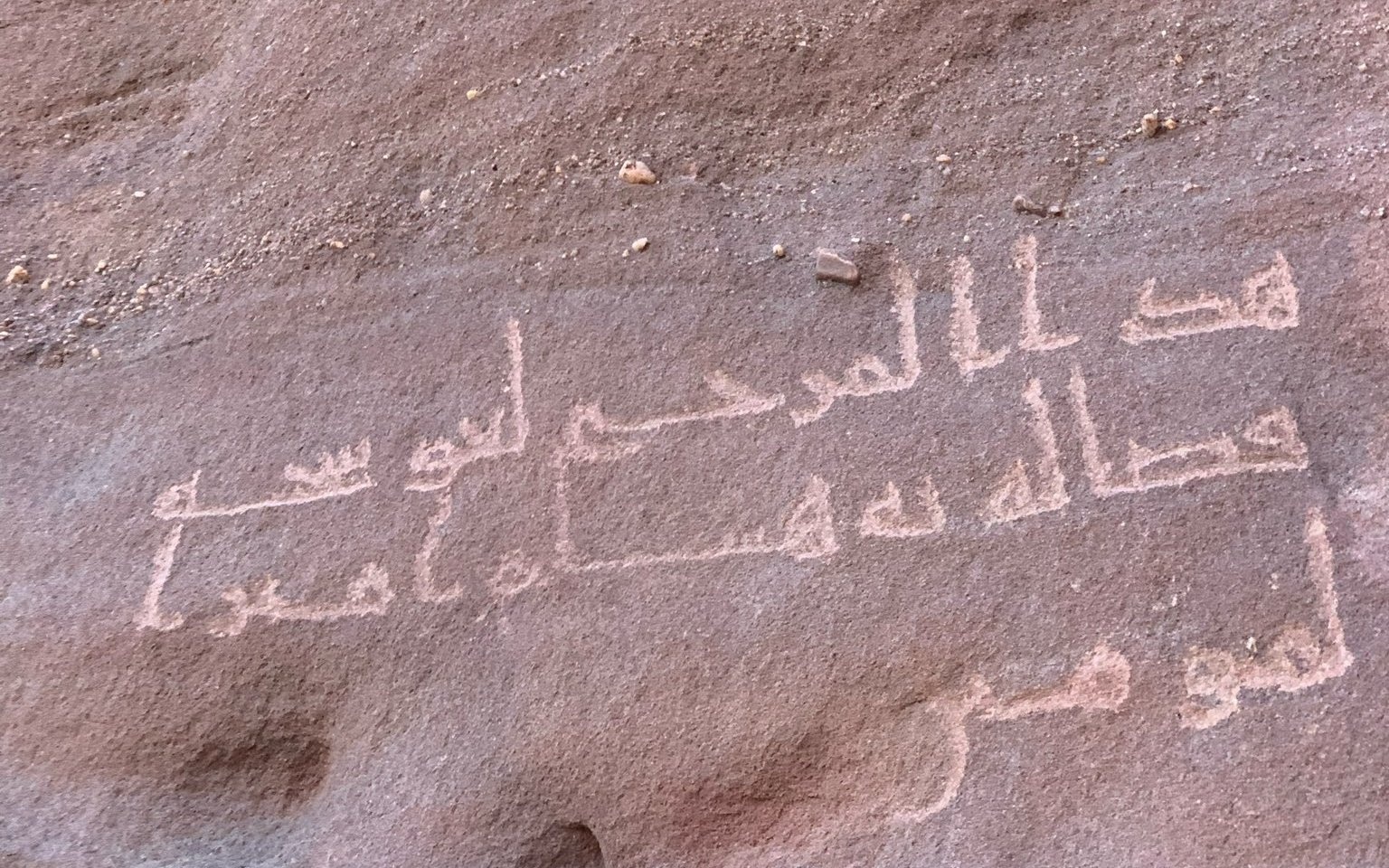
Umayyad tax letter ink on marble Qinnasrīn Muʿāwiya ibn Hishām

Inscription of the Meadow of ʿAwsajah, al-ʿUlā
105–125 AH CommemorativeClear

Inscription of the Meadow of ʿAwsajah, al-ʿUlā

نقش مرج عوسجة، العلا

al-ʿUlā, Saudi Arabia
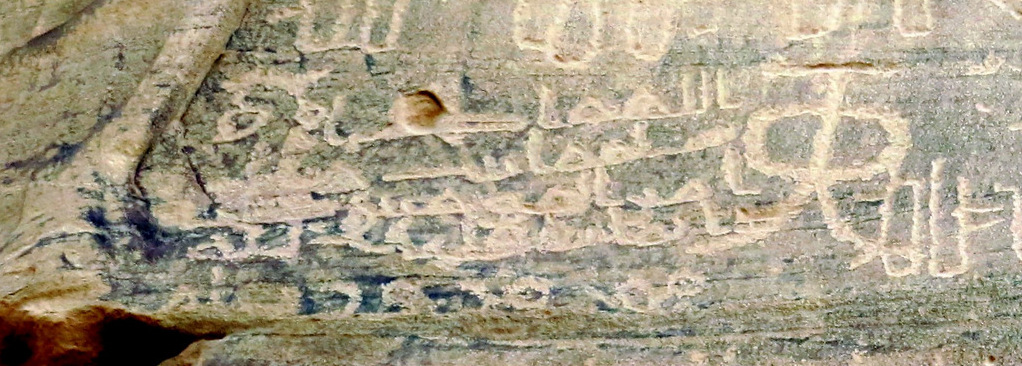
Kūfic Hishām meadow royal judgment land

Inscription of Umm Salamah bint Hishām
105–125 AH CommemorativePartly preserved

Inscription of Umm Salamah bint Hishām

نقش أم سلمة بنت هشام

Desert route, north-western Arabia
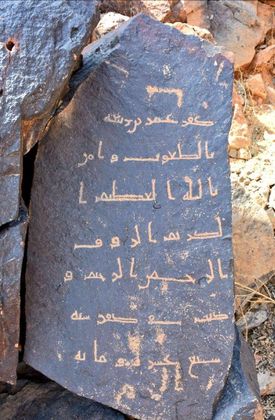
Kūfic Hishām woman travelling prayer caliph’s daughter

Inscription of ʿUmar ibn Rabīʿah
117 AH Profession of FaithClear

Inscription of ʿUmar ibn Rabīʿah

نقش عمر بن ربيعة

Desert of al-Madīnah (Bādiyat al-Madīnah)
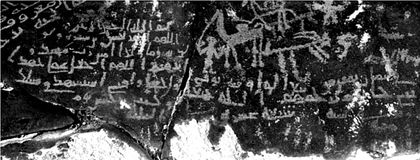
profession of faith al-ṭāghūt Ṣafar divine names

Inscription of Ḥasan ibn Maysarah, al-Naqab, 117 AH
117 AH Prayer for ForgivenessLargely clear

Inscription of Ḥasan ibn Maysarah, al-Naqab, 117 AH

نقش حسن بن ميسرة

al-Naqab

al-Naqab dated by year

Inscription of Muḥammad ibn Ibrāhīm ibn Nāfiʿ
120 AH Prayer for ForgivenessClear

Inscription of Muḥammad ibn Ibrāhīm ibn Nāfiʿ

نقش محمد بن إبراهيم بن نافع

Ḥismā, north-western Arabia
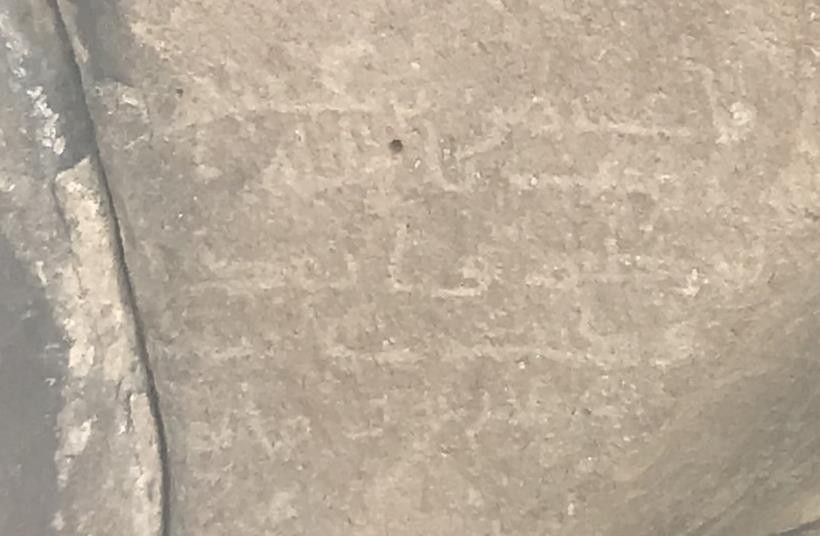
prayer for forgiveness client of Abū Hurayrah Ḥismā Ḥijāzī script

Inscription of ʿUthmān ibn ʿUbaydallāh, Rawāwah
120 AH Profession of FaithPartly preserved

Inscription of ʿUthmān ibn ʿUbaydallāh, Rawāwah

نقش عثمان بن عبيد الله، رواوة

Rawāwah, al-Madīnah region

ʿUmar's descendants faith Rawāwah

Inscription of Ward ibn Sālim, al-Naqab
119 AH Prayer for ForgivenessLargely clear

Inscription of Ward ibn Sālim, al-Naqab

نقش ورد بن سالم

al-Naqab

prayer for forgiveness al-Naqab dated by year

Inscription of Ḥafṣ, Jabal Usays
119 AH Profession of FaithClear

Inscription of Ḥafṣ, Jabal Usays

نقش حفص، جبل أسيس

Jabal Usays, Syria

creed Qurʾanic phrasing Jabal Usays warning against effacing

Inscription of the Umayyad Market, Baysān
120 AH Foundation InscriptionLargely clear

Inscription of the Umayyad Market, Baysān

نقش سوق الأمويين ببيسان

Baysān, Jordan Valley
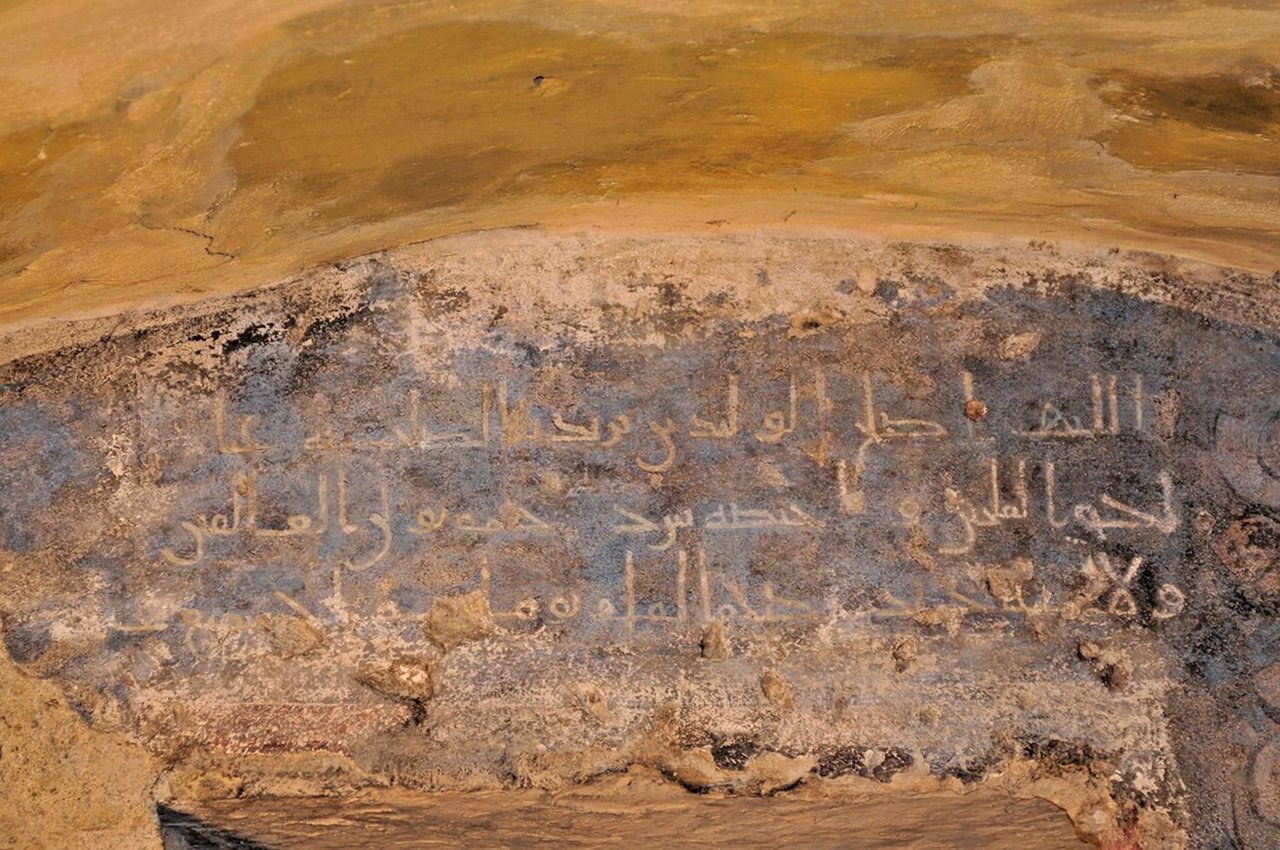
foundation inscription Hishām ibn ʿAbd al-Malik Umayyad market Kūfī script

Inscription of al-Walīd b. Yazīd, Quṣayr ʿAmra
c. 105–125 AH Prayer for MercyPartly preserved

Inscription of al-Walīd b. Yazīd, Quṣayr ʿAmra

نقش الوليد بن يزيد في قصير عمرة

Quṣayr ʿAmra, Jordan
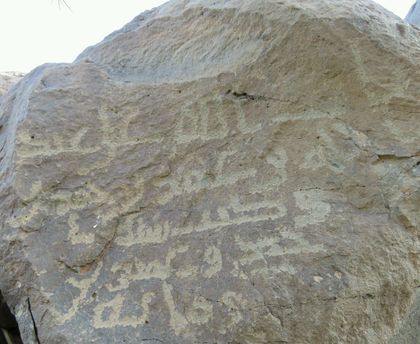
painted al-Walīd b. Yazīd bathhouse

Inscription of ʿAbdallāh ibn ʿUmar ibn Ḥafṣ
121 AH Prayer for ForgivenessClear

Inscription of ʿAbdallāh ibn ʿUmar ibn Ḥafṣ

نقش عبد الله بن عمر بن حفص

Location unpublished
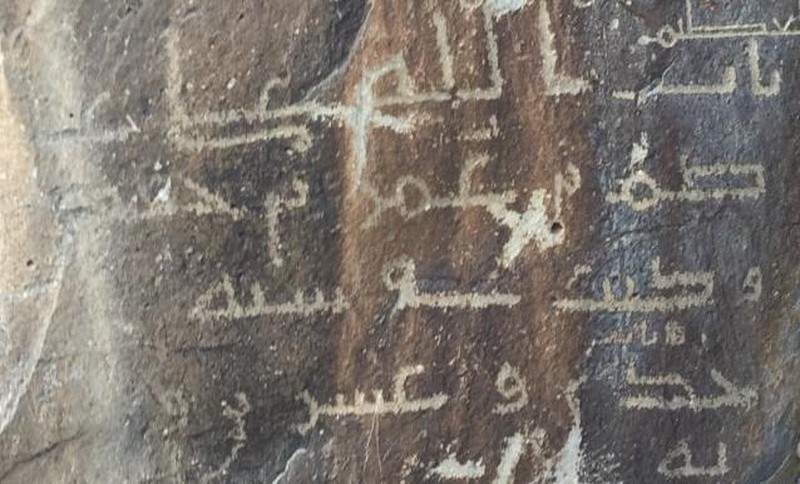
prayer for repentance dated by year ʿUmarī family

Inscription of ʿĀṣim ibn ʿUmar ibn Ḥafṣ, Rawāwah, 121 AH
121 AH Prayer for ForgivenessLargely clear

Inscription of ʿĀṣim ibn ʿUmar ibn Ḥafṣ, Rawāwah, 121 AH

نقش عاصم بن عمر بن حفص، رواوة، ١٢١ هـ

Rawāwah, al-Madīnah region
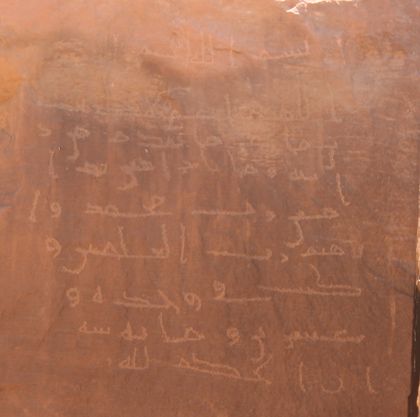
ʿUmar's descendants repentance Rawāwah

Inscription of al-Ḥārith ibn Ṣāghir
121 AH Prayer for ForgivenessClear

Inscription of al-Ḥārith ibn Ṣāghir

نقش الحارث بن صاغر

Qārat al-Nayṣah, east of Dūmat al-Jandal, al-Jawf
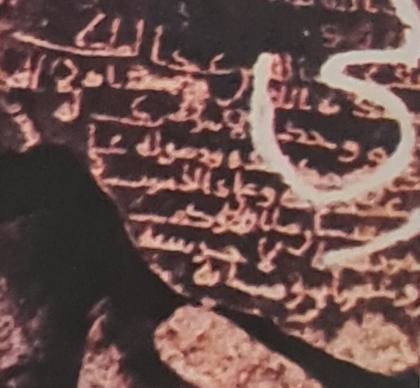
prayer for forgiveness al-Jawf dated by year

Inscription of Muḥammad ibn ʿAbdallāh ibn ʿAbd al-Malik
122 AH Profession of FaithLargely clear

Inscription of Muḥammad ibn ʿAbdallāh ibn ʿAbd al-Malik

نقش محمد بن عبد الله بن عبد الملك

Jabal Thawr, Mecca
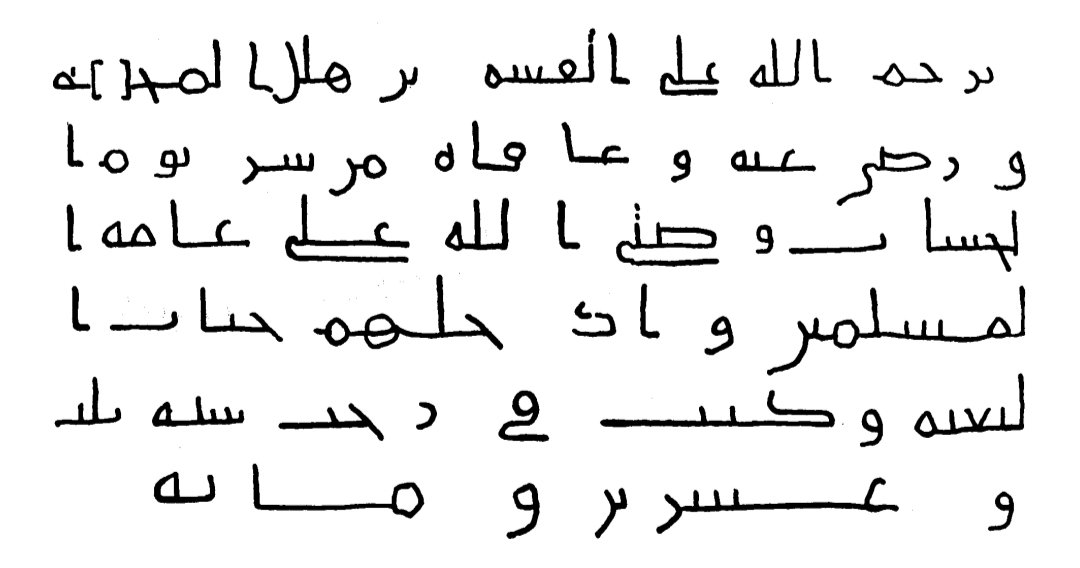
profession of faith witnesses Jabal Thawr Mecca

Inscription of ʿAnjar
123 AH Prayer for MercyLargely clear

Inscription of ʿAnjar

نقش عنجر

Umayyad palace-city of ʿAnjar, Biqāʿ valley, Lebanon
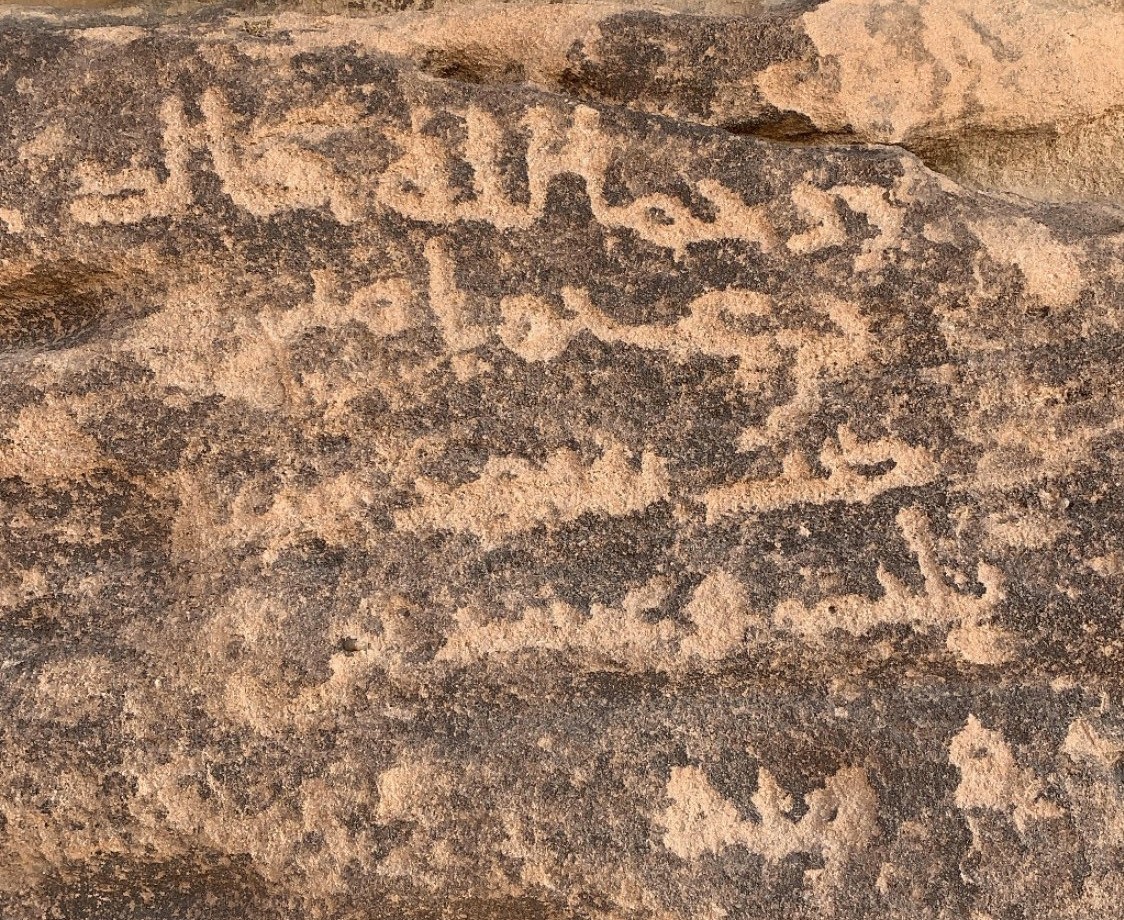
prayer for mercy ʿAnjar Lebanon prayer for all Muslims

Inscription of Khālid ibn Ghannām, Najrān
123 AH Prayer for MercyClear

Inscription of Khālid ibn Ghannām, Najrān

نقش خالد بن غنام، نجران

Najrān region, Saudi Arabia
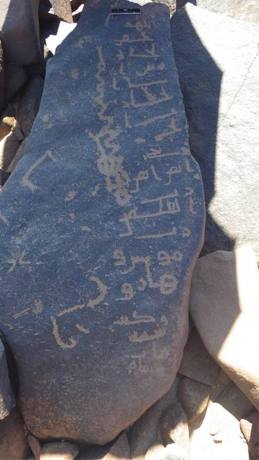
prayer for mercy Najrān late Umayyad

Inscription of Wādī ash-Shuwayṭī
125 AH Prayer for ForgivenessClear

Inscription of Wādī ash-Shuwayṭī

نقش وادي الشويطي

Wādī ash-Shuwayṭī, Ḥarrah (Black Desert), north-eastern Jordan
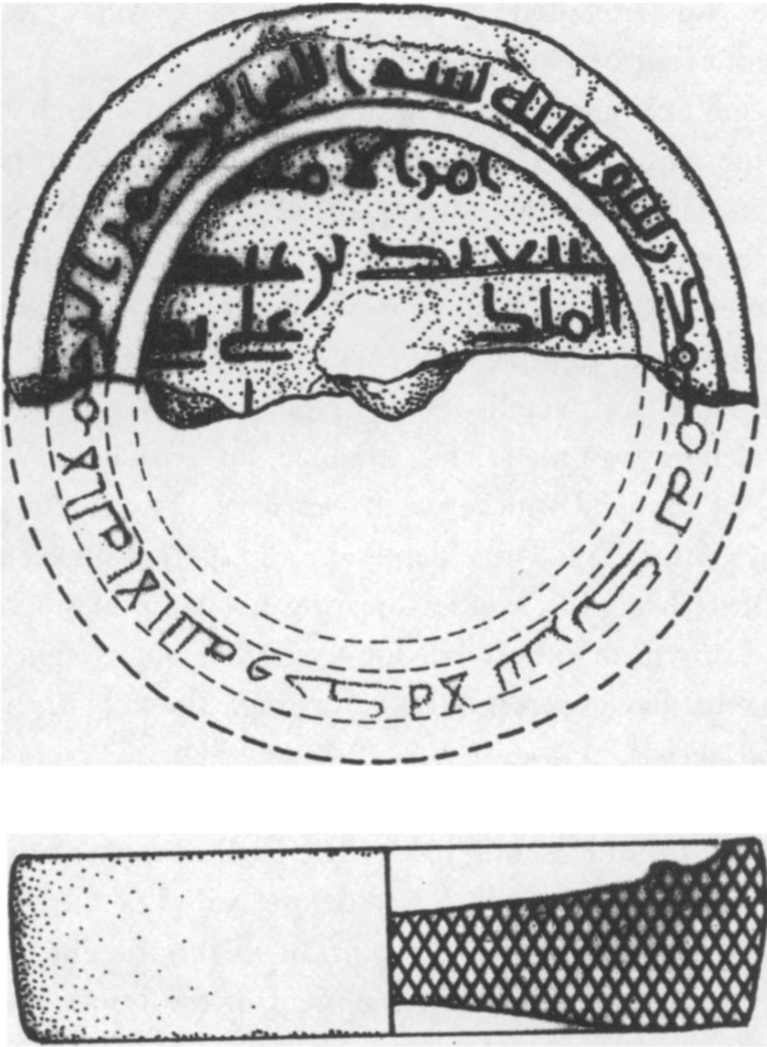
dated by event death of Hishām Lord of Moses and Aaron one word per line Black Desert Jordan

Bronze weight of Saʿīd ibn ʿAbd al-Malik, Baysān (drawing)
c. 125–126 AH Foundation InscriptionPartly preserved

Bronze Weight of Saʿīd ibn ʿAbd al-Malik, Baysān

صنجة سعيد بن عبد الملك البرونزية، بيسان

Baysān, Palestine
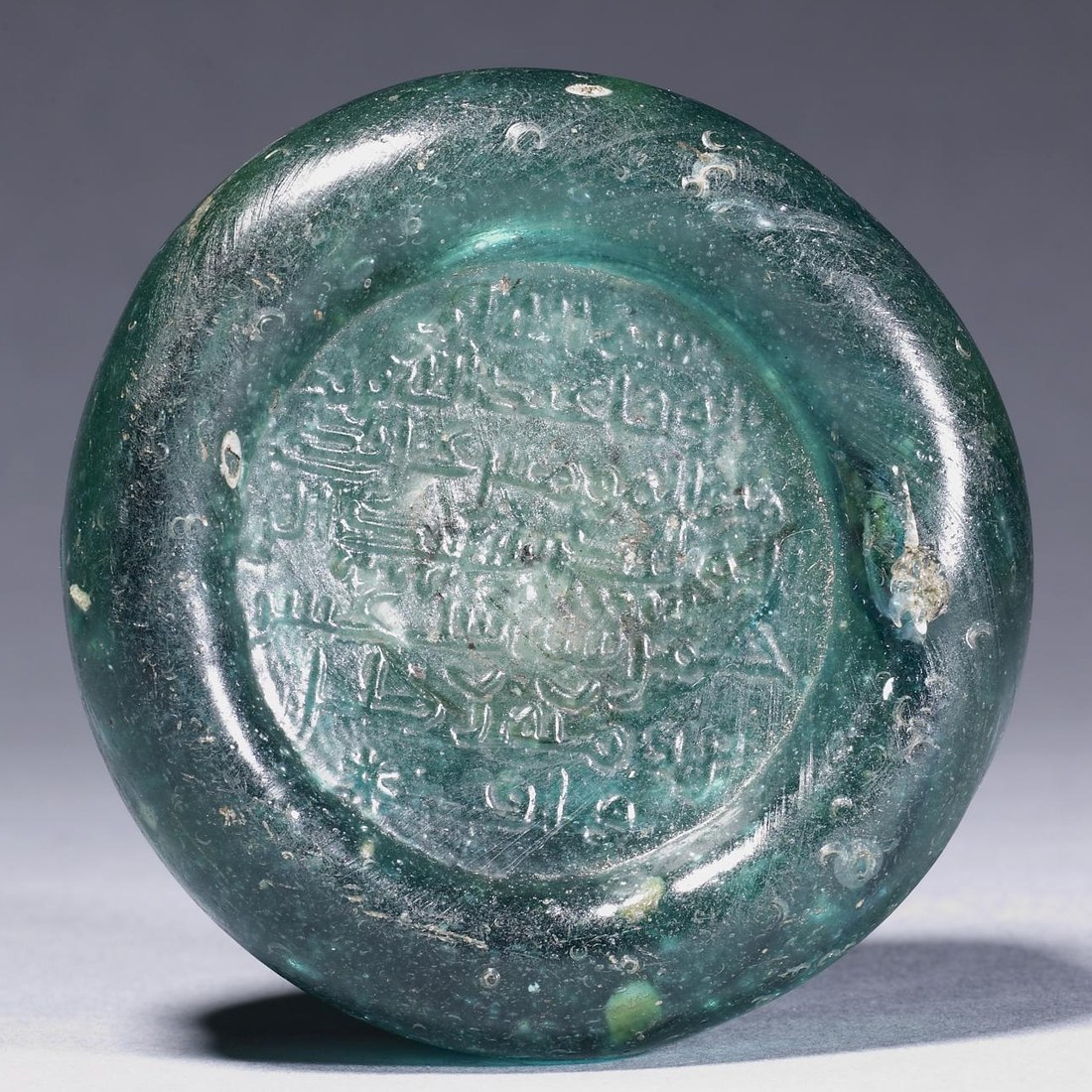
weight official text Umayyad prince Byzantine form

Glass Raṭl Weight of Yazīd III
126 AH Foundation InscriptionClear

Glass Raṭl Weight of Yazīd III

رطل زجاجي باسم يزيد بن الوليد

Damascus; Walters Art Museum
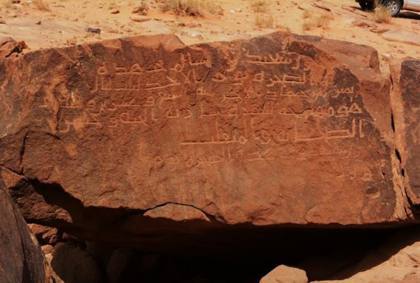
glass weight Yazīd III official

Inscription of Saʿīd ibn Sālim
127 AH CommemorativeClear

Inscription of Saʿīd ibn Sālim

نقش سعيد بن سالم

Jabal al-Aqraʿ, north of al-ʿUlā
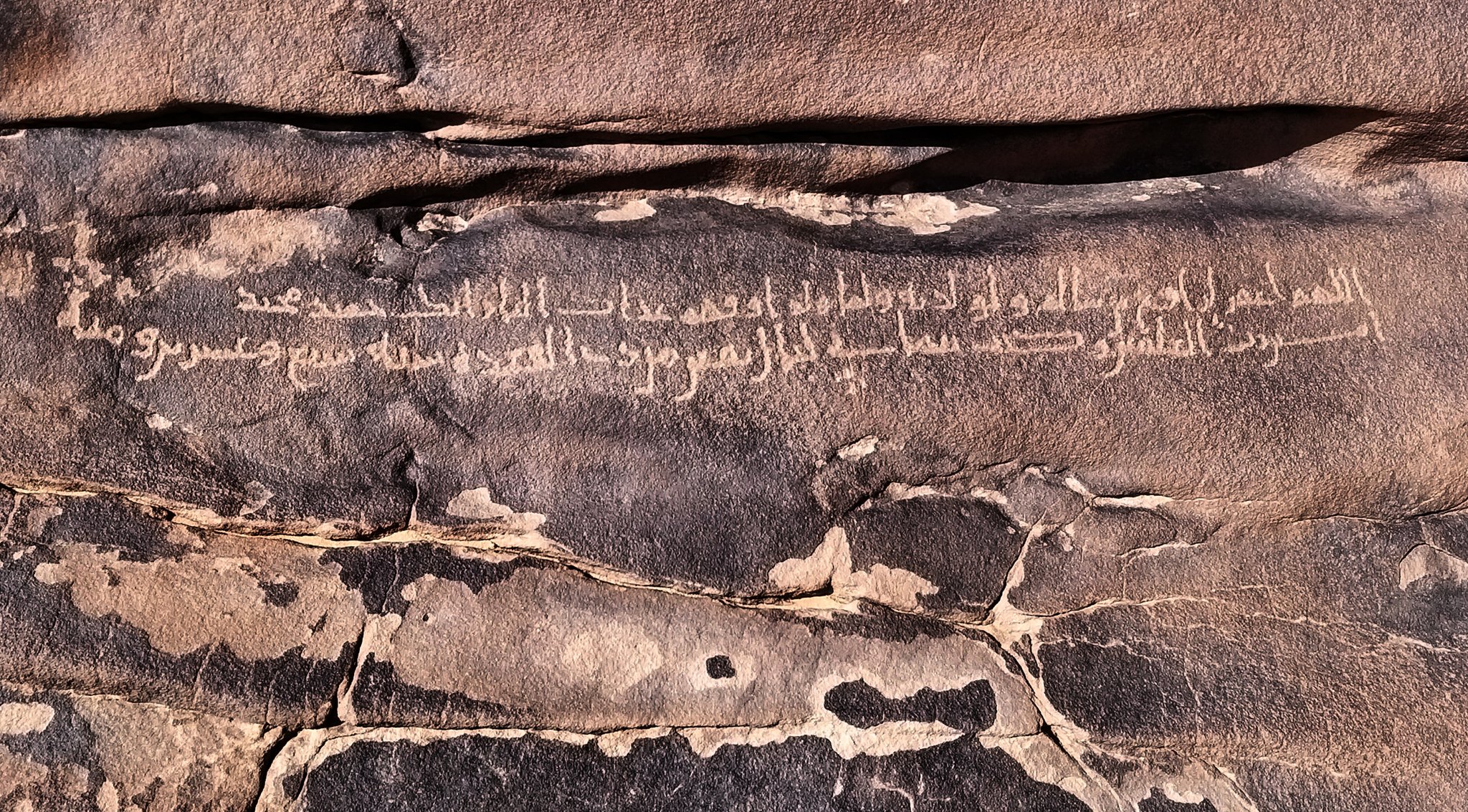
traveller ʿUmrah dated to the day al-ʿUlā

Inscription of Rāfiʿ ibn Sālim
127 AH Prayer for ForgivenessClear

Inscription of Rāfiʿ ibn Sālim

نقش رافع بن سالم

North-western Arabia
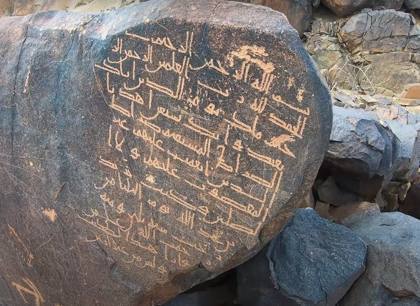
prayer for parents Qurʾanic phrasing dated by nights remaining

Inscription of Yazīd ibn ʿAbdallāh (Sūrat al-Fātiḥah)
130 AH Qurʾanic VerseClear

Inscription of Yazīd ibn ʿAbdallāh (Sūrat al-Fātiḥah)

نقش يزيد بن عبد الله (سورة الفاتحة)

A valley east of al-Namāṣ, Bilād Rijāl al-Ḥajr, ʿAsīr
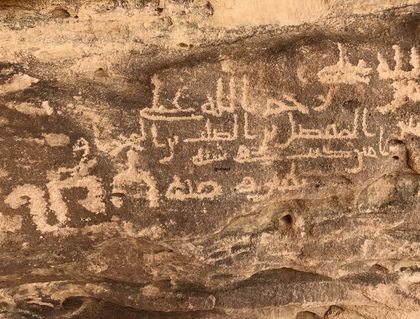
Qurʾanic verse al-Fātiḥah ʿAsīr Marwān II

Inscription of al-Mufaḍḍal ibn al-Ṣalt, second prayer
130 AH Prayer for MercyClear

Inscription of al-Mufaḍḍal ibn al-Ṣalt, second prayer

نقش المفضل بن الصلت

Najrān

prayer for mercy Najrān dated by year

Inscription of ʿAbd al-Raḥmān ibn Sulaymān, east of al-Madīnah
130 AH Prayer for MercyClear

Inscription of ʿAbd al-Raḥmān ibn Sulaymān, east of al-Madīnah

نقش عبد الرحمن بن سليمان، شرق المدينة

East of al-Madīnah
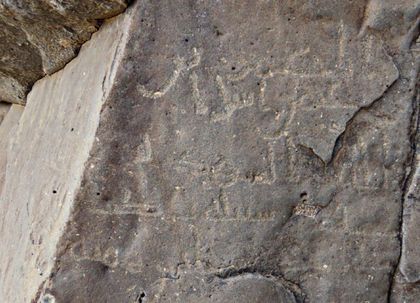
refuge the hereafter al-Madīnah

Inscription of ʿUmar ibn ʿUthmān
131 AH Prayer for MercyClear

Inscription of ʿUmar ibn ʿUthmān

نقش عمر بن عثمان

Ghadīr Rawāwah, al-Madīnah region
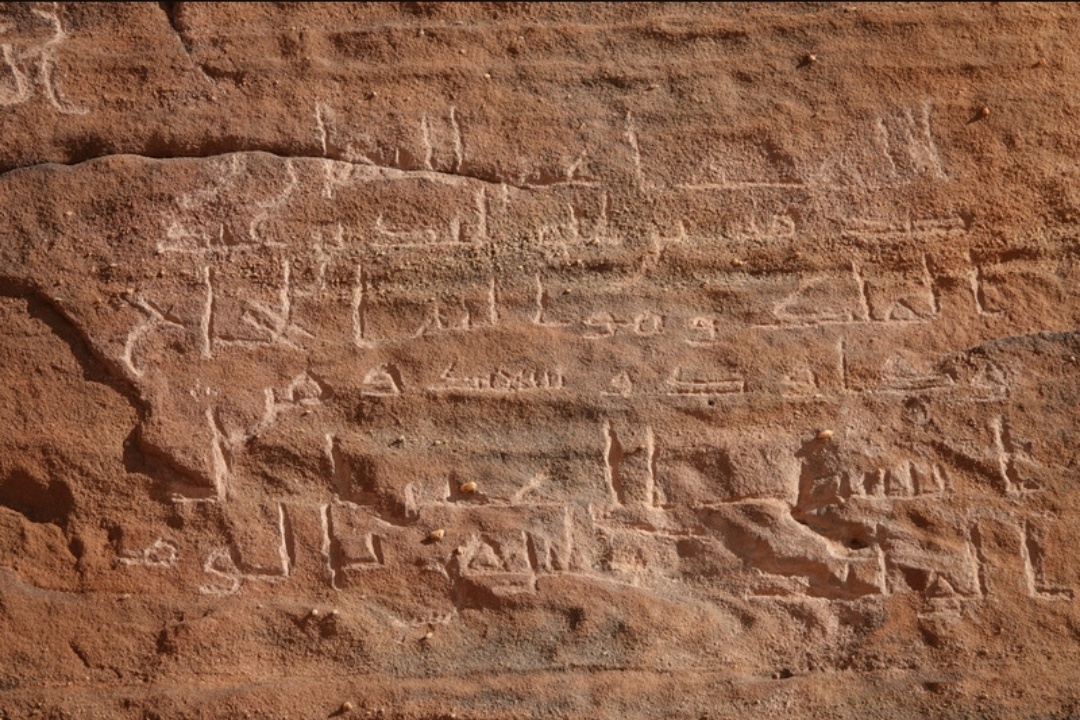
prayer for martyrdom first person fī sabīlihi al-Madīnah

Inscription of al-Yamān ibn Ṣadaqah, Grandson of the Caliph al-Walīd
c. 100–132 AH Prayer for ForgivenessLargely clear

Inscription of al-Yamān ibn Ṣadaqah, Grandson of the Caliph al-Walīd

نقش اليمان بن صدقة بن الوليد بن عبد الملك

Northern Ḥijāz (site unpublished)
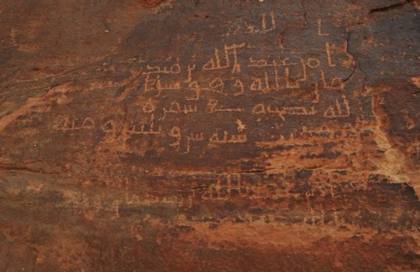
Umayyad house mawlā end of the dynasty

Inscription of ʿAbdallāh ibn Mundhqān
132 AH Profession of FaithClear

Inscription of ʿAbdallāh ibn Mundhqān

نقش عبد الله بن منذقان

Jabal al-Aqraʿ, north of al-ʿUlā
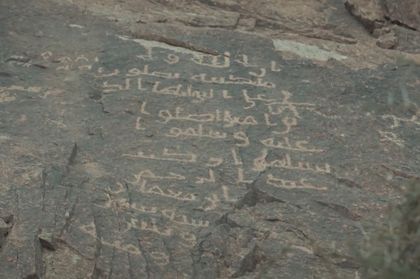
profession of faith traveller’s prayer fall of the Umayyads al-ʿUlā

Inscription of the Verse on Blessing the Prophet
132 AH Qurʾanic VerseClear

Inscription of the Verse on Blessing the Prophet

نقش آية الصلاة على النبي

al-Madīnah al-Munawwarah
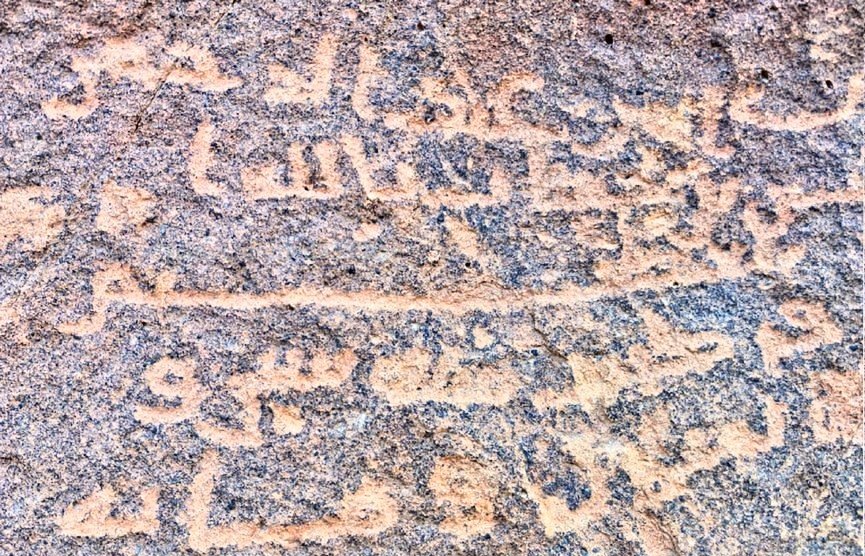
Qurʾān al-Madīnah dated by year

Inscription of ʿAbd al-Raḥmān ibn Khaṭṭāb, north of al-Madīnah
132 AH Profession of FaithClear

Inscription of ʿAbd al-Raḥmān ibn Khaṭṭāb, north of al-Madīnah

نقش عبد الرحمن بن خطاب، شمال المدينة

North of al-Madīnah
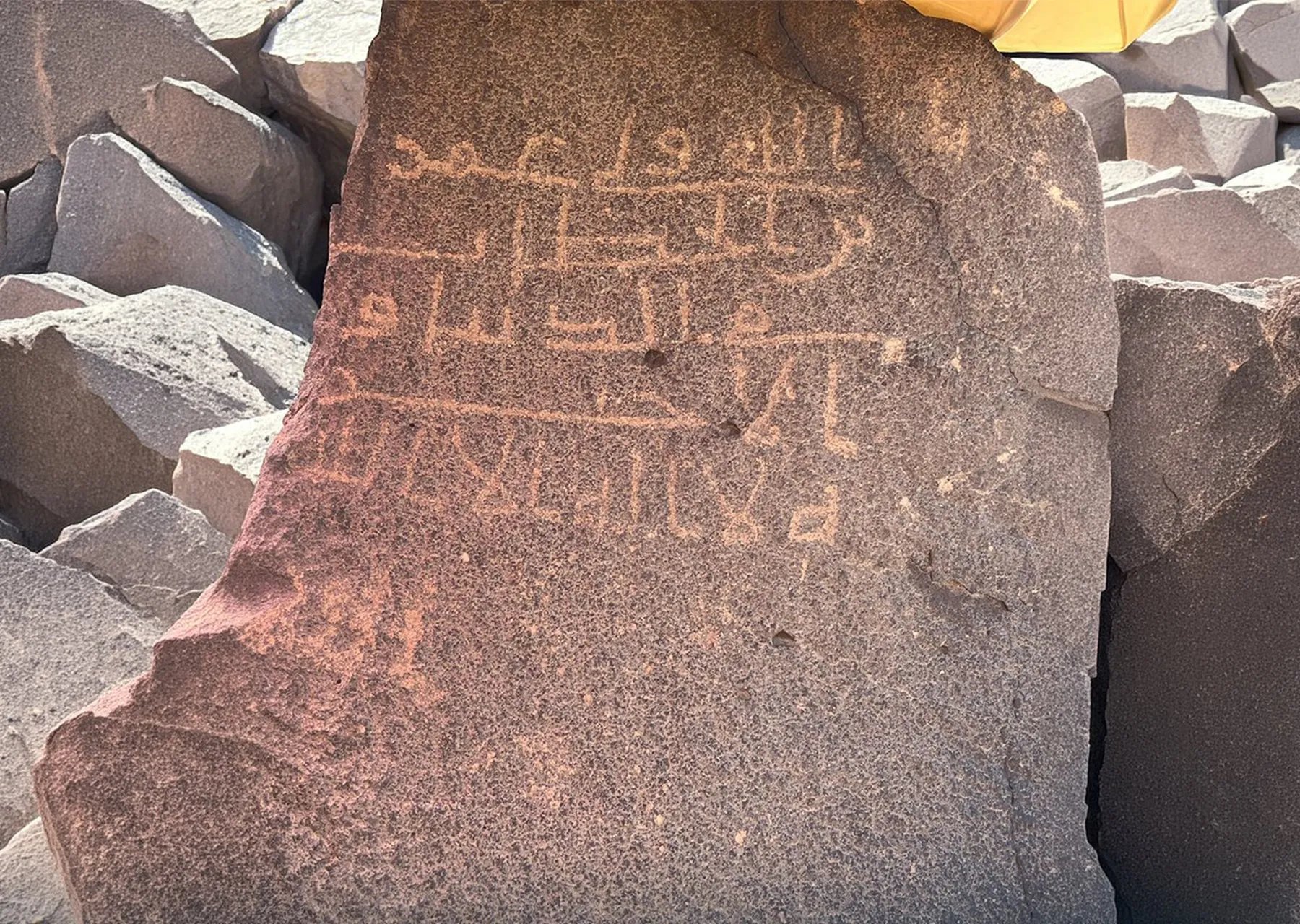
profession of faith Anṣār 132 AH

Inscription of al-Mahd naming ʿUmar ibn al-Khaṭṭāb
2nd c. AH CommemorativeClear

Inscription of al-Mahd: “God is the Protector of ʿUmar ibn al-Khaṭṭāb”

نقش المهد: «الله ولي عمر بن الخطاب»

al-Mahd, al-Madīnah region
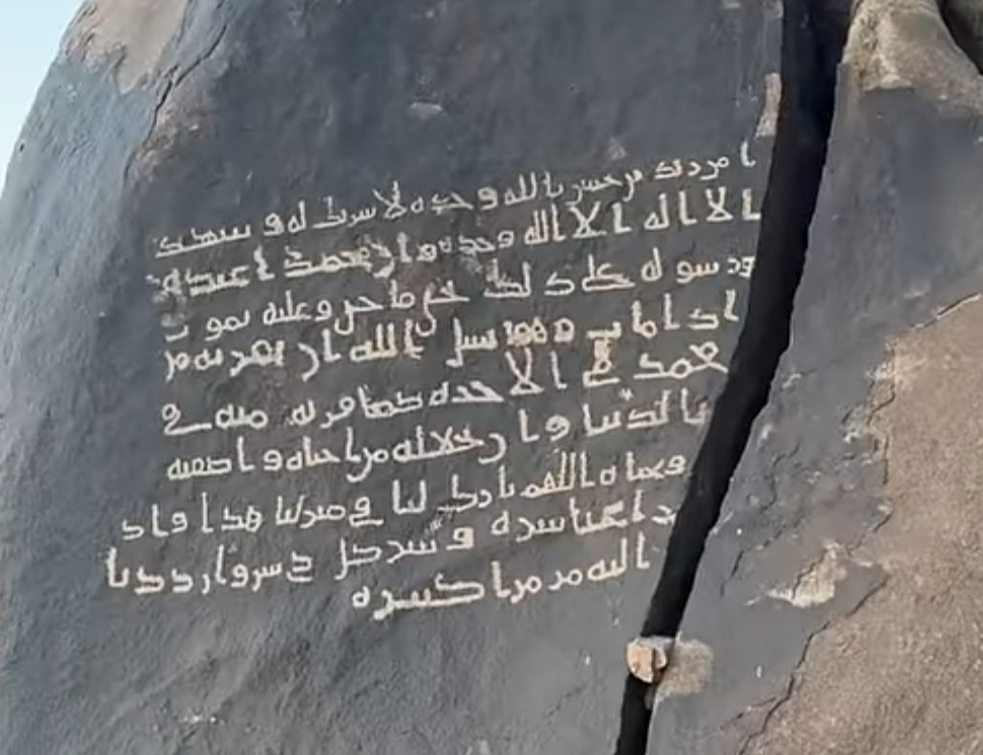
ʿUmar ibn al-Khaṭṭāb Heritage Commission undated

Rock inscription of Zayd ibn Ḥasan, al-Madīnah
c. 50–120 AH Profession of FaithLargely clear

Inscription of Zayd ibn Ḥasan: “Bless Us in This Dwelling of Ours”

نقش زيد بن حسن: «اللهم بارك لنا في منزلنا هذا»

al-Madīnah

profession of faith Zayd ibn al-Ḥasan house undated

No inscriptions match your search.

Know an early inscription that is not in the catalog? Suggest it.

Glossary

Terms used throughout this catalog's readings and commentary

Scripts

Ḥijāzī
The early, somewhat cursive Arabic hand used in most rock inscriptions in this catalog, native to the Hijaz region of western Arabia.
Kūfī
A more angular, monumental script, seen here in the Dome of the Rock's inner octagon mosaic (no. 12) and in the gilded mosaic of the Baysān market gate (no. 93).
Makkī
A Meccan script variant, used in the three inscriptions of ʿUthmān ibn Wahrān (nos. 25–27).
Paleo-Arabic
The pre-Islamic phase of the Arabic script, before the Ḥijāzī hand of the Islamic period; used in the inscriptions of Ḥanẓalah (QMI-PRE-001) and ʿAbd Shams (QMI-PRE-002).
Madanī
A Medinan script variant, used in the inscription of al-Ḥārith ibn al-Muṭṭalib (no. 19).

People & Titles

mawlā (pl. mawālī)
A client or affiliate bound to a patron by a formal tie of loyalty or manumission — one of the most common relationships recorded in this corpus.
fatā
"Young man"; used like mawlā to denote a client or dependent (no. 37).
kunyah
A name of the form Abū/Umm + child's name ("father/mother of..."), used instead of or alongside a given name.
Amīr al-Muʾminīn
"Commander of the Faithful," the standard caliphal title used throughout this corpus to date texts by a ruler's reign.
al-Fārūq
Epithet of the caliph ʿUmar ibn al-Khaṭṭāb, "the one who distinguishes truth from falsehood" (no. 54).
ghuzāt ahl al-Madīnah
"The military expedition of the people of Medina," a phrase read in the inscription of Abū Bakr (QMI-INS-000) and linked by its editors to the expedition to Tabūk (Q 9:120).
taṣdīq
A second person's added endorsement to someone else's inscription, confirming its truth (no. 31).

Religious & Formulaic Language

basmalah
The opening formula "In the name of God, the Merciful, the Compassionate," bismillāh al-raḥmān al-raḥīm.
bismika Allāhumma / bismika rabbanā
"In your name, O God" / "In your name, our Lord": pre-Islamic opening invocations, used before the basmalah became standard. At al-Ḥudaybiyya the Qurayshi negotiator asked for bismika Allāhumma in place of the basmalah (QMI-PRE-001, QMI-PRE-002).
taḥmīd
Praising God, especially the phrase al-ḥamdu lillāh ("praise be to God").
takbīr
Declaring God's greatness, Allāhu akbar ("God is greater").
tasbīḥ
Glorifying God, subḥān Allāh ("glory be to God").
Āyat al-Kursī
"The Throne Verse," Qurʾān 2:255, considered the greatest verse in the Qurʾān per a hadith in Ṣaḥīḥ Muslim; quoted or echoed in nos. 41 and 55.
shafāʿah
Intercession, especially the Prophet Muḥammad's intercession for believers on the Day of Judgment (no. 23).
ṭāghūt
A Qurʾanic term for a false god or idol — whatever is worshipped instead of God (no. 44).
riḍā
God's good pleasure or contentment, the object of several "O God, be pleased with..." prayers (nos. 16, 35).
āmīn formula
A closing convention inviting any future reader who says "āmīn" aloud to share in the inscription's prayer — found across many entries in this catalog.

Epigraphic & Orthographic Terms

iʿjām (diacritical dots)
Dots added to distinguish letters that share the same base shape (e.g. bāʾ/tāʾ/thāʾ). Rare and inconsistent in this corpus; no. 30 is a notable exception.
tāʾ mabsūṭah ("open tāʾ")
Spelling the feminine ending -ah with an open tāʾ (ت) rather than the tied tāʾ (ة) — an archaic orthographic habit seen throughout this corpus, inherited from pre-Islamic Nabataean script.
alif omission
The common early habit of dropping a medial or final alif in writing (e.g. qatlā written without its alif) — seen in many entries here.
word split across lines
A physical carving convention, not a spelling error: the stonecutter continued a single word onto the next line when the rock surface ran out of space (e.g. entry no. 9's "a-" / "llāhumma").
dating by event vs. by year
Two coexisting early Islamic dating conventions — naming a historical event ("the year ʿUmar died," "the year the Sacred Mosque was rebuilt") versus a numbered Hijri year — sometimes combined in a single inscription (e.g. no. 17).
pl.
"Plate," an abbreviation used in this catalog's source citations to reference a numbered illustration in the cited publication.

This Catalog

facsimile
A scholarly line drawing of an inscription, faithful to the original. Shown when no photograph is available (e.g. nos. 7, 31, 41, 44, 51).
QMI-INS-XXX
This catalog's own unique identifier for each inscription, used in its "How to cite" citation. Inscriptions added after publication take the number of the inscription before them plus a letter (e.g. QMI-INS-003a), so that every number stays fixed.
Hijri (AH)
"After the Hijrah," the Islamic lunar calendar era used to date every inscription in this catalog, beginning 622 CE.

Index of Names

Caliphs, Companions, scribes, and other individuals named across this catalog's 161 inscriptions

Rulers Named in the Inscriptions

Marwān ibn al-Ḥakam
Governor of Medina for Muʿāwiyah, later caliph (r. 64–65 AH); addressee of the caliph’s letter —
ʿUmar [ibn al-Khaṭṭāb]
2nd caliph, named only as "ʿUmar" in no. 1 and "al-Fārūq" in no. 54, and, on the publishers’ reading, as the unnamed “Commander of the Faithful” whose killing dates no. 2a; the patronymic is a scholarly identification, not in the text itself — , , ,
[ʿUthmān] ibn ʿAffān
3rd caliph, named only by patronymic ("ibn ʿAffān") in no. 2; named in full, "ʿUthmān ibn ʿAffān," in no. 4a, which curses his killers — ,
Muʿāwiyah [ibn Abī Sufyān]
1st Umayyad caliph, named only as "ʿAbdallāh Muʿāwiyah, Commander of the Faithful" in nos. 7a and 9, and as sender of the letter no. 7b; the patronymic is a scholarly identification in those texts, but he is named in full, “Muʿāwiyah ibn Abī Sufyān”, as the patron of Saʿīd ibn Dhakwān in no. 9a — , ,
al-Walīd [ibn ʿAbd al-Malik]
Named only as "al-Walīd" in no. 28; the patronymic is inferred from the title "son of the Commander of the Faithful" given in the text, not spelled out —
Sulaymān [ibn ʿAbd al-Malik]
Named only as "Sulaymān, Commander of the Faithful" in no. 45; the patronymic is inferred from context (the Umayyad house), not stated in the text —
Yazīd [ibn ʿAbd al-Malik]
Named only as "ʿAbdallāh Yazīd, Commander of the Faithful" in no. 55s; the patronymic is inferred from context (the Umayyad house and the palace at al-Muwaqqar), not stated in the text —
Hishām [ibn ʿAbd al-Malik]
Umayyad caliph (r. 105–125 AH), named as “the servant of God Hishām, Commander of the Faithful” in the foundation text of Qaṣr al-Ḥayr al-Sharqī in the pool inscription, in the Andarīn tax letter (as the father of the emir Muʿāwiya) as the awarder of a meadow in the al-ʿUlā text as the father of Umm Salamah in her travelling prayer, and as the caliph whose death dates the prayer of Jābir ibn Abī al-Khaṭṭāb — , , , , ,
ʿAbd al-Malik [ibn Marwān]
Umayyad caliph, named as “the servant of God ʿAbd al-Malik, Commander of the Faithful” in the road inscription at ʿAqabat Fīq and on his milestones in Palestine and the Golan; his name, almost certainly carried by the line cut from the copper plaques of the Dome of the Rock, no longer survives there — , , , , , , , , ,
Marwān [ibn Muḥammad]
Last Umayyad caliph, named in the commentary as the ruler of the caliphate in which the inscription was written —
Yazīd [III, ibn al-Walīd]
Umayyad caliph (r. 126 AH), named as “the servant of God Yazīd, Commander of the Faithful” on a glass raṭl weight of 126 AH —
ʿAbdallāh al-Maʾmūn
ʿAbbāsid caliph (r. 198–218 AH); his name and the date Rabīʿ al-Ākhir 216 AH were added to the Umayyad copper plaques of the Dome of the Rock, in place of a line cut away — ,
Abū Isḥāq [al-Muʿtaṣim] ibn al-Rashīd
Brother of al-Maʾmūn and governor in whose term the copper plaques were altered (216 AH); later caliph (r. 218–227 AH) — ,
al-Rashīd [Hārūn]
Named as father of al-Maʾmūn’s brother Abū Isḥāq in the added lines of the copper plaques — ,
Muʿāwiya [ibn Hishām]
Umayyad prince, son of the caliph Hishām; named as “the emir Muʿāwiya, son of the Commander of the Faithful” in the tax letter from Andarīn (identification by Hoyland) —

Companions & Their Households

Yazīd ibn Muʿāwiyah ibn Ḥazn [ibn al-Muḥajjal]
Subject of two prayers for mercy, both made in his lifetime, one of them east of Najrān; probably Yazīd ibn al-Muḥajjal of Banū al-Ḥārith ibn Kaʿb, who came to the Prophet with the delegation of Najrān in 10 AH (Ibn Saʿd) — ,
Saʿīd ibn al-ʿĀṣ
Qurashī governor of Kufa and Medina (d. c. 59 AH), signature (before 59 AH) — ; named as patron of a client in 110 AH —
ʿAbdallāh ibn ʿAlqamah [ibn al-Muṭṭalib]
Identified by the Desert Team as a Qurashī of Banū l-Muṭṭalib who accepted Islam late —
Abū Masʿūd [al-Badrī]
Named by kunya alone; identified by the Desert Team as ʿUqbah ibn ʿAmr, whose detention dates the text —
Ḥanẓalah [ibn] ʿAbd ʿAmr
Author of the Paleo-Arabic inscription near al-Ṭāʾif; probably, though not certainly, the Companion killed at Uḥud in 3 AH —
ʿUrwah ibn al-Zubayr
Tābiʿī jurist, one of the "Seven Jurists of Medina"; named as patron in no. 21 and as ancestor in no. 44 — ,
ʿĀʾishah
Named in no. 11; possibly ʿĀʾishah bint Abī Bakr, though not certainly —
Abū Hurayrah
Companion named as the patron (mawlā) of Muḥammad ibn Ibrāhīm ibn Nāfiʿ, 120 AH —
ʿAbdallāh ibn ʿAmr [ibn al-ʿĀṣ]
Companion and scholar, son of the conqueror of Palestine and Egypt; named as the patron of Ḥakīm, presumably this man (Lecker) —
ʿAbdallāh ibn ʿAbbās
Companion, cousin of the Prophet; named as the patron of Abū Raddād (the editor notes a possible reading ʿAbdallāh ibn ʿAyyāsh) —

Prophets

Prophet Muḥammad
Named or blessed by formula in nos. 23 and 42, and named in a prayer of forgiveness in no. 37b — , ,
Mūsā (Moses)
Invoked by name in the prayers of Qaṣr al-Kharrānah, of al-Mufaḍḍal ibn al-Ṣalt, of Ḥakīm at Ruḥeibe, of Muḥammad ibn ʿUmar ibn Ḥafṣ and of Jābir ibn Abī al-Khaṭṭāb — , , , ,
Ibrāhīm (Abraham)
Invoked by name alongside Moses in the prayer of al-Mufaḍḍal ibn al-Ṣalt —
Hārūn (Aaron)
Invoked by name alongside Moses in the Qaṣr al-Kharrānah prayer, by Muḥammad ibn ʿUmar ibn Ḥafṣ and by Jābir ibn Abī al-Khaṭṭāb — , ,

Mawālī (Clients) and Their Patrons

Ṣāliḥ ibn Yaḥyā
Client of the Commander of the Faithful, by whose hand the copper plaques of the Dome of the Rock were altered in 216 AH; not identified in the sources — ,
Saʿīd ibn Dhakwān
Client of Muʿāwiyah ibn Abī Sufyān; blessing on the Prophet and prayer to fight in God’s path —
al-Ḥajjāj, Dāwūd and Saʿīd
Clients of al-Yamān ibn Ṣadaqah ibn al-Walīd, named in his prayer —
Muḥammad ibn Kathīr ibn Abī Ḥakīm
Mawlā of Saʿīd ibn al-ʿĀṣ; prayer dated 14 Ṣafar 110 AH —
Zuhayr
Mawlā of “the daughter of Shaybah”, a woman patron named through her father —
al-Ḥārith ibn Būlī (Abū l-Walīd)
Ghulām, later mawlā, of ʿAbdallāh ibn Sibāʿ; author of three graffiti dated by events — , ,
Shurayḥ
Mawlā of Banū ʿAdī ibn Kaʿb —
Ḥabīb ibn Abī Ḥabīb
Mawlā of ʿUrwah ibn al-Zubayr —
Maymūn
Mawlā of Abū Maryam, who was himself mawlā of Rabāḥ — a two-step chain of clientage —
Abū Maryam
Mawlā of Rabāḥ, and patron of Maymūn —
Sahm
Mawlā of Abū Zurʿah —
Maḥmūd al-Abram al-Sammān
Mawlā of Yaʿmar ibn Ḥabīb —
Ṣabīḥ
Fatā (client) of Razīq ibn Amn-... —
Mukhlid ibn Abī Mukhlid
Mawlā of ʿAlī —
Ḥakīm ibn Abī Asmāʾ
Mawlā of ʿAbdallāh ibn ʿAmr ibn al-ʿĀṣ; not mentioned in any other source (Lecker) —
Abū Raddād
Mawlā of ʿAbdallāh ibn ʿAbbās; builder of the dam of Muʿāwiyah —

Kunyas

Abū ʿAbd Shams
Author of the Paleo-Arabic inscription in the Ḥismā Desert; the first word may also be read anā ("I"), and the article names him ʿAbd Shams son of al-Mughīrah —
Abū Kuthayr
Kunya of Qays the scribe, who cursed the killers of ʿUthmān —
Abū Salamah ibn ʿAbdallāh ibn ʿAbdallāh ibn ʿUmar
Author of no. 53 —
Umm Hārūn
Named at the close of the Qaṣr al-Kharrānah prayer —

Tribes, Clans & Nisbas

Banū al-Ḥārith ibn Kaʿb
Tribe of Najrān; not named in the texts, but the tribe of Yazīd ibn al-Muḥajjal according to Ibn Saʿd — ,
Khathʿam
Arabian tribe settled in Filasṭīn: ʿAbdallāh ibn ʿĀbid al-Khathʿamī, 100 AH; Ibn Rabʿiyyah al-Khathʿamiyyah at Bayt Jibrīn —
al-Duʾalī (Banū al-Duʾil of Kinānah)
Nisbah of Nūḥ ibn ʿAbd al-Raḥmān, 114 AH —
al-Thaqafī
Nisba of ʿAmr ibn Rabīʿah —
al-Laythī
Nisba of ʿAmmār ibn Jarā [Jazāʾ] —
Ahl al-Madīnah
"The people of Medina," whose military expedition (ghuzāt) Abū Bakr joined —
Quraysh
Tribe to which, the article suggests, the author of PRE-002 likely belonged; its preferred opening, bismika Allāhumma, is used there —
Banū ʿAdī ibn Kaʿb
Clan named as Shurayḥ's patrons —
al-Sulūlī
Nisba of Yazīd ibn ʿAbdallāh — ,
al-Ḥajarī
Nisba of ʿAbd al-Raḥmān ibn Khayr —
al-Ashʿarī
Nisba of Thābit ibn Yazīd —
al-Munabbihī
Nisba of Anas ibn Salamah —
Ahl Qinnasrīn
"The people of Qinnasrīn," the group accompanying Ibn al-ʿĀṣ —
al-Aslamī
Nisba of Bakr ibn Abī Bakrah —
al-Namarī
Nisba of ʿAbdallāh ibn Saʿd —
al-Ḥimṣī
Geographic nisba (from Ḥimṣ) of Muḥammad ibn Abī Ṭaybah —
al-Hāshimī
Nisba of Abū Jaʿfar ibn Ḥasan —
ʿAnazah al-Azd
Tribal group speaking collectively in no. 51 —
al-Anṣārī
Nisba of ʿAbdallāh ibn Abī Saʿīd —
Banū Ḥātim
Tribe named in the prayer from al-Naqab of Ḥasan ibn Maysarah, 117 AH —

Other Named Individuals

al-Walīd ibn ʿAbd al-Raḥmān
Official by whose hand the glass raṭl weight of Yazīd III was made, 126 AH —
al-Ḍaḥḥāk ibn Dāwūd ibn Abī Zubayr
Signs a text at Ḥismā recording that his father sent him and that he “took the inheritance of Zayd”; not identified in the biographical literature —
Zayd
Named in the phrase “the inheritance of Zayd”: either a man whose estate was being settled, or the Companion Zayd ibn Thābit, authority on the law of inheritance —
Zayd ibn [al-]Ḥasan
Writer of a profession of faith and a prayer for “this dwelling of ours” at al-Madīnah; named only as “Zayd ibn Ḥasan”, probably Zayd ibn al-Ḥasan ibn ʿAlī ibn Abī Ṭālib, great-grandson of the Prophet (d. 120 AH) —
ʿAṭāʾ ibn Mīnāʾ
Named in a prayer from Tabūk that also asks forgiveness for the Prophet; possibly the Medinan transmitter, client of Ibn Abī Dhubāb (d. 91–100 AH) —
Jābir ibn Abī al-Khaṭṭāb al-Kharajī
Prayer for forgiveness dated to the year the caliph Hishām died (125 AH), Ḥarrah, north-eastern Jordan —
al-Ḥārith ibn Khālid ibn al-ʿĀṣ
Prayer for forgiveness, Wādī Khara, al-Bāḥah —
Ismāʿīl ibn ʿAbd al-Raḥmān ibn Khālid
Grandson of Khālid ibn al-ʿĀṣ; two prayers, Wādī Khara, al-Bāḥah —
Ziyād
Writer of a prayer for Khālid ibn al-ʿĀṣ, Wādī Khara —
Muḥammad ibn ʿUmar ibn Ḥafṣ
Prayer for repentance, Rawāwah, 114 AH —
ʿUthmān ibn ʿUbaydallāh ibn ʿAbdallāh ibn ʿUmar
Declaration of faith, Rawāwah, 120 AH —
Saʿīd ibn ʿAbd al-Malik
Son of the caliph ʿAbd al-Malik and governor of Palestine, who ordered the bronze weight of Baysān, c. 125–126 AH —
Abū Muḥammad ʿAmr ibn Rāfiʿ
Asks his Lord’s good pleasure, Rabīʿ al-Ākhir 44 AH —
Musāwir
Client (mawlā) of the Commander of the Faithful, at whose hands the milestones of Fīq were made, 85 AH — ,
Nawfal ibn Qays
Prayer for travellers on the pilgrim road, al-ʿUlā —
ʿAbdallāh ibn ʿĀmir ibn Rabīʿah al-ʿAnazī
Ally of Banū ʿAdī ibn Kaʿb; b. 6 AH, d. c. 85 AH; text beside Ibn Muṭīʿ, Ḥismā —
ʿAbdallāh ibn Muṭīʿ al-ʿAdawī
Qurashī of Banū ʿAdī; led al-Madīnah at al-Ḥarrah (63 AH); d. 73 AH —
Thawābah ibn ʿUthmān al-Ṣarmī
Prayer for forgiveness, Wādī Salma, 105 AH —
ʿAbbāsah bint Jurayj ibn Sanad
Gravestone, Aswān, d. 14 Dhū al-Qaʿdah 71 AH (as written) —
Fāṭimah bint al-Ḥasan
Gravestone, Aswān, d. 1 Shaʿbān 102 AH —
Saʿīd ibn ʿUthmān ibn ʿAffān
Son of the caliph ʿUthmān (?); governor of Khurāsān for Muʿāwiyah, 56–57 AH; signature at Ḥismā —
ʿAbd al-Raḥmān ibn Khaṭṭāb
Profession of faith north of al-Madīnah, 132 AH; of the family of Kaʿb ibn Mālik al-Anṣārī, per the publisher —
ʿAbd al-Raḥmān ibn Sulaymān
Prayer for refuge, east of al-Madīnah, 130 AH —
Shihr
Writer of the prayer for Khālid ibn Ghannām, Najrān, 123 AH —
Khālid ibn Ghannām
Prayer for mercy, Najrān, 123 AH —
Rāfiʿ ibn Sālim
Prayer for himself, his parents and his siblings, 127 AH; perhaps brother of Saʿīd ibn Sālim (no. 55q) —
Khālid ibn al-ʿĀṣ ibn Hishām al-Makhzūmī
Companion, governor of Mecca for ʿUmar and ʿUthmān; father of ʿAbd al-Raḥmān and al-Ḥārith —
Ḥafṣ ibn ʿAbdallāh; Ḥafṣ
Jabal Usays: prayer for Ḥafṣ ibn ʿAbdallāh, 113 AH — ; profession of faith signed by Ḥafṣ, 119 AH, possibly the same man —
Jarīr
Commended by Muʿāwiyah to Marwān ibn al-Ḥakam, governor of Medina —
Hilāl
Named first in a prayer from a cave house at Bayt Jibrīn —
Ibn Rabʿiyyah al-Khathʿamiyyah
Writer of the Bayt Jibrīn prayer, known by his mother of Khathʿam —
al-Yamān ibn Ṣadaqah ibn al-Walīd
Grandson of the caliph al-Walīd ibn ʿAbd al-Malik; undated prayer, early 2nd century AH —
ʿAbd al-ʿAzīz ibn al-Ḥārith ibn al-Ḥakam
Nephew of Marwān ibn al-Ḥakam; possibly the secretary of Sulaymān ibn ʿAbd al-Malik; prayer at Khirbat Nitil, c. 100 AH —
Nūḥ ibn ʿAbd al-Raḥmān ibn Mālik al-Duʾalī
Prayer for forgiveness, 114 AH —
Salamah
Author of the signature dated “three and twenty” near Yanbuʿ al-Nakhl —
ʿAmr ibn Rabīʿah al-Thaqafī
Dated his text by “the year of Ifrīqiyah” —
ʿAmmār ibn Jarā [Jazāʾ] al-Laythī
Dated his text by “the year of the conquest of the sea” —
Abū Bakr
Named by kunya alone in an undated early inscription from Ḥismā; possibly, but not certainly, Abū Bakr al-Ṣiddīq —
Qays al-Kātib
"Qays the scribe," Abū Kuthayr; author of the graffito near Taymāʾ that curses the killers of ʿUthmān —
ʿAbd al-ʿUzzā ibn Sufyān
Author of the second Paleo-Arabic inscription carved below Ḥanẓalah's, discussed in its commentary —
al-Mughīrah
Named by the article as the father of ʿAbd Shams —
ʿAbdallāh ibn Muslim
Client (mawlā) of ʿAmr ibn ʿUthmān al-Makkī; author of the profession of faith at Ḥismā, 110 AH —
Ward ibn Sālim
Author of the prayer for forgiveness in al-Naqab, 119 AH —
al-Mufaḍḍal ibn al-Ṣalt ibn al-Mukhāriq
Named in a prayer for mercy at Najrān, 130 AH; also named in no. 55aa (110 AH) —
al-Ḥārith ibn Ṣāghir
Author of the prayer for forgiveness at Qārat al-Nayṣah, 121 AH —
al-Mufaḍḍal ibn al-Ṣalt
Author of the prayer invoking the Lord of Moses and Abraham, Najrān region, 110 AH; perhaps a brother of al-Rammāḥ ibn al-Ṣalt —
al-Rammāḥ ibn al-Ṣalt
Author of two prayers for mercy in the Najrān region, 109 and 110 AH — ,
ʿUmar ibn ʿUthmān
Author of the prayer for martyrdom at Ghadīr Rawāwah, 131 AH —
ʿAbdallāh ibn ʿUmar ibn Ḥafṣ
Subject of the prayer for repentance, 121 AH; possibly of the ʿUmarī family (cf. nos. 55, 55e) —
ʿUmar ibn Rabīʿah
Author of the profession of faith rejecting al-ṭāghūt, Ṣafar 117 AH —
ʿAbd [al-ʿAzīz] ibn Abī [al-ʿ…]
Author of the profession of faith in Bilād Thumālah, Shaʿbān 109 AH (name partly broken) —
Khālid ibn Nuʿaym
Author of the prayer for forgiveness at Taymāʾ, 102 AH —
Yaḥyā ibn al-Ḥakam
Overseer of the road works at ʿAqabat Fīq for ʿAbd al-Malik, 73 AH —
Saʿīd ibn Sālim
Traveller on his way to the ʿUmrah, 127 AH —
ʿAbdallāh ibn Mundhqān
Traveller at Jabal al-Aqraʿ, 132 AH —
Sulaym ibn ʿUbayd
Overseer of the work at Qaṣr al-Ḥayr al-Sharqī, 110 AH —
Khaṭṭāb ibn Ḥajar al-ʿAmmī then al-Ṣakhrī
Writer at Cnidus, 98 AH —
Yazīd ibn ʿAbdallāh
Writer of the Fātiḥah inscription, 130 AH —
al-Qāsim ibn Hilāl al-Muj[...]
Remembered in the ʿAnjar inscription, Rajab 123 AH —
Ibrāhīm ibn Jamīl ibn ʿAbd al-Raḥmān
The muezzin; author of the exhortation of Rajab [90] AH —
Muḥammad ibn Ibrāhīm ibn Nāfiʿ
Client of Abū Hurayrah; author of the prayer of 120 AH —
ʿAbdallāh ibn ʿĀbid al-Khathʿamī
Author; “of the people of Palestine”, 100 AH —
Muḥammad ibn Sayyār
Witness in the Jabal Thawr inscription, 122 AH —
Sulaymān ibn Maḥmūd
Author of the prayer for forgiveness at Petra, 109 AH —
ʿAbdallāh ibn Sulaym
Builder of the reservoir at al-Muwaqqar for Yazīd II, 105 AH —
Muḥammad ibn ʿAbdallāh ibn ʿAbd al-Malik
Author of the attested profession of faith on Jabal Thawr, 122 AH —
Ḥafṣ ibn ʿUmar
Prayed for, with all the people of Taymāʾ, in Ramaḍān 108 AH —
al-Haytham ibn Ziyād
Remembered in two prayers from the Najrān region, of Rajab and of Ramaḍān 108 AH — ,
[Ziyād] ibn Dhakwān
Author of the Tanūmah inscription of 105 AH —
Jaʿfar ibn Muḥammad
Author of the testament of Shaʿbān 110 AH; possibly Jaʿfar al-Ṣādiq —
ʿAbdallāh ibn Saʿīd
Remembered in the prayer for mercy of Ramaḍān 103 AH —
ʿAbdallāh
Author of the dual-dated inscription of 30 AH —
ʿAbd al-Malik ibn ʿUmar
Author of the long Qaṣr al-Kharrānah prayer —
ʿAbd al-Raḥmān ibn Khālid ibn al-ʿĀṣ
Subject of no. 5 (40 AH); author of no. 4cb —
ʿAbd al-Raḥmān ibn Khayr al-Ḥajarī
Subject of the oldest dated Islamic gravestone —
ʿAbd al-Raḥmān ibn Sufyān ibn ʿAmr
Subject of no. 35 —
ʿAbd al-Raḥmān ibn Muʿammar
Writer of the Qurʾānic inscription (Q 33:56) at al-Madīnah, 132 AH —
ʿAbdallāh ibn Abī ʿArīḍ
Author of no. 31, later endorsed by a second scribe —
ʿAbdallāh ibn Abī Saʿīd al-Anṣārī
Author of no. 52 —
ʿAbdallāh ibn Dīrām
Subject of no. 7, whose prayer was later vandalized —
ʿAbdallāh ibn ʿImārah
Author of no. 33 —
ʿAbdallāh ibn Saʿd al-Namarī
Author of no. 36; four-generation genealogy recorded —
Yazīd al-Naqqāsh
Engraver; author of the long profession of faith dated Ramaḍān 88 AH —
Umm Salamah bint Hishām
Daughter of the caliph Hishām; author of a travelling prayer —
ʿAbdallāh ibn Ṣakhr
Builder of the Ṭāʾif dam —
Abū Jaʿfar ibn Ḥasan al-Hāshimī
Author of the corpus's one poetic inscription —
ʿAlī ibn ʿAbdallāh
Author of no. 41, quoting Āyat al-Kursī —
ʿAmr
Subject of no. 16; prayed for by his likely son, Yaḥyā ibn ʿAmr —
ʿAmr ibn Khabbāb
Composed the dedicatory text of the Ṭāʾif dam inscription —
Anas ibn Salamah al-Munabbihī
Named alongside ʿUmar ibn Ṭarīf in no. 15 —
ʿĀṣim ibn ʿUmar ibn Ḥafṣ
Author of two dated texts at Rawāwah, 100 and 121 AH —
Bakr ibn Abī Bakrah al-Aslamī
Author of no. 23, an early prayer for prophetic intercession —
Farqad ibn Nāfiʿ
Author of no. 42 —
Ḥakīm ibn ʿAlī ibn Hubayrah
Subject of no. 8 —
Ḥakīm ibn ʿImārah
Author of no. 34 —
al-Ḥārith ibn al-Muṭṭalib
Subject of no. 19 —
[Ibn al-ʿĀṣ]
Author of the eroded no. 18; full name lost —
al-Mughīrah ibn ʿUmar
Author of no. 39 —
Mughīrah(?) ibn Saʿd
Named in no. 15; reading of this name is uncertain —
Muḥammad ibn Abī Ṭaybah al-Ḥimṣī
Author of no. 45, dated by a caliph's pilgrimage —
Muḥammad ibn Ibrāhīm
Second endorser of no. 31 —
Qāsim
Subject of no. 50 —
Rabāḥ ibn Ḥafṣ ibn ʿĀṣim
Author of nos. 43 and 54 — ,
Suwayd ibn Samurah
Proposed reading for the damaged opening of no. 32 —
Thābit ibn Abī Tamīm
Author of no. 48, identified as a jar-maker —
Thābit ibn Yazīd al-Ashʿarī
Subject of the Ḥafnat al-Abyaḍ inscription —
ʿUmayr [ʿUfayr?]
Whose return dates no. 3a —
ʿUfayr ibn al-Muḍārib
Author of no. 30 —
ʿUmar ibn ʿAbdallāh ibn ʿUrwah
Author of no. 44 —
ʿUmar ibn Ṭarīf ibn al-Ḥārith
Subject of the collective prayer no. 15 —
ʿUmayr ibn Abī Muslim
Subject of no. 24, son of a martyr —
Umayyah ibn ʿAbd al-Malik
Author of two Qurʾanic inscriptions, nos. 46–47 — ,
ʿUthmān ibn Wahrān
Author of three Qurʾanic inscriptions, nos. 25–27 — , ,
Yaḥyā ibn ʿAmr
Scribe of no. 16, likely ʿAmr's son —
Yazīd ibn ʿAbdallāh al-Sulūlī
Author of nos. 3 and 3b — ,
Zuhayr
Author of two of the oldest dated Islamic inscriptions, nos. 1–2, and probably of an undated signature naming his patron, no. 1a — , ,
ʿAwsajah
Beneficiary of the caliph Hishām’s award of a meadow at al-ʿUlā —

Qurʾanic Quotations

The thirty-five inscriptions in this catalog that quote or echo the Qurʾān

Verses are listed in Qurʾanic (muṣḥaf) order, with the inscription(s) that quote each one noted alongside.

Sūrat al-Fātiḥah 1:1–7 (in full)
Sūrat al-Baqarah 2:21
Sūrat al-Baqarah 2:117
Sūrat al-Baqarah 2:127 (echoed)
Sūrat al-Baqarah 2:136
Sūrat al-Baqarah 2:255 (Āyat al-Kursī, opening)
, ,
Sūrat al-Baqarah 2:256 (echoed)
Sūrat al-Baqarah 2:257 (echoed)
Sūrat Āl ʿImrān 3:18–19
Sūrat Āl ʿImrān 3:26
Sūrat al-Nisāʾ 4:87
Sūrat al-Nisāʾ 4:171–172
Sūrat al-Māʾidah 5:47
Sūrat al-Anʿām 6:163
Sūrat al-Aʿrāf 7:122; al-Shuʿarāʾ 26:48 (“Lord of Moses and Aaron”)
, , ,
Sūrat Hūd 11:47 (echoed)
Sūrat Hūd 11:73
Sūrat al-Ḥijr 15:80–83 (echoed)
Sūrat al-Isrāʾ 17:111
Sūrat Maryam 19:15, 34–36
Sūrat Ṭā Hā 20:130
Sūrat al-Ḥajj 22:7
Sūrat al-Nūr 24:35
Sūrat al-Aḥzāb 33:56
, ,
Sūrat al-Aḥzāb 33:61 (echoed)
Sūrat Ṣād 38:26
Sūrat al-Zumar 39:14 (echoed)
Sūrat Ghāfir 40:3
Sūrat Ghāfir 40:7 (echoed)
Sūrat Ghāfir 40:16 (echoed)
Sūrat al-Shūrā 42:10 (echoed)
Sūrat Muḥammad 47:19 (echoed)
Sūrat al-Fatḥ 48:2 (“what has gone before of his sins and what is to come”)
, , , , , , , ,
Sūrat al-Wāqiʿah 56:28–40
Sūrat al-Ṣaff 61:9
Sūrat al-Taghābun 64:1
Sūrat al-Taghābun 64:10
Sūrat al-Ṭalāq 65:3
Sūrat al-Mulk 67:1
Sūrat al-Ikhlāṣ 112 (in full)
Sūrat al-Ikhlāṣ 112:2–4
,

Who Wrote These Inscriptions — and Where

The people behind the texts, and the landscape they wrote in

Isḥāq bin Qabīṣa
Governor through whom the Baysān market was built, named in the seven-line inscription —
Ḥasan ibn Maysarah
Author of the prayer in al-Naqab, dated Tuesday 23 Rabīʿ I, 117 AH —
ʿAmr ibn ʿUthmān al-Makkī
Patron (mawlā) of ʿAbdallāh ibn Muslim, named in the Ḥismā inscription, 110 AH —
Rāghim [Zāʿim?] ibn Mukhlid
Pilgrim who records passing on Friday, 1 al-Muḥarram 110, “returning from the pilgrimage”; reading of the name uncertain —
al-Layth ibn al-Dhiyāl
Governor (ʿāmil) for the emir Muʿāwiya in the province of Qinnasrīn; sender of the tax letter —
Kathīr ibn al-Ṣalt, Abū Mūsā
Supervisors of the building of the dam of Muʿāwiyah at Wādī al-Khunaq —

Most of the texts in this catalog were not commissioned by any state. They were left on the stone by ordinary people who stopped at a place and recorded their name, a prayer, and a date. Only a few are official or monumental — a dam, a building, a shrine, a gravestone. Read together, they offer a rare, first-hand picture of who was moving through Arabia and its neighbouring lands in the first Islamic century, and where they went.

Who they were

Travellers. The largest group are people on the move: merchants, messengers, soldiers, and families crossing between Syria, the Ḥijāz, and Iraq. They wrote at halting places, near water, and on rock faces that caught the eye — often on the very same surfaces where others had written before them, so that a single rock can carry names from several decades.

Pilgrims. The roads to Mecca carried pilgrims every year, and several inscriptions say so directly, asking God to accept a pilgrimage or recording that a group performed it together.

Clients (mawālī). Many writers describe themselves as the client of a patron, a family, or a clan. Their texts show clients as literate and mobile, and careful to record both their own names and the bonds that tied them to others.

Households and tribes. Others belong to known families of the Ḥijāz — including descendants of Companions — or name their tribe and clan. Genealogies two, three, or four generations long are carved with evident care, and some texts speak for a whole group rather than one person.

Craftsmen, scribes, and poets. Occupations are rarely stated, which makes them precious when they are: a maker of jars, the builder of a dam and the man who composed its text, a son writing a prayer for his father, and one writer who left verse rather than a prayer.

Women. Women appear seldom, but they are present — named in prayers written for them.

Rulers. A smaller set of texts is official: foundation inscriptions for works built in a caliph's or prince's name, and the monumental inscriptions of the Dome of the Rock.

Where they wrote

The landscape of the corpus is one of routes, wadis, and hills. Inscriptions cluster along the great roads — the Syrian pilgrim road, Darb Ḥismā, and Darb Zubaydah — and in the wadis around Mecca and Ṭāʾif, on the outskirts of Medina, and at sites in northern and southern Arabia. Beyond the Peninsula they reach Jerusalem, Jordan, Syria, Iraq, and Egypt. The choice of place was rarely random: a road junction, a well, a shaded rock, or a mountain pass was where people paused, and where the next traveller would see what they had written.

Every person, clan, tribe, and kunya actually named in these texts is listed, with links to the inscriptions, in the Index of Names.

Script and Orthography

Letter shapes, layout, and spelling in the early Islamic inscriptions

These inscriptions were written before Arabic spelling was fixed by grammarians and before dots and vowel signs became standard. They preserve Arabic writing as it was actually practised in the first Islamic century: its letter shapes, its spelling habits, and the way scribes fitted words onto uneven stone. This page describes what the corpus shows; the individual commentaries note the details of each text.

The scripts

Almost the whole corpus is written in the Ḥijāzī hand: a flowing, somewhat cursive script with an uneven baseline, letters of varying size, and tall uprights. It is the everyday writing of the Arabian Peninsula, used by travellers and residents alike. A few texts are classed more narrowly as Makkī (Meccan) or Madanī (Medinan) — local variants of the same tradition, such as the Qurʾanic inscriptions of ʿUthmān ibn Wahrān near Mecca and the inscription of al-Ḥārith ibn al-Muṭṭalib in Medina.

At the other end stands Kūfī: angular, regular, and monumental, suited to architecture rather than to a traveller's quick hand. Its clearest example here is the inner mosaic band of the Dome of the Rock (72 AH), while the gravestone of ʿAbd al-Raḥmān al-Ḥajarī (31 AH) already shows a more formal, early-Kūfī tendency.

Over the century, the hands grow more assured. Some later texts are laid out with real care — even spacing between words and lines, straight uprights, and decorative curves — as in the inscriptions of al-Mughīrah ibn ʿUmar and Farqad ibn Nāfiʿ.

Carved, painted, and set in mosaic

Nearly all the texts are incised into rock. The exceptions are telling: a limestone gravestone, a painted prayer on a wall of Qaṣr al-Kharrānah, a copper band, and the gold-and-glass mosaic of the Dome of the Rock. The medium shaped the writing: a wall or a mosaic allowed long, regular lines; a boulder imposed its own shape on the text.

How long is an inscription?

Most inscriptions are short. The typical text runs to three to six lines, and the median is five: a name, a prayer, and a date. The shortest is the inscription of Ṣabīḥ (90 AH) — just two lines, giving his name, his patron, and the year.

The longest are the two mosaic bands of the Dome of the Rock, each of 24 lines — official, architectural texts on a scale no traveller could match. Among rock inscriptions, the longest reach 13 lines: the prayer at Ḥafnat al-Abyaḍ in Iraq (64 AH) and the second, extended prayer of Rabāḥ ibn Ḥafṣ (100 AH). Length usually follows purpose: a signature is short, while a Qurʾanic quotation or an elaborate prayer spreads across the stone.

Lines and divided words

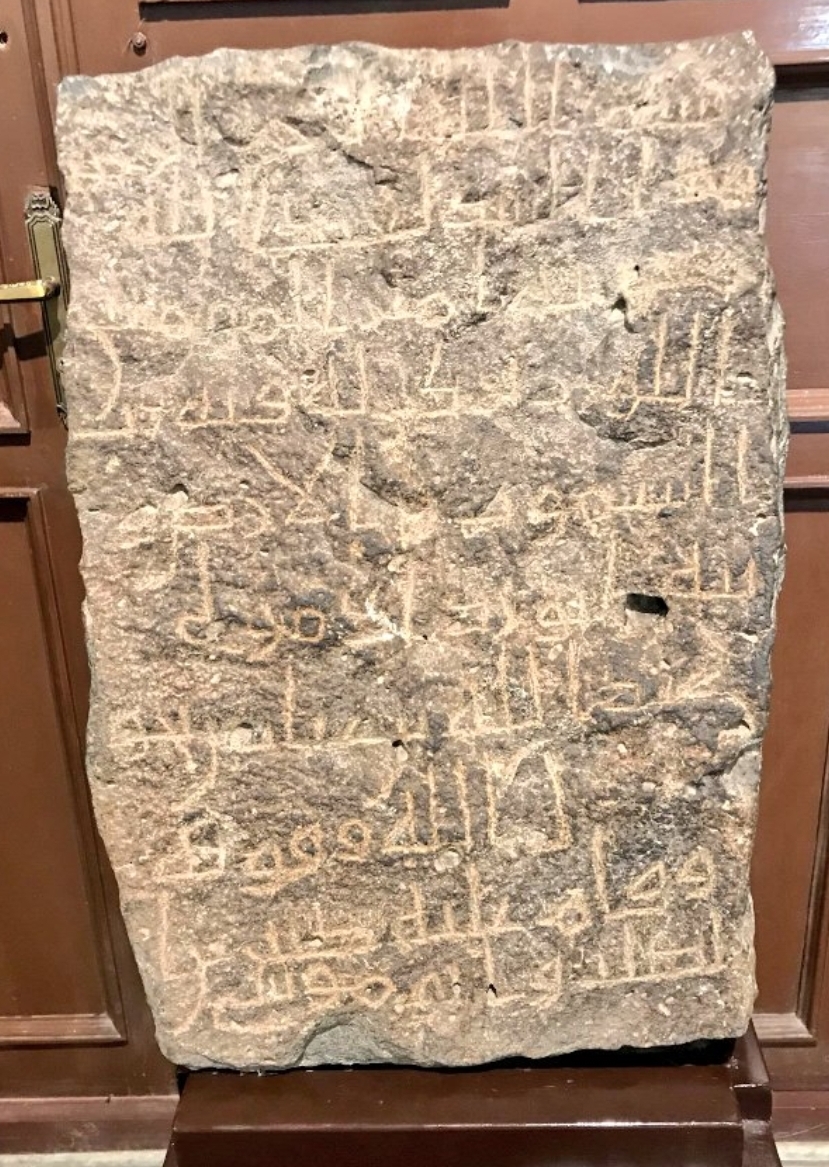
A scribe working on rock wrote until the usable surface ran out, then carried on at the start of the next line — even in the middle of a word. So a single word is often split between two lines. On the Ṭāʾif Dam the word اللهم is divided as ا / للهم; al-Mughīrah writes his own name as ا / لمغيرة; and in the inscription of ʿAbdallāh ibn Dīrām even the number forty is broken, وأر / بعين. These divisions follow the stone, not the grammar, and this catalog keeps them exactly as they appear, line by line.

Spelling

The spelling of these texts often differs from later standard Arabic, in ways that recur across the corpus and match the consonantal spelling of early Qurʾān manuscripts:

Alongside these regular habits there are plain slips — a transposed letter in الملائكة, or a Qurʾanic verse quoted from memory with a word changed. They remind us that these were personal texts, written quickly and far from any teacher or copyist.

For the gradual appearance of dots and the marks used to distinguish letters, see Dotting and Vocalization.

Write in Early Rasm

Type an Arabic phrase and see it as the first-century scribes wrote it: without dots, on stone
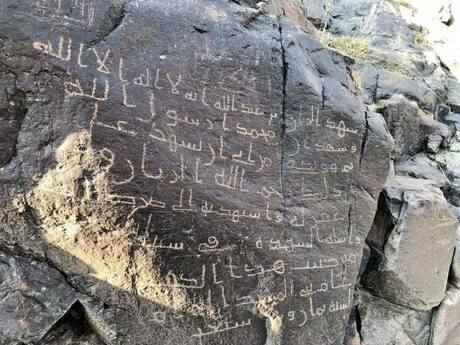
Try:
Download the QMI Hijazi font (TTF) QMI Hijazi (v2.0, experimental) is drawn from Ahmed W. Shaker’s hand studies of four dated inscriptions in this catalog — ʿUthmān’s Appointment (no. 2, 24 AH), ʿAbd al-Raḥmān ibn Khālid (no. 5, 40 AH), the Ṭāʾif Dam (no. 9, 58 AH) and Ḥafnat al-Abyaḍ (no. 10, 64 AH). One hand gives the whole font a single, consistent ductus; each letter keeps the structure seen on the stones, written as an even, monoline stroke. Comments and corrections are welcome. The Kufic and Naskh styles use modern typefaces.

Index of Hijri Months

The months named in the dated inscriptions

Thirty inscriptions in the catalog name a Hijri month alongside the year. Ten months occur. Several carry particular weight in the Islamic calendar: Muḥarram and Dhū al-Qaʿdah are among the sacred months in which fighting was forbidden. On how the inscriptions record their dates, see Dating Methods.

Muḥarramمحرّم
no. 7, no. 14a, no. 40
Ṣafarصفر
no. 55aaa, no. 55v
Rabīʿ Iربيع الأول
no. 55va
Rabīʿ al-Ākhirربيع الآخر
no. 32, no. 55r
Jumādā / Jumādā al-Ākhirahجمادى / جمادى الآخرة
no. 3, no. 4, no. 35, no. 36, no. 48, no. 55c, no. 55i, no. 55q
Rajabرجب
no. 37a, no. 55d, no. 55l
Shaʿbānشعبان
no. 50, no. 55b, no. 55u
Ramaḍānرمضان
no. 55a, no. 55e, no. 55f
Shawwālشوّال
no. 10, no. 41, no. 42
Dhū al-Qaʿdahذو القعدة
no. 15, no. 38

Phraseology

Opening formulas of the early Islamic inscriptions

The opening formulas of an inscription are the quickest guide to what it is about. They reveal its subject, clarify its meaning, and place it in its historical setting. They also mirror the religious and social concerns of the communities that produced them, and the spiritual and cultural outlook of their day. The recurrence of the same phrases across many inscriptions shows how widely they were used, and in which settings — a commemorative record, a prayer, or the documentation of a particular person. The principal formulas are listed below, with the inscriptions in which each occurs.

بسم الله / بسم الله الرحمن الرحيمThe basmalah

The most common opening of all, in its short form “In the name of God” or its full form “In the name of God, the Merciful, the Compassionate.” It ties the act of writing to invocation and blessing, and its wide spread shows it was already a basic part of written culture.

Found in: no. 1, no. 4, no. 10, no. 12, no. 28, no. 34, no. 51, no. 52

أنا فلان / وكتب فلانSelf-identification

The writer introduces himself — “I am so-and-so” or “and so-and-so wrote [this]” — whether to announce his role in carving the text, to record his presence at the place, or to authenticate what he wrote.

Found in: no. 1, no. 2, no. 6, no. 21, no. 22, no. 32, no. 39

اللهم اغفرPrayer for forgiveness

Among the most frequent formulas: “O God, forgive…” expresses hope for divine pardon, especially in commemorative inscriptions, often as a prayer for the dead.

Found in: no. 7, no. 8, no. 9, no. 10, no. 19, no. 24, no. 36, no. 38, no. 50, no. 52

اللهم عافِPrayer for well-being

“O God, grant well-being…” asks for health and safety, in personal or commemorative settings.

Found in: no. 43, no. 54

اللهم ارضَPrayer for God's good pleasure

“O God, be pleased with…” seeks God's contentment, usually in a devotional setting.

Found in: no. 16, no. 35

بالله آمنDeclaration of faith

“[He] believed in God” — a formula of strong doctrinal weight, used to profess faith and God's oneness.

Found in: no. 18

عفا اللهPrayer for pardon

“May God pardon…” asks forgiveness and indulgence, whether for the writer himself or for another person named in the text.

Found in: no. 20

ترحّم الله / رحمت اللهPrayer for mercy

Prayers for mercy take more than one form: “May God have mercy” (ترحّم الله) in no. 3, and “The mercy of God” (رحمت الله) in nos. 5 and 48 — usually in commemorative settings.

Found in: no. 3, no. 5, no. 48

Historical Context

Events and developments surrounding the inscriptions, 24–100 AH

The years between 24 and 100 AH saw profound change across Arabia, Syria, Egypt, Palestine, and Iraq. The inscriptions in this catalog were carved against this backdrop — and a few of them name the events of their day outright.

From the Rightly Guided Caliphs to Umayyad Rule

The period opens with the assassination of the caliph ʿUmar ibn al-Khaṭṭāb in 23 AH and the accession of ʿUthmān ibn ʿAffān in 24 AH. Both moments are recorded on stone by the same man: Zuhayr dated his first inscription “at the time ʿUmar died,” and his second “at the time ibn ʿAffān was appointed” — two primary witnesses, carved the year the events took place.

Political turmoil followed, ending in ʿUthmān's killing in Medina in 35 AH and the outbreak of the first civil war: the Battle of the Camel (36 AH), the Battle of Ṣiffīn (37 AH), the arbitration, and the emergence of the Khawārij in 38 AH. ʿAlī ibn Abī Ṭālib was killed in 40 AH, and in 41 AH Muʿāwiyah ibn Abī Sufyān took power in what became known as the Year of Unity (ʿĀm al-Jamāʿah). Seventeen years later, the Ṭāʾif Dam inscription (58 AH) names him directly as “ʿAbdallāh Muʿāwiyah, Commander of the Faithful.”

Damascus and the Expansion of the State

From 41 AH Damascus served as the capital of the Umayyad state, and grew into an administrative and architectural centre for decades. The conquests continued east and west: the whole of Persia by 50 AH, Khurāsān and Transoxiana by 80 AH, and North Africa by 89 AH. An inscription on Darb Ḥismā (QMI-INS-002b) is dated to “the year of Ifrīqiyah” — a campaign remembered well enough to name a year by (see Dating Methods). Within the catalog, the inscription of Ibn al-ʿĀṣ (78 AH) names its party as “people of Qinnasrīn,” one of the garrison districts of northern Syria.

Iraq

In Iraq, new cities were founded to anchor Muslim rule: Baṣra in 14 AH and Kūfa in 17 AH, which grew into military, administrative, and scholarly centres. In 83 AH al-Ḥajjāj ibn Yūsuf al-Thaqafī founded Wāsiṭ as an administrative and military base for controlling the province. The catalog's one Iraqi entry, the Ḥafnat al-Abyaḍ inscription west of Karbalāʾ, is dated Shawwāl 64 AH — the very year of Ibn al-Zubayr's revolt.

Administration and Coinage

In 78 AH the caliph ʿAbd al-Malik ibn Marwān ordered the state registers (dīwāns) to be kept in Arabic in place of Persian and Greek, unifying the administration and establishing Arabic as the official language of government and commerce. In 77 AH he had issued the first independent Islamic coinage. The same year of 78 AH is recorded in the inscription of al-Rayyān ibn ʿAbdallāh, dated “the year the Sacred Mosque was built.”

The Qurʾān

In 25 AH the caliph ʿUthmān ordered the Qurʾān compiled into a single codex, with copies sent to the garrison cities and a unified orthography to preserve a single reading among Muslims. Later in the Umayyad period, toward the end of the first century, the codex was dotted under the direction of al-Ḥajjāj ibn Yūsuf, supervised by a group of scholars, to ease reading and prevent errors in recitation (see Dotting and Vocalization). Twelve inscriptions in this catalog quote the Qurʾān (see Qurʾanic Quotations).

Building Projects

The era saw major building works. ʿAbdallāh ibn al-Zubayr enlarged the Sacred Mosque in Mecca in 65 AH; al-Walīd ibn ʿAbd al-Malik later enlarged the Prophet's Mosque in Medina between 88 and 91 AH, incorporating the Prophet's chambers and lavish materials, and enlarged the Sacred Mosque as well. In 72 AH ʿAbd al-Malik ordered the Dome of the Rock built in Jerusalem — its inscriptions appear in this catalog as nos. 12, 13 and 14 — and in 87 AH the Umayyad Mosque of Damascus was built. On a smaller scale, the Qaṣr al-Burquʿ inscription (81 AH) records houses built by “the amīr al-Walīd, son of the Commander of the Faithful.”

Revolts and Conflict

The period was also marked by revolt: the rising of ʿAbdallāh ibn al-Zubayr in Mecca (64–73 AH), Khārijite movements, Shīʿī uprisings against Umayyad rule, and tribal rivalry between Qays and Yaman in Iraq.

Palestine and Egypt

Muslim rule over Palestine and Egypt was consolidated with stronger administrative and fiscal systems. Jerusalem became a major religious centre after the building of the Dome of the Rock, while Egypt developed into an important naval base defending Muslim coasts against Byzantine attack, with growing trade and agriculture. The gravestone of ʿAbd al-Raḥmān ibn Khayr al-Ḥajarī (31 AH), found among material from the cemeteries of Cairo and Aswān, is the catalog's witness from Egypt.

This was a decisive period in the consolidation and expansion of the Islamic state. Despite its political and military challenges, it shaped early Islamic identity and left a rich legacy — not least in the inscriptions, linguistic developments, and buildings that recorded these transformations.

Timeline

23 AH
Assassination of the caliph ʿUmar ibn al-KhaṭṭābInscriptions of that year or era: no. 1
24 AH
ʿUthmān ibn ʿAffān becomes caliphInscriptions of that year or era: no. 1, no. 2
25 AH
ʿUthmān orders the Qurʾān compiled into a single codex and copies sent to the garrison cities
35 AH
ʿUthmān is killed in Medina; the first civil war (fitnah) begins
36 AH
Battle of the Camel
37 AH
Battle of Ṣiffīn
38 AH
Arbitration; emergence of the Khawārij
40 AH
Death of ʿAlī ibn Abī Ṭālib
41 AH
Muʿāwiyah ibn Abī Sufyān rules; the "Year of Unity" (ʿĀm al-Jamāʿah); Damascus becomes the capitalInscriptions of that year or era: no. 9
64 AH
Revolt of ʿAbdallāh ibn al-Zubayr in Mecca begins (to 73 AH)Inscriptions of that year or era: no. 10
65 AH
Ibn al-Zubayr enlarges the Sacred Mosque
72 AH
ʿAbd al-Malik ibn Marwān orders the Dome of the Rock builtInscriptions of that year or era: no. 12, no. 13, no. 14, no. 14g
77 AH
ʿAbd al-Malik issues the first independent Islamic coinage
78 AH
Arabization of the state registers (dīwāns)Inscriptions of that year or era: no. 17, no. 18
83 AH
Al-Ḥajjāj ibn Yūsuf founds the city of WāsiṭInscriptions of that year or era: no. 30, no. 31, no. 32
87 AH
The Umayyad Mosque of Damascus is built
88 AH
Al-Walīd ibn ʿAbd al-Malik enlarges the Prophet's Mosque in Medina (to 91 AH)Inscriptions of that year or era: no. 36
89 AH
Conquest of North Africa completed

Dotting and Vocalization

Diacritical marks in the early Islamic inscriptions

Islamic tradition reports that the first ʿUthmānic codices of the Qurʾān were written without dots (naqṭ) or vowel marks (shakl), and that dots were later added to tāʾ and yāʾ — “there is no harm in it,” it was said, “it is a light for it.” This suggests that Arabic writing adopted letter-dotting gradually after the spread of Islam, not all at once. The documents of the first Islamic century — Qurʾānic manuscripts, inscriptions, and papyri alike — bear this out: dots appear on some letters, at the writer's discretion.

Round Dots

The scribes of the rock inscriptions used round dots to distinguish letters that share the same base shape — bāʾ, tāʾ, and thāʾ, for instance. Yet they did not dot every letter of a shared shape. Often a scribe dots a letter once and then leaves the same letter undotted elsewhere in the text; there is no consistent rule. The choice was the writer's: to dot one letter, a group of letters, or none at all.

The likely reasons are two. Dotting was not yet widespread or standardized at this early stage of Arabic script; and commemorative graffiti left by travellers along the old routes had little need for it — these were personal texts, where a misreading carried no consequence. Today we sometimes struggle to fix the exact form of names and titles in these inscriptions precisely because they lack dots and vowels. Their original readers did not: they stood far closer in time to the people and events recorded, relied on hearing, memory, and oral transmission, and knew their own genealogies and tribes by instinct.

A telling example comes from the Ṭāʾif Dam inscription (58 AH): the scribe dots the yāʾ of معوية (Muʿāwiyah) in the first line, then writes the same name again in the fourth line with no dots at all.

Elongated Strokes

Alongside round dots, a second dotting style appears in the Dome of the Rock inscriptions (72 AH): short, slightly slanted strokes. Bāʾ takes one short stroke below, tāʾ two above, thāʾ three above, and shīn three slanted strokes, one for each of its teeth — and so on for the other letters.

The system is distinctive in marking qāf with a single dot below. Later Maghribī practice dots fāʾ with one dot below and Mashriqī practice with one dot above; this early system differs from both. As far as is known, qāf dotted below occurs only in early material documents: the Dome of the Rock inscriptions and a handful of rock inscriptions. The slanted-stroke method itself is also attested on the milestones erected by order of the caliph ʿAbd al-Malik ibn Marwān, and in a number of early Qurʾān manuscripts on parchment.

Dotted Letters in the Dated Inscriptions

The following dated inscriptions of the first century in this catalog show dotted letters:

Inscription of ZuhayrNo. 1 · 24 AH · 6 dotted letters
زنتفبش
Inscription of the appointment of ibn ʿAffānNo. 2 · 24 AH · 1 dotted letter
ش
بيث
Inscription of Shurayḥ, mawlā of Banū ʿAdīNo. 6 · 43 AH · 1 dotted letter
ن
Ṭāʾif Dam inscriptionNo. 9 · 58 AH · 7 dotted letters
بتيثنفخ
Ḥafnat al-Abyaḍ inscriptionNo. 10 · 64 AH · 3 dotted letters
بيث
Dome of the Rock inscriptionsNo. 12 · 72 AH · 10 dotted letters
بتثفضيشذخن
Inscription of ʿUmar ibn ṬarīfNo. 15 · 74 AH · 4 dotted letters
بتفذ
Inscription of ʿUfayr ibn al-MuḍāribNo. 30 · 83 AH · 8 dotted letters
نذبجتفيض
Inscription of ʿAnazah al-AzdNo. 51 · 100 AH · 1 dotted letter
ن

Dating Methods

How the inscriptions in this catalog record their dates

Every inscription in this catalog is dated by the Hijri calendar: a purely lunar calendar whose era begins with the year the Prophet emigrated from Mecca to Medina. Islamic sources credit the caliph ʿUmar ibn al-Khaṭṭāb with adopting it as the official reckoning of the state in 17 AH, after consulting the Companions. They settled on Muḥarram as the first month of the year — although the Hijrah itself took place in Rabīʿ al-Awwal — since it is the first lunar month after the close of the pilgrimage season. The earliest known document dated by the Hijri era is an administrative papyrus of the year 22 AH, preserved in the Archduke Rainer collection in Vienna (PERF 558).

Methods of Dating

Pre-Islamic Arabia knew several ways of fixing a date. Some of them survive in the early Islamic inscriptions; one became the norm.

1. Dating by a famous event

Years were named after well-known episodes: the Day of al-Fijār, the Pact of the Virtuous (Ḥilf al-Fuḍūl), the Year of the Elephant, the Year of Ashes (ʿĀm al-Ramādah), or the battles between al-Aws and al-Khazraj. The practice continues in early Islamic rock inscriptions — an inscription on Darb Ḥismā in northwestern Saudi Arabia (QMI-INS-002b) reads: “I am ʿAmr ibn Rabīʿah al-Thaqafī, and I wrote this in the year of Ifrīqiyah.” A text on the same rock is dated by “the year of the conquest of the sea” (QMI-INS-002c).

2. Dating by a famous person

Arabs dated by the death of Hishām ibn al-Mughīrah, the year of ʿAmr ibn Rabīʿah's leadership, or the death of Kaʿb ibn Luʾayy. The same method appears in the catalog's earliest entry, the inscription of Zuhayr (24 AH): “I am Zuhayr, I wrote at the time ʿUmar died.”

3. Dating by a ruler's reign

The Nabataeans dated by the regnal years of their kings, written out in words — for example, “in the fourth year of the reign of Ḥārithah IV.”

4. Dating by the era of Bostra

Several Arabic inscriptions written in Nabataean script, from northern Arabia and the fringes of Syria, use the era of the Roman province of Arabia, reckoned from Bostra: the Namārah inscription (223 of that era = 328 CE), the Jabal Usays inscription (423 = 528 CE), and the Ḥarrān inscription (462 = 568 CE).

5. Writing out the Hijri year in words

This is the method used across the inscriptions in this catalog. The scribe spells out the year in words, beginning with the units, then the tens, then the hundreds — for example, “written in the year eight and fifty and one hundred” = 158 AH. The same ones-before-tens order explains why many English translations in this catalog read “the year four and twenty” rather than “twenty-four.”

6. Combining an event with a written year

A handful of first-century inscriptions join the two approaches — naming a historical event and writing out the year:

Hijri Months

Thirteen inscriptions name a Hijri month alongside the year. For the months and the inscriptions in which each occurs, see the Index of Hijri Months.

Introduction

An overview of this catalog and how to read it

Why Dated Inscriptions?

Chronicles and biographical dictionaries record the first Islamic century decades, sometimes centuries, after the events they describe, filtered through generations of oral transmission and later editorial hands. A rock inscription is different: it is a document contemporary with the moment it records, carved by someone who was there, in the very year — sometimes the very month — it claims. When a scribe writes “the year ʿUmar died” or “the year the Sacred Mosque was rebuilt,” that phrase is itself a primary historical witness, older than any surviving manuscript of the histories that later described the same events.

The Corpus

This catalog gathers 78 dated Islamic inscriptions from the first Islamic century (24–100 AH), drawn from Arabia’s Ḥijāz, the Levant, Jordan, and Iraq. They range from a three-word rock inscription to an eleven-line painted prayer, cut in four related but distinct hands: Ḥijāzī, Kūfī, Makkī, and Madanī. Each entry carries a date physically inscribed on the object itself — not an estimate, not a stylistic guess, but a year the scribe wrote down.

Orthography as Evidence

Many of these texts predate the diacritical dots and vowel marks that later stabilized Arabic spelling. Scribes dropped medial and final alifs, spelled feminine endings with an open tāʾ, and sometimes split a single word across two carved lines when the rock ran out of space. These are not errors to correct silently — they are a working record of how Arabic script was still settling into its classical form, and this catalog flags them wherever they appear rather than smoothing them away.

How Readings Are Presented

Where a name or word is damaged, reconstructed, or read differently by different scholars, this catalog marks it in brackets rather than presenting a single confident reading as fact. A gap the editor could not fill is left as a gap. Where the Arabic line breaks fall mid-word, the English translation preserves that same order rather than the more natural English word order, so a researcher comparing the two can follow the physical inscription line by line.

Finding Your Way

Browse chronologically from the timeline, by theme through the topic filters, or search directly. Cross-referencing tools sit under Reference: an Index of Names for every historical figure actually named in a text, a Glossary of recurring terms, a page on the dating methods the scribes used, and a page collecting the ten inscriptions that quote or echo the Qurʾān.

This is a working catalog, not a finished monument — corrections and new discoveries will continue to be added.

Inscription of ḤanẓalahPhoto: Al-Jallad and Sidky (2024)⤢ Click to enlarge
c. 7th QMI-PRE-001

Inscription of Ḥanẓalah b. ʿAbd ʿAmr

نقش حنظلة بن عبد عمرو

SiteKarmat ʿAddās al-Naṣrānī, near al-Ṭāʾif
Writing surfaceProminent boulder, about 100 m uphill from an abandoned mosque attributed to ʿAlī
Lines4
ScriptPaleo-Arabic
SubjectPersonal name and exhortation to piety
ReadingClear · nothing restored
Grade 1 of 5. The text is complete; nothing is restored.

Original text (Arabic)

  1. بسمك ربنا
  2. أنا حنظلة بن
  3. عبد عمرو
  4. أوصي ببر الله

Translation

  1. In your name, our Lord
  2. I am Ḥanẓalah son of
  3. ʿAbd-ʿAmr
  4. I urge (you) to be pious towards God

Commentary

Found on a boulder about 100 m uphill from an abandoned mosque attributed to ʿAlī, in karmat ʿAddās al-Naṣrānī near al-Ṭāʾif. The inscription is undated. Its Paleo-Arabic script points to the late 6th or early 7th century CE, before the oldest surviving Qurʾanic manuscripts. The opening formula b-sm-k rb-n is a variant of bismika allāhumma, which the Quraysh used before the Islamic basmala was standardized, and its “Lord” (rabb) rather than “God” (Allāh) also points to a pre-Islamic date. Both this opening and bismika Allāhumma predate the standard basmala, which was not yet the accepted opening of a text at this time. Compare the Ḥismā inscription of ʿAbd Shams b. al-Mughīrah (QMI-PRE-002), which opens with bismika Allāhumma.

Directly below it is a second inscription by ʿAbd al-ʿUzzā b. Sufyān (ʾnʾ ʿbdʾlʿzy br sfyn, “I am ʿAbd al-ʿUzzā, son of Sufyān”). It opens with the same formula, b-sm-k rb-n, and closes its exhortation with the same wording, “I urge (you) to be pious towards God” (ʾwṣy b-br ʾllh). Al-Jallad and Sidky note identical formulae and paleographic uniformity, and suggest that one person may have carved both for two friends, or that the second was inspired by the first. Both are dated by the same paleography to the late 6th or early 7th century CE. The name ʿAbd al-ʿUzzā supports this date: ten of the 102 men whose names Muḥammad changed were called ʿAbd al-ʿUzzā, so the name was common in Muḥammad’s lifetime, and its bearer may have kept it.

Al-Jallad and Sidky identify the writer with Ḥanẓalah b. ʿAbd ʿAmr, a Companion killed at Uhud in 3 AH (625 CE). This is probable, not proven, since five Companions bore the name. If it holds, the inscription predates his conversion and was likely carved before the hijra (622 CE). The word “son” (bn) was cut lightly with a different tool, so it was probably added later.

Source: Al-Jallad, Ahmad, and Hythem Sidky. “A Paleo-Arabic Inscription of a Companion of Muhammad?” Journal of Near Eastern Studies 83, no. 1 (2024): 1–14.

How to cite

Shaker W. Ahmed. “Inscription of Ḥanẓalah b. ʿAbd ʿAmr” (Cat. No. QMI-PRE-001). QMI, quranmss.com, 2026.

Inscription of ʿAbd Shams b. al-Mughīrah, ḤismāPhoto: Alhatlani and Al-Otibi (2023)⤢ Click to enlarge
Pre-Islamic QMI-PRE-002

Inscription of ʿAbd Shams b. al-Mughīrah

نقش عبد شمس بن المغيرة

SiteḤismā Desert, Tabūk region, north-western Arabia
Lines1
ScriptPaleo-Arabic
SubjectPersonal name and prayer for forgiveness
ReadingClear · nothing restored
Grade 1 of 5. The text is complete; nothing is restored.

Original text (Arabic)

  1. بسمك اللهم أبا عبد شمس يستغفر ربه

Translation

  1. In your name, O God: Abū ʿAbd Shams asks forgiveness from his Lord

Commentary

The inscription opens with bismika Allāhumma, which the article identifies as the first Palaeo-Arabic inscription attested with an opening invocation that names God as Allāhumma. It differs from Ḥanẓalah’s inscription (QMI-PRE-001), which opens with bismika rabbanā. The article also counts it as the second Palaeo-Arabic inscription to call the Lord Rabb. The undated inscription of Abū Bakr (QMI-INS-000) also comes from the Ḥismā desert.

Openings of the form bismika Allāhumma and bismika rabbanā belong to the pre-Islamic period, before the basmala bismillāh al-Raḥmān al-Raḥīm became the standard opening. The treaty of al-Ḥudaybiyya (6 AH) preserves this contrast. When the scribe was ordered to write the basmala, Suhayl ibn ʿAmr, the Qurayshi negotiator, objected that he did not know al-Raḥmān, and asked for the older formula, bismika Allāhumma, to be written instead (Ṣaḥīḥ al-Bukhārī, Kitāb al-Shurūṭ). The formula used here is therefore the one the Quraysh themselves preferred, which fits the article’s suggestion that the author belonged to that tribe.

The name ʿAbd Shams is written in Arabic script here, the first such attestation in the Palaeo-Arabic corpus according to the article. The author is named as the son of al-Mughīrah, and the article suggests he likely belonged to the Quraysh tribe. The first word can be read either as أنا (ʾnā, “I”) or as أبا (Abā, “father of”). This entry reads أبا, which fits the grammar of the sentence, so ʿAbd Shams appears here as a kunya, Abū ʿAbd Shams. The inscription was first documented by its finder, Muhammed Abdul Nayeem, and recently redocumented by the Saudi citizen Saleh al-Hwaiti.

The same opening, bismika Allāhumma, is used by ʿAbdallāh ibn ʿAlqamah, a Qurashī who accepted Islam late, in a text that ends with an Islamic bequest (QMI-INS-000b); the formula alone does not prove a pre-Islamic date.

Source: Alhatlani, Abdullah Saad, and Ajab Mohammad Al-Otibi. “A Palaeo-Arabic Inscription from the Ḥismā Desert (Tabūk Region).” Arabian Archaeology and Epigraphy 34, no. 3 (2023). DOI: 10.1111/aae.12235.

How to cite

Shaker W. Ahmed. “Inscription of ʿAbd Shams b. al-Mughīrah” (Cat. No. QMI-PRE-002). QMI, quranmss.com, 2026.

Inscription of Abū Bakr, ḤismāPhoto: C. Robin⤢ Click to enlarge
c. 9 AH? QMI-INS-000

Inscription of Abū Bakr

نقش أبي بكر

Siteal-Qaṭṭār, Bajda Mountains, Ḥismā plateau, about 124 km west of Tabūk (NEOM region)
Writing surfaceRock face, with other Arabic inscriptions above and a camel petroglyph below
Lines2 (12 words, carved in a zigzag, without diacritics)
ScriptEarly Arabic (1st century AH)
SubjectMilitary expedition of the people of Medina, with a prayer for mercy
ReadingLargely clear · a few letters restored
Grade 2 of 5. Nearly complete; a few letters are restored by the editor.

Original text (Arabic)

  1. مر أبو بكر في غزة (غزاة) أهل المدينة
  2. [رحم] الله من دعا لهم

Translation

  1. Abū Bakr marched with the military expedition of the people of al-Madīna.
  2. May God [have mercy] upon those who prayed for them.

Commentary

The inscription is undated, but its features point to the very beginning of the Islamic period. The letter forms belong to the 1st century AH: the alif has a tail to the right, a feature of early Islamic writing absent from Paleo-Arabic texts such as Ḥanẓalah’s (QMI-PRE-001). The editors compare it with Zuhayr (QMI-INS-001), Qays the Scribe (QMI-INS-004a) and Shurayḥ of 43 AH, also from Ḥismā (QMI-INS-006), and place it among the earliest inscriptions of the Hijra period, possibly within the Prophet’s lifetime. The wording points the same way: “the military expedition of the people of Medina” is a phrase the editors link to the expedition to Tabūk (9 AH), where the Qurʾān names ahl al-Madīna (Q 9:120).

The inscription was discovered by Saʿd al-Tuwayjirī, who published its photograph on X on 22 October 2019 with the reading fī ghurrat; its academic study followed in the editions cited below. Abū Bakr is named by his kunya alone. The editors consider Abū Bakr al-Ṣiddīq the most likely candidate, since he was known by this name without further lineage, but the text itself does not confirm the identification. The first editors, al-Moraekhi and el-Sawy (2018), read ghurrat ahl al-Madīna (“leading the people of Medina”) and added “katabahu ʿUmar” (written by ʿUmar) at the end. The new study reads ghuzāt and finds no writing after lahum, only a scratch in the rock. The opening marr (“marched, passed”) is rare in Arabic inscriptions, and the closing daʿā lahum is unique. Like ʿAbd Shams’s inscription (QMI-PRE-002), it comes from the Ḥismā desert.

Source: Discovered and photographed by Saʿd al-Tuwayjirī (published on X, 22 October 2019). Academic studies: al-Moraekhi, M., and A. el-Sawy, in Studies on the History and Archaeology of the Arabian Peninsula (Riyadh, 2018), 689–694; Alhatlani, Abdullah Saad, and Husain Thaqal Alajmi. “The Abū Bakr Inscription, an Early Arabic-Islamic Inscription: An Epigraphical and Historical Study.” Arab Journal for the Humanities 44, no. 173 (2026): 245–272. DOI: 10.34120/ajh.v44i173.3555.

How to cite

Shaker W. Ahmed. “Inscription of Abū Bakr” (Cat. No. QMI-INS-000). QMI, quranmss.com, 2026.

Inscription of ʿAbdallāh ibn ʿAlqamah⤢ Click to enlarge
Early 1st c. AH QMI-INS-000b

Inscription of ʿAbdallāh ibn ʿAlqamah

نقش عبد الله بن علقمة

SiteDarb Ḥismā, north-western Arabia
Writing surfaceRock face
Lines4
DimensionsUnrecorded
ScriptḤijāzī
SubjectBequest (waṣiyyah) of piety and kinship, opening with bismika Allāhumma
ReadingLargely clear · a few letters restored
Grade 2 of 5. Nearly complete; a few letters are restored by the editor.

Original text (Arabic)

  1. بسمك اللهم
  2. انا عبدالله بن علقمة
  3. اوصي ببر الله والرحم لـ
  4. [..] عه لديك؟

Translation

  1. In Your name, O God.
  2. I am ʿAbdallāh ibn ʿAlqamah.
  3. I enjoin dutifulness to God and to kin (al-raḥim) …
  4. […] with You (?)

Commentary

A short text that opens with the old Meccan formula bismika Allāhumma, “in Your name, O God”, and then gives the writer’s bequest, “I enjoin dutifulness to God and to kin”. The opening is the one Suhayl ibn ʿAmr asked to be written at al-Ḥudaybiyah in place of the basmala, and it is usually taken as a sign of pre-Islamic date (compare QMI-PRE-002). The bequest, however, is the Islamic formula of the early rock inscriptions, found for example in the text of Shurayḥ dated 43 AH (QMI-INS-006).

The Desert Team identify the writer as ʿAbdallāh ibn ʿAlqamah ibn al-Muṭṭalib ibn ʿAbd Manāf, Abū Nabiqah, a Qurashī of Banū l-Muṭṭalib who accepted Islam late and to whom, according to al-Ṭabarī, the Prophet assigned fifty wasq from the produce of Khaybar. On that identification the writer is a mukhaḍram, a man who lived in both periods and kept the opening he had learned before Islam. The team draw the wider conclusion that a text opening with bismika Allāhumma is not necessarily pre-Islamic, and that each must be judged by its context.

The text is undated. The early letter forms and the identification of the writer place it in the first decades of Islam; the date given here is an estimate. The fourth line is uncertain and, in the team’s view, may have been added by a different hand.

Source: Desert Team (Farīq al-Ṣaḥrāʾ), “Nuqūsh wa-ḥikāyāt min zaman al-ṣaḥābah wa-l-tābiʿīn”, alsahra.org, 4 June 2025, no. 1. Reading by ʿAbdallāh ibn ʿAbd al-ʿAzīz al-Saʿīd.

How to cite

Shaker W. Ahmed. “Inscription of ʿAbdallāh ibn ʿAlqamah” (Cat. No. QMI-INS-000b). QMI, quranmss.com, 2026.

Inscription of al-Ḥārith ibn Būlī: the Time Abū Masʿūd Was Detained⤢ Click to enlarge
c. 22 AH QMI-INS-000a

Inscription of al-Ḥārith ibn Būlī: “the Time Abū Masʿūd Was Detained”

نقش الحارث بن بولي: زمن حُبس أبو مسعود

SiteDarb Ḥismā, north-western Arabia
Writing surfaceRock face
Lines3
DimensionsUnrecorded
ScriptḤijāzī
SubjectCommemorative record dated by an event, the detention of Abū Masʿūd
ReadingLargely clear · a few letters restored
Grade 2 of 5. Nearly complete; a few letters are restored by the editor.

Original text (Arabic)

  1. أنا أبو الوليد الحرث (الحارث)
  2. فت[…] غلم (غلام) عبد الله بن سبع (سباع) وكتب
  3. هذا زمن حُبس أبو مسعود

Translation

  1. I am Abū l-Walīd al-Ḥārith,
  2. […] the young man (ghulām) of ʿAbdallāh ibn Sibāʿ, and he wrote
  3. this at the time Abū Masʿūd was detained.

Commentary

The first of three graffiti by the same man, al-Ḥārith ibn Būlī, who dates each one by an event rather than by year (QMI-INS-002a, QMI-INS-004b). Here he is still the ghulām (young servant) of ʿAbdallāh ibn Sibāʿ, and he records that he wrote “at the time Abū Masʿūd was detained”.

The Desert Team identify Abū Masʿūd as the Companion ʿUqbah ibn ʿAmr, Abū Masʿūd al-Badrī, known by his kunya alone. They read the “detention” (ḥabs) not as imprisonment but as the restriction of movement that ʿUmar imposed on senior Companions in Medina, and connect it with Abū Masʿūd’s dispute with al-Mughīrah ibn Shuʿbah, governor of Kūfah, which Ibn Kathīr places in 22 AH. On that reasoning the text dates to about 22 AH, before ʿUmar’s death in 23 AH.

If the identification holds, this is the earliest Islamic inscription dated by an event, two years before the inscription of Zuhayr (QMI-INS-001), which is dated by the death of ʿUmar in 24 AH. The date is the publishers’ inference from the historical sources; the stone itself gives no year. The second word of line 2 is damaged. The reading was first published in the Desert Team’s book Nuqūsh Ḥismā (2017).

Source: Desert Team (Farīq al-Ṣaḥrāʾ), “al-Taʾrīkh bi-l-ḥawādith fī al-nuqūsh al-islāmiyyah al-mubakkirah”, alsahra.org, 4 May 2018. Reading and dating by ʿAbdallāh ibn ʿAbd al-ʿAzīz al-Saʿīd. First published in Nuqūsh Ḥismā (Riyadh: Dār al-Majallah al-ʿArabiyyah, 2017).

How to cite

Shaker W. Ahmed. “Inscription of al-Ḥārith ibn Būlī: “the Time Abū Masʿūd Was Detained”” (Cat. No. QMI-INS-000a). QMI, quranmss.com, 2026.

Inscription of SalamahPhoto: Heritage Commission⤢ Click to enlarge
23 AH QMI-INS-000c

Inscription of Salamah

نقش سلمة

SiteNorth-west of Yanbuʿ al-Nakhl, Saudi Arabia
Writing surfaceDark rock face
Lines2
DimensionsUnrecorded
ScriptEarly Arabic
SubjectSignature with a date, “three and twenty”
ReadingClear · nothing restored
Grade 1 of 5. The text is complete; nothing is restored.

Original text (Arabic)

  1. كتب سلمة
  2. بثلاث وعشرين

Translation

  1. Salamah wrote [this]
  2. in three and twenty.

Commentary

A signature and a date and nothing more: the writer gives his name, Salamah, with no father, tribe or prayer, and dates the text to [the year] twenty-three. If the date is to the Hijrah, it falls in 23 AH (643–644 CE), the last year of ʿUmar’s caliphate, a year before the inscription of Zuhayr (QMI-INS-001). The Saudi Heritage Commission counts it among the earliest dated Islamic rock inscriptions.

The text was first read kataba Salamah thalāth wa-ʿishrīn. The new photograph shows a bāʾ before the number, so the reading given here is kataba Salamah bi-thalāth wa-ʿishrīn, “Salamah wrote in three and twenty”.

One feature of the dating formula should be noted. The date is introduced by the preposition bi- directly, without the word sanah (“year”). The other dated texts of the first decades in this catalog name the year: Zuhayr, “the year four and twenty” (QMI-INS-001); Yazīd al-Sulūlī, “of the year nine and twenty” (QMI-INS-003); Shurayḥ, “of the year three and forty” (QMI-INS-006). Later texts do the same and write out the hundred, as at ʿAnjar, “of the year three and twenty and one hundred” (QMI-INS-055l). The short form here is unusual.

The letter forms are also worth noting. The mīm of Salamah is drawn as a pointed triangle standing on a long horizontal baseline. In the other dated inscriptions of the first decades in this catalog the mīm is a small rounded loop, as in the texts of al-Ḥārith ibn Būlī (QMI-INS-000a, QMI-INS-002a), of al-Sulūlī (QMI-INS-003, QMI-INS-003b) and of Shurayḥ (QMI-INS-006). A triangular mīm of this kind appears in the facsimile of the Pool of Hishām (QMI-INS-055ab), in amara and ʿAmmār. The long, evenly spaced horizontal strokes are also closer to the later formal hand than to the compact Ḥijāzī of the 20s AH.

These are observations, not a conclusion. The formula without sanah and the triangular mīm are unusual for a text of 23 AH; on the other hand, the bare name-and-date form is that of the earliest graffiti, and no hundred is written. The date is given here as it reads on the stone.

Source: Saudi Heritage Commission (photograph). Earlier reading kataba Salamah thalāth wa-ʿishrīn as published in announcements of the Commission’s list of the earliest dated inscriptions (e.g. CNN Arabic, 11 June 2022). Revised reading as supplied for the catalog. First published in Kawatoko, M. “Archaeological Survey of Najran and Madinah 2002.” Atlal: The Journal of Saudi Arabian Archaeology 18 (2005), pp. 51–52, pl. 8.13(A), as a graffito from Muthallath near Yanbuʿ, translated “Salmah wrote / in three and twenty”. See also Hoyland, Robert G. “New Documentary Texts and the Early Islamic State.” Bulletin of the School of Oriental and African Studies 69.3 (2006), p. 411, n. 76.

How to cite

Shaker W. Ahmed. “Inscription of Salamah” (Cat. No. QMI-INS-000c). QMI, quranmss.com, 2026.

Inscription of ZuhayrPhotograph: ʿAlī ibn Aḥmad al-Shahrī⤢ Click to enlarge
24 AH QMI-INS-001

Inscription of Zuhayr

نقش زهير

SiteQāʿ al-Muʿtadil, near al-ʿUlā
Writing surfaceLarge rock face
Lines3
Dimensions215 × 50 cm
ScriptḤijāzī
SubjectPersonal name / commemorative record
ReadingClear · All three lines; nothing restored
Grade 1 of 5. Every letter is legible; nothing is restored.

Original text (Arabic)

  1. بسم الله
  2. أنا زهير كتبت زمن توفي عمر سنة أربع
  3. وعشرين

Translation

  1. Bismillāh (In the name of God)
  2. I, Zuhayr, wrote [this] at the time ʿUmar died, the year four
  3. and twenty.

Commentary

The oldest securely dated Islamic inscription known, discovered by Saudi archaeologist Dr. ʿAlī al-Ghabbān in Wādī al-Muʿtadil, northeast of al-ʿUlā, on the Syrian pilgrimage route (Darb al-Ḥajj al-Shāmī). Zuhayr dated his inscription by the death of the second caliph, ʿUmar ibn al-Khaṭṭāb — the earliest documentary Islamic source to mention him. The text opens with the short basmala ("bismillāh"), a formula also attested on Sasanian-influenced Arab coinage of 31, 43, 65 and 66 AH. Compare Qays’s graffito from Taymāʾ (QMI-INS-004a), which names the murder of ʿUthmān directly, after the dating by ʿUmar’s death given here.

Another graffito dates itself by the killing of the Commander of the Faithful, probably ʿUmar (QMI-INS-002a); its writer, al-Ḥārith ibn Būlī, may have dated an earlier text by the detention of Abū Masʿūd, about 22 AH (QMI-INS-000a).

A shorter text from near Yanbuʿ al-Nakhl, “Salamah wrote in three and twenty”, would be a year earlier if its date is to the Hijrah (QMI-INS-000c). An undated signature beside this text, “I am Zuhayr, client of the daughter of Shaybah”, is probably by the same writer (QMI-INS-001a). The same practice of dating by an event appears a century later in the prayer of Jābir ibn Abī al-Khaṭṭāb, written “in the year Hishām died”, 125 AH (QMI-INS-055h). A rock inscription from al-Mahd, which QMI places in the second century AH, asks that God be ʿUmar’s protector “in this world and the Hereafter” (QMI-INS-055pz).

Source: Ghabban, ʿAlī ibn Ibrāhīm, and Robert Hoyland. "The Inscription of Zuhayr, the Oldest Islamic Inscription (24 AH/AD 644–645), the Rise of the Arabic Script and the Nature of the Early Islamic State." Arabian Archaeology and Epigraphy 19 (2008): 210–237. Arabic edition: al-Ghabbān, ʿAlī ibn Ibrāhīm. Naqsh Zuhayr: naqsh islāmī muʾarrakh bi-sanat 24 H. Riyadh: King Fahd National Library, 2008.

How to cite

Shaker W. Ahmed. “Inscription of Zuhayr” (Cat. No. QMI-INS-001). QMI, quranmss.com, 2026.

Inscription of Zuhayr, Mawlā of the Daughter of Shaybah⤢ Click to enlarge
c. 24 AH QMI-INS-001a

Inscription of Zuhayr, Mawlā of the Daughter of Shaybah

نقش زهير مولى ابنت شيبة

SiteQāʿ al-Muʿtadil, near al-ʿUlā
Writing surfaceRock face (sandstone)
Lines1
DimensionsUnrecorded
ScriptḤijāzī
SubjectSignature naming the writer’s patron; undated, found beside the inscription of 24 AH
ReadingClear · nothing restored
Grade 1 of 5. The text is complete; nothing is restored.

Original text (Arabic)

  1. أنا زهير مولى ابنت شيبة

Translation

  1. I am Zuhayr, client (mawlā) of the daughter of Shaybah.

Commentary

An undated signature found close to the inscription of Zuhayr dated 24 AH, at Qāʿ al-Muʿtadil near al-ʿUlā (QMI-INS-001). It carries no date and no formula, only the name and a relationship, but its place beside the dated text and the closeness of the hand make it likely that the same Zuhayr wrote it. That remains an inference from the setting and the script, not something the text itself states, so the date given here is approximate.

If the identification holds, the text adds what the dated inscriptions do not say: Zuhayr was a client (mawlā) of a woman, “the daughter of Shaybah”. A woman as patron of a client is worth noting in so early a text. She is named only through her father, and the text does not allow us to say which Shaybah is meant; among the Qurashīs of the time the name was borne, for example, by Shaybah ibn Rabīʿah ibn ʿAbd Shams, killed at Badr, and by Shaybah ibn ʿUthmān of the ʿAbd al-Dār, keeper of the Kaʿbah.

The word for daughter is spelled ibnat with an open tāʾ (ابنت), as in the prayer for Umm Salamah, “daughter of Hishām” (QMI-INS-055ae). With this text the catalog holds two other inscriptions by Zuhayr, dated by the death of ʿUmar and by the appointment of ʿUthmān, both in 24 AH (QMI-INS-001, QMI-INS-002).

Source: Photograph by the Desert Team (فريق الصحراء), alsahra.org/damigh. Reading as supplied for the catalog.

How to cite

Shaker W. Ahmed. “Inscription of Zuhayr, Mawlā of the Daughter of Shaybah” (Cat. No. QMI-INS-001a). QMI, quranmss.com, 2026.

Inscription of ʿUthmān's Appointment⤢ Click to enlarge
24 AH QMI-INS-002

Inscription of ʿUthmān's Appointment

نقش تأمير عثمان

SiteNear al-ʿUlyā Palace, Mecca
Writing surfaceRock face
Lines4
DimensionsUnrecorded
ScriptḤijāzī
SubjectProfession of faith
ReadingClear · nothing restored
Grade 1 of 5. The text is complete; nothing is restored.

Original text (Arabic)

  1. أنا زهير آمنت با
  2. لله وكتبت زمن
  3. أمّر بن عفان سنة
  4. أربع وعشرين

Translation

  1. I, Zuhayr, believe in
  2. God, and wrote [this] at the time
  3. ibn ʿAffān was appointed [caliph], year
  4. twenty-four

Commentary

A second inscription by the same Zuhayr (compare no. 1), this time dated by the caliphal appointment of ʿUthmān ibn ʿAffān rather than his predecessor's death — though the inscription itself names him only by patronymic ("ibn ʿAffān"), without his given name. The scribe again combines two Arab dating conventions — by event ("the appointment of ibn ʿAffān") and by numbered year ("twenty-four") — within a single short text. The inscription was discovered in 2022 by Muḥammad al-Mughadhdhawī and ʿĪd al-Yaḥyā, and later documented by the Saudi Heritage Commission (Hayʾat al-Turāth). Compare the graffito of Qays the Scribe from Taymāʾ (QMI-INS-004a), which records ʿUthmān’s murder and curses his killers. A further, undated signature of a Zuhayr, client of “the daughter of Shaybah”, lies beside the inscription of no. 1 (QMI-INS-001a).

Source: al-Ghabbān, Maysāʾ ʿAlī. "al-Naqsh al-Thālith li-Zuhayr al-Muʾarrakh bi-Sanat 24 Hijrī/644 Mīlādī min Khilāfat ʿUthmān ibn ʿAffān Raḍiya Allāh ʿAnhu: Dirāsah Taḥlīlīyah Muqāranah." Majallat al-Muʾarrikh al-ʿArabī, vol. 1, no. 32 (2024): 267–310.

How to cite

Shaker W. Ahmed. “Inscription of ʿUthmān's Appointment” (Cat. No. QMI-INS-002). QMI, quranmss.com, 2026.

Inscription of al-Ḥārith ibn Būlī: the Time the Commander of the Faithful Was Killed⤢ Click to enlarge
c. 24 AH QMI-INS-002a

Inscription of al-Ḥārith ibn Būlī: “the Time the Commander of the Faithful Was Killed”

نقش الحارث بن بولي: زمن قُتل أمير المؤمنين

SiteOutskirts of Medina
Writing surfaceRock face
Lines5
DimensionsUnrecorded
ScriptḤijāzī
SubjectCommemorative record dated by the killing of the Commander of the Faithful
ReadingLargely clear · a few letters restored
Grade 2 of 5. Nearly complete; a few letters are restored by the editor.

Original text (Arabic)

  1. أنا الحرث (الحارث) ا
  2. بن بولي غلم (غلام) ابن
  3. سبع (سباع؟) وكتبت هذا
  4. الكتب زمن قتل
  5. امير المؤمنين

Translation

  1. I am al-Ḥārith i-
  2. bn Būlī, the young man (ghulām) of Ibn
  3. Sibāʿ, and I wrote this
  4. writing at the time of the killing of
  5. the Commander of the Faithful.

Commentary

The second graffito of al-Ḥārith ibn Būlī, found on the outskirts of Medina by Muḥammad al-Mughadhdhawī. It names him in full (al-Ḥārith ibn Būlī) and confirms that the writer of the Ḥismā texts was a man of Medina (QMI-INS-000a, QMI-INS-004b).

He dates it “at the time of the killing of the Commander of the Faithful” without naming the caliph. The Desert Team take this to be ʿUmar ibn al-Khaṭṭāb, stabbed at the end of Dhū l-Ḥijjah 23 AH, because al-Ḥārith still calls himself a ghulām here, as in the Abū Masʿūd text, whereas by 35 AH he is a mawlā. ʿUthmān, killed in 35 AH, is the other caliph who was killed in this period, so the identification rests on that argument. The same event dates the inscription of Zuhayr (QMI-INS-001), “at the time ʿUmar died, the year four and twenty”; compare also the curse on ʿUthmān’s killers in QMI-INS-004a.

The spelling al-kitāb without alif (al-ktb) and the dropped alif in al-Ḥārith and ghulām are normal in Ḥijāzī texts of the period.

Source: Desert Team (Farīq al-Ṣaḥrāʾ), “al-Taʾrīkh bi-l-ḥawādith fī al-nuqūsh al-islāmiyyah al-mubakkirah”, alsahra.org, 4 May 2018. Reading and dating by ʿAbdallāh ibn ʿAbd al-ʿAzīz al-Saʿīd. Discovered by Muḥammad al-Mughadhdhawī.

How to cite

Shaker W. Ahmed. “Inscription of al-Ḥārith ibn Būlī: “the Time the Commander of the Faithful Was Killed”” (Cat. No. QMI-INS-002a). QMI, quranmss.com, 2026.

Inscription of ʿAmr ibn Rabīʿah al-Thaqafī⤢ Click to enlarge
c. 27 AH QMI-INS-002b

Inscription of ʿAmr ibn Rabīʿah al-Thaqafī: “the Year of Ifrīqiyah”

نقش عمرو بن ربيعة الثقفي: عام إفريقية

SiteDarb Ḥismā, north-western Arabia
Writing surfaceRock face crowded with inscriptions
Lines2
DimensionsUnrecorded
ScriptḤijāzī
SubjectCommemorative record dated by an event, the campaign to Ifrīqiyah
ReadingClear · nothing restored
Grade 1 of 5. The text is complete; nothing is restored.

Original text (Arabic)

  1. أنا عمرو بن ربيعة الثّقفيّ
  2. وكتبت هذا عام إفرقيّة

Translation

  1. I am ʿAmr ibn Rabīʿah al-Thaqafī,
  2. and I wrote this in the year of Ifrīqiyah.

Commentary

A traveller of the tribe of Thaqīf dates his name by a campaign: “the year of Ifrīqiyah”. Ifrīqiyah is the Roman province of Africa, roughly modern Tunisia. The expedition is that of ʿAbdallāh ibn Saʿd ibn Abī Sarḥ, governor of Egypt, sent by ʿUthmān and reinforced from Medina with many Companions and their sons, among them ʿAbdallāh ibn ʿUmar, ʿAbdallāh ibn ʿAmr and ʿAbdallāh ibn al-Zubayr. It defeated the Byzantine exarch Gregory (Jurjīr) near Sufetula (Sbeitla). Khalīfah ibn Khayyāṭ, al-Ṭabarī and Ibn Kathīr place it in 27 AH (647–648 CE), and the Desert Team date the inscription to that year.

The date is that of the event named on the stone; the writer gives no year. The name is spelled Ifrqyh, without the yāʾ after the rāʾ, a foreign name still new to Arabic writers. The text is on the same crowded rock as the inscription of ʿAmmār al-Laythī, dated by “the year of the conquest of the sea” (QMI-INS-002c). Both are among the few early texts dated by a military campaign. Compare the dating by the death or killing of ʿUmar (QMI-INS-001, QMI-INS-002a) and by the rising in Egypt (QMI-INS-004b).

Source: Desert Team (Farīq al-Ṣaḥrāʾ), “al-Taʾrīkh bi-l-ḥawādith fī al-nuqūsh al-islāmiyyah al-mubakkirah”, alsahra.org, 4 May 2018; and “Nuqūsh mutafarriqah min Ḥismā”, alsahra.org, 19 September 2018. Reading and dating by ʿAbdallāh ibn ʿAbd al-ʿAzīz al-Saʿīd.

How to cite

Shaker W. Ahmed. “Inscription of ʿAmr ibn Rabīʿah al-Thaqafī: “the Year of Ifrīqiyah”” (Cat. No. QMI-INS-002b). QMI, quranmss.com, 2026.

Inscription of ʿAmmār al-Laythī⤢ Click to enlarge
c. 28 AH QMI-INS-002c

Inscription of ʿAmmār al-Laythī: “the Year of the Conquest of the Sea”

نقش عمار الليثي: عام فتح البحر

SiteDarb Ḥismā, north-western Arabia
Writing surfaceRock face crowded with inscriptions
Lines2
DimensionsUnrecorded
ScriptḤijāzī
SubjectCommemorative record dated by an event, the first Muslim naval campaign
ReadingClear · nothing restored
Grade 1 of 5. The text is complete; nothing is restored.

Original text (Arabic)

  1. أنا عمّار ابن جرا (جَزاء) اللّيثيّ
  2. وكتبتُ هذا عام فتح البحر

Translation

  1. I am ʿAmmār ibn Jarā [or Jazāʾ] al-Laythī,
  2. and I wrote this in the year of the conquest of the sea.

Commentary

A man of Banū Layth dates his text by “the year of the conquest of the sea” (ʿām fatḥ al-baḥr). The Desert Team identify it with the first Muslim naval expedition, against Cyprus. ʿUmar had refused Muʿāwiyah’s requests to campaign by sea; ʿUthmān allowed it. The fleet, led by Muʿāwiyah and joined by forces from Egypt under ʿAbdallāh ibn Abī Sarḥ, carried Companions such as ʿUbādah ibn al-Ṣāmit, Abū Ayyūb, Abū Dharr and Abū l-Dardāʾ, and the island agreed to pay tribute. Umm Ḥarām bint Milḥān died on this campaign.

Al-Ṭabarī, Khalīfah ibn Khayyāṭ, al-Balādhurī and Ibn Kathīr place the expedition in 28 AH (648–649 CE), and the team date the inscription to that year. Other reports give 25, 26, 29 or 33 AH; a second campaign against Cyprus followed in 33 AH, so the date rests on the identification of the event. Al-Kindī uses a similar phrase, “the sea expedition” (baʿth al-baḥr).

The father’s name is uncertain: it is read Jarā, or Jazāʾ with the dot of the zāy unwritten. The inscription is on the same rock as the “year of Ifrīqiyah” text of ʿAmr ibn Rabīʿah (QMI-INS-002b), dated one year earlier; together they show how the campaigns of ʿUthmān’s caliphate were used as markers of time.

Source: Desert Team (Farīq al-Ṣaḥrāʾ), “al-Taʾrīkh bi-l-ḥawādith fī al-nuqūsh al-islāmiyyah al-mubakkirah”, alsahra.org, 4 May 2018; and “Nuqūsh mutafarriqah min Ḥismā”, alsahra.org, 19 September 2018. Reading and dating by ʿAbdallāh ibn ʿAbd al-ʿAzīz al-Saʿīd.

How to cite

Shaker W. Ahmed. “Inscription of ʿAmmār al-Laythī: “the Year of the Conquest of the Sea”” (Cat. No. QMI-INS-002c). QMI, quranmss.com, 2026.

Inscription of Yazīd ibn ʿAbdallāh al-SulūlīPhotograph: Frédéric Imbert⤢ Click to enlarge
29 AH QMI-INS-003

Inscription of Yazīd ibn ʿAbdallāh al-Sulūlī

نقش يزيد بن عبد الله السلولي

SiteWādī al-Khushaybah, Najrān region
Writing surfaceRock face
Lines3
DimensionsUnrecorded
ScriptḤijāzī
SubjectPrayer for mercy
ReadingClear · nothing restored
Grade 1 of 5. The text is complete; nothing is restored.

Original text (Arabic)

  1. ترحم الله على يزيد بن عبد الله السلولي و
  2. كتب في جمدى (جمادى) من سنه تسع
  3. وعشرين

Translation

  1. May God have mercy upon Yazīd ibn ʿAbdallāh al-Sulūlī, and
  2. he wrote [this] in Jumādā of the year nine
  3. and twenty.

Commentary

Found by a survey expedition in February 2002 in Wādī al-Khushaybah, southwest Saudi Arabia. A companion, undated inscription by the same author nearby reads: "Allāhumma ighfir li-Yazīd..." (O God, forgive Yazīd...) (QMI-INS-003b). The text preserves a rare, archaic orthography — ileh/ilehumma for Allāh/Allāhumma — also attested in a bilingual Greek–Arabic papyrus of 22 AH and in later rock inscriptions of 46 AH and undated material from Wādī al-Khanq. The same opening, taraḥḥama Allāh ʿalā, stands in an undated prayer for another Yazīd, Yazīd ibn Muʿāwiyah ibn Ḥazn ibn al-Muḥajjal, probably the Companion of that name who came with the delegation of Najrān (QMI-INS-003c).

Source: Kawatoko, Mutsuo. "Masḥ Athārī fī Janūb wa-Gharb al-Mamlakah al-ʿArabīyah al-Saʿūdīyah." Aṭlāl 18 (2005): 146, pl. 12a.

How to cite

Shaker W. Ahmed. “Inscription of Yazīd ibn ʿAbdallāh al-Sulūlī” (Cat. No. QMI-INS-003). QMI, quranmss.com, 2026.

Second Inscription of Yazīd ibn ʿAbdallāh al-SulūlīPhoto: Mashʿal ibn ʿAbdallāh⤢ Click to enlarge
c. 29 AH QMI-INS-003b

Second Inscription of Yazīd ibn ʿAbdallāh al-Sulūlī

النقش الثاني ليزيد بن عبد الله السلولي

SiteWādī al-Khushaybah, Najrān region
Writing surfaceRock face
Lines2
DimensionsUnrecorded
ScriptḤijāzī
SubjectPrayer for forgiveness; undated, placed near the author’s inscription of 29 AH
ReadingClear · nothing restored
Grade 1 of 5. The text is complete; nothing is restored.

Original text (Arabic)

  1. الهم (اللهم) اغفر ليزيد بن
  2. عبد اله (الله) السلولي

Translation

  1. O God, forgive Yazīd ibn
  2. ʿAbdallāh al-Sulūlī.

Commentary

A second, shorter text by Yazīd ibn ʿAbdallāh al-Sulūlī, cut near his inscription dated Jumādā 29 AH (QMI-INS-003). This one asks for forgiveness rather than mercy and carries no date. Because it is by the same man, on the same rock face, and in the same early hand, it is placed here at about 29 AH; the date is an estimate.

The text repeats the archaic spelling of the divine name found in his dated inscription: al-hm for Allāhumma and ʿbd ālh for ʿAbd Allāh, without the doubled lām. The letter forms are those of the early Ḥijāzī hand: tall, upright alifs and lāms and a long horizontal baseline. The same one-lām spelling of the divine name appears in the signature of the Qurashī Saʿīd ibn al-ʿĀṣ (QMI-INS-000d).

Source: Reading as supplied for the catalog. The text is noted beside no. 3 in Kawatoko, Mutsuo. “Masḥ Athārī fī Janūb wa-Gharb al-Mamlakah al-ʿArabīyah al-Saʿūdīyah.” Aṭlāl 18 (2005): 146.

How to cite

Shaker W. Ahmed. “Second Inscription of Yazīd ibn ʿAbdallāh al-Sulūlī” (Cat. No. QMI-INS-003b). QMI, quranmss.com, 2026.

Rock inscription with a prayer for Yazīd ibn Muʿāwiyah ibn Ḥazn ibn al-MuḥajjalPhoto: Saʿd al-Tuwayjirī⤢ Click to enlarge
c. 10–60 AH QMI-INS-003c

Inscription of Yazīd ibn Muʿāwiyah ibn Ḥazn ibn al-Muḥajjal

نقش يزيد بن معاوية بن حزن بن المحجل

SiteUnrecorded
Writing surfaceSandstone rock face
Lines3
DimensionsUnrecorded
ScriptḤijāzī
SubjectPrayer for mercy for Yazīd ibn Muʿāwiyah ibn Ḥazn ibn al-Muḥajjal, probably the Companion of Banū al-Ḥārith ibn Kaʿb who came to the Prophet with the delegation of Najrān in 10 AH; undated, placed c. 10–60 AH, in his lifetime
ReadingClear · nothing restored
Grade 1 of 5. The text is complete; nothing is restored.

Original text (Arabic)

  1. ترحم الله على يزيد بن
  2. معوية (معاوية) بن حزن
  3. بن المحجل آمين

Translation

  1. May God have mercy on Yazīd ibn
  2. Muʿāwiyah ibn Ḥazn
  3. ibn al-Muḥajjal. Āmīn.

Commentary

A three-line prayer for mercy for Yazīd ibn Muʿāwiyah ibn Ḥazn ibn al-Muḥajjal, closed with āmīn. It uses the early formula taraḥḥama Allāh ʿalā, “may God have mercy on”, and names Yazīd in the third person; the writer does not give his own name. The name Muʿāwiyah is written without its long alif, معوية, as often in early texts. The same rock face carries further writing, in a larger hand above this text and in other lines below it, which is not part of the reading given here.

The name agrees with a Companion recorded by Ibn Saʿd: Yazīd ibn al-Muḥajjal of Banū al-Ḥārith ibn Kaʿb, whose father al-Muḥajjal was Muʿāwiyah ibn Ḥazn ibn Muwālah, so called for a white mark on him (kāna bihi bayāḍ fa-summiya al-Muḥajjal). Ibn Saʿd, on the authority of al-Wāqidī, counts Yazīd among those who came to the Prophet as delegates. He belonged to the delegation of Banū al-Ḥārith ibn Kaʿb from Najrān that came to al-Madīnah in 10 AH. The stone gives the same father and grandfather, Muʿāwiyah and Ḥazn, and closes with “ibn al-Muḥajjal”, the name by which the sources know Yazīd. Read with Ibn Saʿd, al-Muḥajjal is the father’s nickname rather than a further ancestor, and the writer has given both the full lineage and the familiar name. A rare nickname together with three generations of names makes the identification strong, though the text itself does not say that Yazīd was a Companion.

Yazīd is the subject of the prayer, not its writer, and the text carries no date. A second prayer for him, east of Najrān, opens with the same words and asks God to accept him “living, and on the day he dies” (QMI-INS-003d): there the prayer for mercy is plainly made for a living man, as it is in the earliest dated text of this formula, in which Yazīd ibn ʿAbdallāh al-Sulūlī prays for himself in 29 AH (QMI-INS-003). Both prayers for Yazīd ibn Muʿāwiyah are therefore taken as written in his lifetime, after his Islam in 10 AH and before his death, for which the sources give no date; QMI places this text, like the second, c. 10–60 AH. The estimate rests on the identification of Yazīd, not on a date in the text. The formula taraḥḥama Allāh ʿalā recurs in dated texts of the catalog down to 130 AH.

Photograph: Saʿd al-Tuwayjirī. Reading by Ahmed W. Shaker. On Yazīd ibn al-Muḥajjal: Ibn Saʿd, al-Ṭabaqāt al-kabīr, Mutammim al-ṣaḥābah, al-ṭabaqah al-rābiʿah, II, 765.

How to cite

Shaker W. Ahmed. “Inscription of Yazīd ibn Muʿāwiyah ibn Ḥazn ibn al-Muḥajjal” (Cat. No. QMI-INS-003c). QMI, quranmss.com, 2026.

Rock inscription east of Najrān with a prayer for Yazīd ibn Muʿāwiyah ibn ḤaznPhoto: Ḥamad ibn Mahdī (@hamad_najran)⤢ Click to enlarge
c. 10–60 AH QMI-INS-003d

Second Inscription of Yazīd ibn Muʿāwiyah ibn Ḥazn, East of Najrān

النقش الثاني ليزيد بن معاوية بن حزن، شرق نجران

SiteEast of Najrān, Saudi Arabia
Writing surfaceSandstone rock face
Lines4
DimensionsUnrecorded
ScriptḤijāzī
SubjectPrayer for mercy and acceptance for Yazīd ibn Muʿāwiyah ibn Ḥazn “living, and on the day he dies”, probably the Companion Yazīd ibn al-Muḥajjal of Banū al-Ḥārith ibn Kaʿb; undated, placed c. 10–60 AH, in his lifetime
ReadingClear · nothing restored
Grade 1 of 5. The text is complete; nothing is restored.

Original text (Arabic)

  1. ترحم الله على يزيد
  2. بن معوية (معاوية) بن حزن آمين
  3. رب المؤمنين وتقبله
  4. حيا ويوم يموت

Translation

  1. May God have mercy on Yazīd
  2. ibn Muʿāwiyah ibn Ḥazn. Āmīn,
  3. Lord of the believers, and accept him
  4. living, and on the day he dies.

Commentary

A four-line prayer for Yazīd ibn Muʿāwiyah ibn Ḥazn, from the country east of Najrān. It opens like the first text for him, “may God have mercy on Yazīd ibn Muʿāwiyah ibn Ḥazn” (QMI-INS-003c), and continues: “Āmīn, Lord of the believers, and accept him living, and on the day he dies.” The name Muʿāwiyah is again written without its long alif, معوية. Here the familiar name “ibn al-Muḥajjal” is not given; the lineage stops at the grandfather, Ḥazn.

The closing words show that Yazīd was alive when the text was cut. The writer asks God to accept him “living, and on the day he dies” (ḥayyan wa-yawma yamūtu), a phrase that recalls the Qurʾānic blessing on John, “peace be upon him the day he was born, and the day he dies, and the day he is raised up alive” (Q 19:15). The prayer for mercy with taraḥḥama Allāh ʿalā is therefore made here for a living man, as it is in the earliest dated text of this formula, in which Yazīd ibn ʿAbdallāh al-Sulūlī prays for himself in 29 AH (QMI-INS-003). The address “Lord of the believers” (rabb al-muʾminīn) occurs nowhere else in the catalog, where twenty-four texts close with the usual “Lord of the Worlds” (rabb al-ʿālamīn). It is taken here as an early wording, from before the closing formula settled on “Lord of the Worlds”, and it agrees with a date early in the first century.

Najrān was the home of Banū al-Ḥārith ibn Kaʿb, the tribe to which Ibn Saʿd assigns Yazīd ibn al-Muḥajjal, whose father al-Muḥajjal was Muʿāwiyah ibn Ḥazn, and from which the tribe’s delegation came to the Prophet in 10 AH. The place of this text, east of Najrān, agrees with that identification, and the two texts, with the same name, father, grandfather and formula, are taken here to concern the same man. If so, this inscription was written after Yazīd’s Islam in 10 AH and before his death, of which the sources give no date; QMI places it c. 10–60 AH. The estimate rests on the identification and on the words “living, and on the day he dies”, not on a date in the text.

Source: Published on Twitter (X) by Ḥamad ibn Mahdī (@hamad_najran), 8 February 2018. Photograph: Ḥamad ibn Mahdī. Reading by Ahmed W. Shaker. On Yazīd ibn al-Muḥajjal: Ibn Saʿd, al-Ṭabaqāt al-kabīr, Mutammim al-ṣaḥābah, al-ṭabaqah al-rābiʿah, II, 765.

How to cite

Shaker W. Ahmed. “Second Inscription of Yazīd ibn Muʿāwiyah ibn Ḥazn, East of Najrān” (Cat. No. QMI-INS-003d). QMI, quranmss.com, 2026.

Inscription of Najrān: May God Forgive the MuslimsPhoto: Mashʿal ibn ʿAbdallāh⤢ Click to enlarge
1st c. AH QMI-INS-055ak

Inscription of Najrān: “May God Forgive the Muslims”

نقش نجران: يغفر الله للمسلمين

SiteNajrān region, Saudi Arabia
Writing surfaceRock face, among earlier petroglyphs
Lines2
DimensionsUnrecorded
ScriptḤijāzī
SubjectPrayer of forgiveness for the Muslims as a community; undated; first century AH by script
ReadingClear · nothing restored
Grade 1 of 5. The text is complete; nothing is restored.

Original text (Arabic)

  1. بسم الله يغفر الله
  2. للمسلمين آمين رب العالمين

Translation

  1. In the name of God. May God forgive
  2. the Muslims. Āmīn, Lord of the Worlds.

Commentary

A two-line prayer from the Najrān region, cut on a dark rock face among older drawings of camels, ostriches and riders. The writer gives no name. He opens with the short basmalah, bi-smi llāh, and asks forgiveness not for himself or for a named person but for “the Muslims” as a whole, closing with āmīn rabb al-ʿālamīn. The letter forms are those of the early Ḥijāzī hand, upright and undotted, with a long flat baseline, and on that ground the text belongs to the first century AH; it carries no date.

The interest of the text lies in its one collective word. In the dated inscriptions of this catalog the community is rarely named at all. The writers pray for themselves, for a patron or a kinsman, and the believers appear in the titles of the caliph, amīr al-muʾminīn. The plural al-muslimūn as the name of the community is late and rare on stone: a text of Wādī al-Gharra of 107 AH professes faith in “the Lord of the Muslims” (rabb al-muslimīn) while rejecting Wadd and Hubal, and the inscription of ʿAnjar of 123 AH asks blessing “upon all the Muslims” (ʿalā ʿāmmat al-muslimīn) (QMI-INS-055g, QMI-INS-055l). The name of the religion itself, al-islām, is rarer still outside quotations of the Qurʾān: at Jabal Usays in 119 AH a man named Ḥafṣ declares “my Lord is God and my religion is Islam” (rabbī Allāh wa-dīnī al-islām) (QMI-INS-055kb). Together the two texts show the community and its faith being named by ordinary writers, not only in official formulae. Prayers that reach beyond the writer are found in a few other texts, for “the people of Taymāʾ all together” in 108 AH and for whoever reads the stone and says āmīn in 119 AH (QMI-INS-055e, QMI-INS-055ka).

The name is also attested outside the stones, in the opening of the Constitution of Medina (Ṣaḥīfat al-Madīnah): «هذا كتاب من محمد النبي بين المؤمنين والمسلمين من قريش ويثرب», “between the believers and the Muslims of Quraysh and Yathrib” (Ibn Hishām, after Ibn Isḥāq). Though it survives only in later sources, most scholars accept the document as authentic and date it to the first years after the hijrah, c. 1–2 AH (622–624 CE) (M. Lecker, The “Constitution of Medina”, Princeton 2004). The word is thus in use long before 107 AH, its earliest occurrence among the dated inscriptions of this catalog (QMI-INS-055g).

The script places the text in the first century, but it cannot be dated more closely. The nearest hand in the catalog is the second inscription of Yazīd ibn ʿAbdallāh al-Sulūlī, also from the Najrān region and placed at about 29 AH: both are pecked broadly into the dark patina, with tall straight alifs and lāms and the same small closed hāʾ, though the present text is more regular and draws its letters out further along the line (QMI-INS-003b). The wording, on the other hand, finds its dated parallels later in the century: the closing āmīn rabb al-ʿālamīn does not occur in the dated inscriptions of this catalog before 64 AH (Ḥafnat al-Abyaḍ, QMI-INS-010), and prayers made for a whole community, and the word al-muslimūn itself, belong in the dated texts to the late first and early second century. The text is short, and neither line of evidence is decisive, so it is dated here only to the first century AH. Whatever its exact decade, it is an early witness to the collective use of al-muslimūn as the name of a community for which one prays. A dated prayer of 123 AH from the same region, for Khālid ibn Ghannām, extends the Najrān series to the end of the Umayyad period (QMI-INS-055la). A prayer on the pilgrim road at al-ʿUlā asks forgiveness for all who pass “of the believing men and the believing women” (QMI-INS-055aka).

Source: Published by Mashʿal ibn ʿAbdallāh, 13 June 2026, Najrān region. Reading as supplied for the catalog.

How to cite

Shaker W. Ahmed. “Inscription of Najrān: May God Forgive the Muslims” (Cat. No. QMI-INS-055ak). QMI, quranmss.com, 2026.

Inscription of Nawfal ibn Qays on the pilgrim road at al-ʿUlāPhoto: Saʿd al-Tuwayjirī⤢ Click to enlarge
1st–2nd c. AH QMI-INS-055aka

Inscription of Nawfal ibn Qays: a prayer for travellers, al-ʿUlā

نقش نوفل بن قيس: دعاء لمن مر هذه الطريق، العلا

SitePilgrim road, al-ʿUlā, Saudi Arabia
Writing surfaceSandstone rock face
Lines5
DimensionsUnrecorded
ScriptEarly Kūfic
SubjectPrayer of forgiveness for all believing travellers on the road, with a greeting to the reader; undated
ReadingClear · nothing restored
Grade 1 of 5. The text is complete; nothing is restored.

Original text (Arabic)

  1. اللهم اغفر لمن مر هذه الطريق
  2. من المؤمنين والمؤمنات
  3. واصحبهم في سفرهم
  4. وكتب نوفل بن قيس
  5. وهو يقرأ عليكم السلم (السلام) ورحمت (ورحمة) الله

Translation

  1. O God, forgive whoever passes along this road
  2. of the believing men and the believing women,
  3. and accompany them on their journey.
  4. Nawfal ibn Qays wrote [this],
  5. and he greets you with peace and the mercy of God.

Commentary

A five-line prayer on a sandstone face along the pilgrim road at al-ʿUlā, among other early Arabic texts. Its writer, Nawfal ibn Qays, prays not for himself but for every traveller who passes the spot: “O God, forgive whoever passes along this road of the believing men and the believing women, and accompany them on their journey.” He then signs his name and turns to the reader with a greeting, wa-huwa yaqraʾu ʿalaykum al-salām wa-raḥmat Allāh, “and he greets you with peace and the mercy of God”. The text is undated.

The prayer joins two familiar elements. “The believing men and the believing women” (al-muʾminīn wa-l-muʾmināt) is Qurʾānic, as in the command to seek forgiveness “for your sin and for the believing men and the believing women” (Q 47:19). The request that God “accompany them on their journey” echoes the travel prayer of the ḥadīth, “O God, You are the Companion on the journey” (Allāhumma anta al-ṣāḥib fī al-safar, Muslim). The community is named here as believers, as in the prayer of Thawābah ibn ʿUthmān of 105 AH, who asks that “the believers” be his companions in Paradise (QMI-INS-055sa). Prayers that reach beyond the writer to a whole group are rare: the Muslims as a community in an undated prayer from Najrān, and the people of Taymāʾ in 108 AH (QMI-INS-055ak, QMI-INS-055e).

Two spellings point to an early hand: al-salām is written without its long alif (السلم), and raḥmah keeps the open tāʾ (رحمت), as in the gravestone of ʿAbbāsah and in the inscription of ʿAbd al-Raḥmān ibn Khālid of 40 AH (QMI-INS-011a, QMI-INS-005). The letters are tall and widely spaced, with the long horizontal strokes of the early Kūfic of the Ḥijāz, and the text is placed here in the first or early second century AH on that ground.

Source: Photographed and published by Saʿd ibn Muḥammad al-Tuwayjirī on X (@OfNajd), 10 January 2023, with the reading followed here.

How to cite

Shaker W. Ahmed. “Inscription of Nawfal ibn Qays: a prayer for travellers, al-ʿUlā” (Cat. No. QMI-INS-055aka). QMI, quranmss.com, 2026.

Inscription of Saʿīd ibn al-ʿĀṣPhoto: Desert Team⤢ Click to enlarge
Before 59 AH QMI-INS-000d

Inscription of Saʿīd ibn al-ʿĀṣ

نقش سعيد بن العاص

SiteNorthern Arabia (site unpublished)
Writing surfaceSandstone rock face
Lines4 (broken)
DimensionsUnrecorded
ScriptḤijāzī
SubjectSignature with a profession of faith; undated, before the writer’s death in 57 or 59 AH
ReadingClear · nothing restored
Grade 1 of 5. The text is complete; nothing is restored.

Original text (Arabic)

  1. أنا سعيد بن العص (العاص) ربي اله (الله)

Translation

  1. I am Saʿīd ibn al-ʿĀṣ. My Lord is God.

Commentary

A signature of five words: the writer gives his name and declares rabbī Allāh, “my Lord is God”. The Desert Team identify him as Saʿīd ibn al-ʿĀṣ ibn Saʿīd ibn al-ʿĀṣ ibn Umayyah, the Qurashī who was a boy when the Prophet died, was among the men ʿUthmān charged with writing out the copies of the Qurʾan, governed Kufa under ʿUthmān and Medina under Muʿāwiyah, and died in 57 or 59 AH. If the identification holds, this is the hand of a man the sources place at the copying of the muṣḥaf, and the text must have been cut before his death. Nothing in it gives a date, so the year shown here is only that upper limit.

The divine name is written with a single lām, ālh (اله) for Allāh. The catalog already has this spelling in the two texts of Yazīd ibn ʿAbdallāh al-Sulūlī, one of them dated Jumādā 29 AH, where ʿAbd Allāh is written ʿbd ālh and Allāhumma is written ālhm (QMI-INS-003, QMI-INS-003b), and again in the prayer of ʿAbdallāh ibn Dīrām dated Muḥarram 46 AH, which writes li-ʿAbd ālh (QMI-INS-007). It is found in papyri of the same years as well: the bilingual Greek–Arabic receipt PERF 558, written at Heracleopolis in Jumādā I 22 AH (April 643 CE) and kept in the Austrian National Library in Vienna, writes the divine name with a single lām. The Desert Team suggest that Qurashī scribes accepted the one-lām spelling until about the middle of the first century, and that the doubled lām of the ʿUthmānic copies followed Medinan practice. The name of the father is also written without its long ā, al-ʿṣ (العص), as long ā is often left out in Ḥijāzī texts of the period.

The words are spread over the rock in short broken lines, a layout common in early graffiti; the Desert Team give it as anā / Saʿīd ibn a- / rabbī ālh / -l-ʿṣ, with a crack in the stone under the alif of the father’s name. A man who called himself a client of this Saʿīd ibn al-ʿĀṣ prayed for forgiveness at Medina in 110 AH, half a century after the patron’s death (QMI-INS-055ag).

Source: al-Saʿīd, ʿAbdallāh ibn ʿAbd al-ʿAzīz. “Riḥlat naqsh Saʿīd ibn al-ʿĀṣ, al-juzʾ al-awwal.” Farīq al-Ṣaḥrāʾ (alsahra.org), 7 April 2026. Photograph by the Desert Team (Aḥmad al-Dāmigh and Ziyād al-Saʿīd). Reading as supplied for the catalog.

How to cite

Shaker W. Ahmed. “Inscription of Saʿīd ibn al-ʿĀṣ” (Cat. No. QMI-INS-000d). QMI, quranmss.com, 2026.

Inscription of ʿAbdallāhPhotograph: Aḥmad al-Dāmigh (Al-Sahra Team)⤢ Click to enlarge
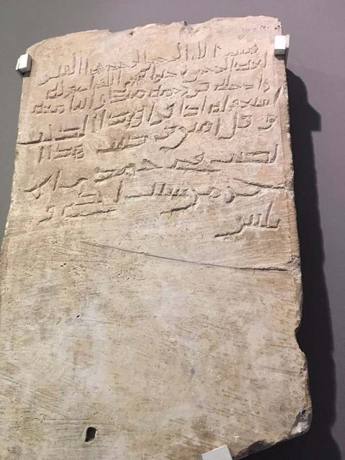
30 AH QMI-INS-003a

Inscription of ʿAbdallāh

نقش عبد الله

SiteḤismā, north-western Arabia
Writing surfaceRock face
Lines4
DimensionsUnrecorded
ScriptḤijāzī
SubjectCommemorative (dated by event and by year)
ReadingLargely clear · a few letters restored
Grade 2 of 5. Nearly complete; a few letters are restored by the editor.

Original text (Arabic)

  1. بسم الله أنا عبد الله
  2. كتبت هذا زمن رجع
  3. عمير (عفير؟) من سنة
  4. ثلثين (ثلاثين)

Translation

  1. In the name of God. I am ʿAbdallāh.
  2. I wrote this at the time ʿUmayr
  3. [or ʿUfayr?] returned, in the year
  4. thirty.

Commentary

A dual-dated inscription: like Zuhayr’s (nos. 1–2), the scribe gives both an event — the return of a man called ʿUmayr (or possibly ʿUfayr) — and a numbered Hijri year, thirty. Only nos. 1–3 in this catalog are older. As in the earliest texts, ʿAbdallāh gives neither his father’s name nor a kunya, and adds no prayer. The second line is partly unclear: the editor reads “zaman” (“at the time”) with some hesitation, since its letters spread over more space than the word needs.

Source: al-Saʿīd, ʿAbdallāh ibn ʿAbd al-ʿAzīz. “Nuqūsh Muʾarrakhah Mubakkirah min Ṣadr al-Islām.” Farīq al-Ṣaḥrāʾ (alsahra.org), 26 May 2018, updated 4 May 2025, inscription 1.

How to cite

Shaker W. Ahmed. “Inscription of ʿAbdallāh” (Cat. No. QMI-INS-003a). QMI, quranmss.com, 2026.

Gravestone of ʿAbd al-Raḥmān ibn Khayr al-Ḥajarī⤢ Click to enlarge
31 AH QMI-INS-004

Gravestone of ʿAbd al-Raḥmān ibn Khayr al-Ḥajarī

شاهد قبر عبد الرحمن بن خير الحجري

SiteCairo/Aswan cemeteries (findspot); Museum of Islamic Art, Cairo
Writing surfaceLimestone slab
Lines8
Dimensions38 × 71 cm
ScriptḤijāzī / early Kūfī
SubjectFunerary prayer
ReadingClear · nothing restored
Grade 1 of 5. The text is complete; nothing is restored.

Original text (Arabic)

  1. بسم الله الرحمن الرحيم هذا القبر
  2. لعبد الرحمن بن خير الحجري اللهم اغفر له
  3. وأدخله في رحمة منك وإننا معه
  4. استغفر له إذا قرأ هذا ا
  5. لكتب (الكتاب) وقل آمين وكتب هذا ا
  6. لكتب (الكتاب) في جمدى (جمادى) الا
  7. خر من سنت إحدى و
  8. ثلثين (ثلاثين)

Translation

  1. In the name of God, the Merciful, the Compassionate. This is the grave
  2. of ʿAbd al-Raḥmān ibn Khayr al-Ḥajarī. O God, forgive him
  3. and admit him into Your mercy. And we, together with him,
  4. ask forgiveness for him, if he reads this
  5. writing and says "āmīn." And this
  6. writing was written in the last part of Jumādā
  7. of the year one and
  8. thirty.

Commentary

The oldest dated Islamic gravestone known, discovered by Ḥasan Muḥammad al-Hawārī in 1929 among a large group of inscribed marble pieces brought from Islamic cemeteries in Cairo and Aswān to the Museum of Arab Antiquities (today the Museum of Islamic Art, Cairo). The upper four lines are cut in noticeably smaller letters than the lower four, and the word "year" (sanat) is spelled with an open tāʾ — an orthographic feature inherited from pre-Islamic Nabataean script and also preserved in three places in the Qurʾanic consonantal text. The Aswān tradition continues in the gravestone of Fāṭimah bint al-Ḥasan, dated 102 AH, which opens with Q 67:1 (QMI-INS-055tb). A second Aswān gravestone, of ʿAbbāsah bint Jurayj, is dated 71 AH as written (QMI-INS-011a). The same appeal to the reader closes the text of al-Fātiḥah written by Yazīd ibn ʿAbd Allāh near al-Namāṣ in 130 AH (QMI-INS-055m).

Source: al-Hawārī, Ḥasan Muḥammad. "Aqdam Athar Islāmī." Majallat al-Hilāl 10 (August 1930): 1179–1191; El-Hawary, H. M. "The Most Ancient Islamic Monument Known Dated A.H. 31 (A.D. 652) from the Time of the Third Calif ʿUthman." Journal of the Royal Asiatic Society of Great Britain & Ireland 62, no. 2 (1930): 321–333.

How to cite

Shaker W. Ahmed. “Gravestone of ʿAbd al-Raḥmān ibn Khayr al-Ḥajarī” (Cat. No. QMI-INS-004). QMI, quranmss.com, 2026.

Inscription of Qays the scribe, TaymāʾPhoto: M.C.A. Macdonald⤢ Click to enlarge
After 35 AH QMI-INS-004a

Inscription of Qays the Scribe

نقش قيس الكاتب أبو كثير

SiteNear Taymāʾ, Saudi Arabia (documented in the 2013 epigraphic campaign, TS-13-al-Ṭulaylāt-III-Ar.1)
Lines4
ScriptEarly Arabic
SubjectCurse on the murderers of the caliph ʿUthmān ibn ʿAffān
ReadingClear · nothing restored
Grade 1 of 5. The text is complete; nothing is restored.

Original text (Arabic)

  1. أنا قيس
  2. الكاتب أبو كثير
  3. لعن الله من قتل عثمان بن عفان
  4. ومن أحب قتله يقتلا

Translation

  1. I am Qays
  2. the scribe, Abū Kuthayr.
  3. May God curse whoever killed ʿUthmān ibn ʿAffān,
  4. and [those who] urged his killing, without mercy.

Commentary

The graffito opens with anā and the author’s name, as in older graffiti, where the carver records his name before the event he has chosen to mention. Unlike Zuhayr (QMI-INS-001), who dated his inscription by the death of ʿUmar without naming the killing, Qays states the murder outright. The formula echoes Q 33:61, which promises the cursed hypocrites of Medina that they will be seized and killed without mercy (quttilū taqtīlan). The author applies that verse to the murder of ʿUthmān, on the eve of the first civil war.

The graffito carries no date. Its terminus post quem is the murder of ʿUthmān in Dhū l-Ḥijjah 35 AH (June 656), which is why the entry is dated by event. Frédéric Imbert suggests the curse was directed at the insurgents and at those who benefited from the murder, among them partisans of ʿAlī ibn Abī Ṭālib and some Medinans. ʿUthmān is named as the son of ʿAffān here, while the appointment inscription (QMI-INS-002) names him only by patronymic.

Qays names himself by his occupation, al-kātib; so does Yazīd al-Naqqāsh (“the Engraver”), whose dated profession of faith is QMI-INS-036a.

The same year is named in the graffito of al-Ḥārith ibn Būlī dated “at the time of the rebellion of Egypt” (QMI-INS-004b).

Source: Imbert, Frédéric. “Califes, princes et poètes dans les graffiti du début de l’Islam.” In George Grigore et al. (eds.), Graffiti, Writing and Street Art in the Arab World, Romano-Arabica XV (Bucharest: Editura Universităţii din Bucureşti, 2015), pp. 64–65. The photograph is credited to M.C.A. Macdonald, presented in the article by permission.

How to cite

Shaker W. Ahmed. “Inscription of Qays the Scribe” (Cat. No. QMI-INS-004a). QMI, quranmss.com, 2026.

Inscription of al-Ḥārith ibn Būlī: the Time of the Rebellion of Egypt⤢ Click to enlarge
c. 35 AH QMI-INS-004b

Inscription of al-Ḥārith ibn Būlī: “the Time of the Rebellion of Egypt”

نقش الحارث بن بولي: زمن طغي مصر

SiteDarb Ḥismā, north-western Arabia
Writing surfaceRock face
Lines3
DimensionsUnrecorded
ScriptḤijāzī
SubjectCommemorative record dated by an event, the uprising in Egypt
ReadingClear · nothing restored
Grade 1 of 5. The text is complete; nothing is restored.

Original text (Arabic)

  1. أنا الحارث بن بولي مولى عبد
  2. الله بن سبع (سباع) وكتب
  3. زمن طغي مصر

Translation

  1. I am al-Ḥārith ibn Būlī, client (mawlā) of ʿAbd-
  2. allāh ibn Sibāʿ, and he wrote [this]
  3. at the time of the rebellion (ṭughy) of Egypt.

Commentary

The third graffito of al-Ḥārith ibn Būlī, again on the Ḥismā road. He now calls himself the mawlā (freed client) of ʿAbdallāh ibn Sibāʿ, no longer his ghulām, which suggests he had been freed since his earlier texts (QMI-INS-000a, QMI-INS-002a). The hand is also firmer.

The Desert Team read the dating as “the time of the rebellion of Egypt” and refer it to the rising in Egypt in 35 AH led by Muḥammad ibn Abī Ḥudhayfah, which al-Ṭabarī puts at the head of the events of that year; the Egyptian rebels then marched on Medina, and ʿUthmān was killed in Dhū l-Ḥijjah 35 AH. The same year is the terminus of Qays’s curse on ʿUthmān’s killers (QMI-INS-004a).

The reading of the last line is disputed. The team note that the first letter of ṭughy could be a ṣād. Muḥammad Shafīq al-Bayṭār proposed instead zaman ṭuʿina Maṣād, “the time Maṣād was stabbed”, naming a person rather than a place; on that reading the event, and the date, would be different. The 35 AH date therefore depends on the team’s reading. The same rock carries the signature “I am Saʿīd ibn ʿUthmān ibn ʿAffān”, perhaps the caliph’s son (QMI-INS-004d).

Source: Desert Team (Farīq al-Ṣaḥrāʾ), “al-Taʾrīkh bi-l-ḥawādith fī al-nuqūsh al-islāmiyyah al-mubakkirah”, alsahra.org, 4 May 2018. Reading and dating by ʿAbdallāh ibn ʿAbd al-ʿAzīz al-Saʿīd.

How to cite

Shaker W. Ahmed. “Inscription of al-Ḥārith ibn Būlī: “the Time of the Rebellion of Egypt”” (Cat. No. QMI-INS-004b). QMI, quranmss.com, 2026.

Inscription of Saʿīd ibn ʿUthmān ibn ʿAffān, Ḥismā⤢ Click to enlarge
c. 35–61 AH QMI-INS-004d

Inscription of Saʿīd ibn ʿUthmān ibn ʿAffān, Ḥismā

نقش سعيد بن عثمان بن عفان، حسمى

SiteDarb Ḥismā, north-western Arabia; same rock as no. 4b
Writing surfaceSandstone rock face
Lines2
DimensionsUnrecorded
ScriptḤijāzī
SubjectSignature; undated, placed at c. 35–61 AH if the writer is the son of the caliph ʿUthmān
ReadingClear · nothing restored
Grade 1 of 5. The text is complete; nothing is restored.

Original text (Arabic)

  1. أنا سعيد
  2. بن عثمن (عثمان) بن عفان

Translation

  1. I am Saʿīd
  2. ibn ʿUthmān ibn ʿAffān.

Commentary

A signature of five words on the Ḥismā road in north-western Arabia, cut on the same rock as the graffito of al-Ḥārith ibn Būlī dated “at the time of the rebellion of Egypt” (QMI-INS-004b). The writer gives his name with two generations of ancestors and nothing more: no prayer and no date. ʿUthmān is written ʿthmn, without the long alif, as is usual in the early Ḥijāzī hand, while ʿAffān keeps its alif. The text is reduced to the bare signature, without the prayers and dating formulae that fill the inscriptions of the later first and second centuries, and the hand is upright, plain and undotted; both features belong to the earliest stratum of Islamic rock writing, as in the signature of Saʿīd ibn al-ʿĀṣ (QMI-INS-000d).

The full name points to Saʿīd, son of the caliph ʿUthmān ibn ʿAffān by Fāṭimah bint al-Walīd of Makhzūm. Muʿāwiyah gave him command of the conquests in Khurāsān in 56 AH; he crossed the Oxus, received the submission of Bukhārā and laid siege to Samarqand, and was recalled the following year. After Muʿāwiyah’s death he was killed in Medina, about 61 AH, by Sogdian captives he had brought back from the East (al-Ṭabarī; al-Balādhurī). If the identification holds, the text must have been cut before his death, about 61 AH; and since he led an army in 56 AH, he was a grown man by the time of his father’s death in 35 AH or soon after. The inscription is therefore placed at c. 35–61 AH. The rock itself bears texts of the same decades, those of al-Ḥārith ibn Būlī, dated by events of about 22–35 AH on the reading of their publishers. The identification rests on the name alone, but a son of ʿUthmān named Saʿīd is attested, and the three names together are rare. The Ḥismā road joined the Ḥijāz to Syria, the seat of Muʿāwiyah, and a man of his standing would have travelled it more than once. Another Qurashī name on the Ḥismā road is that of ʿAbdallāh ibn Muṭīʿ, who led the people of al-Madīnah at al-Ḥarrah (QMI-INS-006a). An undated text from Ḥismā, signed by al-Ḍaḥḥāk ibn Dāwūd, records a journey made at his father’s bidding to take “the inheritance of Zayd” (QMI-INS-037c).

Source: Reading by Ahmed W. Shaker, from a photograph of the rock that also bears the graffito of al-Ḥārith ibn Būlī (Darb Ḥismā). Biographical data: al-Ṭabarī, Taʾrīkh, years 56–57 AH; al-Balādhurī, Futūḥ al-buldān.

How to cite

Shaker W. Ahmed. “Inscription of Saʿīd ibn ʿUthmān ibn ʿAffān, Ḥismā” (Cat. No. QMI-INS-004d). QMI, quranmss.com, 2026.

Inscription of Khālid ibn al-ʿĀṣ, al-Bāḥah⤢ Click to enlarge
c. 8–60 AH QMI-INS-004c

Inscription of Khālid ibn al-ʿĀṣ, al-Bāḥah

نقش خالد بن العاص، الباحة

Siteal-Bāḥah region
Writing surfaceBoulder, with other inscriptions
Lines4
DimensionsUnrecorded
ScriptḤijāzī
SubjectPrayer for forgiveness by the Companion Khālid ibn al-ʿĀṣ al-Makhzūmī; dated by his lifetime as a Muslim, c. 8–60 AH
ReadingClear · nothing restored
Grade 1 of 5. The text is complete; nothing is restored.

Original text (Arabic)

  1. أنا خلد (خالد) بن العص (العاص) بن
  2. هشم (هشام) بن ا
  3. لمغيرة استغفر
  4. ربي لذنبي كله

Translation

  1. I am Khālid ibn al-ʿĀṣ ibn
  2. Hishām ibn al-
  3. Mughīrah. I ask forgiveness of
  4. my Lord for all my sins.

Commentary

A first-person prayer for forgiveness by Khālid ibn al-ʿĀṣ ibn Hishām ibn al-Mughīrah of Makhzūm, cut on a large boulder in the al-Bāḥah region among several other texts. He names himself with three generations of ancestors and asks forgiveness “for all my sins” (li-dhanbī kullihi). The names are written without the long alif (khld, al-ʿṣ, hshm), as is usual in the early Ḥijāzī hand, and al-Mughīrah is divided across the line end after the alif of the article.

Khālid is known from the biographical works. His father, al-ʿĀṣ ibn Hishām, fell at Badr fighting against the Muslims, and he was a nephew of Abū Jahl; he himself accepted Islam at the conquest of Mecca in 8 AH. ʿUmar appointed him governor of Mecca, and ʿUthmān appointed him again, and Ibn Ḥajar notes that he lived on into the caliphate of Muʿāwiyah (al-Iṣābah). The text carries no date, but the writer fixes it within his own life as a Muslim, c. 8–60 AH, and the upright, undotted Ḥijāzī hand agrees. His son ʿAbd al-Raḥmān is named in a dated inscription of 40 AH near Mecca (QMI-INS-005); the book from which this text is taken gathers further inscriptions of Khālid’s sons in the same region. Five further texts of the family survive in Wādī Khara: a prayer for Khālid written by Ziyād (QMI-INS-004ca), prayers of his sons ʿAbd al-Raḥmān and al-Ḥārith (QMI-INS-004cb, QMI-INS-004cc), and two of his grandson Ismāʿīl ibn ʿAbd al-Raḥmān (QMI-INS-004cd, QMI-INS-004ce). No year of death is recorded for Khālid; Qashshāsh suggests about 48 AH, after which he no longer appears in the sources, and Alhatlani notes that he kept the governorship of Mecca for two years under Muʿāwiyah (Alhatlani (2021), pp. 74–76).

Source: Qashshāsh, Aḥmad ibn Saʿīd. Nuqūsh al-ṣaḥābī al-jalīl Khālid ibn al-ʿĀṣ wa-abnāʾihi fī manṭiqat al-Bāḥah. 1st ed., 2015.

How to cite

Shaker W. Ahmed. “Inscription of Khālid ibn al-ʿĀṣ, al-Bāḥah” (Cat. No. QMI-INS-004c). QMI, quranmss.com, 2026.

Prayer of Ziyād for Khālid ibn al-ʿĀṣ, al-Bāḥah: photographPhoto: after Alhatlani (2021)⤢ Click to enlarge
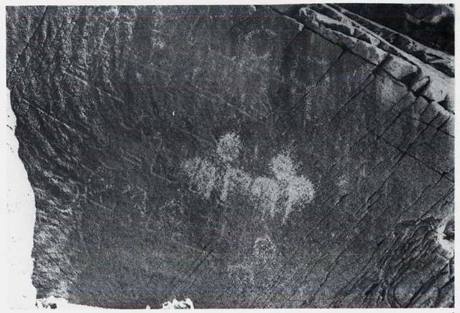
1st c. AH QMI-INS-004ca

Prayer of Ziyād for Khālid ibn al-ʿĀṣ, al-Bāḥah

دعاء زياد لخالد بن العاص، الباحة

SiteWādī Khara, al-Bāḥah region, Saudi Arabia
Writing surfaceRock face
Lines4
DimensionsUnrecorded
ScriptḤijāzī
SubjectPrayer for God's mercy upon the Companion Khālid ibn al-ʿĀṣ and upon whoever prays for him, written by Ziyād; undated
ReadingClear · nothing restored
Grade 1 of 5. The text is complete; nothing is restored.

Original text (Arabic)

  1. رحمت الله
  2. على خلد (خالد) بن العص (العاص)
  3. وعلى ما (من) يصلي عليه
  4. بخير وكتب زياد

Translation

  1. The mercy of God
  2. be upon Khālid ibn al-ʿĀṣ
  3. and upon whoever prays for him
  4. with good; and Ziyād wrote [this].

Commentary

A four-line prayer in which the writer does not pray for himself but for Khālid ibn al-ʿĀṣ: “The mercy of God be upon Khālid ibn al-ʿĀṣ, and upon whoever prays for him with good.” It is signed by Ziyād, who is not otherwise identified. The wish extends the blessing to every later reader who adds a prayer for Khālid, a device also found in prayers that close “may God have mercy on whoever says amen”.

Raḥmat is written with the open tāʾ (رحمت), as in the dated text of Khālid's son ʿAbd al-Raḥmān of 40 AH (QMI-INS-005), and man is written ما. The text is undated; Alhatlani places it in the first century AH, possibly reaching into the second. Whether Khālid was still alive when it was cut cannot be decided from the wording, since raḥmat Allāh ʿalā is used both for the living and for the dead.

The Makhzūmī family of Khālid ibn al-ʿĀṣ ibn Hishām is unusually well represented on the rocks of Wādī Khara: the Companion himself (QMI-INS-004c), a prayer for him written by one Ziyād (QMI-INS-004ca), his sons ʿAbd al-Raḥmān and al-Ḥārith (QMI-INS-004cb, QMI-INS-004cc), and his grandson Ismāʿīl ibn ʿAbd al-Raḥmān (QMI-INS-004cd, QMI-INS-004ce). ʿAbd al-Raḥmān also left a text dated 40 AH on the road north-east of Mecca (QMI-INS-005). Qashshāsh suggests that Khālid died about 48 AH; whether Ziyād wrote before or after that date cannot be decided from the text (Alhatlani (2021), pp. 74–76).

Source: Qashshāsh, Aḥmad ibn Saʿīd. Nuqūsh al-ṣaḥābī al-jalīl Khālid ibn al-ʿĀṣ wa-abnāʾihi fī manṭiqat al-Bāḥah. 1st ed., 2015, p. 10, n. 1; Alhatlani, Abdullah Saad. Descendants and Ancestors: A Study of Arabic Inscriptions from the Arabian Peninsula (1st–4th c. AH/7th–10th c. CE). PhD thesis, Leiden University, 2021 (hdl.handle.net/1887/3217834), ch. 1, no. 2, p. 216 (photograph).

How to cite

Shaker W. Ahmed. “Prayer of Ziyād for Khālid ibn al-ʿĀṣ, al-Bāḥah” (Cat. No. QMI-INS-004ca). QMI, quranmss.com, 2026.

Inscription of ʿAbd al-Raḥmān ibn Khālid ibn al-ʿĀṣ⤢ Click to enlarge
40 AH QMI-INS-005

Inscription of ʿAbd al-Raḥmān ibn Khālid ibn al-ʿĀṣ

نقش عبد الرحمن بن خالد بن العاص

SiteWādī al-Shāmiyah (Ṣanq al-Zarqāʾ), ~45 km NE of Mecca
Writing surfaceRock face
Lines5
Dimensions80 × 100 cm
ScriptḤijāzī
SubjectPrayer for forgiveness
ReadingClear · nothing restored
Grade 1 of 5. The text is complete; nothing is restored.

Original text (Arabic)

  1. رحمت (رحمة) الله وبر
  2. كته (بركاته) على عبد ا
  3. لرحمن بن خلد (خالد)
  4. بن العاص وكتب
  5. لسنه أربعين

Translation

  1. The mercy of God and His bless-
  2. ings upon ʿAbd
  3. al-Raḥmān ibn Khālid
  4. ibn al-ʿĀṣ, and [he] wrote
  5. [this] in the year forty

Commentary

ʿAbd al-Raḥmān was a Tābiʿī (a member of the generation after the Prophet's Companions) who transmitted a hadith on wiping over leather socks; some scholars even counted him among the Companions. His father was Khālid ibn al-ʿĀṣ ibn Hishām al-Makhzūmī, who governed Mecca and embraced Islam at its conquest. The word "mercy" (raḥmah) is spelled with an open tāʾ — raḥmat — a spelling influenced by pre-Islamic Nabataean practice and also found in the Dome of the Rock inscriptions (72 AH) and several first-century papyri. A prayer for forgiveness by his father, Khālid ibn al-ʿĀṣ, survives on a boulder in the al-Bāḥah region (QMI-INS-004c). ʿAbd al-Raḥmān also left an undated prayer of his own in Wādī Khara in the al-Bāḥah region (QMI-INS-004cb), close to those of his brother al-Ḥārith and his son Ismāʿīl (QMI-INS-004cc, QMI-INS-004cd, QMI-INS-004ce).

Source: Sharaf al-Dīn, Aḥmad Ḥusayn. "al-Nuqūsh al-Islāmīyah bi-Darb Zubaydah." Aṭlāl 1 (1977): 69–70, pl. 49.

How to cite

Shaker W. Ahmed. “Inscription of ʿAbd al-Raḥmān ibn Khālid ibn al-ʿĀṣ” (Cat. No. QMI-INS-005). QMI, quranmss.com, 2026.

Inscription of ʿAbd al-Raḥmān ibn Khālid, al-Bāḥah: photographPhoto: after Alhatlani (2021)⤢ Click to enlarge
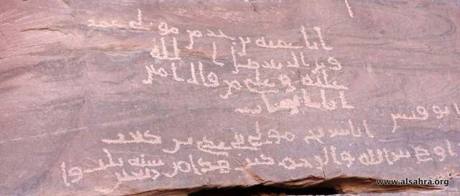
mid-1st c. AH QMI-INS-004cb

Inscription of ʿAbd al-Raḥmān ibn Khālid, al-Bāḥah

نقش عبد الرحمن بن خالد، الباحة

SiteWādī Khara, al-Bāḥah region, Saudi Arabia
Writing surfaceRock face
Lines5
Dimensions140 × 120 cm
ScriptḤijāzī
SubjectFirst-person prayer for God's mercy by ʿAbd al-Raḥmān, son of the Companion Khālid ibn al-ʿĀṣ; undated
ReadingLargely clear · a few letters restored
Grade 2 of 5. Nearly complete; a few letters are restored by the editor.

Original text (Arabic)

  1. أنا عبد ا
  2. لرحمن بن
  3. خلد (خالد)
  4. أسل (أسأل) ربي ر
  5. [حمت]ه

Translation

  1. I, ʿAbd al-
  2. Raḥmān ibn
  3. Khālid,
  4. ask my Lord for His
  5. [mer]cy.

Commentary

A five-line prayer by ʿAbd al-Raḥmān ibn Khālid ibn al-ʿĀṣ al-Makhzūmī: “I, ʿAbd al-Raḥmān ibn Khālid, ask my Lord for His mercy.” The end of the fourth line is damaged. The verb asʾalu is written أسل without the medial hamzah seat, as in other early texts (QMI-INS-006b), and Khālid is written without the long alif.

The same man is the subject of a prayer dated 40 AH at Wādī al-Shāmiyah north-east of Mecca (QMI-INS-005). This text carries no date, but Alhatlani places it in the first century AH, and it falls within ʿAbd al-Raḥmān's lifetime as an adult. In the published photograph the line of his brother al-Ḥārith appears to run across the top of the same rock (QMI-INS-004cc).

The Makhzūmī family of Khālid ibn al-ʿĀṣ ibn Hishām is unusually well represented on the rocks of Wādī Khara: the Companion himself (QMI-INS-004c), a prayer for him written by one Ziyād (QMI-INS-004ca), his sons ʿAbd al-Raḥmān and al-Ḥārith (QMI-INS-004cb, QMI-INS-004cc), and his grandson Ismāʿīl ibn ʿAbd al-Raḥmān (QMI-INS-004cd, QMI-INS-004ce). ʿAbd al-Raḥmān also left a text dated 40 AH on the road north-east of Mecca (QMI-INS-005).

Dating. ʿAbd al-Raḥmān was the eldest son of Khālid ibn al-ʿĀṣ, who became Muslim at the conquest of Mecca in 8 AH, and is described in the sources as a poet. He is attested in a prayer dated 40 AH (QMI-INS-005), and Alhatlani notes that this text was written above his father's own graffito (QMI-INS-004c). No death date for him is recorded in the literary sources; Qashshāsh proposes one from his disappearance from the sources. The text is placed here beside his dated prayer of 40 AH, in the middle of the first century AH (Alhatlani (2021), pp. 74–76).

Source: Qashshāsh, Aḥmad ibn Saʿīd. Nuqūsh al-ṣaḥābī al-jalīl Khālid ibn al-ʿĀṣ wa-abnāʾihi fī manṭiqat al-Bāḥah. 1st ed., 2015, pp. 40–41; Alhatlani, Abdullah Saad. Descendants and Ancestors: A Study of Arabic Inscriptions from the Arabian Peninsula (1st–4th c. AH/7th–10th c. CE). PhD thesis, Leiden University, 2021 (hdl.handle.net/1887/3217834), ch. 1, no. 4, p. 217 (photograph).

How to cite

Shaker W. Ahmed. “Inscription of ʿAbd al-Raḥmān ibn Khālid, al-Bāḥah” (Cat. No. QMI-INS-004cb). QMI, quranmss.com, 2026.

Inscription of Shurayḥ, Mawlā of Banū ʿAdī⤢ Click to enlarge
43 AH QMI-INS-006

Inscription of Shurayḥ, Mawlā of Banū ʿAdī

نقش شريح مولى بني عدي

SiteDarb Ḥismā
Writing surfaceSandstone rock, right bank of the road
Lines4
Dimensions40 cm
ScriptḤijāzī
SubjectExhortation to piety and kinship
ReadingClear · nothing restored
Grade 1 of 5. The text is complete; nothing is restored.

Original text (Arabic)

  1. أنا شريح مولى بني عدي بن كعب
  2. أوصي ببر الله والرحم كتب هذا من سنه ثلث وأ
  3. ربعين

Translation

  1. I, Shurayḥ, mawlā of Banū ʿAdī ibn Kaʿb, exhort [reverence for]
  2. God and ties of kinship. This was written in the year three and
  3. forty.

Commentary

Carved on a rock along Darb Ḥismā, a route that linked Syria and Medina in the 1st–2nd centuries AH. Unlike most entries in this corpus, Shurayḥ's text is not a prayer but a brief moral exhortation — reverence for God and the maintenance of family ties — following his self-identification as a mawlā (client/ally) of Banū ʿAdī ibn Kaʿb. First documented by the Al-Sahra desert survey team. The inscription carries no diacritical dots except on the nūn of "sanah" (year). Its alif is compared with that of the undated inscription of Abū Bakr from Ḥismā (QMI-INS-000).

The same bequest, “I enjoin dutifulness to God and to kin”, follows the old opening bismika Allāhumma in the text of ʿAbdallāh ibn ʿAlqamah (QMI-INS-000b). On the same road a man of the same clan, ʿAbdallāh ibn Muṭīʿ of Banū ʿAdī ibn Kaʿb, left his name with the words “there is no dominion but God’s” (QMI-INS-006a). A dated text of the following year, 44 AH, is the prayer of Abū Muḥammad ʿAmr ibn Rāfiʿ (QMI-INS-006b).

Source: al-Saʿīd, ʿAbdallāh ʿAbd al-ʿAzīz, et al. Nuqūsh Ḥismā: Kitābāt min Ṣadr al-Islām Shamāl Gharb al-Mamlaka. Manshūrāt al-Majallah al-ʿArabīyah, 2017, p. 14.

How to cite

Shaker W. Ahmed. “Inscription of Shurayḥ, Mawlā of Banū ʿAdī” (Cat. No. QMI-INS-006). QMI, quranmss.com, 2026.

Inscription of ʿAbdallāh ibn Muṭīʿ, ḤismāPhoto: Saʿd al-Tuwayjirī⤢ Click to enlarge
Before 73 AH QMI-INS-006a

Inscription of ʿAbdallāh ibn Muṭīʿ, Ḥismā

نقش عبد الله بن مطيع، حسمى

SiteDarb Ḥismā, Tabūk region, Saudi Arabia
Writing surfaceSandstone rock face
Lines2
DimensionsUnrecorded
ScriptḤijāzī
SubjectName of the writer with a declaration of God’s sovereignty; undated, before 73 AH if the writer is ʿAbdallāh ibn Muṭīʿ al-ʿAdawī
ReadingClear · nothing restored
Grade 1 of 5. The text is complete; nothing is restored.

Original text (Arabic)

  1. أنا عبد الله بن مطيع
  2. لا مُلكَ إلا لله

Translation

  1. I am ʿAbdallāh ibn Muṭīʿ.
  2. There is no dominion but God’s.

Commentary

A two-line text cut in the banded sandstone of Darb Ḥismā, north-west of Tabūk, on the road that joined al-Madīnah to Syria. The writer gives his name in the first person, anā, and follows it with a short declaration: lā mulka illā li-llāh, “there is no dominion but God’s”. The phrase recalls Qurʾānic language of God’s sovereignty, “Whose is the dominion today? God’s, the One, the Overpowering” (Q 40:16). It has no parallel among the dated inscriptions of this catalog.

The form of the phrase is its most striking feature. Lā mulka illā li-llāh is built exactly like lā ḥukma illā li-llāh, “judgment belongs to God alone”, the cry raised at Ṣiffīn in 37 AH by those who rejected the arbitration, itself drawn from the Qurʾanic in al-ḥukmu illā li-llāh (Q 6:57; 12:40, 67). Both reduce a claim to a single word placed under God alone: in the one case judgment, in the other dominion. In the first century the word mulk, kingship, was also used of worldly rule as distinct from the caliphate, and a declaration that dominion is God’s alone could carry that sense as well as a purely devotional one. The rock gives no context beyond the writer’s name, and the phrase is recorded here as he wrote it.

Beside it on the same rock is a second text with the same declaration: أنا عبد الله بن عامر بن / ربيعة لا ملك (إ)لا لله, “I am ʿAbdallāh ibn ʿĀmir ibn Rabīʿah; there is no dominion but God’s”. A man of this name is well known: ʿAbdallāh ibn ʿĀmir ibn Rabīʿah al-ʿAnazī, son of an early Companion and emigrant to Abyssinia, of a family allied to Banū ʿAdī ibn Kaʿb and to the house of al-Khaṭṭāb. He was born in al-Madīnah in 6 AH and died, by most reports, in 85 AH. The two writers would then be men of the same generation and the same clan alliance, born in the Prophet’s lifetime, who stopped together on the Ḥismā road and wrote the same words side by side. The repetition shows that the phrase was not one man’s private prayer but a formula shared by companions on the journey.

The best-known bearer of the name is ʿAbdallāh ibn Muṭīʿ ibn al-Aswad al-ʿAdawī of Quraysh, of the clan of Banū ʿAdī ibn Kaʿb. He was born in the Prophet’s lifetime, and the sources relate that the Prophet chewed a date for him as a newborn, named him ʿAbdallāh and prayed for blessing on him. In 63 AH he led Quraysh and the people of al-Madīnah at the battle of al-Ḥarrah against the army of Yazīd ibn Muʿāwiyah; afterwards he joined ʿAbdallāh ibn al-Zubayr, who sent him to al-Kūfah as governor until al-Mukhtār expelled him, and he was killed beside Ibn al-Zubayr at Mecca in 73 AH. If the writer is this man, the stone was cut before 73 AH, and its declaration gains a particular resonance in the life of a leader of the Ḥijāz who stood against the Umayyad claim to rule. The identification rests on the name alone, however, and the text carries no date.

The hand is upright and undotted, of the early Ḥijāzī type, and the rock belongs to the same route as the inscription of Shurayḥ, a mawlā of the same clan of Banū ʿAdī ibn Kaʿb, dated 43 AH (QMI-INS-006), and the inscription of Saʿīd, son of the caliph ʿUthmān (QMI-INS-004d).

Source: Discovered and photographed by Saʿd ibn Muḥammad al-Tuwayjirī, published on X (@OfNajd), 3 July 2020, with the reading «أنا عبدالله بن مطيع / لا ملك إلا (ا)لله». The neighbouring text of ʿAbdallāh ibn ʿĀmir ibn Rabīʿah after the same publisher. On ʿAbdallāh ibn Muṭīʿ: Ibn Ḥajar, al-Iṣābah; Ibn al-Athīr, Usd al-ghābah; Ibn Kathīr, al-Bidāyah wa-l-nihāyah, among those killed with Ibn al-Zubayr in 73 AH; al-Ziriklī, al-Aʿlām. On ʿAbdallāh ibn ʿĀmir ibn Rabīʿah: al-Dhahabī, Tārīkh al-Islām; Ibn Saʿd, al-Ṭabaqāt; Ibn ʿAbd al-Barr, al-Istīʿāb.

How to cite

Shaker W. Ahmed. “Inscription of ʿAbdallāh ibn Muṭīʿ, Ḥismā” (Cat. No. QMI-INS-006a). QMI, quranmss.com, 2026.

Inscription of Abū Muḥammad ʿAmr ibn Rāfiʿ, dated Rabīʿ al-Ākhir 44 AHPhoto: Saʿd al-Tuwayjirī⤢ Click to enlarge
44 AH QMI-INS-006b

Inscription of Abū Muḥammad ʿAmr ibn Rāfiʿ

نقش أبي محمد عمرو بن رافع

SiteTabūk region, north-western Arabia
Writing surfaceRock face
Lines8
DimensionsUnrecorded
ScriptEarly Arabic (Ḥijāzī)
SubjectSelf-presentation and prayer for God’s good pleasure, dated 5 Rabīʿ al-Ākhir 44 AH
ReadingLargely clear · a few letters restored
Grade 2 of 5. Nearly complete; a few letters are restored by the editor.

Original text (Arabic)

  1. أنا أبو
  2. محمد عمر
  3. و بن رفع (رافع) أسل (أسأل)
  4. ربي رضه (رضاه)
  5. كتب لخمس ليل (ليال)
  6. خلون من شهر ربيع
  7. الآخر من سنة
  8. أربع وأربع[ين]

Translation

  1. I am Abū
  2. Muḥammad ʿAm-
  3. r ibn Rāfiʿ. I ask
  4. my Lord His good pleasure.
  5. [He] wrote [this] when five nights
  6. had passed of the month of Rabīʿ
  7. al-Ākhir, of the year
  8. forty-fo[ur].

Commentary

A rock inscription from the region of Tabūk, discovered and photographed by Saʿd al-Tuwayjirī, who published it on 27 January 2021; Muḥammad al-Mughadhdhawī and Aḥmad al-Aqṭash contributed to its reading. Its writer introduces himself by his kunyah and name, “I am Abū Muḥammad ʿAmr ibn Rāfiʿ”, and asks for a single thing: “I ask my Lord His good pleasure” (asʾalu rabbī riḍāhu). He then dates the text to the day: five nights into Rabīʿ al-Ākhir of the year forty-four, that is, about 6 July 664 CE, in the caliphate of Muʿāwiyah.

The date formula, “he wrote [this] when five nights had passed” (kataba li-khams layālin khalawna), is the same as that of ʿAbdallāh ibn Dīrām two years later, who wrote “when four nights had passed of Muḥarram of the year forty-six” (QMI-INS-007); the month Rabīʿ al-Ākhir is named in the same way in 83 AH (QMI-INS-032). The inscription stands between the exhortation of Shurayḥ of 43 AH and the text of ʿAbdallāh ibn Dīrām of 46 AH (QMI-INS-006, QMI-INS-007).

The long vowel ā is left unwritten throughout, as in many texts of the first century: رفع for Rāfiʿ, ليل for layālī, رضه for riḍāhu, and أسل for asʾalu, the last also found in the inscriptions of 80 and 92 AH (QMI-INS-022, QMI-INS-039). The name ʿAmr is divided between the second and third lines. The end of the last line is worn, and the reading of the year as forty-four follows the editors.

Source: Discovered and photographed by Saʿd al-Tuwayjirī, published 27 January 2021, with the reading followed here; Muḥammad al-Mughadhdhawī and Aḥmad al-Aqṭash contributed to the reading.

How to cite

Shaker W. Ahmed. “Inscription of Abū Muḥammad ʿAmr ibn Rāfiʿ” (Cat. No. QMI-INS-006b). QMI, quranmss.com, 2026.

Inscription of ʿAbdallāh ibn DīrāmDrawing⤢ Click to enlarge
46 AH QMI-INS-007

Inscription of ʿAbdallāh ibn Dīrām

نقش عبد الله بن ديرام

SiteWādī al-Sabīl
Writing surfaceSandstone rocks
Lines5
DimensionsUnrecorded
ScriptḤijāzī
SubjectPrayer for forgiveness
ReadingClear · nothing restored
Grade 1 of 5. The text is complete; nothing is restored.

Original text (Arabic)

  1. اللهم
  2. اغفر لعبد اله (الله) بن ديرام
  3. كتب لأربع ليل (ليال) خلون من
  4. محرم من سنة ست وأر
  5. بعين

Translation

  1. O God,
  2. forgive ʿAbdallāh ibn Dīrām.
  3. Written on the fourth night that had passed of
  4. Muḥarram, in the year six and
  5. forty.

Commentary

Discovered by G. Ryckmans on 17 December 1951 in Wādī al-Sabīl, some 60 km northwest of al-Ḥuṣayniyyah. A later hand deliberately defaced the prayer by inserting the negation "lā," turning "O God, forgive ʿAbdallāh" into "O God, do NOT forgive ʿAbdallāh ibn Dīrām" — one of at least five known cases of intentional textual sabotage among early Arabic rock inscriptions, apparently driven by personal hostility toward the person prayed for. "Allāh" in line 2 is spelled with a single lām (ileh) — a very rare orthographic feature found in only a handful of inscriptions and papyri. The same one-lām spelling of the divine name appears in the signature of the Qurashī Saʿīd ibn al-ʿĀṣ (QMI-INS-000d). The same date formula, “when five nights had passed”, is used two years earlier by Abū Muḥammad ʿAmr ibn Rāfiʿ in Rabīʿ al-Ākhir 44 AH (QMI-INS-006b).

Source: Grohmann, Adolf. Arabic Inscriptions. Expédition Philby–Ryckmans–Lippens en Arabie, IIe partie: Textes épigraphiques, tome I. Bibliothèque du Muséon 50. Louvain: Publications universitaires, 1962. The text was copied by Gonzague Ryckmans in Wādī al-Sabīl on 17 December 1951.

How to cite

Shaker W. Ahmed. “Inscription of ʿAbdallāh ibn Dīrām” (Cat. No. QMI-INS-007). QMI, quranmss.com, 2026.

Dam Inscription of Muʿāwiyah, Wādī al-Khunaq⤢ Click to enlarge
41–60 AH QMI-INS-007a

Dam Inscription of Muʿāwiyah, Wādī al-Khunaq

نقش سد معاوية بوادي الخنق

SiteWādī al-Khunaq, Medina region; on top of the first western mass of the dam, facing north
Writing surfaceBasalt block, dark brown, with natural holes
Present locationNational Museum, Riyadh
Lines10 (27–44 cm each), incised
Dimensions65 × 46 cm, 14 cm thick
ScriptUnrecorded
SubjectFoundation of a dam of the caliph Muʿāwiyah, built by his client Abū Raddād; dated by his caliphate, 41–60 AH
ReadingClear · nothing restored
Grade 1 of 5. The text is complete; nothing is restored.

Original text (Arabic)

  1. بسم الله الرحمن الرحيم
  2. هذا السد لعبد الله
  3. معويه (معاوية) أمير المؤمنين
  4. اللهم برك (بارك) له فيه رب
  5. السموت (السماوات) والأرض
  6. بنه (بناه) أبو رداد مولى
  7. عبد الله بن عباس بحو
  8. ل الله وقوته
  9. وقام عليه كثير بن ا
  10. لصلت وأبو موسى

Translation

  1. In the name of God, the Merciful, the Compassionate.
  2. This dam is for the servant of God
  3. Muʿāwiyah, Commander of the Faithful.
  4. O God, bless him in it, Lord of
  5. the heavens and the earth.
  6. Abū Raddād, client of
  7. ʿAbdallāh ibn ʿAbbās, built it, by the power
  8. and strength of God.
  9. And Kathīr ibn
  10. al-Ṣalt and Abū Mūsā supervised it.

Commentary

A foundation text of a dam built for the caliph Muʿāwiyah ibn Abī Sufyān at Wādī al-Khunaq, in the region of Medina. It carries no year. It names him “the servant of God Muʿāwiyah, Commander of the Faithful,” and the editor, Saʿd al-Rāshid, concludes that the dam was built after Muʿāwiyah became caliph; the text is therefore placed in his caliphate, 41–60 AH. It opens with the same words as the inscription of Muʿāwiyah’s dam at Ṭāʾif of 58 AH (QMI-INS-009), “This dam is for the servant of God Muʿāwiyah, Commander of the Faithful,” but its prayer differs: here “O God, bless him in it, Lord of the heavens and the earth,” at Ṭāʾif a prayer for forgiveness, steadfastness and help.

The stone is a dark brown basalt block, with some natural holes and cavities, about 65 × 46 cm and 14 cm thick. It was set above the top of the first western mass of the dam, facing north, fixed between the three upper steps. The ten lines are incised and clear, and well matched in length and letter size (27 to 44 cm). Besides the caliph, the text names three men: Abū Raddād, who built the dam and is the client (mawlā) of ʿAbdallāh ibn ʿAbbās (the editor notes that the patron may also be read ʿAbdallāh ibn ʿAyyāsh), and Kathīr ibn al-Ṣalt and Abū Mūsā, who supervised the work. The words are divided across the line ends twice (biḥaw-/l Allāh and ibn al-/Ṣalt), and several words keep the old spelling without the long alif: Muʿwiyah, al-samwāt, baraka. The editor records that the stone is now in the National Museum in Riyadh. He would have preferred it to stay in place on the dam wall, but antiquities thieves, after hearing of its discovery, climbed to the top of the dam and pulled the stone out; it fell to the ground and they could not carry it away. A mineral-resources team then moved it to the mission headquarters at al-ʿĀqūl in Medina, from where it was deposited in the National Museum. A letter of Muʿāwiyah to his governor of Medina, Marwān ibn al-Ḥakam, copied on a rock at al-Ḥanākiyah, spells his name in the same way (QMI-INS-007b).

Source: al-Rāshid, Saʿd ibn ʿAbd al-ʿAzīz. “Sadd al-Khanaq: An Early Umayyad Dam near Medina, Saudi Arabia.” Proceedings of the Seminar for Arabian Studies 38 (2008): 265–276. Also al-Rāshid, Saʿd ibn ʿAbd al-ʿAzīz. Dirāsāt fī al-āthār al-islāmiyyah al-mubakkirah bi-l-Madīnah al-munawwarah. 1st ed. Riyadh, 1421 AH / 2000 CE, pp. 46–60.

How to cite

Shaker W. Ahmed. “Dam Inscription of Muʿāwiyah, Wādī al-Khunaq” (Cat. No. QMI-INS-007a). QMI, quranmss.com, 2026.

Letter of the Caliph Muʿāwiyah to Marwān ibn al-Ḥakam, al-ḤanākiyahPhoto: Aḥmad ibn Hishām al-Mālikī⤢ Click to enlarge
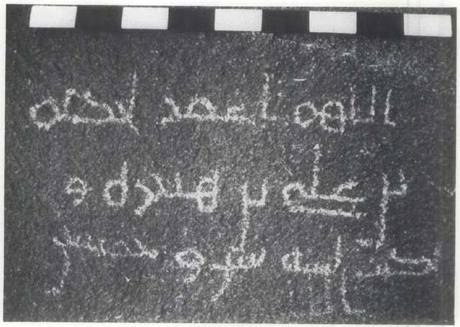
c. 42–57 AH QMI-INS-007b

Letter of the Caliph Muʿāwiyah to Marwān ibn al-Ḥakam, al-Ḥanākiyah

كتاب معاوية إلى مروان بن الحكم، الحناكية

Siteal-Ḥanākiyah governorate, al-Madīnah region
Writing surfaceBoulder
Lines10; the end of line 10 is effaced by weathering
DimensionsUnrecorded
ScriptḤijāzī
SubjectLetter of the caliph Muʿāwiyah to Marwān ibn al-Ḥakam, governor of Medina, commending one Jarīr; dated by the two correspondents, c. 42–57 AH
ReadingPartly preserved · several words restored
Grade 3 of 5. Several words are damaged and restored by the editor; the rest is legible.

Original text (Arabic)

  1. بسم الله
  2. من معوية (معاوية) بن
  3. أمير المؤمنين إلى مرو
  4. ن بن الحكم سلم عليك
  5. فإني أحمد إليك الله
  6. الذي لا إليه (إله) إلا هو أما بعد
  7. فإذا أتاك جرير بن د
  8. فا شرفه واعطه
  9. أحسن أما بعد
  10. فاعف لله ......

Translation

  1. In the name of God.
  2. From Muʿāwiyah ibn
  3. Commander of the Faithful, to Mar-
  4. wān ibn al-Ḥakam. Peace be upon you.
  5. I praise to you God,
  6. besides whom there is no god. To proceed:
  7. when Jarīr ibn D… comes to you,
  8. honour him and give him
  9. the best (?). To proceed:
  10. and pardon (?) for God’s sake …

Commentary

A letter of the caliph Muʿāwiyah to Marwān ibn al-Ḥakam, his governor of Medina, copied onto a boulder at al-Ḥanākiyah, north-east of Medina, on the road that joins the city to Najd and Iraq. The inscription was found by a local resident in 2020, and despite its importance it has received little attention. It follows the opening of an early Arabic letter step by step: the basmalah, “from so-and-so to so-and-so”, the greeting salām ʿalayka, the praise fa-innī aḥmadu ilayka Allāh alladhī lā ilāha illā huwa, and ammā baʿd, after which the business of the letter begins. The name of the caliph is written mʿwyh, without the long alif, as on his dams at Ṭāʾif and near Medina (QMI-INS-009, QMI-INS-007a), and ilāh appears to be cut as ilayh, with a tooth before the final hāʾ. This is not a slip: Ahmad Al-Jallad has identified a letter shape for final hē with a denticle-like stroke before it, used in Qurʾānic manuscripts and Arabic inscriptions of the seventh and eighth centuries, so the word is simply ilāh written in an early form (Al-Jallad, “The Digraph اى in the Quranic Consonantal Text and the Identification of a New Letter Shape for Final Hē in the 7th to 8th Century Arabic Script”, Al-ʿUṣūr al-Wusṭā 29.1, 2021). It agrees with the early date of the inscription. Marwān’s name is divided across the line end (Mar-/wān).

The business is a commendation, and its last four lines (7–10) are only partly understood. After “Jarīr ibn” the father’s name begins with dāl and is not completed. Line 8 reads fa-sharrifhu wa-aʿṭihi, “honour him and give him”, and line 9 aḥsan, “the best”, so that Jarīr is to be received with honour and given generously, in keeping with his standing; the early register of stipends ranked men of standing in what the sources call sharaf al-ʿaṭāʾ. Line 9 then repeats ammā baʿd, and line 10 begins fa-ʿfu li-llāh, “and pardon, for God’s sake”, or, with the same letters, “and exempt him, for God’s sake”; the rest of that line is effaced by weathering. What is clear is the sense: Jarīr is to be honoured and given generously.

Who this Jarīr was cannot yet be said. The two best-known men of the name in Muʿāwiyah’s time do not fit the letter dāl. Jarīr ibn ʿAbdallāh al-Bajalī, the Companion, lived in Iraq and al-Jazīrah and died about 51–54 AH; the poet Jarīr ibn ʿAṭiyyah al-Khaṭafī, of Kulayb of Tamīm in al-Yamāmah, was a young man in these years. Either would require the reading of the father’s name to be wrong. More likely this Jarīr was a man of local standing, a tribal leader or a herd-owner of the country between Medina and Najd, who is not otherwise recorded; a clearer photograph of line 7 may settle the name.

A letter of this kind would normally have been written on papyrus or parchment and carried by its bearer. The rock copy does not fit that pattern well. The later route from Damascus to Medina that Ibn Khurradādhbih describes passes Tabuk and Wādī al-Qurā, not al-Ḥanākiyah, so the stone was not on the letter’s path of delivery. Three explanations seem open: a copy cut by Jarīr or one of his party to keep the caliph’s word at hand; a copy made by an official in that district; or an unfinished copy or practice text. The sender’s name stops at “Muʿāwiyah ibn” without “Abī Sufyān”, and ammā baʿd is written a second time in line 9, after the business has begun. Both features favour the last explanation, an unfinished copy or practice text, over a fair copy of the letter as sent. It is the only copy of a caliphal letter on stone in this catalog; the tax letter from Andarīn is of another kind, a draft written in ink on a marble slab (QMI-INS-055ac).

The letter carries no date, but its two correspondents fix it. Muʿāwiyah is “Commander of the Faithful”, so the text falls in his caliphate, 41–60 AH, and Marwān governed Medina for him twice, about 42–49 AH and again about 54–57 AH (the sources differ on the exact years). The inscription is therefore placed at c. 42–57 AH. The Ḥijāzī hand, upright and undotted, agrees with this. The same division of a word across the line end appears in a dated inscription of 76 AH from the Medina region (QMI-INS-016b).

Source: Published by Aḥmad ibn Hishām al-Mālikī on X (formerly Twitter), 27 March 2025. Reading by Ahmed W. Shaker; the end of line 10 is effaced.

How to cite

Shaker W. Ahmed. “Letter of the Caliph Muʿāwiyah to Marwān ibn al-Ḥakam, al-Ḥanākiyah” (Cat. No. QMI-INS-007b). QMI, quranmss.com, 2026.

Inscription of Ḥakīm ibn ʿAlī⤢ Click to enlarge
52 AH QMI-INS-008

Inscription of Ḥakīm ibn ʿAlī

نقش حكيم بن علي

SiteWādī al-Khushanah, on Darb Zubaydah
Writing surfaceUnrecorded
Lines3
DimensionsUnrecorded
ScriptḤijāzī
SubjectPrayer for forgiveness
ReadingClear · nothing restored
Grade 1 of 5. The text is complete; nothing is restored.

Original text (Arabic)

  1. اللهم اغفر لحكيم
  2. بن علي بن هبيرة و
  3. كتب لسنة ثنتين وخمسين

Translation

  1. O God, forgive Ḥakīm
  2. ibn ʿAlī ibn Hubayrah, and
  3. it was written in the year fifty-two.

Commentary

Found by a survey expedition at Wādī al-Khushanah on Darb Zubaydah in 1997. Scholars have read the personal names in several different ways — "Ḥakīm" has also been proposed as Ḥudhaym, Judhaym, Ḥadabah or Hadiyyah, and "Hubayrah" as Hunaydah — since letters such as kāf/dāl and rāʾ/dāl are graphically similar in this undotted early hand. The inscription carries no diacritical dots at all.

Source: Sharaf al-Dīn, Aḥmad Ḥusayn. "al-Nuqūsh al-Islāmīyah bi-Darb Zubaydah." Aṭlāl: Annual of Saudi Arabian Archaeology 1 (1977): 73–74.

How to cite

Shaker W. Ahmed. “Inscription of Ḥakīm ibn ʿAlī” (Cat. No. QMI-INS-008). QMI, quranmss.com, 2026.

Dam of Ṭāʾif Inscription⤢ Click to enlarge
58 AH QMI-INS-009

Dam of Ṭāʾif Inscription

نقش سد الطائف

SiteWādī Saysad, near Ṭāʾif
Writing surfaceLarge rock face
Lines6
Dimensions132 × 71 cm
ScriptḤijāzī
SubjectFoundation / dedicatory text
ReadingClear · nothing restored
Grade 1 of 5. The text is complete; nothing is restored.

Original text (Arabic)

  1. هذا السد لعبد الله معو ية (معاو ية)
  2. أمير المؤمنين بنيه (بناه) عبد الله بن صخر
  3. بإذن الله سنة ثمن (ثمان) وخمسين ا
  4. للهم اغفر لعبد الله معو ية (معاو ية) ا
  5. مير المؤمنين وثبته وانصره ومتع ا
  6. لمؤمنين به كتب عمرو بن خباب

Translation

  1. This dam belongs to ʿAbdallāh Muʿāwiyah,
  2. Commander of the Faithful; ʿAbdallāh ibn Ṣakhr built it
  3. by God's leave, in the year fifty-eight.
  4. O God, forgive ʿAbdallāh Muʿāwiyah,
  5. Commander of the Faithful — keep him steadfast, aid him, and let
  6. the Believers benefit through him. Written by ʿAmr ibn Khabbāb.

Commentary

Discovered in 1945 by the American mining engineer Karl S. Twitchell while surveying Saudi Arabia's mineral resources, and first read by George C. Miles in 1948. It commemorates a dam built near Ṭāʾif under the caliph Muʿāwiyah ibn Abī Sufyān (r. 41–60 AH), constructed by ʿAbdallāh ibn Ṣakhr, with the dedicatory text (dībāja) composed by ʿAmr ibn Khabbāb. Miles misread the final line, inserting an extra word he believed the grammar required; the correct sense is simply "let the Believers benefit through him," the pronoun referring back to Muʿāwiyah himself.

The same title, “servant of God … Commander of the Faithful,” is used for Hishām in the pool inscription (QMI-INS-055ab).

A second dam of Muʿāwiyah, from Wādī al-Khunaq near Medina, opens with the same words and names the builder, his client Abū Raddād (QMI-INS-007a). The same spelling of the caliph’s name appears in his letter to Marwān ibn al-Ḥakam, copied on a rock at al-Ḥanākiyah (QMI-INS-007b). Muʿāwiyah is named in full, “Muʿāwiyah ibn Abī Sufyān”, by his client Saʿīd ibn Dhakwān in an undated prayer (QMI-INS-009a).

Source: Miles, George C. "Early Islamic Inscriptions Near Ṭāʾif in the Ḥijāz." Journal of Near Eastern Studies 7, no. 4 (1948): 236–242.

How to cite

Shaker W. Ahmed. “Dam of Ṭāʾif Inscription” (Cat. No. QMI-INS-009). QMI, quranmss.com, 2026.

Prayer of Saʿīd ibn Dhakwān, client of Muʿāwiyah ibn Abī SufyānPhoto: Desert Team (alsahra.org)⤢ Click to enlarge
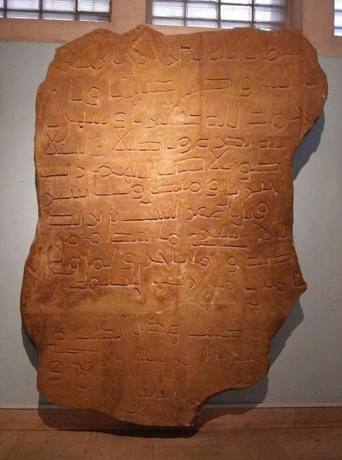
1st c. AH QMI-INS-009a

Inscription of Saʿīd ibn Dhakwān, Client of Muʿāwiyah ibn Abī Sufyān

نقش سعيد بن ذكوان مولى معاوية بن أبي سفيان

SiteNorthwestern Arabia (site as published by the Desert Team)
Writing surfaceSandstone boulder
Lines4
DimensionsUnrecorded
ScriptEarly Kūfic
SubjectBlessing on the Prophet and prayer for the honour of fighting in God’s path, by a client of Muʿāwiyah ibn Abī Sufyān; undated
ReadingClear · nothing restored
Grade 1 of 5. The text is complete; nothing is restored.

Original text (Arabic)

  1. اللهم صلي على محمد عبدك ورسولك وأعظم أجره
  2. وأكرم نزله وكتب سعيد بن ذكوان مولى معاوية
  3. ابن أبي سفيان وهو يسل (يسأل) الله بأفضل ما سله (سأله) عبد من الأولين
  4. والآخرين أن يرزقه شرف القتل (القتال) في سبيله

Translation

  1. O God, bless Muḥammad, Your servant and Your messenger, and make great his reward
  2. and honour his abode. Saʿīd ibn Dhakwān, client of Muʿāwiyah
  3. ibn Abī Sufyān, wrote [this], and he asks God for the best that any servant has asked of Him, of the first
  4. and the last: that He grant him the honour of fighting in His path.

Commentary

A four-line prayer cut across the upper face of a sandstone boulder. The writer first calls down blessing on the Prophet, “Your servant and Your messenger”, asking God to make his reward great and to honour his abode (nuzul). He then names himself, Saʿīd ibn Dhakwān, client (mawlā) of Muʿāwiyah ibn Abī Sufyān, and asks for “the best that any servant has asked of Him, of the first and the last”: the honour of fighting in God’s path. Below the prayer, a framed panel and a short graffito on the left are separate texts by other hands.

The inscription is undated. Its value lies in the patron it names. Muʿāwiyah appears elsewhere in the catalog only by his title, as “the servant of God Muʿāwiyah, Commander of the Faithful”, on the dam of al-Ṭāʾif of 58 AH and in his letter to Marwān ibn al-Ḥakam (QMI-INS-009, QMI-INS-007b); here he is named in full, with his father, by a man of his own household. A client named himself by his patron both during the patron’s life and after it, so the text can be placed only broadly: Muʿāwiyah died in 60 AH, and the script and formulae suit the second half of the first century AH. No Saʿīd ibn Dhakwān, client of Muʿāwiyah, has yet been identified in the biographical literature.

The blessing on Muḥammad as “Your servant and Your messenger” and the request for an honoured nuzul recur in the prayer of Ziyād ibn Dhakwān at Tanūmah, 105 AH, who asks God for Paradise as his nuzul (QMI-INS-055c); the shared name Dhakwān is common, and no link between the two men is implied. The wish to fight, or to die, in God’s path is also voiced by Ḥasan ibn Maysarah in 117 AH (“let me be martyred in Your path”, QMI-INS-055va).

Source: Photograph and reading published by the Desert Team (Farīq al-Ṣaḥrāʾ), alsahra.org (no. 8a). Reading checked against the photograph by Ahmed W. Shaker.

How to cite

Shaker W. Ahmed. “Inscription of Saʿīd ibn Dhakwān, Client of Muʿāwiyah ibn Abī Sufyān” (Cat. No. QMI-INS-009a). QMI, quranmss.com, 2026.

Ḥafnat al-Abyaḍ Inscription⤢ Click to enlarge
64 AH QMI-INS-010

Ḥafnat al-Abyaḍ Inscription

نقش حفنة الأبيض

SiteWādī al-Abyaḍ, near Karbalāʾ, Iraq
Writing surfaceTop of a high cliff
Lines13
Dimensions170 cm / 130 cm (two blocks)
ScriptḤijāzī
SubjectPrayer for forgiveness, opening with taḥmīd/takbīr
ReadingClear · nothing restored
Grade 1 of 5. The text is complete; nothing is restored.

Original text (Arabic)

  1. بسم الله الرحمن الرحيم
  2. الله وكبر (أكبر) كبيرا وا
  3. لحمد لله كثيرا وسبحن (وسبحان) ا
  4. لله بكرة وأصيلا وليلا
  5. طويلا اللهم رب
  6. جبريل وميكل (وميكال) واسر
  7. فيل اغفر لثبت (لثابت) بن يزيد
  8. الأشعري ما تقدم من
  9. ذنبه وما تأخر ولمن قال
  10. آمين آمين رب العلمين (العالمين)
  11. وكتب هذا الكتب (الكتاب) في
  12. شوال من سنة أربع و
  13. ستين

Translation

  1. In the name of God, the Merciful, the Compassionate.
  2. God is greater, greatly, and
  3. praise be to God abundantly, and glory
  4. to God morning and evening and night
  5. long. O God, Lord of
  6. Gabriel, Michael and Isrāfīl,
  7. forgive Thābit ibn Yazīd
  8. al-Ashʿarī his past and
  9. future sins, and whoever says
  10. 'āmīn, āmīn,' Lord of the Worlds.
  11. And this writing was written in
  12. Shawwāl of the year four and
  13. sixty.

Commentary

Discovered in 1949 west of Karbalāʾ, Iraq, by Sayyid ʿIzz al-Dīn al-Ṣundūq, at a spot called Ḥafnat al-Abyaḍ. The text is split into two blocks — ten lines and three — because the rock surface was uneven. It opens with the takbīr and taḥmīd formulas and closes with a prayer echoing a hadith invocation the Prophet used to open night prayer ("O God, Lord of Gabriel, Michael and Isrāfīl..."); the phrase "his past and future sins" echoes Qurʾān 48:2. A rectangular mark in line 5 resembles a Qurʾanic verse-end marker. A plaster cast of the inscription is preserved in the Iraq Museum.

Source: al-Ṣundūq, ʿIzz al-Dīn. "Ḥajar Ḥafnat al-Abyaḍ." Sumer 5 (1949): 213–214.

How to cite

Shaker W. Ahmed. “Ḥafnat al-Abyaḍ Inscription” (Cat. No. QMI-INS-010). QMI, quranmss.com, 2026.

Inscription of Ḥakīm, Client of ʿAbdallāh ibn ʿAmrPhoto: as published in Nevo (1989)⤢ Click to enlarge
c. 65 AH QMI-INS-010a

Inscription of Ḥakīm, Client of ʿAbdallāh ibn ʿAmr

نقش حكيم مولى عبد الله بن عمرو بن العاص

SiteRuḥeibe (Ruheibe), Northern Church, south-western atrium (Loc. 523), al-Naqab
Writing surfaceFlagstone, still in situ
Lines5
DimensionsUnrecorded
ScriptEarly Arabic
SubjectPrayer of mercy for Ḥakīm, client of ʿAbdallāh ibn ʿAmr ibn al-ʿĀṣ
ReadingClear · nothing restored
Grade 1 of 5. The text is complete; nothing is restored.

Original text (Arabic)

  1. يرحمك الله يا حكيم
  2. ابن أبي أسماء مولى
  3. عبد الله ابن
  4. عمرو بن العاص آ
  5. مين رب موسى

Translation

  1. May God have mercy on you, Ḥakīm,
  2. son of Abū Asmāʾ, client (mawlā) of
  3. ʿAbdallāh ibn
  4. ʿAmr ibn al-ʿĀṣ. Amen,
  5. Lord of Moses.

Commentary

A prayer of mercy for a man named Ḥakīm ibn Abī Asmāʾ, who describes himself as the client (mawlā) of ʿAbdallāh ibn ʿAmr ibn al-ʿĀṣ. It was found by Yehuda Nevo at Ruḥeibe in al-Naqab, on a flagstone still in place in the south-western part of the atrium of the Northern Church (Loc. 523); the letters are carefully and clearly cut. The slab also carries the outline of a foot, and the text ends with āmīn rabb Mūsā (“Amen, Lord of Moses”), followed by an illegible trace; compare the prayers from al-Naqab of Ward ibn Sālim, which asks “the Lord of Moses and Aaron” (QMI-INS-055ka), and of Ḥasan ibn Maysarah (QMI-INS-055va).

The inscription carries no date. It is placed here by the lifetime of the patron, as the catalog dates a text by the person it names. ʿAbdallāh ibn ʿAmr ibn al-ʿĀṣ, the Companion and scholar, son of the conqueror of Palestine and Egypt, is presumed to be the man meant (Lecker 1989); the sources disagree on the year of his death, giving 63, 65 and 69 AH (the dates also reported run to the early 70s), and 65 AH is the year used for the placement. This is a terminus for the life of the patron, not for the writing: a client could name his patron after the patron’s death, so the true date may be somewhat later. Lecker notes that no other literary or archaeological source mentions this Ḥakīm, and that the family had strong ties with Palestine: ʿAmr ibn al-ʿĀṣ held an estate (qaṣr) there, and ʿAbdallāh was present in Palestine in the years after the Battle of the Camel. The patron’s father is attested in a document of his own lifetime: the Greek papyrus PERF 556, a letter of 13 Tybi of the first indiction (Ṣafar 22 AH / January 643 CE) to the pagarch of Heracleopolis in Egypt, issued by “Ambros”, that is ʿAmr, as governor, with his clay seal still attached (Vienna, Papyrussammlung; Grohmann, From the World of Arabic Papyri, Cairo 1952, pp. 115–116).

Source: Nevo, Yehuda D. “A New Negev Arabic Inscription.” Bulletin of the School of Oriental and African Studies 52, no. 1 (1989): 18–23. Lecker, Michael. “The Estates of ʿAmr b. al-ʿĀṣ in Palestine: Notes on a New Negev Arabic Inscription.” Bulletin of the School of Oriental and African Studies 52, no. 1 (1989): 24–37.

How to cite

Shaker W. Ahmed. “Inscription of Ḥakīm, Client of ʿAbdallāh ibn ʿAmr” (Cat. No. QMI-INS-010a). QMI, quranmss.com, 2026.

Inscription of al-Ḥārith ibn Khālid ibn al-ʿĀṣ, al-Bāḥah: photographPhoto: after Alhatlani (2021)⤢ Click to enlarge
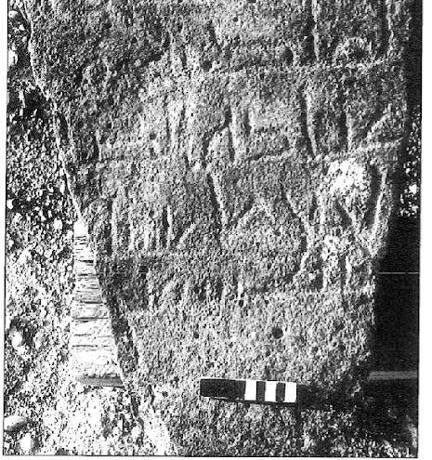
before c. 85 AH QMI-INS-004cc

Inscription of al-Ḥārith ibn Khālid ibn al-ʿĀṣ, al-Bāḥah

نقش الحارث بن خالد بن العاص، الباحة

SiteWādī Khara, al-Bāḥah region, Saudi Arabia
Writing surfaceRock face
Lines2
Dimensions135 × 15 cm
ScriptḤijāzī
SubjectFirst-person prayer for forgiveness by al-Ḥārith, son of the Companion Khālid ibn al-ʿĀṣ; undated
ReadingClear · nothing restored
Grade 1 of 5. The text is complete; nothing is restored.

Original text (Arabic)

  1. أنا الحرث (الحارث) بن خلد (خالد) بن العص (العاص) أستغفر
  2. ربي

Translation

  1. I, al-Ḥārith ibn Khālid ibn al-ʿĀṣ, ask forgiveness
  2. of my Lord.

Commentary

A long single line, 135 cm across, with the last word set below it: “I, al-Ḥārith ibn Khālid ibn al-ʿĀṣ, ask forgiveness of my Lord.” The wording repeats his father's prayer on a nearby boulder, astaghfiru rabbī (QMI-INS-004c), and all three names are written without the long alif: الحرث, خلد, العص.

Alhatlani dates the text to the first century AH. In the published photograph the beginning of his brother ʿAbd al-Raḥmān's prayer appears directly below this line (QMI-INS-004cb), so the two brothers seem to have written on the same rock.

The Makhzūmī family of Khālid ibn al-ʿĀṣ ibn Hishām is unusually well represented on the rocks of Wādī Khara: the Companion himself (QMI-INS-004c), a prayer for him written by one Ziyād (QMI-INS-004ca), his sons ʿAbd al-Raḥmān and al-Ḥārith (QMI-INS-004cb, QMI-INS-004cc), and his grandson Ismāʿīl ibn ʿAbd al-Raḥmān (QMI-INS-004cd, QMI-INS-004ce). ʿAbd al-Raḥmān also left a text dated 40 AH on the road north-east of Mecca (QMI-INS-005).

Dating. al-Ḥārith, son of Khālid by Fāṭimah bint Abī Saʿīd ibn al-Ḥārith, was a poet and governor of Mecca. He held the post under Yazīd I until the rising of ʿAbd Allāh ibn al-Zubayr, was reinstated after Ibn al-Zubayr's defeat in 73 AH, and was later removed by ʿAbd al-Malik (al-Zubayr ibn Bakkār, Jamharat nasab Quraysh). The sources give no year of death; Qashshāsh suggests that he died after 80 AH. The prayer therefore falls within his adult life, before c. 80–85 AH, and is placed here in the decades of his governorship (Alhatlani (2021), pp. 74–76).

Source: Qashshāsh, Aḥmad ibn Saʿīd. Nuqūsh al-ṣaḥābī al-jalīl Khālid ibn al-ʿĀṣ wa-abnāʾihi fī manṭiqat al-Bāḥah. 1st ed., 2015, pp. 42–43; Alhatlani, Abdullah Saad. Descendants and Ancestors: A Study of Arabic Inscriptions from the Arabian Peninsula (1st–4th c. AH/7th–10th c. CE). PhD thesis, Leiden University, 2021 (hdl.handle.net/1887/3217834), ch. 1, no. 7, p. 219 (photograph).

How to cite

Shaker W. Ahmed. “Inscription of al-Ḥārith ibn Khālid ibn al-ʿĀṣ, al-Bāḥah” (Cat. No. QMI-INS-004cc). QMI, quranmss.com, 2026.

Inscription of ʿĀʾishah⤢ Click to enlarge
70 AH QMI-INS-011

Inscription of ʿĀʾishah

نقش عائشة

SiteUmm al-Quṭayn, Jordan
Writing surfaceBasalt stone
Lines5
Dimensions75.5 × 44 cm
ScriptḤijāzī
SubjectPrayer for mercy (for a woman)
ReadingClear · nothing restored
Grade 1 of 5. The text is complete; nothing is restored.

Original text (Arabic)

  1. صلى الله وا
  2. لملائكة و
  3. عباده الصا
  4. لحين على عائشة
  5. سنت (سنة) سبعن (سبعين)

Translation

  1. May God and
  2. His angels, and
  3. His righteous
  4. servants, bless ʿĀʾishah —
  5. [written in the] year seventy.

Commentary

A prayer for a woman named ʿĀʾishah — possibly, though not certainly, ʿĀʾishah bint Abī Bakr, the only Companion recorded under that name. The scribe misspelled "al-malāʾikah" (the angels) by transposing the kāf and yāʾ, and the text is otherwise free of diacritical dots. "Sanah" (year) is spelled with an open tāʾ, and "sabʿīn" (seventy) without its medial yāʾ — orthographic habits shared with several other inscriptions in this corpus.

Another woman’s text, by the daughter of the caliph Hishām, is QMI-INS-055ae.

Source: al-Ḥiṣṣān, ʿAbd al-Qādir Maḥmūd. "Mukhtārāt min al-Nuqūsh wa-al-Kitābāt al-Muktashafah fī al-Mafraq wa-Maʿān." Ḥawliyyat Dāʾirat al-Āthār al-ʿĀmmah 50 (2006): 15–44.

How to cite

Shaker W. Ahmed. “Inscription of ʿĀʾishah” (Cat. No. QMI-INS-011). QMI, quranmss.com, 2026.

Gravestone of ʿAbbāsah bint Jurayj, AswānPhoto: museum collection (credit to be confirmed)⤢ Click to enlarge
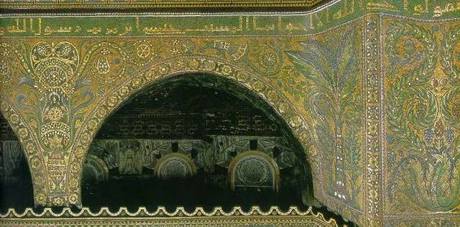
71 AH QMI-INS-011a

Gravestone of ʿAbbāsah bint Jurayj, Aswān

شاهد قبر عباسة بنت جريج، أسوان

SiteAswān cemetery, Upper Egypt; Museum of Islamic Art, Cairo
Writing surfaceSandstone gravestone
Lines14
DimensionsUnrecorded
ScriptKūfic
SubjectEpitaph of ʿAbbāsah bint Jurayj ibn Sanad, dated Monday, 14 Dhū al-Qaʿdah 71 AH as written; a later date (171 AH) has been proposed
ReadingClear · nothing restored
Grade 1 of 5. The text is complete; nothing is restored.

Original text (Arabic)

  1. بسم الله الرحمن الرحيم
  2. ان اعظم مصائب أهل الا
  3. سلام مصيبتهم بالنبي محمد
  4. صلى الله عليه وسلم
  5. هذا قبر عباسة ابنت (ابنة)
  6. جريج بن سند رحمت (رحمة) الله
  7. ومغفرته ورضوانه عليها
  8. توفيت يوم الاثنين لاربع
  9. عشر خلون من ذي القعدة
  10. سنة احدى وسبعين
  11. وهي تشهد ألا إله إلا الله
  12. وحده لا شريك له وأن
  13. محمدا عبده ورسوله
  14. صلى الله عليه وسلم

Translation

  1. In the name of God, the Compassionate, the Merciful.
  2. The greatest calamity of the people of
  3. Islam is their loss of the Prophet Muḥammad,
  4. may God bless him and grant him peace.
  5. This is the grave of ʿAbbāsah daughter of
  6. Jurayj ibn Sanad. The mercy of God,
  7. His forgiveness and His good pleasure be upon her.
  8. She died on Monday, with four-
  9. teen nights elapsed of Dhū al-Qaʿdah,
  10. in the year seventy-one,
  11. bearing witness that there is no god but God
  12. alone; He has no partner; and that
  13. Muḥammad is His servant and His messenger,
  14. may God bless him and grant him peace.

Commentary

A sandstone gravestone from the cemetery of Aswān, dated Monday, 14 Dhū al-Qaʿdah of the year seventy-one (19 April 691 CE). It opens not with the dead but with the Prophet: “the greatest calamity of the people of Islam is their loss of the Prophet Muḥammad”, a thought that consoles the mourners by setting every later loss beside his. It then names ʿAbbāsah, daughter of Jurayj ibn Sanad, and closes with her profession of faith, “that there is no god but God alone; He has no partner; and that Muḥammad is His servant and His messenger”. The name Jurayj is borne by several clients of non-Arab origin in the early sources. Two words keep the open tāʾ of the feminine, ibnat for ibnah and raḥmat Allāh for raḥmah, a spelling found in the inscription of ʿAbd al-Raḥmān ibn Khālid of 40 AH and in the Dome of the Rock (QMI-INS-005), and al-islām is divided across the line end after its article (al-/islām).

The year is written iḥdā wa-sabʿīn, “seventy-one”, without a word for the hundred. It has been proposed that the hundred was left out and that the stone belongs to 171 AH or later, because its ruled layout, its opening formula and the phrase “the people of Islam” are otherwise known from Aswān gravestones of the second and third centuries. The dated inscriptions of this catalog allow some observations. The profession of faith, with waḥdahu lā sharīka lahu and ʿabduhu wa-rasūluhu, is the wording of the Dome of the Rock in 72 AH and of the road inscription at ʿAqabat Fīq in 73 AH (QMI-INS-012, QMI-INS-014a). A personal prayer of 80 AH already blesses the Prophet and asks for his intercession (QMI-INS-023), and the Egyptian practice of dated gravestones reaches back to 31 AH (QMI-INS-004). The thought that the Prophet’s death is the greatest of calamities is transmitted from Successors of this generation, as in the mursal reports of Mālik’s Muwaṭṭaʾ and al-Dārimī’s Sunan. On the other side, the collective phrase ahl al-islām has no dated parallel in this catalog before the second century, where “the Muslims” first appear as a community in 107 AH and a writer calls his religion al-islām in 119 AH (QMI-INS-055g, QMI-INS-055kb).

Single texts often run ahead of their series. The gravestone of 31 AH already asks whoever reads it to pray for the dead and say āmīn, a request that recurs on dated stones only from 64 AH onward, and the long invocation of Ḥafnat al-Abyaḍ in 64 AH, addressed to “the Lord of Gabriel, Michael and Isrāfīl”, has no parallel at all among the dated inscriptions (QMI-INS-004, QMI-INS-010). The hand of the Aswān stone is plain and crowded, without the ornamental terminals that become common in Egyptian epitaphs of the third century. Nothing in the wording is therefore impossible for 71 AH, and the stone is kept here under the date it gives; the later date remains a possibility that only further dated parallels can settle. Its formulae continue in the Aswān gravestone of Fāṭimah bint al-Ḥasan of 102 AH (QMI-INS-055tb).

Source: El-Hawary, Hassan Mohammed. “The Second Oldest Islamic Monument Known, Dated A.H. 71 (A.D. 691), from the Time of the Omayyad Calif ʿAbd-el-Malik ibn Marwān.” Journal of the Royal Asiatic Society (1932): 289 ff.; Bacharach, Jere L., and Sherif Anwar. “Early Versions of the shahāda: A Tombstone from Aswan of 71 A.H., the Dome of the Rock, and Contemporary Coinage.” Der Islam 89 (2012). On the later date: Hoyland, Robert G. Seeing Islam as Others Saw It (1997), 695 n. 29. Museum of Islamic Art, Cairo. Reading and line division after El-Hawary (1932).

How to cite

Shaker W. Ahmed. “Gravestone of ʿAbbāsah bint Jurayj, Aswān” (Cat. No. QMI-INS-011a). QMI, quranmss.com, 2026.

Dome of the Rock Inscription (Inner Octagon)⤢ Click to enlarge
72 AH QMI-INS-012

Dome of the Rock Inscription (Inner Octagon)

كتابات قبة الصخرة (المثمن الداخلي)

SiteDome of the Rock, Jerusalem
Writing surfaceInner octagonal arcade
Lines24
DimensionsUnrecorded
ScriptKūfī
SubjectQurʾanic verses and devotional formulas
ReadingClear · nothing restored
Grade 1 of 5. The text is complete; nothing is restored.

Original text (Arabic)

  1. بسم الله الرحمن الرحيم لا إله الا الله وحده لا
  2. شريك له له الملك وله الحمد يحي ويميت وهو
  3. على كل شي قدير محمد عبد الله ورسوله
  4. ان الله وملئكته يصلون على النبي يايها الذين امنوا
  5. صلوا عليه وسلموا تسليما صلى الله عليه والسلم
  6. عليه ورحمت الله ياهل الكتاب لا تغلوا في دينكم
  7. ولا تقولوا على الله الا الحق انما المسيح عيسى ابن
  8. مريم رسول الله وكلمته القيـها الى مريم وروح
  9. منه فامنوا بالله ورسله ولا تقولوا ثلثة انتهوا
  10. خيرا لكم انما الله اله وحد سبحنه ان يكون له ولد
  11. له ما في السموت وما في الأرض وكفى بالله
  12. وكيلا لن يستنكف المسيح أن يكون
  13. عبد الله ولا الملـكة المقربون ومن يستنكف
  14. عن عبدته ويستكبر فسيحشرهم اليه جميعا
  15. اللهم صلي على رسولك وعبدك عيسى
  16. ابن مريم والسلم عليه يوم ولد ويوم يموت
  17. ويوم يبعث حيا ذلك عيسى ابن مريم قول الحق
  18. الذي فيه تمترون ما كان لله ان يتخذ ولدا سبحنه
  19. اذا قضى امرا انما يقول له كن فيكون ان الله ربي وربكم
  20. فاعبدوه هذا صراط مستقيم شهد الله انه لا اله
  21. الا هو والملئكة والوا العلم قـما بالقسط لا اله الا هو
  22. العزيز الحكيم ان الدين عند الله الاسلم وما اختلف الذين
  23. اوتوا الكتب الا من بعد ما جاهم العلم بغيا بينهم ومن
  24. يكفر باييات الله فان الله سريع الحساب

Commentary

A 24-line mosaic band running around the inner octagonal arcade of the Dome of the Rock, dated 72 AH — among the earliest surviving monumental Qurʾanic inscriptions. The Arabic reading is given in full above, without a translation; in outline, the band opens with the basmalah and the declaration of God's oneness, then quotes portions of Sūrat al-Taghābun (64:10), al-Aḥzāb (33:56), al-Nisāʾ (4:171–172), Maryam (19:15 and 34–36), and Āl ʿImrān (3:18–19), interspersed with blessings on the Prophet Muḥammad and on Jesus son of Mary (ʿĪsā ibn Maryam). The Nisāʾ and Maryam passages explicitly affirm Jesus as a messenger and "word" of God while rejecting the doctrine of the Trinity — a theological statement addressed to Jerusalem's Christian population at the time of the building's construction under the caliph ʿAbd al-Malik ibn Marwān. One word, tamtarūn ("you doubt," in the second person, line 18), preserves a Qurʾanic reading variant transmitted by several Companions and Successors rather than the second-person-absent form (yamtarūn) standard in the Ḥafṣ-ʿan-ʿĀṣim recitation used in most printed Qurʾāns today — arguably the oldest surviving physical evidence for this variant reading in a dated inscription.

Source: Kessler, Christel. "ʿAbd al-Malik's Inscription in the Dome of the Rock: A Reconsideration." Journal of the Royal Asiatic Society of Great Britain and Ireland, no. 1 (1970): 2–14.

How to cite

Shaker W. Ahmed. “Dome of the Rock Inscription (Inner Octagon)” (Cat. No. QMI-INS-012). QMI, quranmss.com, 2026.

Dome of the Rock Inscription (Outer Octagon)⤢ Click to enlarge
72 AH QMI-INS-013

Dome of the Rock Inscription (Outer Octagon)

كتابات قبة الصخرة (المثمن الخارجي)

SiteDome of the Rock, Jerusalem
Writing surfaceOuter octagonal arcade
Lines24
DimensionsUnrecorded
ScriptḤijāzī
SubjectQurʾanic verses, blessings, and a later political alteration
ReadingLargely clear · a few letters restored
Grade 2 of 5. Nearly complete; a few letters are restored by the editor.

Original text (Arabic)

  1. بسم الله الرحمن الرحيم لا اله الا لله وحده لا شريك
  2. له قل هو الله احد الله الصمد لم يلد ولم يولد ولم
  3. يكن له كفوا حد محمد رسول الله صلى الله عليه •
  4. بسم الله الرحمن الرحيم لا اله الا الله
  5. وحده لا شريك له محمد رسول الله
  6. ان الله وملئكته يصلون على النبي
  7. يا يها الذين امنوا صلوا عليه وسلموا
  8. تسليما • بسم الله الرحمن
  9. الرحيم لا اله الا اله وحده الحمد
  10. لله الذي لم يتخذ ولدا ولم لكن له
  11. شريك في الملك ولم يكن له ولي
  12. من الذل وكبره تكبيرا محمد رسول الـ
  13. له صلى الله عليه وملئكته ورسله والسلم
  14. عليه ورحمت الله • بسم الله الرحمن
  15. الرحيم لا اله الا الله وحده لا شريك له
  16. له الملك وله الحمد يحي ويميت وهو على
  17. كل شي قدير محمد رسول الله صلى الله
  18. عليه وتقبل شفعته يوم القيمة في امته •
  19. بسم الله الرحمن الرحيم لا إله الا الله وحده
  20. لا شريك له محمد رسول الله صلى الله
  21. عليه • بنى هذه القبة عبد
  22. ]الله الامام المأمون امير المؤمنين[ في سنة
  23. اثنين وسبعين تقبل الله منه ورضي
  24. عنه امين رب العلمين لله الحمد •

Commentary

The companion 24-line mosaic band on the outer octagonal arcade, also dated 72 AH. The Arabic reading is given in full above, without a translation; in outline, it repeats the basmalah and declaration of God's oneness several times, quotes Sūrat al-Ikhlāṣ (112) in full, and portions of al-Aḥzāb (33:56), al-Isrāʾ (17:111) and al-Taghābun (64:1), interspersed four times with the blessing formula on the Prophet Muḥammad ("Muḥammad rasūl Allāh, ṣallā Allāh ʿalayhi..."). The final three lines record the building's founder and date — originally naming the Umayyad caliph ʿAbd al-Malik ibn Marwān, but later physically altered: the Abbasid caliph al-Maʾmūn had ʿAbd al-Malik's name replaced with his own ("al-Imām al-Maʾmūn, Amīr al-Muʾminīn") without changing the original construction date of 72 AH still visible in the text — leaving an inscription that anachronistically credits al-Maʾmūn (who did not become caliph until 198 AH) with a building completed over a century earlier. This is one of the earliest and best-documented cases of an inscription being deliberately altered for political credit in Islamic history.

Source: Kessler, Christel. "ʿAbd al-Malik's Inscription in the Dome of the Rock: A Reconsideration." Journal of the Royal Asiatic Society of Great Britain and Ireland, no. 1 (1970): 2–14.

How to cite

Shaker W. Ahmed. “Dome of the Rock Inscription (Outer Octagon)” (Cat. No. QMI-INS-013). QMI, quranmss.com, 2026.

Copper plaque from the east door of the Dome of the RockPhoto: after Salameh (2024)⤢ Click to enlarge
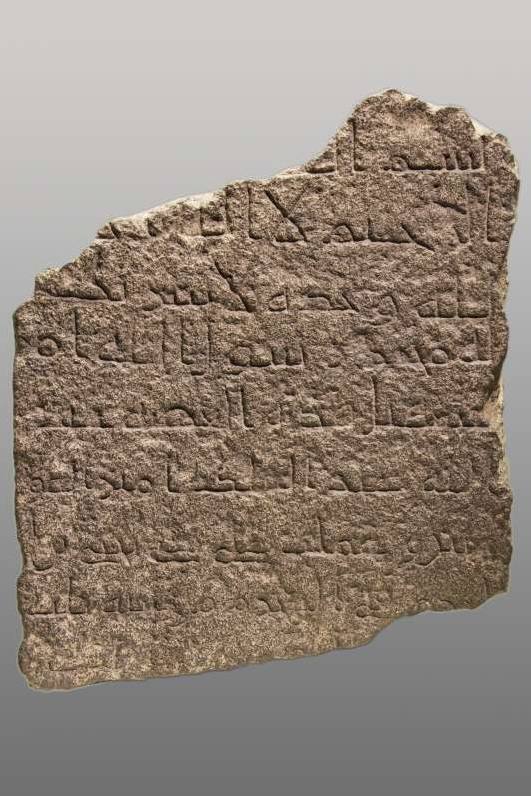
c. 72 AH QMI-INS-014

Copper Plaque over the East Door of the Dome of the Rock

اللوحة النحاسية على الباب الشرقي لقبة الصخرة

SiteDome of the Rock, Jerusalem
Writing surfaceCopper plaque, repoussé, letters gilded on a blue ground
Lines9: 7 Umayyad, 2 added under al-Maʾmūn
Dimensions247.5 × 72 cm (inside the frame)
ScriptEarly Kūfic; the added lines in a smaller, rounder hand
SubjectPraise of God’s oneness and sovereignty in Qurʾanic phrases, and a prayer for the Prophet’s intercession; name and date of al-Maʾmūn added in 216 AH
Present locationIslamic Museum, al-Ḥaram al-Sharīf, Jerusalem
ReadingLargely clear · last Umayyad line cut away
Grade 2 of 5. The seven surviving Umayyad lines are clear; the eighth was cut away when al-Maʾmūn’s text was added.

Original text (Arabic)

Lines in colour: addition made under al-Maʾmūn, 216 AH

  1. بسم الله الرحمن الرحيم الحمد لله الذي لا اله الا هو الحي القيوم بديع السموت (السماوات) والارض ونور السموت
  2. والارض وقيم السموت والارض الاحد الصمد لم يلد ولم يولد ولم يكن له كفوا احد ملك ا
  3. لملك تؤتي الملك من تشا (تشاء) وتنزع الملك ممن تشا كل ملك لك ومنك ربنا واليك مصيره رب العزة
  4. الرحمن الرحيم كتب على نفسه الرحمة وسعت رحمته كل شيء سبحنه (سبحانه) وتعلى (وتعالى) عما يشركون نسئلك (نسألك) اللهم بر
  5. حمتك واسمائك الحسنى وبوجهك الكريم وسلطنك (وسلطانك) العظيم وبكلمتك التامة التي بها تقوم السموت والارض و
  6. بها تعصم برحمتك من الشيطن (الشيطان) وتنجي بها من عذابك يوم القيمة (القيامة) وبنعمتك السبغة (السابغة) وفضلك العظيم وبحلمك وقدر
  7. تك وعفوك وبجودك ان تصلي على محمد عبدك ونبيك وتتقبل شفعته (شفاعته) في امته صلى الله عليه والسلم (والسلام) عليه ورحمت (ورحمة) الله و
  8. مما امر به عبد الله عبد الله الامام المامون (المأمون) امير المومنين (المؤمنين) اطال الله بقاه (بقاءه) في ولاية اخي امير المومنين ابي اسحق (إسحاق) بن امير المومنين / مما امر به عبد الله عبد الله الامام المامون امير المومنين اطال الله بقاه في ولاية اخي امير المومنين ابي
  9. المومنين الرشيد ابقاه الله وجرا (وجرى) على يدي صلح (صالح) بن يحيى مولى امير المومنين في شهر ربيع الاخر سنة ست عشرة وماتين (ومائتين) / اسحق بن امير المومنين الرشيد ابقاه الله وجرا على يدي صلح بن يحيى مولى امير المومنين في شهر ربيع الاخر سنة ست عشرة وماتين

Translation

  1. In the name of God, the Merciful, the Compassionate. Praise be to God; there is no god but He, the Living, the Self-Subsisting, Originator of the heavens and the earth, and Light of the heavens
  2. and the earth, Sustainer of the heavens and the earth, the One, the Eternal; He begets not, nor was He begotten, and there is none equal to Him. Mas-
  3. ter of sovereignty, You give sovereignty to whom You will and take sovereignty from whom You will. All sovereignty is Yours and from You, our Lord, and to You is its return, Lord of might,
  4. the Merciful, the Compassionate. He has prescribed mercy for Himself; His mercy embraces all things. Glory be to Him, exalted is He above what they associate with Him. We ask You, O God, by
  5. Your mercy, by Your beautiful names, by Your noble face, by Your mighty authority, and by Your perfect word, by which the heavens and the earth stand, and
  6. by which, through Your mercy, You protect from Satan and save from Your punishment on the Day of Resurrection; and by Your abundant favour, Your great bounty, Your forbearance, Your power,
  7. Your pardon and Your generosity, that You bless Muḥammad, Your servant and Your prophet, and accept his intercession for his community. God bless him, and peace be upon him, and the mercy of God, and …
  8. Among what the servant of God ʿAbdallāh, the imam al-Maʾmūn, Commander of the Faithful, ordered, may God prolong his life, under the governorship of the brother of the Commander of the Faithful, Abū Isḥāq, son of the Commander
  9. of the Faithful al-Rashīd, may God preserve him; carried out by Ṣāliḥ ibn Yaḥyā, client of the Commander of the Faithful, in the month of Rabīʿ al-Ākhir of the year two hundred and sixteen.

Commentary

One of two copper plaques that were set above the inner side of the doors of the Dome of the Rock, facing those who entered; both are now in the Islamic Museum of the Ḥaram in Jerusalem. The letters are raised in repoussé, hammered from behind over a carved model, and were gilded on a blue ground. This, the larger plaque, hung over the east door. It is made of four pieces of metal: two original panels carrying the Umayyad text, and two narrow strips fixed below them later. Inside its frame it measures 247.5 × 72 cm.

The seven Umayyad lines are a composition, not a sequence of whole verses. They weave phrases from the Throne Verse (Q 2:255), from Q 2:117 and 24:35 (“Originator of the heavens and the earth”, “Light of the heavens and the earth”), from Sūrat al-Ikhlāṣ (Q 112) and from Q 3:26 (“Master of sovereignty, You give sovereignty to whom You will…”) into a single hymn on God’s oneness and kingship. A prayer follows, asking God by His names, His face and His perfect word to bless Muḥammad and to accept his intercession for his community, a petition that the mosaic band of the outer octagon also makes (QMI-INS-013). Stone spellings are those of the period: al-samawāt without its long vowels, raḥmat with open tāʾ, and “Master” (mālik) written mlk, its word divided across lines 2 and 3.

The eighth Umayyad line was cut away, and with it, almost certainly, the name of the caliph ʿAbd al-Malik. In its place two strips were added, each carrying two lines in a smaller and less regular hand, shown here in colour. They state that the work was ordered by “the servant of God ʿAbdallāh, the imam al-Maʾmūn”, under the governorship of his brother Abū Isḥāq (the later caliph al-Muʿtaṣim), and carried out by Ṣāliḥ ibn Yaḥyā, client of the Commander of the Faithful, in Rabīʿ al-Ākhir 216 AH. The same text is written twice, once on each strip, and the right-hand copy repeats the word al-muʾminīn at the end of one line and the start of the next. The new text names no building work and quotes no scripture; it adds a name and a date. In the mosaic band of the octagon the same substitution was made: al-Maʾmūn’s name replaced ʿAbd al-Malik’s, while the year 72 was left in place (QMI-INS-012).

Khader Salameh, who studied both plaques, notes the remains of cut letters at the foot of the original panels and a final wa- (“and”) left hanging at the end of line 7, its continuation lost with the eighth line. He suggests that the change was ordered by the governor Abū Isḥāq in anticipation of al-Maʾmūn’s visit to Syria and Egypt in 216–217 AH; Ṣāliḥ ibn Yaḥyā is not identified in the sources. The Umayyad text bears no surviving date; the catalog places it with the foundation of the building in 72 AH. Its companion over the north door is QMI-INS-014g.

Source: Khader Salameh, al-Nuqūsh fī al-Matḥaf al-Islāmī maʿa nuqūsh Qubbat al-Ṣakhrah al-Umawiyyah (Jerusalem: al-Maktabah al-Khālidiyyah, 2024), pp. 57–73, esp. 67–71; photograph from the same. See also Max van Berchem, Matériaux pour un Corpus Inscriptionum Arabicarum, II: Syrie du Sud, Jérusalem, Ḥaram.

How to cite

Shaker W. Ahmed. “Copper Plaque over the East Door of the Dome of the Rock” (Cat. No. QMI-INS-014). QMI, quranmss.com, 2026.

Copper plaque from the north door of the Dome of the RockPhoto: after Salameh (2024)⤢ Click to enlarge
c. 72 AH QMI-INS-014g

Copper Plaque over the North Door of the Dome of the Rock

اللوحة النحاسية على الباب الشمالي لقبة الصخرة

SiteDome of the Rock, Jerusalem
Writing surfaceCopper plaque, repoussé, letters gilded on a blue ground
Lines6: 4 Umayyad, 2 added under al-Maʾmūn
Dimensions238 × 52 cm (inside the frame)
ScriptEarly Kūfic; the added lines in a smaller, rounder hand
SubjectQurʾanic profession of God’s oneness and of Muḥammad’s mission; name and date of al-Maʾmūn added in 216 AH
Present locationIslamic Museum, al-Ḥaram al-Sharīf, Jerusalem
ReadingClear · nothing restored
Grade 1 of 5. The text is complete; nothing is restored.

Original text (Arabic)

Lines in colour: addition made under al-Maʾmūn, 216 AH

  1. بسم الله الرحمن الرحيم الحمد لله الذي لا اله الا هو الحي القيوم لا شريك له الاحد الصمد لم يلد ولم
  2. يولد ولم يكن له كفوا احد محمد عبد الله ورسوله ارسله الله بالهدى ودين الحق ليظهره على الدين كله
  3. ولو كره المشركون امنا بالله وبما انزل على محمد وبما (وما) اوتي النبيون من ربهم لا نفرق بين احد منهم ونحن
  4. له مسلمون صلى الله على محمد عبده ونبيه والسلم (والسلام) عليه ورحمت (ورحمة) الله وبركته (وبركاته) ومغفرته ورضونه (ورضوانه)
  5. مما امر به عبد الله عبد الله الامام المامون (المأمون) امير المومنين (المؤمنين) اطال الله بقاه (بقاءه) في ولاية اخي امير المومنين ابي اسحق (إسحاق) بن امير / مما امر به عبد الله عبد الله الامام المامون امير المومنين اطال الله بقاه في ولاية اخي امير المومنين ابي اسحق بن امير
  6. المومنين الرشيد ابقاه الله وجرا (وجرى) على يدي صلح (صالح) بن يحيى مولى امير المومنين في شهر ربيع الاخر سنة ست عشرة ومايتين (ومائتين) / المومنين الرشيد ابقاه الله وجرا على يدي صلح بن يحيى مولى امير المومنين في شهر ربيع الاخر سنة ست عشرة ومايتين

Translation

  1. In the name of God, the Merciful, the Compassionate. Praise be to God; there is no god but He, the Living, the Self-Subsisting; He has no partner; the One, the Eternal; He begets not, nor
  2. was He begotten, and there is none equal to Him. Muḥammad is the servant of God and His messenger, whom God sent with the guidance and the religion of truth, to make it prevail over all religion,
  3. even though the polytheists dislike it. We believe in God and in what was sent down to Muḥammad and in what was given to the prophets from their Lord; we make no distinction between any of them, and to Him
  4. we submit. God bless Muḥammad, His servant and His prophet, and peace be upon him, and the mercy of God, His blessings, His forgiveness and His good pleasure.
  5. Among what the servant of God ʿAbdallāh, the imam al-Maʾmūn, Commander of the Faithful, ordered, may God prolong his life, under the governorship of the brother of the Commander of the Faithful, Abū Isḥāq, son of the Commander
  6. of the Faithful al-Rashīd, may God preserve him; carried out by Ṣāliḥ ibn Yaḥyā, client of the Commander of the Faithful, in the month of Rabīʿ al-Ākhir of the year two hundred and sixteen.

Commentary

The smaller of the two copper plaques from the doors of the Dome of the Rock, which hung above the inner side of the north door; it is now in the Islamic Museum of the Ḥaram in Jerusalem. Like its companion over the east door (QMI-INS-014), its letters are raised in gilded repoussé on a blue ground. Inside its frame it measures 238 × 52 cm; the two original panels measure about 120.5 × 37 and 121.5–122 × 35.4–37 cm.

Four Umayyad lines survive. They open with the basmalah and the words of the Throne Verse (Q 2:255), continue with “He has no partner” (Q 6:163) and Sūrat al-Ikhlāṣ (Q 112:2–4), and then turn to the Prophet: “Muḥammad is the servant of God and His messenger”, followed by Q 61:9 (“whom God sent with the guidance and the religion of truth…”) and the creed of Q 2:136 (“we make no distinction between any of them”). Where the Qurʾān reads wa-mā ūtiya, the plaque has wa-bi-mā, echoing the preceding wa-bi-mā unzila. The text closes with a blessing on Muḥammad, “His servant and His prophet”. The same themes of God’s oneness and the Prophet’s mission run through the mosaic bands of the octagon (QMI-INS-012, QMI-INS-013).

Below the Umayyad text, two lines naming al-Maʾmūn were added, shown here in colour: “Among what the servant of God ʿAbdallāh, the imam al-Maʾmūn, ordered… under the governorship of the brother of the Commander of the Faithful, Abū Isḥāq… carried out by Ṣāliḥ ibn Yaḥyā, client of the Commander of the Faithful, in Rabīʿ al-Ākhir of the year 216.” As on the east plaque, the text is written twice side by side and its hand is smaller and closer to the rounded script than the Umayyad Kūfic above. Salameh argues that what was cut away was a two-line text, most likely bearing the name of ʿAbd al-Malik, and that the repeated copy was made to fill a space cut for the original line. The Umayyad text bears no surviving date; the catalog places it with the foundation of the building in 72 AH.

Source: Khader Salameh, al-Nuqūsh fī al-Matḥaf al-Islāmī maʿa nuqūsh Qubbat al-Ṣakhrah al-Umawiyyah (Jerusalem: al-Maktabah al-Khālidiyyah, 2024), pp. 57–66; photograph from the same. See also Max van Berchem, Matériaux pour un Corpus Inscriptionum Arabicarum, II: Syrie du Sud, Jérusalem, Ḥaram.

How to cite

Shaker W. Ahmed. “Copper Plaque over the North Door of the Dome of the Rock” (Cat. No. QMI-INS-014g). QMI, quranmss.com, 2026.

Road Inscription of ʿAbd al-Malik at ʿAqabat FīqPhotograph: museum photograph⤢ Click to enlarge
73 AH QMI-INS-014a

Road Inscription of ʿAbd al-Malik at ʿAqabat Fīq

نقش تسهيل عقبة فيق (عبد الملك)

SiteʿAqabat Fīq, Golan, above the Lake Tiberias
Writing surfaceBasalt slab
Lines9
DimensionsUnrecorded
ScriptKūfic
SubjectRoad-building inscription of the caliph ʿAbd al-Malik, dated Muḥarram 73 AH
ReadingClear · nothing restored
Grade 1 of 5. The text is complete; nothing is restored.

Original text (Arabic)

  1. بسم الله الرحمن
  2. الرحيم لا إله إلا
  3. الله وحده لا شريك
  4. له محمد رسول الله أمر
  5. بتسهيل هذه العقبة عبد
  6. الله عبد الملك أمير المؤ
  7. منين وعملت على يدي يحيى بن
  8. الحكم في المحرم من سنة ثلث
  9. وسبعين تقبله الله منه آمين

Translation

  1. In the name of God, the Most Gracious,
  2. the Most Merciful. There is no god but
  3. God alone; He has no partner;
  4. Muḥammad is the messenger of God. The servant of God ʿAbd al-Malik,
  5. Commander of the Faith-
  6. ful, ordered the levelling of this mountain pass,
  7. and it was made at the hands of Yaḥyā ibn
  8. al-Ḥakam, in Muḥarram of the year seventy-
  9. three. May God accept it from him. Amen.

Commentary

The oldest known Islamic inscription commemorating the building of a road. It records that the caliph ʿAbd al-Malik ordered the “levelling” (tashīl) of this pass — the steep ascent of Fīq, by which the road from the Lake Tiberias climbed to the Golan on the way to Damascus — and that the work was carried out under Yaḥyā ibn al-Ḥakam, brother of the caliph Marwān I and so ʿAbd al-Malik’s uncle, in Muḥarram 73 AH (May–June 692 CE). It belongs to the same years as the Dome of the Rock (72 AH, nos. 12–14) and to the same programme: alongside the milestones of ʿAbd al-Malik on the roads to Jerusalem, it shows the caliph opening the communications of Syria and Palestine while the second civil war was ending, and it opens, as his official texts do, with the profession of the oneness of God and the mission of Muḥammad. After the dome, it is the second-longest inscription of ʿAbd al-Malik’s reign. The closing prayer, “may God accept it from him”, presents the public work itself as a pious deed.

The same title, “servant of God … Commander of the Faithful,” is used for the later caliph Hishām in the pool inscription (QMI-INS-055ab). The milestones of ʿAbd al-Malik are catalogued as QMI-INS-014b, QMI-INS-014c, QMI-INS-014d, QMI-INS-014e, QMI-INS-014f; two of them, from Fīq itself, are dated 85 AH and were made at the hands of Musāwir, client of the caliph (QMI-INS-034a, QMI-INS-034b).

Source: Sharon, Moshe. “An Arabic Inscription from the Time of the Caliph ʿAbd al-Malik.” Bulletin of the School of Oriental and African Studies 29, no. 2 (1966): 367–372.

How to cite

Shaker W. Ahmed. “Road Inscription of ʿAbd al-Malik at ʿAqabat Fīq” (Cat. No. QMI-INS-014a). QMI, quranmss.com, 2026.

Fragment of the fifth milestone from Jerusalem, found near Khirbat IqbālāPhoto: after Cytryn-Silverman (2007), fig. 1; Israel Antiquities Authority⤢ Click to enlarge
65–86 AH QMI-INS-014b

Milestone of ʿAbd al-Malik: the fifth mile from Jerusalem, Khirbat Iqbālā

ميل عبد الملك: الميل الخامس من إيلياء، خربة إقبالا

SiteFound in 1958 in the woods beside Khirbat Iqbālā (Aqua Bella), about 12 km west of Jerusalem, on the road to the coast; not in its original place. Israel Antiquities Authority stores
Writing surfaceMarble slab
LinesEnds of the last three lines; ten lines in the editor’s reconstruction
DimensionsFragment 17 × 27 cm, 9.5 cm thick; letters c. 5 cm (tall) and 2.4 cm (short); whole slab reconstructed at c. 51 × 65 cm
ScriptKūfic
SubjectMilestone: five miles from Īliyāʾ (Jerusalem); reign of ʿAbd al-Malik
ReadingFragmentary · stone broken; what survives is clear
Grade 4 of 5. The slab is broken: only the ends of the last three lines survive. What survives is clearly cut; the rest is restored from the other milestones.

Original text (Arabic)

  1. [بسم الله الرحمن الرحيم]
  2. [لا إله إلا الله وحده لا]
  3. [شريك له محمد رسول ا]
  4. [لله صلى الله عليه وسلم]
  5. [أمر بعمارة هذا الطر]
  6. [يق وصنعة الأميال عبد]
  7. [الله عبد الملك أمير ا]
  8. [لمؤمنين رحمت الله عليه] من
  9. [إيليا إلى هذا ا]لميل خمسة
  10. [أمي]ال

Translation

  1. [In the name of God, the Merciful, the Compassionate.]
  2. [There is no god but God alone; He has]
  3. [no partner. Muḥammad is the messenger of]
  4. [God, may God bless him and grant him peace.]
  5. [Has ordered the building of this road]
  6. [and the making of the milestones the servant of]
  7. [God ʿAbd al-Malik, Commander of]
  8. [the Faithful, may God’s mercy be upon him.] From
  9. [Īliyāʾ to this] milestone (there are) five
  10. [mi]les.

Commentary

A fragment from the lower left corner of a marble milestone, found in 1958 by a schoolboy in the woods beside Khirbat Iqbālā (Aqua Bella), west of Jerusalem. Yitzhak Rahmani of the Department of Antiquities read “the fifth mile” on it but recorded it as a tombstone and filed his report under Abū Ghosh, so that it remained unknown for almost fifty years. Katia Cytryn-Silverman found the report during her doctoral research, and the stone itself was recovered in the stores of the Israel Antiquities Authority in December 2005.

Only the ends of the last three lines survive: من, لميل خمسة and ال. They give the closing formula of the series, “from Īliyāʾ to this milestone, five miles”, and the rest of the text has been reconstructed by its editor on the model of the eighth mile at Bāb al-Wād (QMI-INS-014d), including the order “for the building of this road” (bi-ʿimārat hādhā al-ṭarīq) and the spelling raḥmat with the open tāʾ. Below the text two arches are incised, a decoration found, in other forms, on the seventh and eighth miles of the same road (QMI-INS-014c, QMI-INS-014d).

Khirbat Iqbālā lies some twelve kilometres from Jerusalem, at about the sixth mile, so the stone was not found in its original place; its editor suggests that it stood at Qastal, and that the fourth mile lay at Qālūniyā (Colonia). Following Elad, she dates it after the death of ʿAbd al-Malik in 86 AH, and links it to the report of al-ʿUyūn wa-l-ḥadāʾiq (first half of the third century AH) that al-Walīd “built milestones on the roads” (وبنى الوليد الأميال في الطرق).

The milestones of ʿAbd al-Malik are among the earliest official Arabic texts of the caliphate. Those of the roads of Palestine carry no date and are placed in his reign (65–86 AH) by the caliph’s name and title; two milestones from Fīq in the Golan, made under the same order, are dated 85 AH (QMI-INS-034a, QMI-INS-034b), and the road inscription of ʿAqabat Fīq is dated 73 AH (QMI-INS-014a). On the road from Jerusalem to the coast the miles are counted from Īliyāʾ, the name of Jerusalem in early Islamic texts (QMI-INS-014b, QMI-INS-014c, QMI-INS-014d); on the road from Jerusalem towards Jericho and Damascus they are counted from Damascus (QMI-INS-014e, QMI-INS-014f). The milestones of Palestine pray “may God’s mercy be upon him” after the caliph’s name, a prayer Amikam Elad takes to mean that ʿAbd al-Malik had died when they were set up: planned in his reign, they would then have been completed after it, from 86 AH. The two Golan milestones of 85 AH, made in his lifetime, have no such prayer.

Only the ends of the last three lines are preserved on the stone. All text in square brackets is the editor’s reconstruction, following the eighth mile at Bāb al-Wād and the layout of the fragment.

Source: Cytryn-Silverman, Katia. “The Fifth Mīl from Jerusalem: Another Umayyad Milestone from Southern Bilād al-Shām.” Bulletin of the School of Oriental and African Studies 70, no. 3 (2007): 603–610, with figs. 1–2 (photograph and proposed reconstruction). Elad, Amikam. “The Southern Golan in the Early Muslim Period.” Der Islam 76 (1999): 33–88, at p. 38.

How to cite

Shaker W. Ahmed. “Milestone of ʿAbd al-Malik: the fifth mile from Jerusalem, Khirbat Iqbālā” (Cat. No. QMI-INS-014b). QMI, quranmss.com, 2026.

Photograph to be added
65–86 AH QMI-INS-014c

Milestone of ʿAbd al-Malik: the seventh mile from Jerusalem, Abū Ghosh

ميل عبد الملك: الميل السابع من إيلياء، أبو غوش

SiteFound in 1902 during building works east of the Crusader church at Abū Ghosh, on the road from Jerusalem to the coast; reported in 2007 as kept in the shop of the church
Writing surfaceLimestone
Lines5 (three or four lost at the top)
Dimensions30 × 30 cm
ScriptKūfic
SubjectMilestone: seven miles from Īliyāʾ (Jerusalem); reign of ʿAbd al-Malik
ReadingPartly preserved · top of the stone lost; what survives is clear
Grade 3 of 5. The top of the stone is lost with its first lines. What survives is clearly cut; the missing words are restored from the other milestones.

Original text (Arabic)

  1. [أمر بعمارة هذا] الطريق وصنعة [الأميال]
  2. عبد الله عبد [الملك]
  3. أمير المؤمنين [رحمت الله عليه]
  4. من إيلياء إلى هذا الميل
  5. سبعة [أميال]

Translation

  1. [Has ordered the building of this] road and the making of [the milestones]
  2. the servant of God ʿAbd [al-Malik],
  3. Commander of the Faithful, [may God’s mercy be upon him].
  4. From Īliyāʾ to this milestone (there are)
  5. seven [miles].

Commentary

A limestone milestone found in 1902 during building works east of the Crusader church at Abū Ghosh, west of Jerusalem, on the road to the coast. The upper part is lost, and with it probably three or four lines; what remains gives the order for the road and the milestones, the name and title of the caliph, and the distance of seven miles from Īliyāʾ. A bunch of tendrils is carved to the right of the text, one of the decorations peculiar to the milestones of this road. It stands between the fifth mile at Khirbat Iqbālā and the eighth at Bāb al-Wād (QMI-INS-014b, QMI-INS-014d).

The milestones of ʿAbd al-Malik are among the earliest official Arabic texts of the caliphate. Those of the roads of Palestine carry no date and are placed in his reign (65–86 AH) by the caliph’s name and title; two milestones from Fīq in the Golan, made under the same order, are dated 85 AH (QMI-INS-034a, QMI-INS-034b), and the road inscription of ʿAqabat Fīq is dated 73 AH (QMI-INS-014a). On the road from Jerusalem to the coast the miles are counted from Īliyāʾ, the name of Jerusalem in early Islamic texts (QMI-INS-014b, QMI-INS-014c, QMI-INS-014d); on the road from Jerusalem towards Jericho and Damascus they are counted from Damascus (QMI-INS-014e, QMI-INS-014f). The milestones of Palestine pray “may God’s mercy be upon him” after the caliph’s name, a prayer Amikam Elad takes to mean that ʿAbd al-Malik had died when they were set up: planned in his reign, they would then have been completed after it, from 86 AH. The two Golan milestones of 85 AH, made in his lifetime, have no such prayer.

The Arabic text above is given provisionally: it follows the published translation and the fixed wording of this series of milestones, and will be checked against the photograph when it is added. Square brackets mark restored text.

Source: van Berchem, Max. Matériaux pour un Corpus Inscriptionum Arabicarum, II/3 (Cairo, 1920), pl. II:4; II/1, Jérusalem “Ville” (Cairo, 1922), no. 4, pp. 19–21. Sharon, Moshe. Corpus Inscriptionum Arabicarum Palaestinae, vol. I (Leiden: Brill, 1997), “Abū Ghūsh”, pp. 3–5. Reproduced in Grohmann, Adolf. Arabische Paläographie II (Vienna, 1971), p. 83. On its findspot and decoration: Cytryn-Silverman, Katia. “The Fifth Mīl from Jerusalem: Another Umayyad Milestone from Southern Bilād al-Shām.” Bulletin of the School of Oriental and African Studies 70, no. 3 (2007): 603–610, at pp. 607, 609.

How to cite

Shaker W. Ahmed. “Milestone of ʿAbd al-Malik: the seventh mile from Jerusalem, Abū Ghosh” (Cat. No. QMI-INS-014c). QMI, quranmss.com, 2026.

Milestone of ʿAbd al-Malik from Bāb al-Wād, Musée du LouvrePhoto: Musée du Louvre, Dist. RMN-Grand Palais / Hughes Dubois⤢ Click to enlarge
65–86 AH QMI-INS-014d

Milestone of ʿAbd al-Malik: the eighth mile from Jerusalem, Bāb al-Wād

ميل عبد الملك: الميل الثامن من إيلياء، باب الواد

SiteFound in 1893 by the Ottoman watchtower at Khirbat Ḥarsīs, beside Bāb al-Wād, on the road from Jerusalem to Jaffa; not in its original place, which Sharon places at Khirbat Zabbūd. Now Musée du Louvre, Département des Arts de l’Islam, Paris
Writing surfaceLimestone slab
Lines5
Dimensions57 cm wide; 9 cm thick
ScriptKūfic
SubjectMilestone: eight miles from Īliyāʾ (Jerusalem); reign of ʿAbd al-Malik
ReadingPartly preserved · top of the stone lost; what survives is clear
Grade 3 of 5. The upper part of the slab is lost. The five surviving lines are clearly cut and read without doubt.

Original text (Arabic)

  1. [...] الطريق
  2. عبد الله عبد الملك
  3. أمير المؤمنين رحمت (رحمة) الله
  4. عليه من إيلياء إلى هذا
  5. الميل ثمانية أميال

Translation

  1. [...] the road;
  2. the servant of God ʿAbd al-Malik,
  3. Commander of the Faithful, may God’s mercy be
  4. upon him. From Īliyāʾ to this
  5. milestone (there are) eight miles.

Commentary

Found in a ruin north of the watchtower at Bāb al-Wād, where the road from Jerusalem to Jaffa leaves the hills for the coastal plain, and now in the Louvre. In ʿAbd al-Malik’s time al-Ramla had not yet been founded, and the road ran by way of Lydda to the coast. It is the best preserved of the milestones counted from Īliyāʾ, and its wording served as the model for restoring the fifth mile from Khirbat Iqbālā (QMI-INS-014b). The seventh mile from Abū Ghosh stood on the same road (QMI-INS-014c).

The milestones of ʿAbd al-Malik are among the earliest official Arabic texts of the caliphate. Those of the roads of Palestine carry no date and are placed in his reign (65–86 AH) by the caliph’s name and title; two milestones from Fīq in the Golan, made under the same order, are dated 85 AH (QMI-INS-034a, QMI-INS-034b), and the road inscription of ʿAqabat Fīq is dated 73 AH (QMI-INS-014a). On the road from Jerusalem to the coast the miles are counted from Īliyāʾ, the name of Jerusalem in early Islamic texts (QMI-INS-014b, QMI-INS-014c, QMI-INS-014d); on the road from Jerusalem towards Jericho and Damascus they are counted from Damascus (QMI-INS-014e, QMI-INS-014f). The milestones of Palestine pray “may God’s mercy be upon him” after the caliph’s name, a prayer Amikam Elad takes to mean that ʿAbd al-Malik had died when they were set up: planned in his reign, they would then have been completed after it, from 86 AH. The two Golan milestones of 85 AH, made in his lifetime, have no such prayer.

The reading follows the photograph. Only the last word of the first line, al-ṭarīq (“the road”), survives at the broken upper edge; the other four lines are complete. Raḥmah (“mercy”) is written with the open tāʾ (رحمت), as on the gravestone of ʿAbbāsah of 71 AH (QMI-INS-011a). Below the text is a carved decoration, an amphora flanked by schematic tendrils. Carved ornament of this kind is found only on the three milestones of the road from Jerusalem to Lydda and Jaffa, with tendrils beside the text at Abū Ghosh and a pair of arches on the fifth mile (QMI-INS-014c, QMI-INS-014b); the milestone of Khān al-Ḥathrūra has none (QMI-INS-014f). Square brackets mark lost text.

Source: van Berchem, Max. Matériaux pour un Corpus Inscriptionum Arabicarum, II/3 (Cairo, 1920), pl. I; II/1, Jérusalem “Ville” (Cairo, 1922), no. 2, pp. 18–19, 21; Sharon, Moshe. Corpus Inscriptionum Arabicarum Palaestinae, vol. II (Leiden: Brill, 1999), “Bāb al-Wād”, pp. 1–7; Cytryn-Silverman, Katia. “The Fifth Mīl from Jerusalem: Another Umayyad Milestone from Southern Bilād al-Shām.” Bulletin of the School of Oriental and African Studies 70, no. 3 (2007): 603–610, at pp. 607, 609. Reproduced in Grohmann, Arabische Paläographie II (1971), p. 83.

How to cite

Shaker W. Ahmed. “Milestone of ʿAbd al-Malik: the eighth mile from Jerusalem, Bāb al-Wād” (Cat. No. QMI-INS-014d). QMI, quranmss.com, 2026.

Photograph to be added
65–86 AH QMI-INS-014e

Milestone of ʿAbd al-Malik from Dayr al-Qalṭ

ميل عبد الملك من دير القلط

SiteThe monastery of Khoziba near Dayr al-Qalṭ, on the road from Jerusalem towards Jericho and Damascus; now Çinili Köşk, Istanbul Archaeological Museums
Writing surfaceMarble slab
Lines6 (top and right side broken; line division to be checked)
Dimensions31 × 39 cm
ScriptKūfic
SubjectMilestone: distance counted from Damascus (about 107 miles); reign of ʿAbd al-Malik
ReadingFragmentary · stone broken; what survives is clear
Grade 4 of 5. The slab is broken at the top and right. What survives is clear, but much of the text is lost or restored.

Original text (Arabic)

  1. [...] صنعة الأميال [...]
  2. عبد [الله عبد] الملك أمير [المؤمنين ...]
  3. [من] دمشق إلى هذا الميل [سبعة] ومائة (؟) ميل

Translation

  1. [...] the making of the milestones [...]
  2. the servant of [God ʿAbd] al-Malik, Commander of [the Faithful ...]
  3. [From] Damascus to this milestone (there are) [one hundred and seven] (?) miles.

Commentary

A broken marble slab found at the monastery of Khoziba in Wādī al-Qalṭ, on the road that runs down from Jerusalem towards Jericho and the Jordan valley, and now in Istanbul. Six lines survive, with the top and the right side lost. As at Khān al-Ḥathrūra on the same road, the distance is counted not from Jerusalem but from Damascus, the capital (QMI-INS-014f); the number, read as about one hundred and seven miles, is uncertain.

The milestones of ʿAbd al-Malik are among the earliest official Arabic texts of the caliphate. Those of the roads of Palestine carry no date and are placed in his reign (65–86 AH) by the caliph’s name and title; two milestones from Fīq in the Golan, made under the same order, are dated 85 AH (QMI-INS-034a, QMI-INS-034b), and the road inscription of ʿAqabat Fīq is dated 73 AH (QMI-INS-014a). On the road from Jerusalem to the coast the miles are counted from Īliyāʾ, the name of Jerusalem in early Islamic texts (QMI-INS-014b, QMI-INS-014c, QMI-INS-014d); on the road from Jerusalem towards Jericho and Damascus they are counted from Damascus (QMI-INS-014e, QMI-INS-014f). The milestones of Palestine pray “may God’s mercy be upon him” after the caliph’s name, a prayer Amikam Elad takes to mean that ʿAbd al-Malik had died when they were set up: planned in his reign, they would then have been completed after it, from 86 AH. The two Golan milestones of 85 AH, made in his lifetime, have no such prayer.

The Arabic text above is given provisionally: it follows the published translation and the fixed wording of this series of milestones, and will be checked against the photograph when it is added. Square brackets mark restored text.

Source: van Berchem, Max. Matériaux pour un Corpus Inscriptionum Arabicarum, II/3 (Cairo, 1920), pl. II:3; II/1, Jérusalem “Ville” (Cairo, 1922), no. 3, pp. 19, 21; Sharon, Moshe. Corpus Inscriptionum Arabicarum Palaestinae, vol. III (Leiden: Brill), “Dayr al-Qalṭ”, pp. 94–108. Reproduced in Grohmann, Arabische Paläographie II (1971), p. 83.

How to cite

Shaker W. Ahmed. “Milestone of ʿAbd al-Malik from Dayr al-Qalṭ” (Cat. No. QMI-INS-014e). QMI, quranmss.com, 2026.

Milestone of ʿAbd al-Malik from Khān al-ḤathrūraPhoto: Wikimedia Commons⤢ Click to enlarge
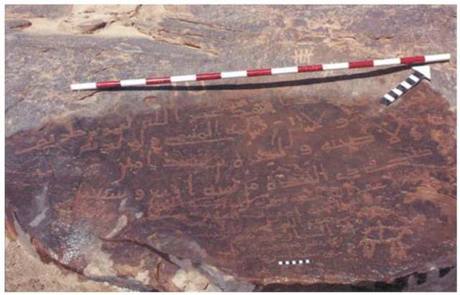
65–86 AH QMI-INS-014f

Milestone of ʿAbd al-Malik: 109 miles from Damascus, Khān al-Ḥathrūra

ميل عبد الملك: تسعة ومائة ميل من دمشق، خان الحثرورة

SiteKhān al-Ḥathrūra, on the road from Jerusalem towards Jericho and Damascus; now Museum of Turkish and Islamic Arts, Istanbul (inv. 2511)
Writing surfaceMarble slab, text in relief
Lines7 (the first almost wholly lost)
Dimensions40 × 30 cm
ScriptKūfic
SubjectMilestone: 109 miles from Damascus; reign of ʿAbd al-Malik
ReadingLargely clear · first line lost; the rest is clear
Grade 2 of 5. The first line is almost wholly lost; the remaining six lines are clear.

Original text (Arabic)

  1. [... أمر بإصلاح]
  2. هذه الطريق و
  3. صنعة الأميال عبد
  4. الله عبد الملك أ
  5. مير المؤمنين رحمة الله
  6. عليه من دمشق إلى هذا
  7. الميل تسعة ومائة ميل

Translation

  1. [... Has ordered the repair of]
  2. this road and
  3. the making of the milestones the servant
  4. of God ʿAbd al-Malik, Com-
  5. mander of the Faithful, may God’s mercy be
  6. upon him. From Damascus to this
  7. milestone (there are) one hundred and nine miles.

Commentary

A marble slab from Khān al-Ḥathrūra, on the road from Jerusalem down to Jericho, with its text carved in relief; it is now in the Museum of Turkish and Islamic Arts in Istanbul. It is the most complete of the milestones counted from Damascus: one hundred and nine miles from the capital to this point. The milestone of Dayr al-Qalṭ, on the same road, gives a slightly smaller number (QMI-INS-014e).

The milestones of ʿAbd al-Malik are among the earliest official Arabic texts of the caliphate. Those of the roads of Palestine carry no date and are placed in his reign (65–86 AH) by the caliph’s name and title; two milestones from Fīq in the Golan, made under the same order, are dated 85 AH (QMI-INS-034a, QMI-INS-034b), and the road inscription of ʿAqabat Fīq is dated 73 AH (QMI-INS-014a). On the road from Jerusalem to the coast the miles are counted from Īliyāʾ, the name of Jerusalem in early Islamic texts (QMI-INS-014b, QMI-INS-014c, QMI-INS-014d); on the road from Jerusalem towards Jericho and Damascus they are counted from Damascus (QMI-INS-014e, QMI-INS-014f). The milestones of Palestine pray “may God’s mercy be upon him” after the caliph’s name, a prayer Amikam Elad takes to mean that ʿAbd al-Malik had died when they were set up: planned in his reign, they would then have been completed after it, from 86 AH. The two Golan milestones of 85 AH, made in his lifetime, have no such prayer.

The reading follows the photograph. The first line is almost wholly lost, and its restoration, the order “has ordered the repair of”, follows the other milestones of the series; the remaining six lines are complete. Words run on from one line to the next, so that amīr is divided between the fourth and fifth lines (أ / مير). Square brackets mark restored text.

Source: van Berchem, Max. Matériaux pour un Corpus Inscriptionum Arabicarum, II/3 (Cairo, 1920), pl. II:1; II/1, Jérusalem “Ville” (Cairo, 1922), no. 1, pp. 17–18, 21; Şahin, Seracettin. The Museum of Turkish and Islamic Arts: Thirteen Centuries of Glory from the Umayyads to the Ottomans (New York, 2009), pp. 20, 26. Reproduced in Grohmann, Arabische Paläographie II (1971), p. 83.

How to cite

Shaker W. Ahmed. “Milestone of ʿAbd al-Malik: 109 miles from Damascus, Khān al-Ḥathrūra” (Cat. No. QMI-INS-014f). QMI, quranmss.com, 2026.

Inscription of ʿUmar ibn Ṭarīf⤢ Click to enlarge
74 AH QMI-INS-015

Inscription of ʿUmar ibn Ṭarīf

نقش عمر بن طريف

SiteWādī al-Abyaḍ
Writing surfaceTop of a high cliff
Lines4
DimensionsUnrecorded
ScriptḤijāzī
SubjectPrayer for forgiveness for several named people
ReadingLargely clear · a few letters restored
Grade 2 of 5. Nearly complete; a few letters are restored by the editor.

Original text (Arabic)

  1. اللهم لك الحمد غفر الله لعمر بن طريف
  2. بن الحرث ولأنس بن سلمة المنبهي ولولديه (ولوالديه)
  3. ولأصحبه (ولأصحابه) ولمغرة (المغيرة؟) بن سعد أمين
  4. وكتب في ذي القعدة من سنة أربع وسبعين

Translation

  1. O God, praise be to You. May God forgive ʿUmar ibn Ṭarīf
  2. ibn al-Ḥārith, and Anas ibn Salamah al-Munabbihī, and his parents,
  3. and his companions, and Mughīrah(?) ibn Saʿd. Āmīn.
  4. And [this] was written in Dhū al-Qaʿdah of the year seventy-four.

Commentary

A collective prayer of forgiveness naming several people at once — ʿUmar ibn Ṭarīf and his companions — rather than a single individual, unusual among the shorter inscriptions in this corpus. The reading of "Mughīrah" is uncertain (marked with a query in the original publication) since the letters could also be construed differently in this undotted hand.

Source: Majallat Aṭlāl 20, no. 1 (2010): pl. 2.3a.

How to cite

Shaker W. Ahmed. “Inscription of ʿUmar ibn Ṭarīf” (Cat. No. QMI-INS-015). QMI, quranmss.com, 2026.

Inscription of ʿAmrPhotograph: ʿAbdallāh ibn Muṣliḥ al-Thumālī⤢ Click to enlarge
76 AH QMI-INS-016

Inscription of ʿAmr

نقش عمرو

SiteWādī Malkān
Writing surfaceGranite rock
Lines5
DimensionsUnrecorded
ScriptḤijāzī
SubjectPrayer of contentment (riḍā)
ReadingLargely clear · a few letters restored
Grade 2 of 5. Nearly complete; a few letters are restored by the editor.

Original text (Arabic)

  1. اللهم ارض عن عمرو
  2. بن ... وكتب يحيى
  3. بن عمرو في بقية سنة
  4. ست و
  5. سبعين

Translation

  1. O God, be pleased with ʿAmr
  2. ibn ... And Yaḥyā
  3. ibn ʿAmr wrote [this], in the latter part of the year six and
  4. seventy.

Commentary

The continuation of ʿAmr's own patronymic is damaged and illegible ("ibn ..."). More telling is the scribe's own signature: Yaḥyā identifies himself as "ibn ʿAmr" immediately after praying for someone named ʿAmr, which makes it very likely this is a son's prayer for his own father rather than for an unrelated namesake. The prayer uses riḍā ("contentment"/"being pleased with") rather than the more common ghufrān ("forgiveness") formula seen elsewhere in this corpus. Another inscription of the same year, from the Medina region, records only that it was written on a Friday (QMI-INS-016b).

Source: Photograph by ʿAbdallāh ibn Muṣliḥ al-Thumālī.

How to cite

Shaker W. Ahmed. “Inscription of ʿAmr” (Cat. No. QMI-INS-016). QMI, quranmss.com, 2026.

Inscription of a Friday, 76 AH, al-MadīnahPhoto: Muḥammad al-Mughadhdhawī⤢ Click to enlarge
76 AH QMI-INS-016b

Inscription of a Friday, 76 AH, al-Madīnah

نقش يوم الجمعة سنة ست وسبعين، المدينة

Siteal-Madīnah region
Writing surfaceBoulder
Lines3
DimensionsUnrecorded
ScriptḤijāzī
SubjectDated record of a writing made on a Friday, 76 AH
ReadingClear · nothing restored
Grade 1 of 5. The text is complete; nothing is restored.

Original text (Arabic)

  1. هذا ا
  2. لكتب يوم الجمعة
  3. من سنة ست وسبعين

Translation

  1. This wri-
  2. ting [was made] on Friday,
  3. in the year seventy-six.

Commentary

A short dated record from the Medina region, cut in three lines on a dark boulder. It names no person and asks for nothing; it says only that “this writing” was made on a Friday in the year 76. The word al-kitāb is written without its long alif (lktb) and is divided across the line end after the first letter of the article (a-/lktb), a habit of early scribes also seen in the letter of Muʿāwiyah at al-Ḥanākiyah, where Marwān’s name is broken in the same way (QMI-INS-007b).

The day of the week is given, but not the month, which is unusual in a dated text: Friday may have been named for its own standing as the day of congregational prayer rather than as part of a full date. The year falls in the caliphate of ʿAbd al-Malik ibn Marwān, and the inscription of ʿAmr from Wādī Malkān carries the same year (QMI-INS-016). The hand is Ḥijāzī, upright and undotted. A prayer from Wādī Salma also names its day, a Friday of Jumādā al-Ākhirah 105 AH (QMI-INS-055sa).

Source: al-Mughadhdhawī, Muḥammad (@mohammed93athar), Nawādir al-āthār wa-l-nuqūsh, photograph dated 10 July 2023. Reading by Ahmed W. Shaker.

How to cite

Shaker W. Ahmed. “Inscription of a Friday, 76 AH, al-Madīnah” (Cat. No. QMI-INS-016b). QMI, quranmss.com, 2026.

Inscription of al-Rayyān ibn ʿAbdallāhPhotograph: ʿAbdallāh al-Numayrī⤢ Click to enlarge
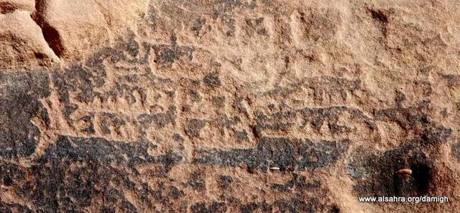
78 AH QMI-INS-017

Inscription of al-Rayyān ibn ʿAbdallāh

نقش الريان بن عبد الله

SiteḤimā al-Numūr, Ṭāʾif
Writing surfaceRock face
Lines9
Dimensions131 × 91 cm
ScriptḤijāzī
SubjectDeclaration of faith, dated by the rebuilding of the Sacred Mosque
ReadingClear · nothing restored
Grade 1 of 5. The text is complete; nothing is restored.

Original text (Arabic)

  1. شهد الريان بن عبد الله أنه لا إله إلا الله
  2. وشهد أن محمداً رسول الله
  3. ثم هو يَكفي من أتى أن يشهد على
  4. ذلك رحم الله الريان و
  5. غفر له وأستهدى به إلى صرط (صراط) الجنة
  6. واسله (واسأله) الشهدة (الشهادة) في سبيله ا
  7. مين كتب هذا الكتب (الكتاب)
  8. عام بني المسجد الحرام
  9. لسنة ثمان وسبعين

Translation

  1. Al-Rayyān ibn ʿAbdallāh bore witness that there is no god but God,
  2. and bore witness that Muḥammad is the Messenger of God.
  3. That suffices whoever comes to bear witness to
  4. that. May God have mercy on al-Rayyān and
  5. forgive him, and guide him by it to the path of Paradise,
  6. and I ask Him for martyrdom in His cause. Ā-
  7. mīn. He wrote this writing
  8. in the year the Sacred Mosque was rebuilt,
  9. in the year seventy-eight.

Commentary

A rare inscription that dates itself by a major construction project rather than a caliph or a numbered year alone: "the year the Sacred Mosque was rebuilt." Historical sources record that the Umayyad caliph ʿAbd al-Malik ibn Marwān began rebuilding the Sacred Mosque in 75 AH after damage from al-Ḥajjāj ibn Yūsuf's catapults during the siege of ʿAbdallāh ibn al-Zubayr, raising the walls and roofing them in teak, and gilding each column capital with fifty mithqāls of gold. First published by Dr. Nāṣir ibn ʿAlī al-Ḥārithī in 2007, who documented 60 Islamic inscriptions at this site. Several comparable rock inscriptions from Darb Ḥismā use the same double-dating technique, naming both a historical event and a numbered year.

Source: al-Ḥārithī, Nāṣir ibn ʿAlī. "Naqsh Kitābī Nādir Yuʾarrikh ʿImārat al-Khalīfah al-Umawī ʿAbd al-Malik ibn Marwān lil-Masjid al-Ḥarām ʿĀm 78 AH." ʿĀlam al-Makhṭūṭāt wa-al-Nawādir 12, no. 2 (2007): 533.

How to cite

Shaker W. Ahmed. “Inscription of al-Rayyān ibn ʿAbdallāh” (Cat. No. QMI-INS-017). QMI, quranmss.com, 2026.

Inscription of Ibn al-ʿĀṣPhotograph: Al-Sahra Desert Survey Team⤢ Click to enlarge
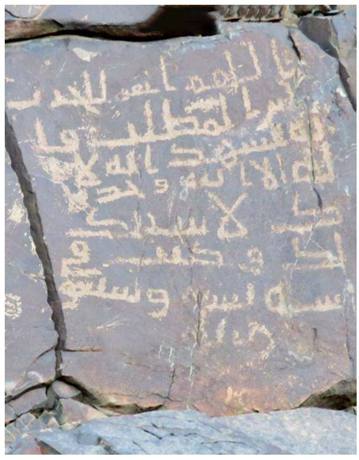
78 AH QMI-INS-018

Inscription of Ibn al-ʿĀṣ

نقش ابن العاص

SiteQāʿ al-Muʿtadil, Darb al-Ḥajj
Writing surfaceRock face
Lines4
Dimensions74 × 34 cm
ScriptḤijāzī
SubjectBelief in God
ReadingPartly preserved · several words restored
Grade 3 of 5. Several words are damaged and restored by the editor; the rest is legible.

Original text (Arabic)

  1. ]بالله آمن[
  2. ] ... بن العاص[
  3. وصحبته (وصحابته) من أهل قنسرين
  4. وكتب ثمن (ثمان) وسبعين

Translation

  1. [Believes] in God
  2. ...] ibn al-ʿĀṣ
  3. and his companions, from the people of Qinnasrīn,
  4. and it was written [in the year] seventy-eight.

Commentary

The first two lines are badly eroded; the brackets mark reconstructed readings the editor considers most likely rather than certain text. The mention of Qinnasrīn (in northern Syria) ties this otherwise anonymous group of companions to a specific garrison region. Found on the same Syrian pilgrim route (Darb al-Ḥajj al-Shāmī) as the Zuhayr inscriptions (nos. 1–2 in this catalog).

Source: al-Kilābī, Ḥayāt. al-Nuqūsh al-Islāmīyah ʿalā Ṭarīq al-Ḥajj al-Shāmī bi-Shamāl Gharb al-Mamlakah al-ʿArabīyah al-Saʿūdīyah min al-Qarn al-Awwal ilā al-Qarn al-Khāmis al-Hijrī. al-Riyāḍ: Maktabat al-Malik Fahd al-Waṭanīyah, 1430 AH / 2009, pp. 61–73.

How to cite

Shaker W. Ahmed. “Inscription of Ibn al-ʿĀṣ” (Cat. No. QMI-INS-018). QMI, quranmss.com, 2026.

Inscription of al-Ḥārith ibn al-MuṭṭalibPhotograph: Muḥammad al-Mughadhdhawī⤢ Click to enlarge
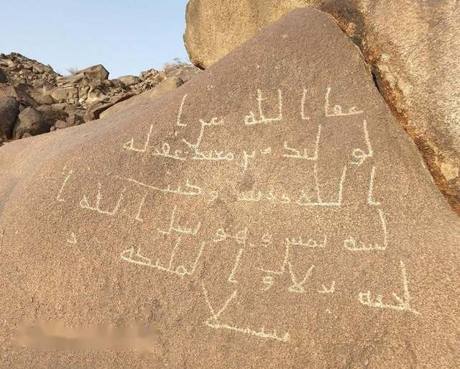
79 AH QMI-INS-019

Inscription of al-Ḥārith ibn al-Muṭṭalib

نقش الحارث بن المطلب

SiteMedina
Writing surfaceRock face
Lines6
DimensionsUnrecorded
ScriptMadanī (Medinan)
SubjectPrayer for forgiveness with profession of faith
ReadingClear · nothing restored
Grade 1 of 5. The text is complete; nothing is restored.

Original text (Arabic)

  1. اللهم اغفر للحرث (للحارث)
  2. ابن المطلب فإ
  3. نه يشهد أنه لا ا
  4. له إلا الله وحد
  5. ك لا شريك
  6. لك وكتب في سنة تسع وسبعين

Translation

  1. O God, forgive al-Ḥārith
  2. ibn al-Muṭṭalib, for
  3. he bears witness that there is no
  4. god but God, alone,
  5. without partner,
  6. and it was written in the year seventy-nine.

Commentary

One of the few inscriptions in this corpus explicitly described as Madanī (Medinan) rather than Ḥijāzī script, and found in Medina itself rather than along a desert route. First published by Muḥammad al-Mughadhdhawī on 22 April 2019, making it one of the more recently documented inscriptions in the catalog.

Source: al-Mughadhdhawī, Muḥammad (@mohammed93athar). Twitter, 22 October 2019.

How to cite

Shaker W. Ahmed. “Inscription of al-Ḥārith ibn al-Muṭṭalib” (Cat. No. QMI-INS-019). QMI, quranmss.com, 2026.

Inscription of al-Walīd ibn MaʿbadPhotograph: ʿAbdallāh Muṣliḥ al-Thumālī⤢ Click to enlarge
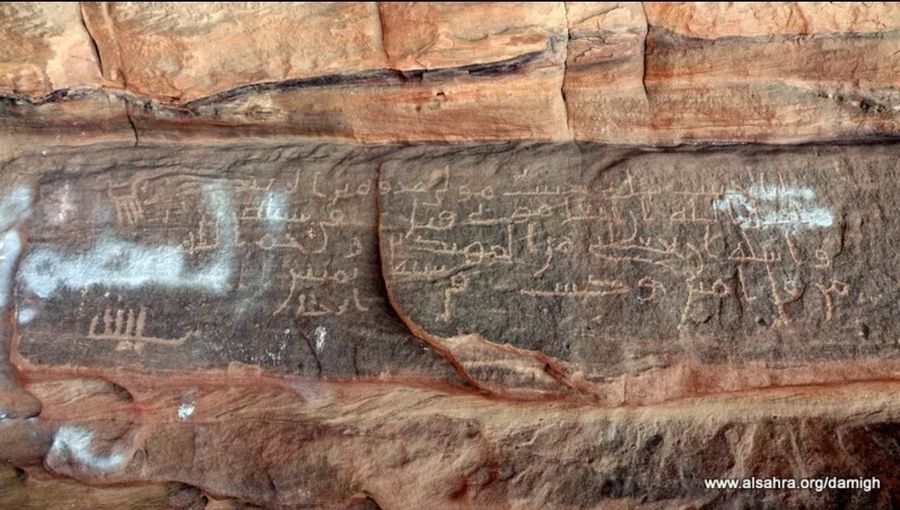
80 AH QMI-INS-020

Inscription of al-Walīd ibn Maʿbad

نقش الوليد بن معبد

SiteWādī al-Jalīl
Writing surfaceRock face
Lines6
DimensionsUnrecorded
ScriptḤijāzī
SubjectPrayer asking God's pardon
ReadingClear · nothing restored
Grade 1 of 5. The text is complete; nothing is restored.

Original text (Arabic)

  1. عفا الله عن ا
  2. لوليد بن معبد غفر له
  3. الله ذنبه وكتب
  4. لسنة ثمنين (ثمانين) وهو يسل (يسأل) الله ا
  5. لجنة نزلا الملئكة (الملائكة) ر
  6. سلا

Translation

  1. May God pardon
  2. al-Walīd ibn Maʿbad, may God forgive
  3. him his sin, and he wrote [this]
  4. for the year eighty, asking God for
  5. Paradise as a lodging, and the angels
  6. as an escort.

Commentary

Al-Walīd ibn Maʿbad left several other inscriptions documented elsewhere by al-Rāshid, all around Mecca; two words here ("al-Walīd" and "al-jannah") are each split across two lines, a recurring feature of how these scribes handled limited rock space.

Source: al-Ḥārithī, Nāṣir ibn ʿAlī. al-Āthār al-Islāmīyah fī Makkah al-Mukarramah. 1st ed. 1430 AH/2009, pp. 568–569.

How to cite

Shaker W. Ahmed. “Inscription of al-Walīd ibn Maʿbad” (Cat. No. QMI-INS-020). QMI, quranmss.com, 2026.

Inscription of Ḥabīb ibn Abī Ḥabīb⤢ Click to enlarge
80 AH QMI-INS-021

Inscription of Ḥabīb ibn Abī Ḥabīb

نقش حبيب بن أبي حبيب

SiteQārat al-Ṣibgh
Writing surfaceNorth face of the outcrop
Lines4
Dimensions190 × 40 cm
ScriptḤijāzī
SubjectPrayer for martyrdom
ReadingClear · nothing restored
Grade 1 of 5. The text is complete; nothing is restored.

Original text (Arabic)

  1. أنا حبيب بن أبي حبيب مولى عروة بن الزبير
  2. اسئل (اسأل) الله أن يجعل موتي قتل (كذا) في سبيله
  3. واسئله (اسأله) أن يجعلني من المهتدين رحم الله
  4. من قل (قال) آمين وكتب في سنة ثمنين (ثمانين)

Translation

  1. I, Ḥabīb ibn Abī Ḥabīb, client (mawlā) of ʿUrwah ibn al-Zubayr,
  2. ask God to make my death a killing in His cause,
  3. and I ask Him to make me one of the rightly guided. May God have mercy
  4. on whoever says āmīn. And it was written in the year eighty.

Commentary

Ḥabīb identifies himself as a mawlā (client) of ʿUrwah ibn al-Zubayr (23–93 AH), a leading Medinan hadith scholar and one of the "Seven Jurists of Medina," who is known to have had many clients — Ḥabīb among them. The scribe consistently omits the alif that marks the accusative case (e.g. writing "qatlā" without its final alif), a common feature of undotted, unvowelled early Ḥijāzī orthography. The inscription shows signs of later tampering by visitors.

Source: al-Ghabbān, Maysāʾ ʿAlī. al-Kitābāt al-Islāmīyah al-Mubakkirah fī Haḍbat Ḥismā bi-Minṭaqat Tabūk. PhD diss., Jāmiʿat al-Malik Saʿūd, 2017, p. 207.

How to cite

Shaker W. Ahmed. “Inscription of Ḥabīb ibn Abī Ḥabīb” (Cat. No. QMI-INS-021). QMI, quranmss.com, 2026.

Inscription of Maymūn, Mawlā of Abū Maryam⤢ Click to enlarge
80 AH QMI-INS-022

Inscription of Maymūn, Mawlā of Abū Maryam

نقش ميمون مولى أبو مريم

SiteWādī al-Ṣānī
Writing surfaceLarge rock
Lines5
Dimensions70 × 50 cm
ScriptḤijāzī
SubjectPrayer asking for Paradise
ReadingClear · nothing restored
Grade 1 of 5. The text is complete; nothing is restored.

Original text (Arabic)

  1. أنا ميمون مولى
  2. أبو مريم مولى رباح
  3. اسل (اسأل) الجنة نزلاً
  4. والملئكة (الملائكة) رسلاً
  5. وكتب في سنة ثمنين (ثمانين)

Translation

  1. I, Maymūn, client (mawlā) of
  2. Abū Maryam, client of Rabāḥ,
  3. ask for Paradise as a lodging
  4. and the angels as an escort,
  5. and it was written in the year eighty.

Commentary

Maymūn names not only his own patron (Abū Maryam) but that patron's own client-relationship to Rabāḥ, a rare three-generation chain of mawlā ties recorded in a single short prayer. The "Paradise as a lodging, angels as an escort" formula echoes the same request seen in the inscription of al-Walīd ibn Maʿbad (no. 20) from the same year.

Source: al-Kilābī, Ḥayāt. al-Nuqūsh al-Islāmīyah ʿalā Ṭarīq al-Ḥajj al-Shāmī bi-Shamāl Gharb al-Mamlakah al-ʿArabīyah al-Saʿūdīyah min al-Qarn al-Awwal ilā al-Qarn al-Khāmis al-Hijrī. al-Riyāḍ: Maktabat al-Malik Fahd al-Waṭanīyah, 1430 AH / 2009, pp. 61–73.

How to cite

Shaker W. Ahmed. “Inscription of Maymūn, Mawlā of Abū Maryam” (Cat. No. QMI-INS-022). QMI, quranmss.com, 2026.

Inscription of Bakr ibn Abī Bakrah⤢ Click to enlarge
80 AH QMI-INS-023

Inscription of Bakr ibn Abī Bakrah

نقش بكر بن أبي بكرة

SiteDarb Ḥismā
Writing surfaceRock face
Lines3
DimensionsUnrecorded
ScriptḤijāzī
SubjectPrayer for the Prophet's intercession
ReadingClear · nothing restored
Grade 1 of 5. The text is complete; nothing is restored.

Original text (Arabic)

  1. اللهم صلي على محمد النبي وتقبل شفعته (شفاعته) في الاخرة
  2. وارحمنا به في الآخرة كما رحمتنا به في الدنيا
  3. وكتب بكر بن أبي بكرة الأسلمي تمام سنة ثمنين (ثمانين)

Translation

  1. O God, bless Muḥammad the Prophet and accept his intercession in the Hereafter,
  2. and have mercy on us through him in the Hereafter as You had mercy on us through him in this world,
  3. and Bakr ibn Abī Bakrah al-Aslamī wrote [this] at the very end of the year eighty.

Commentary

One of the earliest Islamic inscriptions to invoke the Prophet Muḥammad's intercession (shafāʿah) on the Day of Judgment, echoing the Qurʾanic description of the Prophet as "a mercy to the worlds" (Qurʾān 21:107) and a well-known hadith, "O people, I am but a mercy sent [to you]." It stands on a rock along Darb Ḥismā, the overland route linking Syria and Medina in the 1st–2nd centuries AH, which ran north of Medina through al-Marwah, Suqyā al-Jazl, Badā, Shaghb and al-Kharīṭah before splitting toward Ayla/Egypt on one branch and Wādī Ram/Maʿān/Syria on the other. An undated prayer from Tabūk goes further and asks forgiveness for “Muḥammad the Prophet” before the writer, ʿAṭāʾ ibn Mīnāʾ (QMI-INS-037b).

Source: al-Saʿīd, ʿAbdallāh ibn ʿAbd al-ʿAzīz. “Nuqūsh Muʾarrakhah Mubakkirah min Ṣadr al-Islām.” Farīq al-Ṣaḥrāʾ (alsahra.org), 26 May 2018, updated 4 May 2025, inscription 4.

How to cite

Shaker W. Ahmed. “Inscription of Bakr ibn Abī Bakrah” (Cat. No. QMI-INS-023). QMI, quranmss.com, 2026.

Inscription of ʿUmayr ibn Abī Muslim⤢ Click to enlarge
80 AH QMI-INS-024

Inscription of ʿUmayr ibn Abī Muslim

نقش عمير بن أبي مسلم

SiteWādī Malkān
Writing surfaceRock face
Lines5
DimensionsUnrecorded
ScriptḤijāzī
SubjectPrayer for forgiveness for a martyr's son
ReadingClear · nothing restored
Grade 1 of 5. The text is complete; nothing is restored.

Original text (Arabic)

  1. اللهم اغفر لابن
  2. الشهيد عمير
  3. بن أبي مسلم آمين
  4. وكتب سنة
  5. ثمنين (ثمانين)

Translation

  1. O God, forgive the son of
  2. the martyr, ʿUmayr
  3. ibn Abī Muslim. Āmīn,
  4. and it was written in the year
  5. eighty.

Commentary

ʿUmayr identifies himself specifically as the son of a martyr (ibn al-shahīd) rather than naming his father directly — the prayer is for himself, framed through his father's status. The text carries no diacritical dots at all, consistent with many inscriptions of this early period.

Source: Photograph: Al-Sahra desert survey team.

How to cite

Shaker W. Ahmed. “Inscription of ʿUmayr ibn Abī Muslim” (Cat. No. QMI-INS-024). QMI, quranmss.com, 2026.

First Inscription of ʿUthmān ibn Wahrān⤢ Click to enlarge
80 AH QMI-INS-025

First Inscription of ʿUthmān ibn Wahrān

نقش عثمان بن وهران الأول

SiteWādī al-ʿUsaylah
Writing surfaceSouth side of a rock near Jabal al-Waljah al-Ṣaghīr
Lines7
Dimensions82 × 79 cm
ScriptMakkī (Meccan)
SubjectQurʾanic verse (Q 4:87)
ReadingClear · nothing restored
Grade 1 of 5. The text is complete; nothing is restored.

Original text (Arabic)

  1. الله لا إله إلا هو
  2. ليجمعنكم الى
  3. يوم القيامة لا ر
  4. يب فيه ومن أصد
  5. ق من الله حديثا
  6. وكتب عثمن (عثمان) بن
  7. وهرن (وهران) في سنة ثمنين (ثمانين)

Translation

  1. “God — there is no god but He. He will surely gather you to
  2. the Day of Resurrection, about which there is no doubt.
  3. And who is more truthful than
  4. God in speech?” [Q 4:87]. And ʿUthmān ibn
  5. Wahrān wrote [this] in the year eighty.

Commentary

The first of three inscriptions at Wādī al-ʿUsaylah left by the same ʿUthmān ibn Wahrān, each quoting a different Qurʾanic passage — this one from Sūrat al-Nisāʾ (4:87). Described in the book as Makkī (Meccan) script, distinguishing it from the more common Ḥijāzī hand elsewhere in this corpus. A previous reader, Dr. Sāmiḥ ʿAbd al-Raḥmān Fahmī, misread the final line as "wa-hādhā" ("and this") instead of the correct "Wahrān," the scribe's own name.

Source: al-Rāshid, Saʿd ibn ʿAbd al-ʿAzīz. Kitābāt Islāmīyah min Makkah al-Mukarramah: Dirāsah wa-Taḥqīq. al-Riyāḍ: Maktabat al-Malik Fahd al-Waṭanīyah, 1995, pp. 26–29, 55–57, 60–66, 160–164; al-Ḥārithī, Nāṣir ibn ʿAlī, and ʿĀdil Muḥammad Nūr Ghubāshī. "Nuqūsh Islāmīyah Mubakkirah bi-Wādī al-ʿUsaylah bi-Makkah al-Mukarramah." ʿĀlam al-Makhṭūṭāt wa-al-Nawādir 2, no. 1 (Muḥarram–Jumādā al-Ākhirah 1418 AH / May–October 1997): 12–56.

How to cite

Shaker W. Ahmed. “First Inscription of ʿUthmān ibn Wahrān” (Cat. No. QMI-INS-025). QMI, quranmss.com, 2026.

Second Inscription of ʿUthmān ibn Wahrān⤢ Click to enlarge
80 AH QMI-INS-026

Second Inscription of ʿUthmān ibn Wahrān

نقش عثمان بن وهران الثاني

SiteWādī al-ʿUsaylah
Writing surfaceSouthwest side of a rock near Jabal al-Waljah al-Ṣaghīr
Lines8
Dimensions167 × 120 cm
ScriptMakkī (Meccan)
SubjectQurʾanic verse (Q 38:26)
ReadingClear · nothing restored
Grade 1 of 5. The text is complete; nothing is restored.

Original text (Arabic)

  1. يداود إنا جعلنك
  2. خليفة في الأرض
  3. لتحكم بين الناس
  4. بالحق ولا تتبع الهوى
  5. فيضلك عن سبيل الله إن الذين يضلون
  6. عن سبيل الله لهم عذاب شديد بما نسوا يوم
  7. الحساب وكتب عثمن (عثمان) بن
  8. وهرن (وهران) في سنة ثمنين (ثمانين)

Translation

  1. “O David, We have made you
  2. a vicegerent (khalīfah) on the earth,
  3. so judge between the people
  4. with truth, and do not follow desire,
  5. for it will lead you astray from the path of God. Indeed those who stray
  6. from the path of God will have a severe punishment for having forgotten the Day
  7. of Reckoning.” [Q 38:26]. And ʿUthmān ibn
  8. Wahrān wrote [this] in the year eighty.

Commentary

The second of ʿUthmān ibn Wahrān's three Qurʾanic inscriptions at this site, quoting Sūrat Ṣād (38:26) — a verse addressed to the Prophet David (Dāwūd) about just rule, notable given the political resonance of "vicegerent on the earth" language in Umayyad-era inscriptions.

Source: al-Rāshid, Saʿd ibn ʿAbd al-ʿAzīz. Kitābāt Islāmīyah min Makkah al-Mukarramah: Dirāsah wa-Taḥqīq. al-Riyāḍ: Maktabat al-Malik Fahd al-Waṭanīyah, 1995, pp. 26–29, 55–57, 60–66, 160–164; al-Ḥārithī, Nāṣir ibn ʿAlī, and ʿĀdil Muḥammad Nūr Ghubāshī. "Nuqūsh Islāmīyah Mubakkirah bi-Wādī al-ʿUsaylah bi-Makkah al-Mukarramah." ʿĀlam al-Makhṭūṭāt wa-al-Nawādir 2, no. 1 (Muḥarram–Jumādā al-Ākhirah 1418 AH / May–October 1997): 12–56.

How to cite

Shaker W. Ahmed. “Second Inscription of ʿUthmān ibn Wahrān” (Cat. No. QMI-INS-026). QMI, quranmss.com, 2026.

Third Inscription of ʿUthmān ibn Wahrān⤢ Click to enlarge
80 AH QMI-INS-027

Third Inscription of ʿUthmān ibn Wahrān

نقش عثمان بن وهران الثالث

SiteWādī al-ʿUsaylah
Writing surfaceNorth side of a rock below Jabal al-Waljah al-Kabīr
Lines9
Dimensions107 × 80 cm
ScriptḤijāzī
SubjectQurʾanic verse (Q 56:28–40, on the people of the right hand)
ReadingClear · nothing restored
Grade 1 of 5. The text is complete; nothing is restored.

Original text (Arabic)

  1. سدر مخضود وطلح
  2. منضود وظل ممدود وما
  3. مسكوب وفكهة كثيرة
  4. لامقطوعة ولا ممنوعة و
  5. فرش مرفوعة انا انشئنهن انشاءا
  6. فجعلنهن أبكرا عربا أترابا لا
  7. صحب اليمين ما أصحب اليمين
  8. ثلة من الأولين وثلة من الأخرين
  9. وكتب عثمن (عثمان) بن وهرن (وهران)

Translation

  1. “[Amid] lote trees stripped of thorns,
  2. and banana trees layered [with fruit],
  3. and shade extended, and water
  4. poured out, and fruit
  5. abundant, neither limited nor forbidden, and
  6. couches raised high. Indeed, We have produced them [the women of Paradise] in a special creation
  7. and made them virgins, devoted [to their husbands] and equal in age, for
  8. the companions of the right — a company of the former [believers]
  9. and a company of the later [ones].” [cf. Q 56:28–40]. Written by ʿUthmān ibn Wahrān.

Commentary

The third and longest of ʿUthmān ibn Wahrān's three Qurʾanic inscriptions, drawn from Sūrat al-Wāqiʿah's description of Paradise (verses on "the companions of the right hand"). Together, the three inscriptions (nos. 25–27) form a small private epigraphic program by one individual across a single rocky outcrop.

Source: al-Rāshid, Saʿd ibn ʿAbd al-ʿAzīz. Kitābāt Islāmīyah min Makkah al-Mukarramah: Dirāsah wa-Taḥqīq. al-Riyāḍ: Maktabat al-Malik Fahd al-Waṭanīyah, 1995, pp. 26–29, 55–57, 60–66, 160–164; al-Ḥārithī, Nāṣir ibn ʿAlī, and ʿĀdil Muḥammad Nūr Ghubāshī. "Nuqūsh Islāmīyah Mubakkirah bi-Wādī al-ʿUsaylah bi-Makkah al-Mukarramah." ʿĀlam al-Makhṭūṭāt wa-al-Nawādir 2, no. 1 (Muḥarram–Jumādā al-Ākhirah 1418 AH / May–October 1997): 12–56.

How to cite

Shaker W. Ahmed. “Third Inscription of ʿUthmān ibn Wahrān” (Cat. No. QMI-INS-027). QMI, quranmss.com, 2026.

Inscription of Qaṣr al-Burquʿ⤢ Click to enlarge
81 AH QMI-INS-028

Inscription of Qaṣr al-Burquʿ

نقش قصر البرقع

SiteQāʿ al-Muʿtadil, Darb al-Ḥajj
Writing surfaceRock face
Lines3
DimensionsUnrecorded
ScriptḤijāzī
SubjectConstruction of houses by an Umayyad prince
ReadingClear · nothing restored
Grade 1 of 5. The text is complete; nothing is restored.

Original text (Arabic)

  1. يا الله بسم الله الرحمن الرحيم هذا ما
  2. بنا الأمير الوليد بن أمير المؤمنين هو
  3. لا (هؤلاء) البيوت سنة احدى وثمنين (ثمانين)

Translation

  1. O God. In the name of God, the Merciful, the Compassionate. This is what
  2. the Amīr al-Walīd, son of the Commander of the Faithful, built —
  3. these houses, in the year eighty-one.

Commentary

Records construction work commissioned by "the Amīr al-Walīd, son of the Commander of the Faithful" — almost certainly the future Umayyad caliph al-Walīd ibn ʿAbd al-Malik (r. 86–96 AH), here still a prince, referred to through his father ʿAbd al-Malik ibn Marwān's caliphal title rather than by his own name alone. A rare inscription documenting an Umayyad ruling family building project outside the major cities.

The same formula, “the emir X, son of the Commander of the Faithful,” names Hishām’s son Muʿāwiya in the tax letter from Andarīn (QMI-INS-055ac).

Source: Gruendler, Beatrice. The Development of the Arabic Scripts: From the Nabatean Era to the First Islamic Century According to the Dated Texts. Harvard Semitic Series No. 43. Atlanta, GA: Scholars Press, 1993, pp. 18–19.

How to cite

Shaker W. Ahmed. “Inscription of Qaṣr al-Burquʿ” (Cat. No. QMI-INS-028). QMI, quranmss.com, 2026.

Inscription of Sahm, Mawlā of Abū Zurʿah⤢ Click to enlarge
82 AH QMI-INS-029

Inscription of Sahm, Mawlā of Abū Zurʿah

نقش سهم مولى أبو زرعة

SiteUnrecorded rock face
Writing surfaceRock face
Lines6
DimensionsUnrecorded
ScriptḤijāzī
SubjectPrayer for forgiveness and acceptance of pilgrimage
ReadingClear · nothing restored
Grade 1 of 5. The text is complete; nothing is restored.

Original text (Arabic)

  1. غفر الله لسهم مولى أبو زرعة اللهم
  2. وتقبل حجته امين رب العلمين (العالمين)
  3. وغفر الله لمحمود الأبرم
  4. السمان مولى يعمر بن حبيب
  5. وتقبل منه حجته وكتب
  6. في سنة اثنين وثمنين (وثمانين)

Translation

  1. May God forgive Sahm, client (mawlā) of Abū Zurʿah. O God,
  2. accept his pilgrimage (ḥajjah). Āmīn, Lord of the Worlds.
  3. And may God forgive Maḥmūd al-Abram
  4. al-Sammān, client of Yaʿmar ibn Ḥabīb,
  5. and accept his pilgrimage too. And it was written
  6. in the year eighty-two.

Commentary

Like the Ṭāʾif Dam and Ḥafnat al-Abyaḍ inscriptions elsewhere in this corpus, this text prays for two people at once — Sahm and Maḥmūd al-Abram al-Sammān, both identified as mawālī (clients) of different patrons — asking specifically that their ḥajj (pilgrimage) be accepted, one of the few inscriptions in the catalog tied explicitly to the pilgrimage rite itself.

Source: al-Ḥawwās, Fahd Ṣāliḥ, et al. "Taqrīr Awwalī ʿan Aʿmāl al-Tanqībāt al-Athariyah li-Madīnat Fayd al-Tārīkhiyah bi-Minṭaqat Ḥāʾil (al-Mawsim al-Awwal 1427/2006)." Aṭlāl 20, p. 35, pls. 2, 3a.

How to cite

Shaker W. Ahmed. “Inscription of Sahm, Mawlā of Abū Zurʿah” (Cat. No. QMI-INS-029). QMI, quranmss.com, 2026.

Inscription of ʿUfayr ibn al-MuḍāribPhotograph: ʿAbdallāh Muṣliḥ al-Thumālī⤢ Click to enlarge
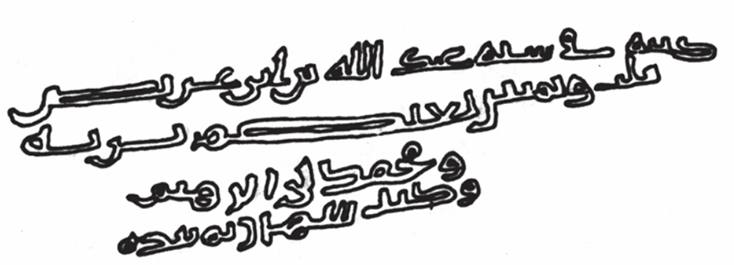
83 AH QMI-INS-030

Inscription of ʿUfayr ibn al-Muḍārib

نقش عفير بن المضارب

SiteWādī al-Aqraʿ
Writing surfaceLarge rock
Lines4
Dimensions100 × 55 cm
ScriptḤijāzī
SubjectDeclaration of belief, echoing Sūrat al-Ḥijr
ReadingClear · nothing restored
Grade 1 of 5. The text is complete; nothing is restored.

Original text (Arabic)

  1. آمنت بما كذب به
  2. أصحب (أصحاب) الحجر وكتب عفير
  3. بن المضرب (المضارب) في سنة
  4. ثلث (ثلاث) وثمنين (ثمانين)

Translation

  1. I believe in what
  2. the companions of al-Ḥijr denied, and ʿUfayr
  3. ibn al-Muḍārib wrote [this], in the year
  4. three and eighty.

Commentary

The phrase "what the companions of al-Ḥijr denied" echoes the Qurʾanic story of Thamūd, the people of the prophet Ṣāliḥ (cf. Qurʾān 15:80–83). The same formula appears in an inscription from south of al-ʿUlā (1st–2nd century AH) reading "I am Abū ʿAmmār, I believe in what the companions of al-Ḥijr denied the messengers," a more direct quotation of the Qurʾanic verse. Unusually for this corpus, the scribe adds dots to distinguish some letters — eight dotted letters in total (nūn, tāʾ, dhāl, bāʾ, jīm, fāʾ, yāʾ, ḍād) — with tāʾ marked by two dots above and yāʾ by two dots below, an early and inconsistent step toward the fully dotted Arabic script of later centuries.

Source: al-Kilābī, Ḥayāt. al-Nuqūsh al-Islāmīyah ʿalā Ṭarīq al-Ḥajj al-Shāmī bi-Shamāl Gharb al-Mamlakah al-ʿArabīyah al-Saʿūdīyah min al-Qarn al-Awwal ilā al-Qarn al-Khāmis al-Hijrī. al-Riyāḍ: Maktabat al-Malik Fahd al-Waṭanīyah, 1430 AH / 2009, pp. 66–68.

How to cite

Shaker W. Ahmed. “Inscription of ʿUfayr ibn al-Muḍārib” (Cat. No. QMI-INS-030). QMI, quranmss.com, 2026.

Inscription of Ibn Abī ʿArīḍ⤢ Click to enlarge
83 AH QMI-INS-031

Inscription of Ibn Abī ʿArīḍ

نقش ابن أبي عريض

SiteWādī Abū ʿŪd
Writing surfaceRock face
Lines5
Dimensions120 × 50 cm
ScriptḤijāzī
SubjectSeeking refuge in God, with a witnessed endorsement
ReadingClear · nothing restored
Grade 1 of 5. The text is complete; nothing is restored.

Original text (Arabic)

  1. عبد الله بن أبي عريض
  2. يعتصم بربه
  3. كتب في سنة ثلث وثمنين (ثمانين)
  4. ومحمد بن إبرهيم (إبراهيم)
  5. وكتب شهادته بيده

Translation

  1. ʿAbdallāh ibn Abī ʿArīḍ
  2. takes refuge in his Lord.
  3. He wrote [this] in the year three and eighty,
  4. and Muḥammad ibn Ibrāhīm [too].
  5. And he wrote his testimony with his own hand.

Commentary

Lines 4–5 are written in a visibly different hand from lines 1–3, on the same rock along the Syrian pilgrim route. The book's author suggests a second person — a resident or traveler who read the original text and wanted to endorse it — added his own name afterward, appending "and he wrote his testimony with his own hand" specifically to confirm that no one wrote it on his behalf. This kind of secondary endorsement (taṣdīq) appears elsewhere among early Islamic rock inscriptions.

Source: al-Kilābī, Ḥayāt. al-Nuqūsh al-Islāmīyah ʿalā Ṭarīq al-Ḥajj al-Shāmī bi-Shamāl Gharb al-Mamlakah al-ʿArabīyah al-Saʿūdīyah min al-Qarn al-Awwal ilā al-Qarn al-Khāmis al-Hijrī. al-Riyāḍ: Maktabat al-Malik Fahd al-Waṭanīyah, 1430 AH / 2009, pp. 68–70.

How to cite

Shaker W. Ahmed. “Inscription of Ibn Abī ʿArīḍ” (Cat. No. QMI-INS-031). QMI, quranmss.com, 2026.

Memorial Inscription of Suwayd ibn Samurah⤢ Click to enlarge
83 AH QMI-INS-032

Memorial Inscription of Suwayd ibn Samurah

نقش تذكاري (سويد بن سمرة)

SiteJabal al-Safīnah
Writing surfaceSoutheast face
Lines4
Dimensions120 × 45 cm
ScriptḤijāzī
SubjectRecording a four-part name
ReadingPartly preserved · several words restored
Grade 3 of 5. Several words are damaged and restored by the editor; the rest is legible.

Original text (Arabic)

  1. أنا ]سويد[ بن ]سمرة[ بن
  2. ]ذكوان[ بن ]سمرة[ وكتب هذ
  3. ا الكتب (الكتاب) لعشر ليل (ليال) خلت من شهر ر
  4. بيع الآخر من سنة ثلث (ثلاث) وثمنين (ثمانين)

Translation

  1. I, [Suwayd] ibn [Samurah] ibn
  2. [Dhakwān] ibn [Samurah], wrote this
  3. writing ten nights into the month of Rabīʿ
  4. al-Ākhir, in the year three and eighty.

Commentary

The opening of the inscription is damaged, so the name in brackets is a proposed reading by Maysāʾ al-Ghabbān (Suwayd ibn Samurah ibn Dhakwān ibn Samurah) rather than a certain one. A second, separate inscription lower on the same rock face reads "O Merciful One, protect the daughter of Judhām" — a short protective prayer for a woman, unrelated to the dated text above it.

Source: al-Ghabbān, Maysāʾ ʿAlī. al-Kitābāt al-Islāmīyah al-Mubakkirah fī Haḍbat Ḥismā bi-Minṭaqat Tabūk. PhD diss., Jāmiʿat al-Malik Saʿūd, 2017, p. 897, inscription no. 234.

How to cite

Shaker W. Ahmed. “Memorial Inscription of Suwayd ibn Samurah” (Cat. No. QMI-INS-032). QMI, quranmss.com, 2026.

Qurʾanic Inscription of ʿAbdallāh ibn ʿImārahPhotograph: ʿAbdallāh Muṣliḥ al-Thumālī⤢ Click to enlarge
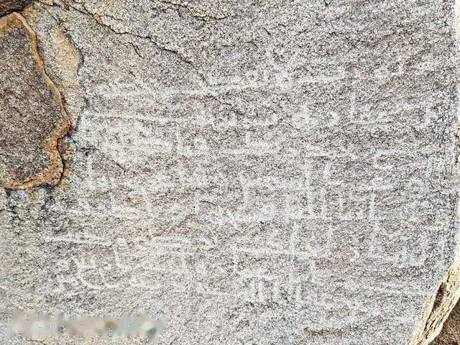
84 AH QMI-INS-033

Qurʾanic Inscription of ʿAbdallāh ibn ʿImārah

نقش عبد الله بن عمارة

SiteWādī al-Ḥurumān
Writing surfaceRock face
Lines3
Dimensions113 × 49 cm
ScriptḤijāzī
SubjectQurʾanic verse (Q 2:21)
ReadingClear · nothing restored
Grade 1 of 5. The text is complete; nothing is restored.

Original text (Arabic)

  1. يايها الناس اتقوا (كذا) ربكم الذي خلقكم وا
  2. لذين من قبلكم لعلكم تفلحون (كذا) وكتب عبد ا
  3. لله بن عمارة لسنة أربع وثمنين (ثمانين)

Translation

  1. “O mankind, worship your Lord, who created you and
  2. those before you, that you may become righteous” [cf. Q 2:21]. And ʿAbd-
  3. allāh ibn ʿImārah wrote [this], in the year four and eighty.

Commentary

The scribe's memory of the verse (opening of Sūrat al-Baqarah, 2:21) slips at two points, marked "kadhā" ("sic") by the editor: writing ittaqū ("be mindful of") where the Qurʾanic text has uʿbudū ("worship"), and tuflihūn ("you may prosper") in place of the verse's tattaqūn ("you may become righteous") — small variations that suggest quotation from memory rather than a written exemplar.

Source: Photograph by ʿAbdallāh Muṣliḥ al-Thumālī (@thoomaly11), posted 29 March 2018.

How to cite

Shaker W. Ahmed. “Qurʾanic Inscription of ʿAbdallāh ibn ʿImārah” (Cat. No. QMI-INS-033). QMI, quranmss.com, 2026.

Inscription of Ḥakīm ibn ʿImārahPhotograph: ʿAbdallāh Muṣliḥ al-Thumālī⤢ Click to enlarge
84 AH QMI-INS-034

Inscription of Ḥakīm ibn ʿImārah

نقش حكيم بن عمارة

SiteWādī al-Ḥurumān
Writing surfaceRock face
Lines8
Dimensions98 × 62 cm
ScriptḤijāzī
SubjectQurʾanic-phrased prayer (echoing Sūrah Ṭā Hā)
ReadingClear · nothing restored
Grade 1 of 5. The text is complete; nothing is restored.

Original text (Arabic)

  1. رب لا تفضح حكيم
  2. بن عمارة بسم الله
  3. فسبح بحمد ربك قبل طلـ
  4. و ع الشمس وقبل غروبها
  5. ومن أنا (أناء) اليل (الليل) فسبحه وأطرف (أطراف)
  6. النهار لعلك ترضى وكتب
  7. حكيم ابن عمارة لسنة أربع و
  8. ثمنين (ثمانين) غفر الله له ذنبه امين

Translation

  1. Lord, do not disgrace Ḥakīm
  2. ibn ʿImārah. In the name of God,
  3. “so glorify your Lord's praise before the ris-
  4. ing of the sun and before its setting,
  5. and in part of the night glorify Him, and at the ends of
  6. the day, that you may be pleased” [cf. Q 20:130]. And
  7. Ḥakīm ibn ʿImārah wrote [this], in the year four and
  8. eighty. May God forgive him his sin. Āmīn.

Commentary

Opens with a personal plea ("Lord, do not disgrace Ḥakīm") before quoting a Qurʾanic verse on glorifying God at set times of day (cf. Ṭā Hā 20:130), then closes with a standard forgiveness formula — combining three distinct registers (personal petition, scripture, prayer) in a single short text.

Source: Photograph by ʿAbdallāh Muṣliḥ al-Thumālī (@thoomaly11), posted 17 February 2019.

How to cite

Shaker W. Ahmed. “Inscription of Ḥakīm ibn ʿImārah” (Cat. No. QMI-INS-034). QMI, quranmss.com, 2026.

Milestone of ʿAbd al-Malik from Fīq, Golan, no. 1 (traced)Image: after Elad (1999), with the letters traced; Israel Antiquities Authority⤢ Click to enlarge
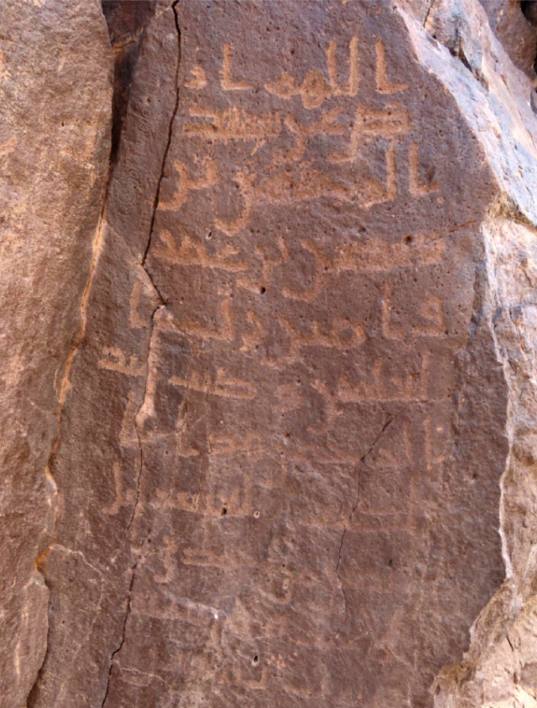
85 AH QMI-INS-034a

Milestone of ʿAbd al-Malik from Fīq, Golan: 52 miles from Damascus

ميل عبد الملك من فيق في الجولان: اثنان وخمسون ميلا من دمشق

SiteThe village of Fīq, southern Golan; now Golan Archaeological Museum
Writing surfaceBasalt block, dressed as a building stone
Lines6 (with a first line, the basmalah, lost)
Dimensions28.5 × 28.5 cm; 24.5 cm deep
ScriptKūfic
SubjectMilestone dated 85 AH: 52 miles from Damascus; made by Musāwir, client of the caliph
ReadingPartly preserved · edges broken; what survives is clear
Grade 3 of 5. The block is broken along its edges, so the ends of most lines are lost and restored. What survives is clearly cut.

Original text (Arabic)

  1. <بسم الله الرحمن الرحيم>
  2. [لا إله إلا الله وحده لا] شريك لـ[ـه محمد رسو]
  3. ل الله أمر بصنعة هـ[ـذه الأميال عبد]
  4. الله عبد الملك أمير المـ[ـؤمنين على يدي]
  5. مساور مولى أميـ[ـر الـ]ـمؤمنين في [...]
  6. من سنة خمس وثمـ[ـنـ]ـين من دمشق [إلى]
  7. هذا إثنين (اثنان) وخمسين (وخمسون) ميـ[ـلا]

Translation

  1. <In the name of God, the Merciful, the Compassionate.> (line lost)
  2. [There is no god but God alone;] no partner h[as He; Muḥammad is the messenge]-
  3. r of God. Has ordered the making of th[ese milestones the servant of]
  4. God ʿAbd al-Malik, Commander of the Fa[ithful, at the hands of]
  5. Musāwir, client of the Comman[der of the] Faithful, in [the month of ...]
  6. of the year eighty-five. From Damascus [to]
  7. this (milestone) fifty-two mi[les].

Commentary

A square basalt block, dressed as a building stone, found in 1968 near the village of Fīq in the southern Golan and kept in the Golan Archaeological Museum. The first line, with the basmalah, is lost, and the right and left edges of the text are worn; the date survives as the year eighty-five, with the month lost. The milestone marks fifty-two miles from Damascus, one mile short of its companion found at the same place (QMI-INS-034b).

The work was carried out “at the hands of” (ʿalā yaday) Musāwir, a client (mawlā) of the Commander of the Faithful, the same formula used in 73 AH for Yaḥyā ibn al-Ḥakam in the road inscription of ʿAqabat Fīq, at the pass above the same village (QMI-INS-014a). The number is written ithnayn wa-khamsīn, in the oblique case, where the grammar of the standard language has ithnān wa-khamsūn; and the text says only “to this” (ilā hādhā), without the word mīl found on the milestones of Palestine.

The milestones of ʿAbd al-Malik are among the earliest official Arabic texts of the caliphate. Those of the roads of Palestine carry no date and are placed in his reign (65–86 AH) by the caliph’s name and title; two milestones from Fīq in the Golan, made under the same order, are dated 85 AH (QMI-INS-034a, QMI-INS-034b), and the road inscription of ʿAqabat Fīq is dated 73 AH (QMI-INS-014a). On the road from Jerusalem to the coast the miles are counted from Īliyāʾ, the name of Jerusalem in early Islamic texts (QMI-INS-014b, QMI-INS-014c, QMI-INS-014d); on the road from Jerusalem towards Jericho and Damascus they are counted from Damascus (QMI-INS-014e, QMI-INS-014f). The milestones of Palestine pray “may God’s mercy be upon him” after the caliph’s name, a prayer Amikam Elad takes to mean that ʿAbd al-Malik had died when they were set up: planned in his reign, they would then have been completed after it, from 86 AH. The two Golan milestones of 85 AH, made in his lifetime, have no such prayer.

The reading follows the edition of Amikam Elad, checked against his traced photograph. Square brackets mark restored text.

Source: Elad, Amikam. “The Southern Golan in the Early Muslim Period: The Significance of Two Newly Discovered Milestones of ʿAbd al-Malik.” Der Islam 76 (1999): 33–88, at pp. 33–35 (inscription no. 1, Qazrin Museum no. 876001). See also Sharon, Moshe. Corpus Inscriptionum Arabicarum Palaestinae, vol. III (Leiden: Brill), “Fīq”, pp. 220–224.

How to cite

Shaker W. Ahmed. “Milestone of ʿAbd al-Malik from Fīq, Golan: 52 miles from Damascus” (Cat. No. QMI-INS-034a). QMI, quranmss.com, 2026.

Milestone of ʿAbd al-Malik from Fīq, Golan, no. 2 (traced)Image: after Elad (1999), with the letters traced; Israel Antiquities Authority⤢ Click to enlarge
85 AH QMI-INS-034b

Milestone of ʿAbd al-Malik from Fīq, Golan: 53 miles from Damascus

ميل عبد الملك من فيق في الجولان: ثلاثة وخمسون ميلا من دمشق

SiteThe village of Fīq, southern Golan; now Golan Archaeological Museum
Writing surfaceBasalt slab
Lines5
Dimensions80.5 × 39.5 cm; 23 cm deep
ScriptKūfic
SubjectMilestone dated Shaʿbān 85 AH: 53 miles from Damascus; made by Musāwir, client of the caliph
ReadingPartly preserved · right edge broken; what survives is clear
Grade 3 of 5. The ends of several lines are lost at the broken edge and restored from the companion milestone. What survives is clear.

Original text (Arabic)

  1. بسم الله الرحمن الرحـ[ـيم]
  2. لا إله إلا الله وحده لا شريك له محـ[ـمد رسول]
  3. الله أمر بصنعة هذه الأميال عبد الله [عبد ا]
  4. لملك أمير المؤمنين على يدي مساور مولى أميـ[ـر المؤمنين]
  5. في شعبان من سنة خمس وثمنين (وثمانين) من دمشق إلى هذا ثلثة (ثلاثة) [وخمسون ميلا]

Translation

  1. In the name of God, the Merciful, the Compas[sionate].
  2. There is no god but God alone; He has no partner; Muḥ[ammad is the messenger of]
  3. God. Has ordered the making of these milestones the servant of God [ʿAbd a]-
  4. l-Malik, Commander of the Faithful, at the hands of Musāwir, client of the Comma[nder of the Faithful],
  5. in Shaʿbān of the year eighty-five. From Damascus to this (milestone) three [and fifty miles].

Commentary

The second milestone from Fīq in the Golan, found with its companion in 1968 and kept in the Golan Archaeological Museum; it is the larger of the two, an almost complete basalt slab. Its date is complete: Shaʿbān of the year eighty-five, that is, between 8 August and 5 September 704 CE. It marks fifty-three miles from Damascus, one mile beyond its companion (QMI-INS-034a), and names the same official, Musāwir, client of the Commander of the Faithful.

The text opens with the basmalah and the profession of God’s oneness and of the mission of Muḥammad, as does the road inscription of ʿAqabat Fīq of 73 AH (QMI-INS-014a). The word waḥdahu (“alone”) in the second line is shown on the traced photograph and in the editor’s translation, though it is missing from his printed Arabic text. Thamānīn and thalāthah are written without the long alif (ثمنين، ثلثة).

The milestones of ʿAbd al-Malik are among the earliest official Arabic texts of the caliphate. Those of the roads of Palestine carry no date and are placed in his reign (65–86 AH) by the caliph’s name and title; two milestones from Fīq in the Golan, made under the same order, are dated 85 AH (QMI-INS-034a, QMI-INS-034b), and the road inscription of ʿAqabat Fīq is dated 73 AH (QMI-INS-014a). On the road from Jerusalem to the coast the miles are counted from Īliyāʾ, the name of Jerusalem in early Islamic texts (QMI-INS-014b, QMI-INS-014c, QMI-INS-014d); on the road from Jerusalem towards Jericho and Damascus they are counted from Damascus (QMI-INS-014e, QMI-INS-014f). The milestones of Palestine pray “may God’s mercy be upon him” after the caliph’s name, a prayer Amikam Elad takes to mean that ʿAbd al-Malik had died when they were set up: planned in his reign, they would then have been completed after it, from 86 AH. The two Golan milestones of 85 AH, made in his lifetime, have no such prayer.

The reading follows the edition of Amikam Elad, checked against his traced photograph. Square brackets mark restored text.

Source: Elad, Amikam. “The Southern Golan in the Early Muslim Period: The Significance of Two Newly Discovered Milestones of ʿAbd al-Malik.” Der Islam 76 (1999): 33–88, at pp. 36–38 (inscription no. 2, Qazrin Museum no. 876313). See also Sharon, Moshe. Corpus Inscriptionum Arabicarum Palaestinae, vol. III (Leiden: Brill), “Fīq”, pp. 220–224.

How to cite

Shaker W. Ahmed. “Milestone of ʿAbd al-Malik from Fīq, Golan: 53 miles from Damascus” (Cat. No. QMI-INS-034b). QMI, quranmss.com, 2026.

Inscription of ʿAbd al-Raḥmān ibn Sufyān ibn ʿAmrPhotograph: Muḥammad al-Mughadhdhawī⤢ Click to enlarge
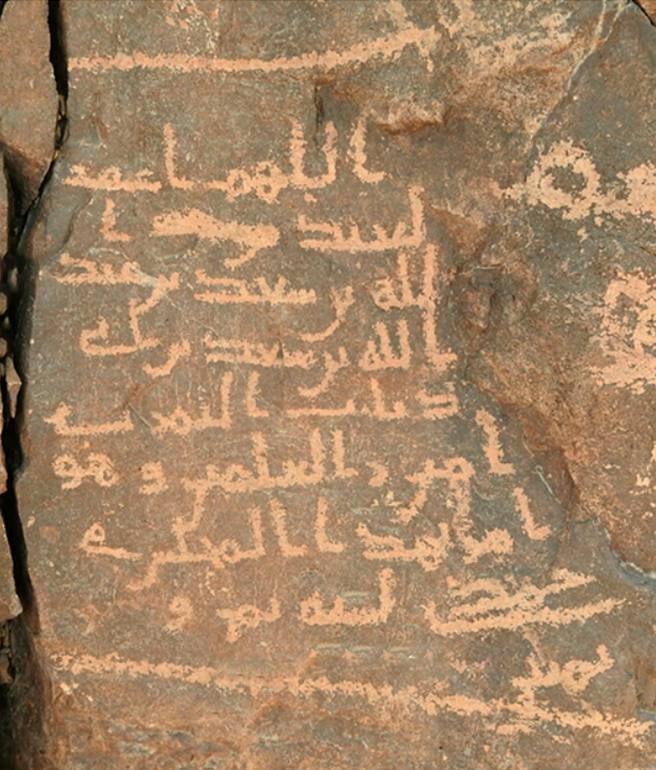
86 AH QMI-INS-035

Inscription of ʿAbd al-Raḥmān ibn Sufyān ibn ʿAmr

نقش عبد الرحمن بن سفيان بن عمرو

SiteQāʿ al-Muʿtadil, Darb al-Ḥajj
Writing surfaceRock face
Lines10
Dimensions74 × 34 cm
ScriptḤijāzī
SubjectPrayer asking for God's good pleasure
ReadingClear · nothing restored
Grade 1 of 5. The text is complete; nothing is restored.

Original text (Arabic)

  1. اللهم أر
  2. ضى عن عبد
  3. الرحمن بن
  4. سفين (سفيان) بن عمر
  5. و آمين رب ا
  6. لعلمين (العالمين) وكتب عبد
  7. الرحمن هذا ا
  8. لكتب (الكتاب) لعشر ليل (ليال)
  9. بقين من جمدى (جمادى) ا
  10. لاخرة

Translation

  1. O God, be
  2. pleased with ʿAbd
  3. al-Raḥmān ibn
  4. Sufyān ibn ʿAmr.
  5. Āmīn, Lord of
  6. the Worlds. And ʿAbd
  7. al-Raḥmān wrote this
  8. writing, ten nights
  9. remaining of Jumādā
  10. al-Ākhirah.

Commentary

Found on the same rock face at Qāʿ al-Muʿtadil, along the Syrian pilgrim route, as several other inscriptions in this catalog (e.g. nos. 18, 28). Uses the same riḍā ("being pleased with") prayer formula seen in the inscription of ʿAmr (no. 16) from a decade earlier.

Source: al-Mughadhdhawī, Muḥammad (@mohammed93athar). Twitter, 22 October 2019.

How to cite

Shaker W. Ahmed. “Inscription of ʿAbd al-Raḥmān ibn Sufyān ibn ʿAmr” (Cat. No. QMI-INS-035). QMI, quranmss.com, 2026.

Inscription of ʿAbdallāh ibn SaʿdPhotograph: Muḥammad al-Mughadhdhawī⤢ Click to enlarge
88 AH QMI-INS-036

Inscription of ʿAbdallāh ibn Saʿd

نقش عبد الله بن سعد

SiteQāʿ al-Muʿtadil, Darb al-Ḥajj
Writing surfaceRock face
Lines9
Dimensions74 × 34 cm
ScriptḤijāzī
SubjectPrayer for forgiveness, dated by an assembly (majlis)
ReadingLargely clear · a few letters restored
Grade 2 of 5. Nearly complete; a few letters are restored by the editor.

Original text (Arabic)

  1. اللهم اغفر
  2. لعبد ]ا[
  3. لله بن سعد بن عبد
  4. الله بن سعد بن أبي
  5. ذباب النمري
  6. امين ر]ب[ العلمين (العالمين) و هو
  7. أمر بهذا المجلس في
  8. جمدى (جمادى) لسنة ثمن (ثمان) و
  9. ثمنين (ثمانين)

Translation

  1. O God, forgive
  2. ʿAbd-
  3. allāh ibn Saʿd ibn ʿAbd-
  4. allāh ibn Saʿd ibn Abī
  5. Dhubāb al-Namarī.
  6. Āmīn, Lord of the Worlds. And he
  7. commanded this assembly (majlis) in
  8. Jumādā, in the year eight and
  9. eighty.

Commentary

A four-generation genealogy packed into a single prayer (ʿAbdallāh ibn Saʿd ibn ʿAbdallāh ibn Saʿd ibn Abī Dhubāb, of the Banū al-Namir), on the same rock face at Qāʿ al-Muʿtadil as several other Darb al-Ḥajj inscriptions in this catalog. The reference to "this assembly" (hādhā al-majlis) is unusual, hinting at some gathering or occasion tied to the inscription's creation that the text does not further explain.

The same year, 88 AH, is recorded on a high rock of the Syrian Ḥajj route by Yazīd the Engraver, whose long profession of faith is dated Ramaḍān 88 AH (QMI-INS-036a).

Source: al-Mughadhdhawī, Muḥammad (@mohammed93athar). Twitter, 22 October 2019.

How to cite

Shaker W. Ahmed. “Inscription of ʿAbdallāh ibn Saʿd” (Cat. No. QMI-INS-036). QMI, quranmss.com, 2026.

Inscription of Yazīd the Engraver⤢ Click to enlarge
88 AH QMI-INS-036a

Inscription of Yazīd the Engraver (al-Naqqāsh)

نقش يزيد النقّاش

SiteSyrian Ḥajj route, north-western Arabia (exact site not named in the publication)
Writing surfaceLarge rock high on a mountainside
Lines10
DimensionsUnrecorded
ScriptḤijāzī
SubjectProfession of faith with belief in the Hour and the resurrection, dated Ramaḍān 88 AH
ReadingClear · nothing restored
Grade 1 of 5. The text is complete; nothing is restored.

Original text (Arabic)

  1. هذا ما شهد يزيد بأنه لا
  2. اله الا الله وحده وان
  3. محمد رسول
  4. الله وان الساعة اتية لا ريب
  5. فيها وان الله يبعث من
  6. في القبور حييت
  7. على ذلك ومت
  8. على ذلك وكتب يزيد
  9. النقاش في رمضان من سنة
  10. ثمان وثمانين

Translation

  1. This is what Yazīd testified: that there is no
  2. god but God alone, and that
  3. Muḥammad is the Messenger of
  4. God, and that the Hour is coming, there is no doubt
  5. about it, and that God will raise up those
  6. in the graves. I lived
  7. by this and I died
  8. by this. And Yazīd
  9. the Engraver (al-Naqqāsh) wrote this in Ramaḍān of the year
  10. eighty-eight.

Commentary

A long and carefully cut profession of faith, dated by month and year: Ramaḍān 88 AH (August–September 707 CE), in the caliphate of al-Walīd ibn ʿAbd al-Malik. It opens in the manner of a testimony, “this is what Yazīd testified” (hādhā mā shahida yazīd), and runs from the two parts of the shahādah to the Hour and the resurrection. The last clause (“the Hour is coming, there is no doubt about it, and God will raise up those in the graves”) follows Q 22:7 word for word. The writer then says that he lived by this belief and died by it (ḥayītu ʿalā dhālika wa-mittu ʿalā dhālika), a profession phrased as a testament.

The writer gives only his first name and his trade, al-naqqāsh, the engraver or carver, with no father, tribe or patron. Another early hand in this catalog that signs with an occupation is Qays the Scribe (QMI-INS-004a). The text is cut high on the rock, so high that the survey team could read it only with binoculars and a long-range camera. The lines are even and the letters well formed, which suits a man who carved for a living. The same year, 88 AH, is also recorded at Qāʿ al-Muʿtadil by the prayer of ʿAbdallāh ibn Saʿd (QMI-INS-036). For other professions of faith dated by month and year, see QMI-INS-055v, QMI-INS-055i and QMI-INS-055aaa.

Source: Desert Team (Farīq al-Ṣaḥrā’), “Riḥlat shitāʾ 1445 H (3): nuqūsh wa-suyūl ʿalā darb al-ḥajj al-shāmī”, alsahra.org, 16 December 2023. Reading by ʿAbdallāh ibn ʿAbd al-ʿAzīz al-Saʿīd; photography by the Desert Team.

How to cite

Shaker W. Ahmed. “Inscription of Yazīd the Engraver (al-Naqqāsh)” (Cat. No. QMI-INS-036a). QMI, quranmss.com, 2026.

Inscription of Ṣabīḥ, Client of Razīq⤢ Click to enlarge
90 AH QMI-INS-037

Inscription of Ṣabīḥ, Client of Razīq

نقش صبيح فتى رزيق

SiteṬūr al-Qawwās
Writing surfaceWest face
Lines2
Dimensions70 × 15 cm
ScriptḤijāzī
SubjectRecording a name
ReadingLargely clear · a few letters restored
Grade 2 of 5. Nearly complete; a few letters are restored by the editor.

Original text (Arabic)

  1. أنا صبيح فتا رزيق بن أمنـ...
  2. سنة تسعين

Translation

  1. I, Ṣabīḥ, client (fatā) of Razīq ibn Amn-...
  2. the year ninety.

Commentary

One of the shortest texts in this catalog, just two lines. The word fatā ("young man") here functions like mawlā elsewhere in the corpus, denoting a client or dependent relationship to a patron, Razīq.

Source: al-Ghabbān, Maysāʾ ʿAlī. al-Kitābāt al-Islāmīyah al-Mubakkirah fī Haḍbat Ḥismā bi-Minṭaqat Tabūk. PhD diss., Jāmiʿat al-Malik Saʿūd, 2017, p. 832, inscription no. 38.

How to cite

Shaker W. Ahmed. “Inscription of Ṣabīḥ, Client of Razīq” (Cat. No. QMI-INS-037). QMI, quranmss.com, 2026.

Inscription of Ibrāhīm ibn Jamīl the MuezzinPhotograph: Al-Sahra Team⤢ Click to enlarge
90 AH QMI-INS-037a

Inscription of Ibrāhīm ibn Jamīl the Muezzin

نقش إبراهيم بن جميل المؤذن

SiteNorth-western Arabia (Desert Team survey)
Writing surfaceRock face (sandstone)
Lines2
DimensionsUnrecorded
ScriptḤijāzī
SubjectExhortation by a muezzin; year read as 90 AH (or 80 AH)
ReadingLargely clear · a few letters restored
Grade 2 of 5. Nearly complete; a few letters are restored by the editor.

Original text (Arabic)

  1. انا ابراهيم بن جميل بن عبد الرحمن الموذن امر بتقوى الله وادل على صلة الرحم
  2. وكتب في رجب سنة [تسعين]

Translation

  1. I am Ibrāhīm ibn Jamīl ibn ʿAbd al-Raḥmān, the muezzin. I enjoin mindfulness of God and point the way to keeping the ties of kinship.
  2. And [this] was written in Rajab of the year [ninety].

Commentary

A short sermon in stone: the writer gives his profession — al-muʾadhdhin, the one who calls to prayer, an occupational title rarely seen in these inscriptions — and then exhorts the reader to mindfulness of God and to keeping the ties of kinship. The letters are cut deep into hard rock, but the year, written in a single word, is the least clear part of the text. The Desert Team read it as “tisʿīn” (ninety), noting a tall first tooth followed by smaller ones; “thamānīn” (eighty) cannot be excluded. On the reading adopted here it falls in Rajab 90 AH (May–June 709 CE), in the caliphate of al-Walīd ibn ʿAbd al-Malik.

Source: Farīq al-Ṣaḥrāʾ (the Desert Team). “Min kitābāt al-musāfirīn fī al-qarn al-awwal.” Farīq al-Ṣaḥrāʾ (alsahra.org), April 2025, inscription 1.

How to cite

Shaker W. Ahmed. “Inscription of Ibrāhīm ibn Jamīl the Muezzin” (Cat. No. QMI-INS-037a). QMI, quranmss.com, 2026.

First Inscription of Ismāʿīl ibn ʿAbd al-Raḥmān ibn Khālid, al-Bāḥah: photographPhoto: after Alhatlani (2021)⤢ Click to enlarge
before c. 125 AH QMI-INS-004cd

First Inscription of Ismāʿīl ibn ʿAbd al-Raḥmān ibn Khālid, al-Bāḥah

نقش إسماعيل بن عبد الرحمن بن خالد (الأول)، الباحة

SiteWādī Khara, al-Bāḥah region, Saudi Arabia
Writing surfaceRock face
Lines4
Dimensions85 × 40 cm
ScriptḤijāzī
SubjectFirst-person prayer for forgiveness by a grandson of the Companion Khālid ibn al-ʿĀṣ; undated
ReadingClear · nothing restored
Grade 1 of 5. The text is complete; nothing is restored.

Original text (Arabic)

  1. أنا إسمعيل (إسماعيل) بن عبد ا
  2. لرحمن بن خلد (خالد) أ
  3. سل (أسأل) الله ا
  4. لمغفرة

Translation

  1. I, Ismāʿīl ibn ʿAbd al-
  2. Raḥmān ibn Khālid, a-
  3. sk God for
  4. forgiveness.

Commentary

A four-line prayer by Ismāʿīl, son of ʿAbd al-Raḥmān and grandson of the Companion Khālid ibn al-ʿĀṣ: “I, Ismāʿīl ibn ʿAbd al-Raḥmān ibn Khālid, ask God for forgiveness.” Ismāʿīl and Khālid are both written without the long alif, and asʾalu is again written أسل, as in his father's prayer (QMI-INS-004cb). The writer divides words freely across the line ends (ʿAbd a-/l-Raḥmān, a-/sʾalu, a-/l-maghfirah).

Alhatlani places the text in the first century AH. As a grandson of a man who became Muslim in 8 AH and whose son was active in 40 AH, Ismāʿīl belongs to the generation of the later Umayyad first century; a second prayer of his, opening with the full basmalah, is on another rock in the same valley (QMI-INS-004ce).

The Makhzūmī family of Khālid ibn al-ʿĀṣ ibn Hishām is unusually well represented on the rocks of Wādī Khara: the Companion himself (QMI-INS-004c), a prayer for him written by one Ziyād (QMI-INS-004ca), his sons ʿAbd al-Raḥmān and al-Ḥārith (QMI-INS-004cb, QMI-INS-004cc), and his grandson Ismāʿīl ibn ʿAbd al-Raḥmān (QMI-INS-004cd, QMI-INS-004ce). ʿAbd al-Raḥmān also left a text dated 40 AH on the road north-east of Mecca (QMI-INS-005).

Dating. Ismāʿīl ibn ʿAbd al-Raḥmān is mentioned only in passing in the literary sources: Ibn Mākūlā (al-Ikmāl) records his descendants, and al-Zubayr ibn Bakkār names his wife, ʿĀtikah bint Karīz. His father was active in 40 AH (QMI-INS-005). Qashshāsh suggests that Ismāʿīl died around 120–130 AH, from his absence from the sources after that time. The text thus belongs to the later first or early second century AH and is placed here at c. 90 AH, the middle of that span (Alhatlani (2021), pp. 74–76).

Source: Qashshāsh, Aḥmad ibn Saʿīd. Nuqūsh al-ṣaḥābī al-jalīl Khālid ibn al-ʿĀṣ wa-abnāʾihi fī manṭiqat al-Bāḥah. 1st ed., 2015, pp. 43–44; Alhatlani, Abdullah Saad. Descendants and Ancestors: A Study of Arabic Inscriptions from the Arabian Peninsula (1st–4th c. AH/7th–10th c. CE). PhD thesis, Leiden University, 2021 (hdl.handle.net/1887/3217834), ch. 1, no. 5, p. 218 (photograph).

How to cite

Shaker W. Ahmed. “First Inscription of Ismāʿīl ibn ʿAbd al-Raḥmān ibn Khālid, al-Bāḥah” (Cat. No. QMI-INS-004cd). QMI, quranmss.com, 2026.

Second Inscription of Ismāʿīl ibn ʿAbd al-Raḥmān ibn Khālid, al-Bāḥah: photographPhoto: after Alhatlani (2021)⤢ Click to enlarge
before c. 125 AH QMI-INS-004ce

Second Inscription of Ismāʿīl ibn ʿAbd al-Raḥmān ibn Khālid, al-Bāḥah

نقش إسماعيل بن عبد الرحمن بن خالد (الثاني)، الباحة

SiteShiʿb ʿĀfiyah, Wādī Khara, al-Bāḥah region, Saudi Arabia
Writing surfaceRock face
Lines6
Dimensions90 × 70 cm
ScriptḤijāzī
SubjectBasmalah and declaration of sincere devotion to God, “the Inheritor, the Protector”, by a grandson of Khālid ibn al-ʿĀṣ; undated
ReadingClear · nothing restored
Grade 1 of 5. The text is complete; nothing is restored.

Original text (Arabic)

  1. بسم الله الرحمن الر
  2. حيم أنا إسمعيل (إسماعيل) ا
  3. بن عبد الرحمن
  4. بن خلد (خالد) أخلصت
  5. ديني للوارث
  6. الوال (الوالي)

Translation

  1. In the name of God, the Compassionate, the
  2. Merciful. I, Ismāʿīl,
  3. son of ʿAbd al-Raḥmān
  4. ibn Khālid, have devoted
  5. my religion purely to the Inheritor,
  6. the Protector.

Commentary

Six lines at Shiʿb ʿĀfiyah in Wādī Khara, opening with the full basmalah: “In the name of God, the Compassionate, the Merciful. I, Ismāʿīl ibn ʿAbd al-Raḥmān ibn Khālid, have devoted my religion purely to the Inheritor, the Protector.” Akhlaṣtu dīnī takes up the Qurʾānic phrase of sincere worship, “Say: God I worship, devoting my religion purely to Him” (mukhliṣan lahu dīnī, Q 39:14).

The two divine names are uncommon in the early inscriptions. Al-Wārith, “the Inheritor”, recalls “and We are the Inheritors” (Q 15:23), and al-wāl, written without its final yāʾ, recalls “they have no protector apart from Him” (min wāl, Q 13:11). Basmalah, Raḥīm and ibn are divided across the line ends. Alhatlani dates the text to the first century AH, as with Ismāʿīl's other prayer (QMI-INS-004cd).

The Makhzūmī family of Khālid ibn al-ʿĀṣ ibn Hishām is unusually well represented on the rocks of Wādī Khara: the Companion himself (QMI-INS-004c), a prayer for him written by one Ziyād (QMI-INS-004ca), his sons ʿAbd al-Raḥmān and al-Ḥārith (QMI-INS-004cb, QMI-INS-004cc), and his grandson Ismāʿīl ibn ʿAbd al-Raḥmān (QMI-INS-004cd, QMI-INS-004ce). ʿAbd al-Raḥmān also left a text dated 40 AH on the road north-east of Mecca (QMI-INS-005).

Dating. As with Ismāʿīl's other prayer (QMI-INS-004cd): his father ʿAbd al-Raḥmān was active in 40 AH, and Qashshāsh places Ismāʿīl's death around 120–130 AH. The text is placed at c. 90 AH, within his adult life (Alhatlani (2021), pp. 74–76).

Source: Qashshāsh, Aḥmad ibn Saʿīd. Nuqūsh al-ṣaḥābī al-jalīl Khālid ibn al-ʿĀṣ wa-abnāʾihi fī manṭiqat al-Bāḥah. 1st ed., 2015, pp. 45–46; Alhatlani, Abdullah Saad. Descendants and Ancestors: A Study of Arabic Inscriptions from the Arabian Peninsula (1st–4th c. AH/7th–10th c. CE). PhD thesis, Leiden University, 2021 (hdl.handle.net/1887/3217834), ch. 1, no. 6, p. 218 (photograph).

How to cite

Shaker W. Ahmed. “Second Inscription of Ismāʿīl ibn ʿAbd al-Raḥmān ibn Khālid, al-Bāḥah” (Cat. No. QMI-INS-004ce). QMI, quranmss.com, 2026.

Prayer for the Prophet and for ʿAṭāʾ ibn Mīnāʾ, TabūkPhoto: Saʿd al-Tuwayjirī⤢ Click to enlarge
1st c. AH QMI-INS-037b

Inscription of ʿAṭāʾ ibn Mīnāʾ, Tabūk

نقش عطاء بن ميناء، تبوك

SiteTabūk region
Writing surfaceRock face
Lines3
DimensionsUnrecorded
ScriptEarly Kūfic
SubjectPrayer for forgiveness for the Prophet Muḥammad and for ʿAṭāʾ ibn Mīnāʾ; undated
ReadingClear · nothing restored
Grade 1 of 5. The text is complete; nothing is restored.

Original text (Arabic)

  1. اللهم اغفر لمحمد
  2. النبي ولعطاء بن مينا (ميناء)
  3. آمين

Translation

  1. O God, forgive Muḥammad
  2. the Prophet, and ʿAṭāʾ ibn Mīnāʾ.
  3. Amen.

Commentary

A three-line prayer from the Tabūk region, cut in broad strokes beneath a carved motif. It asks forgiveness first for “Muḥammad the Prophet” and then for ʿAṭāʾ ibn Mīnāʾ, and closes with “Amen”. A prayer of forgiveness for the Prophet himself, placed before the writer’s own name, is rare in the catalog; elsewhere the Prophet is the object of blessing (ṣalāh) and of hope for his intercession, as in the prayer of Bakr ibn Abī Bakrah, 80 AH (QMI-INS-023). The name Mīnāʾ is written without its final hamzah, as is usual in the period.

The text is undated. The name is uncommon, and the biographical literature knows one man who bore it: ʿAṭāʾ ibn Mīnāʾ, Abū Muʿādh, of al-Madīnah, a client of Ibn Abī Dhubāb al-Dawsī and a well-known pupil of Abū Hurayrah, who also transmitted from ʿAbd Allāh ibn ʿUmar and ʿAbd Allāh ibn ʿAmr. Ibn Ḥibbān lists him among the trustworthy, al-ʿIjlī calls him thiqah, Ibn Ḥajar ṣadūq of the third generation, and al-Bukhārī and Muslim cite him; some sources connect him with al-Baṣrah as well as al-Madīnah. His year of death is not recorded; al-Dhahabī places him among those who died between 91 and 100 AH. If the writer of this prayer is the same man, the inscription belongs to the later first century AH; the identification rests on the name alone and remains possible rather than certain. Tabūk lay on the road from al-Madīnah to Syria, travelled by pilgrims, traders and armies alike.

Source: Photograph by Saʿd ibn Muḥammad al-Tuwayjirī (@OfNajd), published on X. Biography: al-Mizzī, Tahdhīb al-Kamāl, s.v. ʿAṭāʾ ibn Mīnāʾ; Ibn Ḥajar, Taqrīb al-Tahdhīb; Ibn Ḥibbān, al-Thiqāt and Mashāhīr ʿulamāʾ al-amṣār; al-Dhahabī, Tārīkh al-Islām (ṭabaqah 91–100 AH).

How to cite

Shaker W. Ahmed. “Inscription of ʿAṭāʾ ibn Mīnāʾ, Tabūk” (Cat. No. QMI-INS-037b). QMI, quranmss.com, 2026.

Inscription of al-Ḍaḥḥāk ibn Dāwūd, ḤismāPhoto: Desert Team (alsahra.org)⤢ Click to enlarge
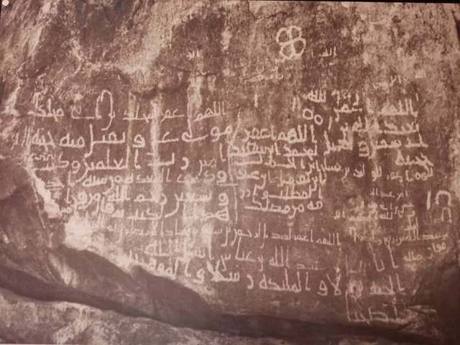
1st–2nd c. AH QMI-INS-037c

Inscription of al-Ḍaḥḥāk ibn Dāwūd: “I Took the Inheritance of Zayd”

نقش الضحاك بن داود: «أخذت ميراث زيد»

SiteḤismā, Tabūk region, north-western Arabia
Writing surfaceSandstone rock face
Lines4
DimensionsUnrecorded
ScriptEarly Kūfic
SubjectSigned record of a journey made at a father’s bidding, to take “the inheritance of Zayd”; undated
ReadingClear · nothing restored
Grade 1 of 5. The text is complete; nothing is restored.

Original text (Arabic)

  1. انا الضحاك بن داود
  2. بن أبي زبير في قبضة الله
  3. اتقلب أرسلني أبي
  4. أخذت ميراث زيد

Translation

  1. I am al-Ḍaḥḥāk ibn Dāwūd
  2. ibn Abī Zubayr, living in the bounty
  3. of God. My father sent me.
  4. I took the inheritance of Zayd.

Commentary

A four-line text on a dark-patinated rock face in Ḥismā. It opens with the writer’s own signature, “I am al-Ḍaḥḥāk ibn Dāwūd ibn Abī Zubayr”, a form that ties a text to its author more firmly than a prayer naming him in the third person (compare Khālid ibn al-ʿĀṣ, QMI-INS-004c, and the note to QMI-INS-055pz). He describes himself as living in the bounty of God: the words fī qabḍat Allāh atqallabu, literally “in the grip of God I turn about”, are rendered here by their sense, that his life and its changes are held in God’s care and favour, and then gives the reason for his journey: “my father sent me; I took the inheritance of Zayd”. Most texts in the catalog are prayers; few record a private errand in the writer’s own words.

The phrase mīrāth Zayd admits two readings, and the text does not decide between them. Read plainly, it records a family matter: al-Ḍaḥḥāk was sent by his father to collect a share in the estate of a man named Zayd, perhaps a kinsman. A second reading takes “the inheritance of Zayd” as the law of inheritance (farāʾiḍ) associated with the Companion Zayd ibn Thābit (d. c. 45 AH), whom a ḥadīth names as the most learned of the community in the shares of inheritance (afraḍuhum Zayd ibn Thābit; al-Tirmidhī, Ibn Mājah), and whose rulings in this field were followed in al-Madīnah, as the chapter on farāʾiḍ in Mālik’s Muwaṭṭaʾ shows. On this reading the writer would be saying that he took Zayd’s teaching on inheritance at his father’s bidding. The verb akhadhtu, “I took”, serves both senses, of receiving property and of receiving knowledge from a teacher.

Neither al-Ḍaḥḥāk ibn Dāwūd nor his grandfather Abū Zubayr has been identified in the biographical literature. The text carries no date; the script and the signature formula fit the first or early second century AH. Ḥismā lies on the route between the Ḥijāz and Syria, and its rocks carry several dated texts of the first century, among them the inscriptions of ʿAmr ibn Rabīʿah al-Thaqafī (QMI-INS-002b) and Saʿīd ibn ʿUthmān ibn ʿAffān (QMI-INS-004d).

Source: Photograph and text published by the Desert Team (Farīq al-Ṣaḥrāʾ), alsahra.org, Ḥismā, 10 December 2021. Reading checked against the photograph by Ahmed W. Shaker. On Zayd ibn Thābit and inheritance: al-Tirmidhī, al-Jāmiʿ, Abwāb al-Manāqib; Ibn Mājah, al-Sunan, al-Muqaddimah; Mālik, al-Muwaṭṭaʾ, Kitāb al-Farāʾiḍ.

How to cite

Shaker W. Ahmed. “Inscription of al-Ḍaḥḥāk ibn Dāwūd: “I Took the Inheritance of Zayd”” (Cat. No. QMI-INS-037c). QMI, quranmss.com, 2026.

Inscription of Mukhlid ibn Abī Mukhlid⤢ Click to enlarge
91 AH QMI-INS-038

Inscription of Mukhlid ibn Abī Mukhlid

نقش مخلد بن أبي مخلد

SiteWādī al-Awjarīyah
Writing surfaceRock face
Lines6
Dimensions80 × 55 cm
ScriptḤijāzī
SubjectPrayer for forgiveness and acceptance of pilgrimage
ReadingClear · nothing restored
Grade 1 of 5. The text is complete; nothing is restored.

Original text (Arabic)

  1. اللهم اغفر لمخلد بن أبي مخلد
  2. مولى علي وتقبل منه حجته
  3. امين رب العلمين (العالمين) وكتب
  4. في ذي القعدة من سنة إحدى
  5. وتسعين رحم الله من قرا (قرأ)
  6. هذا الكتب (الكتاب) ثم قال امين

Translation

  1. O God, forgive Mukhlid ibn Abī Mukhlid,
  2. client (mawlā) of ʿAlī, and accept his pilgrimage (ḥajjah).
  3. Āmīn, Lord of the Worlds. And he wrote
  4. [this] in Dhū al-Qaʿdah, of the year one
  5. and ninety. May God have mercy on whoever reads
  6. this writing and then says āmīn.

Commentary

Follows the same pattern as several other inscriptions in this corpus asking for a pilgrimage (ḥajjah) to be accepted, and closes with a blessing extended to any future reader who says "āmīn" aloud — effectively inviting every passerby who reads the stone to take part in the prayer. The same request for whoever reads the stone and says āmīn recurs at Wādī Salma in 105 AH (QMI-INS-055sa). The blessing on whoever reads the writing recurs in 130 AH at the end of Yazīd ibn ʿAbd Allāh’s text of al-Fātiḥah, there joined to a curse on whoever alters it (QMI-INS-055m).

Source: al-Kilābī, Ḥayāt. al-Nuqūsh al-Islāmīyah ʿalā Ṭarīq al-Ḥajj al-Shāmī bi-Shamāl Gharb al-Mamlakah al-ʿArabīyah al-Saʿūdīyah min al-Qarn al-Awwal ilā al-Qarn al-Khāmis al-Hijrī. al-Riyāḍ: Maktabat al-Malik Fahd al-Waṭanīyah, 1430 AH / 2009, pp. 61–73.

How to cite

Shaker W. Ahmed. “Inscription of Mukhlid ibn Abī Mukhlid” (Cat. No. QMI-INS-038). QMI, quranmss.com, 2026.

Inscription of al-Mughīrah ibn ʿUmarPhotograph: ʿAbdallāh Muṣliḥ al-Thumālī⤢ Click to enlarge
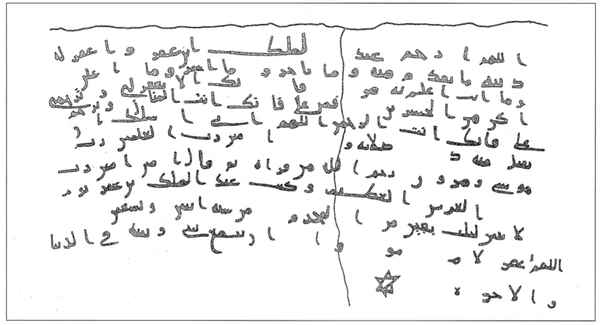
92 AH QMI-INS-039

Inscription of al-Mughīrah ibn ʿUmar

نقش المغيرة بن عمر

SiteWādī Malkān
Writing surfaceRock face
Lines11
DimensionsUnrecorded
ScriptḤijāzī
SubjectPrayer asking for Paradise, the Prophet and the believers as companions
ReadingClear · nothing restored
Grade 1 of 5. The text is complete; nothing is restored.

Original text (Arabic)

  1. أنا ا
  2. لمغيرة ابن
  3. عمر اسل (اسأل) ا
  4. لله الجنة نز
  5. لا والمئلكة
  6. رسلا والنبي ر
  7. فيقا والمومنين (المؤمنين)
  8. أصحبا (أصحابا) امين رب
  9. العلمين (العالمين) وكتب
  10. لسنة اثنتين و
  11. تسعين

Translation

  1. I, al-
  2. Mughīrah ibn
  3. ʿUmar, ask
  4. God for Paradise as a
  5. lodging, the angels
  6. as an escort, the Prophet as a
  7. companion, and the believers
  8. as companions. Āmīn, Lord of
  9. the Worlds. And it was written
  10. for the year two and
  11. ninety.

Commentary

Previously unpublished in the epigraphic literature until documented by ʿAbdallāh Muṣliḥ al-Thumālī in 2019, in Wādī Malkān south of Mecca, an area rich in early Islamic inscriptions. The phrasing (Paradise as a lodging, angels as an escort) echoes Qurʾanic and hadith language found in several other inscriptions of this corpus. The scribe misspells "al-malāʾikah" (angels) as "al-maʾlikah," transposing the hamzah and lām, and the book's author notes the lettering is unusually well-executed, with even spacing between words and lines and consistently straight vertical strokes.

Source: Documented and photographed by ʿAbdallāh Muṣliḥ al-Thumālī, 29 May 2020.

How to cite

Shaker W. Ahmed. “Inscription of al-Mughīrah ibn ʿUmar” (Cat. No. QMI-INS-039). QMI, quranmss.com, 2026.

Inscription of Qaṣr al-KharrānahFacsimile drawing after Imbert (1995), fig. 4⤢ Click to enlarge
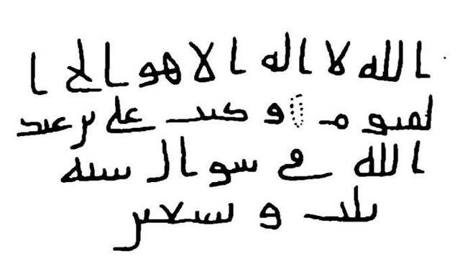
92 AH QMI-INS-040

Inscription of Qaṣr al-Kharrānah

نقش قصر الخرّانة

SiteQaṣr al-Kharrānah, Jordan
Writing surfaceInterior north wall of Room 51, above the door (246 cm above the floor)
Lines11
Dimensions60 × 26 cm
ScriptEarly Kūfī (archaic Umayyad), in ink
SubjectLong personal prayer naming ʿAbd al-Malik ibn ʿUmar
ReadingLargely clear · a few letters restored
Grade 2 of 5. Nearly complete; a few letters are restored by the editor.

Original text (Arabic)

  1. اللهم ارحم عبد الملك بن عمر واغفر له
  2. ذنبه ما تقدم منه وما تأخر من ما أسر وما أعلن
  3. وما أنت أعلم به، إن لم تغفر لي وترحمني
  4. أكن من الخاسرين، ربّ تمنّ عليّ إنك أنت المنّان وترحمني
  5. فإنك أنت الرحمن اللهم إني اسألك أن
  6. تقبل منه ]صـ[لاته وهيابته آمين رب العلمين رب
  7. موسى وهرون رحم الله من قرأه ثم قال آمين آمين رب
  8. العـ]لمـ[ين العزيز العظيم وكتب عبد الملك بن عمر يوم
  9. الاثنين لثلث بقين من المحرّم من سنة اثنين وتسعين
  10. اللهم اغفر لأم […] واسرح بنا أن نجتمع بنبي ونبيه في الدنيا
  11. والآخرة

Translation

  1. O God, have mercy on ʿAbd al-Malik ibn ʿUmar and forgive him
  2. his sin, what came before and what came after, what he kept secret and what he made known,
  3. and what You alone know. If You do not forgive me and have mercy on me,
  4. I would be among the losers. Lord, bestow Your favor upon me; You are the Bestower, and have mercy on me,
  5. me, for You are the Merciful. O God, I ask You to
  6. accept from him his prayer and reverence [for You] — āmīn, Lord of the Worlds, Lord of
  7. Moses and Aaron. May God have mercy on whoever reads it and then says āmīn, āmīn, Lord of
  8. the Worlds, the Mighty, the Majestic. And ʿAbd al-Malik ibn ʿUmar wrote [this] on
  9. Monday, three [nights] remaining of al-Muḥarram, in the year ninety-two (24 November 710),
  10. O God, forgive Umm […], and let us be gathered with my Prophet and his, in this world
  11. and the next.

Commentary

One of the best-known early Islamic inscriptions outside the Arabian Peninsula. It is painted in ink on the north wall of Room 51 at Qaṣr al-Kharrānah, a desert palace in Jordan that is often, though not conclusively, linked to the Umayyads. Nabia Abbott published the first nearly complete reading in 1946. Frédéric Imbert's 1995 study records the inscription as 60 × 26 cm, set 246 cm above the floor above the door, and describes it as archaic Umayyad Kūfī written in ink. The ink is fading, and several words remain uncertain (marked with brackets above). It is longer and more elaborate than most inscriptions in this catalog, and it invokes Moses and Aaron by name.

Imbert's reading corrects Abbott in several places. He confirms the name ʿAbd al-Malik ibn ʿUmar, which Abbott read and which Jaussen and Savignac had read as ʿUbayd. In line 3 he reads “what You alone know” (wa-mā anta aʿlamu bihi) in place of Abbott's unclear reading. In line 4 he identifies the Qurʾānic phrase “I would be among the losers” (Q 11:47). In line 8 he reads al-ʿAẓīm, “the Majestic”, where Abbott had read al-ʿAzīz. In line 10 he rejects Abbott's shahida (“bore witness”) and reads “O God” (Allāh). He cannot confirm or reject Abbott's reading of hiyāba in line 6. Imbert treats lines 10–11 as a second invocation added beneath the main text, possibly in the same period. The reading of the name after “Umm” is illegible.

Imbert records about twenty ink and engraved texts in the palace, concentrated in Room 51. Close to the main text he notes a smaller ink invocation for ʿAbd al-Malik ibn ʿUmar in three lines of fine Kufic (about 40 × 15 cm), probably of the same period, and a Qurʾānic text of Q 2:255 (Āyat al-Kursī) in a rectangular frame, which he dates to the late 1st/7th century. Room 51 also has engraved texts on its pillars. These include a signature of ʿAbd Allāh ibn ʿAbda of the late 1st to early 2nd century AH, and three inscriptions signed by ʿUmar ibn al-Walīd, whom Imbert tentatively identifies as a son of the caliph al-Walīd ibn ʿAbd al-Malik who may have governed the jund al-Urdunn.

Later texts occur elsewhere in the building. A graffito on the ground floor is dated 708 AH (1308–1309 CE), a cursive Ayyubid–Mamluk passage of about nine lines is in the entrance corridor, and an invocation is cut on the door jamb of the courtyard passage. Ink traces in Rooms 29, 33, 37 and 55 are too faded to read. The formula “Lord of Moses and Aaron” recurs in the prayer of Jābir ibn Abī al-Khaṭṭāb, written in the year Hishām died, 125 AH (QMI-INS-055h).

Sources: Abbott, Nabia. “The Ḳaṣr Kharāna Inscription of 92 H. (710 A.D.), a New Reading.” Ars Islamica 11–12 (1946): 190–195, at p. 192. — Imbert, Frédéric. “Inscriptions et espaces d’écriture au palais d’al-Kharrāna en Jordanie.” In Studies in the History and Archaeology of Jordan V, 403 ff. Amman, 1995, at pp. 404–406.

How to cite

Shaker W. Ahmed. “Inscription of Qaṣr al-Kharrānah” (Cat. No. QMI-INS-040). QMI, quranmss.com, 2026.

Inscription of ʿAlī ibn ʿAbdallāh⤢ Click to enlarge
93 AH QMI-INS-041

Inscription of ʿAlī ibn ʿAbdallāh

نقش علي بن عبد الله

SiteJabal Usays, Syria
Writing surfaceRocks
Lines4
Dimensions47 × 25 cm
ScriptḤijāzī
SubjectQurʾanic verse (Q 2:255, Āyat al-Kursī, opening)
ReadingClear · nothing restored
Grade 1 of 5. The text is complete; nothing is restored.

Original text (Arabic)

  1. الله لا إله إلا هو الحي ا
  2. لقيوم * وكتب علي بن عبد
  3. الله في شوال سنة
  4. ثلث (ثلاث) وتسعين

Translation

  1. “God — there is no god but He, the Ever-Living,
  2. the Self-Subsisting” [Q 2:255, opening]. And ʿAlī ibn ʿAbd-
  3. allāh wrote [this], in Shawwāl of the year
  4. three and ninety.

Commentary

Quotes the opening of Āyat al-Kursī (the "Throne Verse," Qurʾān 2:255), widely considered the greatest verse in the Qurʾān according to a hadith in Ṣaḥīḥ Muslim, in which the Prophet asks Ubayy ibn Kaʿb which verse he considers greatest and confirms his answer — this same opening line. Undated inscriptions with the same verse have been found at the same site on Jabal Usays in Syria. A small dotted circle after "al-Qayyūm" likely marks the boundary between the Qurʾanic quotation and the scribe's own words, a device also seen in the Ḥafnat al-Abyaḍ inscription (no. 10) dated 64 AH. The same site and publication preserve a profession of faith signed by Ḥafṣ in 119 AH (QMI-INS-055kb). So does a prayer for Ḥafṣ ibn ʿAbdallāh dated 113 AH (QMI-INS-055agb).

Source: Abū al-Faraj al-ʿUsh, Muḥammad. "Kitābāt ʿArabīyah Ghayr Manshūrah fī Jabal Usays." Majallat al-Abḥāth 17, no. 3 (September 1964): 241.

How to cite

Shaker W. Ahmed. “Inscription of ʿAlī ibn ʿAbdallāh” (Cat. No. QMI-INS-041). QMI, quranmss.com, 2026.

Inscription of Farqad ibn NāfiʿPhotograph: Mālik al-Sulaymī⤢ Click to enlarge
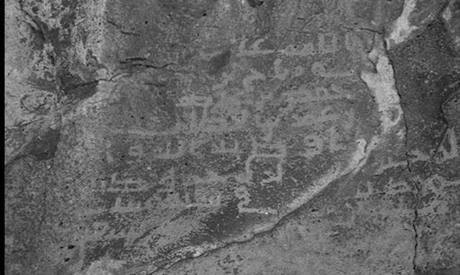
96 AH QMI-INS-042

Inscription of Farqad ibn Nāfiʿ

نقش فرقد بن نافع

SiteTabūk
Writing surfaceSandstone rock
Lines3
DimensionsUnrecorded
ScriptḤijāzī
SubjectDeclaration of the two testimonies of faith
ReadingClear · nothing restored
Grade 1 of 5. The text is complete; nothing is restored.

Original text (Arabic)

  1. يشهد فرقد بن نافع أنه لا إله إلا الله وحده
  2. لا شريك له وأن محمد عبده ورسو
  3. له وكتب في شوال سنة ست وتسعين

Translation

  1. Farqad ibn Nāfiʿ bears witness that there is no god but God alone,
  2. without partner, and that Muḥammad is His servant and Messen-
  3. ger, and he wrote [this] in Shawwāl of the year six and ninety.

Commentary

A carefully executed inscription showing visible artistic craftsmanship — curved letter strokes, hooked letterforms and decorative flourishes — that the book's author singles out as more accomplished calligraphically than many plainer texts in this corpus.

Source: al-Sulaymī, Mālik. Photograph and reading posted on X (formerly Twitter), 2018 (accessed 3 July 2020). Not found in the published scholarly literature.

How to cite

Shaker W. Ahmed. “Inscription of Farqad ibn Nāfiʿ” (Cat. No. QMI-INS-042). QMI, quranmss.com, 2026.

First Inscription of Rabāḥ ibn Ḥafṣ ibn ʿĀṣim⤢ Click to enlarge
96 AH QMI-INS-043

First Inscription of Rabāḥ ibn Ḥafṣ ibn ʿĀṣim

نقش رباح بن حفص بن عاصم (الأول)

SiteRawāwah, Medina
Writing surfaceRough rock face
Lines8
Dimensions48 × 76 cm
ScriptḤijāzī
SubjectPrayer for well-being, with genealogy to ʿUmar ibn al-Khaṭṭāb
ReadingClear · nothing restored
Grade 1 of 5. The text is complete; nothing is restored.

Original text (Arabic)

  1. اللهم عا
  2. في رباح بن
  3. حفص بن عاصم
  4. بن عمر بن الخطاب
  5. أوصي ببر الله وا
  6. لرحم وكتب
  7. في سنة ست
  8. وتسعين

Translation

  1. O God, grant
  2. well-being to Rabāḥ ibn
  3. Ḥafṣ ibn ʿĀṣim
  4. ibn ʿUmar ibn al-Khaṭṭāb.
  5. I exhort [reverence for] God and
  6. kinship ties, and he wrote [this]
  7. in the year six
  8. and ninety.

Commentary

"Rabāḥ" identifies himself as a great-grandson of the second caliph ʿUmar ibn al-Khaṭṭāb. The book's author identifies him with ʿĪsā ibn Ḥafṣ ibn ʿĀṣim ibn ʿUmar al-ʿAdawī, a hadith narrator known by the kunyah Abū Ziyād and the nickname "Rabāḥ," credited with two hadiths (on shortening prayer while traveling, and on Medina's sacred boundary); historians differ on whether he died in 157 or 159 AH, agreeing only that he lived to about eighty. He left a second, much longer inscription elsewhere in this corpus (no. 54) using the same well-being formula.

Source: al-Rāshid, Saʿd ibn ʿAbd al-ʿAzīz. Kitābāt Islāmīyah ghayr manshūrah min Rawāwah al-Madīnah al-Munawwarah: Dirāsah wa-Taḥqīq. 1st ed. al-Riyāḍ: Dār al-Waṭan lil-Nashr wa-al-Iʿlām, 1413 AH / 1993, p. 85.

How to cite

Shaker W. Ahmed. “First Inscription of Rabāḥ ibn Ḥafṣ ibn ʿĀṣim” (Cat. No. QMI-INS-043). QMI, quranmss.com, 2026.

Inscription of ʿUmar ibn ʿAbdallāh⤢ Click to enlarge
96 AH QMI-INS-044

Inscription of ʿUmar ibn ʿAbdallāh

نقش عمر بن عبد الله

SiteRawāwah, Medina
Writing surfaceRough rock face
Lines6
Dimensions48 × 76 cm
ScriptḤijāzī
SubjectBelief in God and disavowal of false gods
ReadingClear · nothing restored
Grade 1 of 5. The text is complete; nothing is restored.

Original text (Arabic)

  1. آمن عمر بن عبد الله
  2. بن ع ُروة بن الزبير
  3. بالله وشهد أنه لا إله ا
  4. لا الله وكفرت بالطغوت (الطاغوت) حيا
  5. وميتا وكتب عمر في سنة ست
  6. وتسعين

Translation

  1. ʿUmar ibn ʿAbdallāh
  2. ibn ʿUrwah ibn al-Zubayr believed
  3. in God, and bore witness that there is no god
  4. but God, and he disbelieved in false gods, living
  5. and dead. And ʿUmar wrote [this] in the year six
  6. and ninety.

Commentary

ʿUmar identifies himself as a grandson of ʿUrwah ibn al-Zubayr, the Medinan scholar and "Seven Jurists" member also named as a patron in the inscription of Ḥabīb ibn Abī Ḥabīb (no. 21) from sixteen years earlier — the two inscriptions together attest to ʿUrwah's household across a generation. "Ṭāghūt" (false gods/idols) is a specifically Qurʾanic term for whatever is worshipped instead of God.

Source: al-Mughadhdhawī, Muḥammad (@mohammed93athar). Photograph and reading posted on X (formerly Twitter).

How to cite

Shaker W. Ahmed. “Inscription of ʿUmar ibn ʿAbdallāh” (Cat. No. QMI-INS-044). QMI, quranmss.com, 2026.

Inscription of Muḥammad ibn Abī Ṭaybah al-ḤimṣīPhotograph: ʿAbdallāh al-Balawī⤢ Click to enlarge
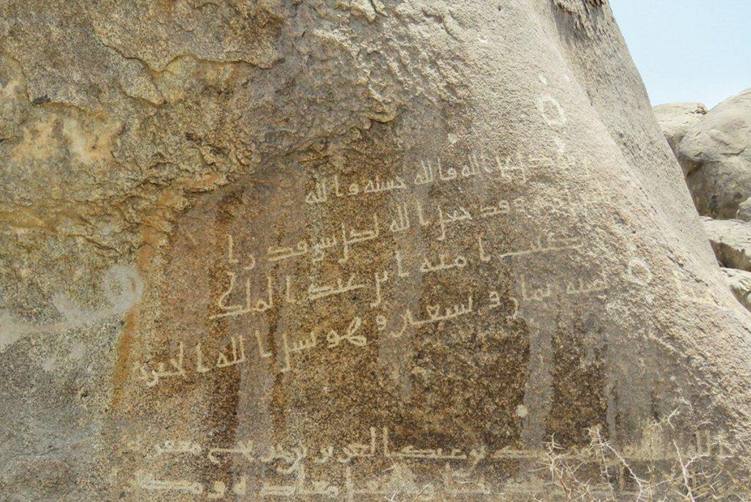
97 AH QMI-INS-045

Inscription of Muḥammad ibn Abī Ṭaybah al-Ḥimṣī

نقش محمد بن أبي طيبة الحمصي

SiteNorth of al-ʿUlā
Writing surfaceLarge rock face
Lines4
DimensionsUnrecorded
ScriptḤijāzī
SubjectTestimony of faith, dated by a caliph's pilgrimage
ReadingClear · nothing restored
Grade 1 of 5. The text is complete; nothing is restored.

Original text (Arabic)

  1. اللهم شهدت وآمنت وأيقنت إنه
  2. لا إله إلا أنت وكتب محمد ابن
  3. أبي طيبة الحمصي
  4. حجة سليمن أمير المؤمنين

Translation

  1. O God, I have witnessed, believed and become certain that
  2. there is no god but You. And Muḥammad ibn
  3. Abī Ṭaybah al-Ḥimṣī wrote [this], during
  4. the pilgrimage (ḥajjah) of Sulaymān, Commander of the Faithful.

Commentary

Dates itself by the pilgrimage of the Umayyad caliph Sulaymān ibn ʿAbd al-Malik, corroborated by Ibn Kathīr's al-Bidāyah wa-al-Nihāyah, which records a scholarly consensus that Sulaymān led the pilgrimage in the year 97 AH while caliph — one of the relatively few inscriptions in this corpus datable by direct cross-reference to a named historical event in the literary sources.

Source: Documented by ʿAbdallāh al-Balawī. For the pilgrimage of the caliph Sulaymān in 97 AH, see Ibn Kathīr, al-Bidāyah wa-al-Nihāyah, vol. 9.

How to cite

Shaker W. Ahmed. “Inscription of Muḥammad ibn Abī Ṭaybah al-Ḥimṣī” (Cat. No. QMI-INS-045). QMI, quranmss.com, 2026.

First Inscription of Umayyah ibn ʿAbd al-Malik⤢ Click to enlarge
98 AH QMI-INS-046

First Inscription of Umayyah ibn ʿAbd al-Malik

نقش أمية بن عبد الملك (الأول)

SiteWādī al-ʿUsaylah
Writing surfaceSouth side of a rock below Jabal al-Waljah al-Ṣaghīr
Lines4
Dimensions127 × 41 cm
ScriptḤijāzī
SubjectQurʾanic verse (Q 65:3)
ReadingClear · nothing restored
Grade 1 of 5. The text is complete; nothing is restored.

Original text (Arabic)

  1. ومن يتوكل على الله فالله حسبه والله
  2. بالغ أمره وقد جعل الله لكل شي قدرا
  3. وكتب أمية بن عبد الملك
  4. لسنة ثمان وتسعين وهو يسل (يسأل) الله الجنة

Translation

  1. “And whoever relies upon God — then He is sufficient for him. Indeed, God
  2. will accomplish His purpose. God has already set for everything a measure” [Q 65:3]. And Umayyah
  3. ibn ʿAbd al-Malik wrote [this], for the year eight and ninety, asking
  4. God for Paradise.

Commentary

The first of two Qurʾanic inscriptions left at Wādī al-ʿUsaylah by the same Umayyah ibn ʿAbd al-Malik (compare no. 47), quoting Sūrat al-Ṭalāq (65:3) on trust in God. Left at the same site as the three inscriptions of ʿUthmān ibn Wahrān (nos. 25–27), eighteen years earlier.

Source: al-Ḥārithī, Nāṣir ibn ʿAlī, and ʿĀdil Muḥammad Nūr Ghubāshī. "Nuqūsh Islāmīyah Mubakkirah bi-Wādī al-ʿUsaylah bi-Makkah al-Mukarramah." ʿĀlam al-Makhṭūṭāt wa-al-Nawādir 2, no. 1 (Muḥarram–Jumādā al-Ākhirah 1418 AH / May–October 1997): 12–56.

How to cite

Shaker W. Ahmed. “First Inscription of Umayyah ibn ʿAbd al-Malik” (Cat. No. QMI-INS-046). QMI, quranmss.com, 2026.

Second Inscription of Umayyah ibn ʿAbd al-Malik⤢ Click to enlarge
98 AH QMI-INS-047

Second Inscription of Umayyah ibn ʿAbd al-Malik

نقش أمية بن عبد الملك (الثاني)

SiteWādī al-ʿUsaylah
Writing surfaceSouthwest side of a rock below Jabal al-Waljah al-Ṣaghīr
Lines3
Dimensions119 × 35 cm
ScriptḤijāzī
SubjectQurʾanic verse (Q 5:47)
ReadingClear · nothing restored
Grade 1 of 5. The text is complete; nothing is restored.

Original text (Arabic)

  1. من لم يحكم بما أنزل
  2. الله فاولئك هم ا
  3. لفسقون وكتب أمية بن عبد الملك

Translation

  1. “And whoever does not judge by what God has revealed —
  2. those are the defiantly disobedient” [Q 5:47]. And Umayyah ibn ʿAbd al-Malik wrote
  3. [this].

Commentary

The second of Umayyah ibn ʿAbd al-Malik's two Qurʾanic inscriptions at this site, quoting Sūrat al-Māʾidah (5:47) — a verse on just judgment, echoing the same political theme (rightful rule and judgment) seen in ʿUthmān ibn Wahrān's quotation of Sūrat Ṣād (no. 26) at the same location.

Source: al-Ḥārithī, Nāṣir ibn ʿAlī, and ʿĀdil Muḥammad Nūr Ghubāshī. "Nuqūsh Islāmīyah Mubakkirah bi-Wādī al-ʿUsaylah bi-Makkah al-Mukarramah." ʿĀlam al-Makhṭūṭāt wa-al-Nawādir 2, no. 1 (Muḥarram–Jumādā al-Ākhirah 1418 AH / May–October 1997): 12–56, pl. 5.

How to cite

Shaker W. Ahmed. “Second Inscription of Umayyah ibn ʿAbd al-Malik” (Cat. No. QMI-INS-047). QMI, quranmss.com, 2026.

Inscription of Thābit ibn Abī Tamīm⤢ Click to enlarge
98 AH QMI-INS-048

Inscription of Thābit ibn Abī Tamīm

نقش ثابت بن أبي تميم

SiteGhayl al-Minḍaj, Ẓahrān al-Janūb
Writing surfaceRock block
Lines10
Dimensions55 × 45 cm
ScriptḤijāzī
SubjectPrayer for mercy for a craftsman and his family
ReadingLargely clear · a few letters restored
Grade 2 of 5. Nearly complete; a few letters are restored by the editor.

Original text (Arabic)

  1. رحمـ]ت[ ]ا[ لله
  2. على ثبت (ثابت) ابن أ
  3. بي تميم صانع
  4. الجرار وعلى أهله
  5. أجمعين آمين رب
  6. العلمين (العالمين) وكتب
  7. ثبت (ثابت) يوم السبت
  8. في عشر ليل (ليال) خلون من
  9. من (كذا) جمدى (جمادى) الأخرة
  10. سنة ثمان وتسعين

Translation

  1. The mercy of God
  2. [be] upon Thābit ibn Abī
  3. Tamīm, maker
  4. of jars, and upon his family
  5. altogether. Āmīn, Lord of
  6. the Worlds. And
  7. Thābit wrote [this] on Saturday,
  8. ten nights having passed of
  9. Jumādā al-Ākhirah,
  10. in the year eight and ninety.

Commentary

One of the few inscriptions in this corpus to record its author's trade: Thābit identifies himself as ṣāniʿ al-jirār, a maker of large storage jars — a rare glimpse of an ordinary craftsman's identity alongside the tribal and genealogical self-descriptions that dominate elsewhere in the corpus.

Source: Muḥammad ibn ʿAbd al-Raḥmān Rāshid al-Thunayān, “Naqsh Ghayl al-Minḍaj ‘al-Mubarraḥ’ al-Islāmī al-Mu’arrakh fī Sanat 98h,” Adumatu 9 (2004): 59–77.

How to cite

Shaker W. Ahmed. “Inscription of Thābit ibn Abī Tamīm” (Cat. No. QMI-INS-048). QMI, quranmss.com, 2026.

Poetic Inscription of Abū Jaʿfar ibn Ḥasan al-Hāshimī⤢ Click to enlarge
98 AH QMI-INS-049

Poetic Inscription of Abū Jaʿfar ibn Ḥasan al-Hāshimī

نقش شعري

SiteḤurumān region, Makkah al-Mukarramah, Saudi Arabia
Writing surfaceRock block
Lines7
Dimensions112 × 52 cm
ScriptḤijāzī
SubjectVerse on the passage of time
ReadingClear · nothing restored
Grade 1 of 5. The text is complete; nothing is restored.

Original text (Arabic)

  1. أفنا (أفنى) الجديد تقلب الشمس
  2. وطلوعها من حيث لا تسمي (لا تمسي)
  3. وطلوعها بيضا (بيضاء) صافية وغروبها
  4. صفرا (صفراء) كالورس
  5. وكتب أبو جعفر بن حسن الهاشمي
  6. سنة ثمان
  7. وتسعين

Translation

  1. The sun’s slow wheel wears all that’s new away;
  2. It rises where it seems it cannot stay.
  3. Pure white its rising, and its setting bright,
  4. Yellow as turmeric in the evening light.
  5. Abū Jaʿfar ibn Ḥasan al-Hāshimī wrote this, in the year ninety-eight.

Commentary

A rare poetic (rather than devotional or documentary) inscription in this corpus — four lines of verse reflecting on the sun's daily cycle as a metaphor for the passage of time and the wearing-away of all that is new, signed by a self-identified Hāshimite (a member of the Prophet's clan). Almost nothing else in the catalog resembles it in genre.

Source: Nāṣir ibn ʿAlī al-Ḥārithī, al-Āthār al-Islāmiyyah fī Makkah al-Mukarramah (Riyadh, 1430/2009), 526.

How to cite

Shaker W. Ahmed. “Poetic Inscription of Abū Jaʿfar ibn Ḥasan al-Hāshimī” (Cat. No. QMI-INS-049). QMI, quranmss.com, 2026.

Inscription of TaymāʾPhotograph: Murtaḍā Julbākh⤢ Click to enlarge
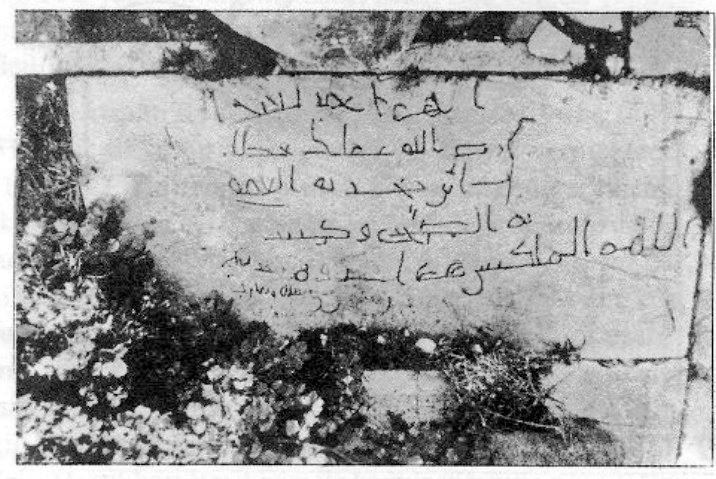
98 AH QMI-INS-050

Inscription of Taymāʾ

نقش تيماء

SiteTaymāʾ, Tabūk
Writing surfaceRock face
Lines4
DimensionsUnrecorded
ScriptḤijāzī
SubjectPrayer for forgiveness
ReadingClear · nothing restored
Grade 1 of 5. The text is complete; nothing is restored.

Original text (Arabic)

  1. اللهم اغفر لقسم (لقاسم)
  2. وكتب يوم السبت
  3. للثلثين (للثلاثين) خلتا من شعبان من سنة
  4. ثمان وتسعين

Translation

  1. O God, forgive Qāsim,
  2. and he wrote [this] on Saturday,
  3. two nights remaining of Shaʿbān, in the year
  4. eight and ninety.

Commentary

A brief, formulaic prayer of forgiveness for a man named Qāsim, precisely dated to a Saturday two nights before the end of Shaʿbān — one of several inscriptions in this corpus giving a day of the week alongside the Hijri date.

Source: Documented by Murtaḍā Julbākh.

How to cite

Shaker W. Ahmed. “Inscription of Taymāʾ” (Cat. No. QMI-INS-050). QMI, quranmss.com, 2026.

Inscription of Khaṭṭāb ibn Ḥajar al-ʿAmmī (Cnidus)Photograph: published image of graffito C1⤢ Click to enlarge
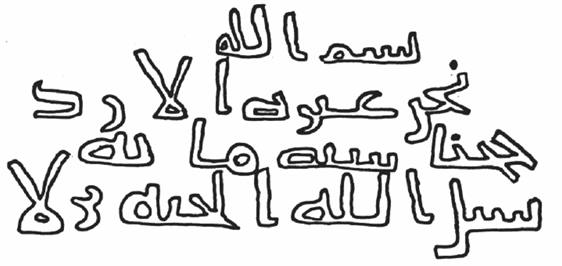
98 AH QMI-INS-050a

Inscription of Khaṭṭāb ibn Ḥajar al-ʿAmmī (Cnidus)

نقش خطاب بن حجر العمّي (كنيدوس)

SiteCnidus (Knidos), south-western Turkey; Byzantine church, nave pavement
Writing surfaceMarble paving slab, 194 × 88 cm
Lines7 (two graffiti)
DimensionsSlab 194 × 88 cm
ScriptArchaic Umayyad Kūfic
SubjectPrayer and signature naming an expedition (ghazwah), dated 98 AH
ReadingPartly preserved · several words restored
Grade 3 of 5. Several words are damaged and restored by the editor; the rest is legible.

Original text (Arabic)

  1. (١) اللهم اغفر لعبد ال[...]
  2. (٢) رضي الله [عن] عملك يخطا[ب] (كذا)
  3. بن حجر ثم العمي
  4. ثم الصخري وكتبت
  5. كتب[ت]ي هذا غزوة [...]
  6. في سنة ثمان و
  7. [ت]سعين

Translation

  1. (1) O God, forgive ʿAbd al-[...]
  2. (2) May God be pleased with your work, O Khaṭṭāb,
  3. son of Ḥajar, al-ʿAmmī,
  4. then al-Ṣakhrī! And I wrote
  5. this inscription of mine. The expedition of [...]
  6. in the year eight and
  7. ninety.

Commentary

The only dated Arabic graffito from Cnidus, on the south-western coast of Asia Minor, and one of the very few first-century inscriptions written beyond the lands of Islam. It is cut into the marble pavement of the nave of a Byzantine church (5th–6th century), near the choir behind the altar. The slab carries two texts. The first is a single line, an invocation for ʿAbd al-[...] left unfinished; its baseline appears to run over the second text, which is therefore the earlier. The second is a prayer that God be pleased with the work of Khaṭṭāb son of Ḥajar, who gives two tribal affiliations joined by “then” (thumma): al-ʿAmmī, of the ʿAmm of Tamīm from the region of Baṣra, then al-Ṣakhrī, of the Banū Ṣakhr, who had moved from the Ḥijāz to the Balqāʾ and the coast of Palestine. He names the campaign itself — “the expedition of [...]”, ghazwah, the word also found in a graffito of the same years on Kos — though the name of the expedition is unread. The date, 98 AH (716–717 CE), places it in the caliph Sulaymān’s great campaign against Constantinople under Maslamah ibn ʿAbd al-Malik, whose fleet sailed in 98 AH; Cnidus, like Kos, seems to have served as a temporary Umayyad post on the way. Imbert counts it among only about thirty Arabic graffiti dated before 100 AH known when he wrote, four of them from the Aegean. It is the best executed of the Cnidus graffiti, finely and deeply incised, in the archaic Umayyad Kūfic of the period.

Source: Imbert, Frédéric. “Graffiti arabes de Cnide et de Kos: premières traces épigraphiques de la conquête musulmane en mer Égée.” In Constructing the Seventh Century, ed. Constantin Zuckerman, Travaux et Mémoires 17 (Paris, 2013), 731–758, at 734–736, graffito C1, photo 1, fig. 1. Earlier: V. Ruggieri, “I graffiti umayyadi a Cnidos,” Orientalia Christiana Periodica 58 (1992): 549–551, at 550, no. 1; F. Özgümüş, “Knidos’taki bizans eserleri,” Sanat Tarihi Araştırmaları Dergisi 11 (1992): 12.

How to cite

Shaker W. Ahmed. “Inscription of Khaṭṭāb ibn Ḥajar al-ʿAmmī (Cnidus)” (Cat. No. QMI-INS-050a). QMI, quranmss.com, 2026.

Inscription of ʿAnazah al-Azd⤢ Click to enlarge
100 AH QMI-INS-051

Inscription of ʿAnazah al-Azd

نقش عنزة الأزد

SiteWādī Abū Ṭāqah
Writing surfaceRock face
Lines4
Dimensions100 × 50 cm
ScriptḤijāzī
SubjectCollective pilgrimage record and prayer for Paradise
ReadingClear · nothing restored
Grade 1 of 5. The text is complete; nothing is restored.

Original text (Arabic)

  1. بسم الله
  2. نحن عنزة الأزد
  3. حجنا سنة مائة
  4. نسل (نسأل) الله الجنة نزلا

Translation

  1. In the name of God.
  2. We [of] ʿAnazah of al-Azd
  3. made pilgrimage in the year one hundred,
  4. [and] ask God for Paradise as a lodging.

Commentary

Unusual among this corpus for speaking in the collective "we" rather than a single named individual — a group from the tribal subsection ʿAnazah, part of the larger Azd tribal confederation, recording a shared pilgrimage in the year 100 AH rather than one person's prayer. No plate of this inscription is reproduced in the source text.

Source: al-Kilābī, Ḥayāt. al-Nuqūsh al-Islāmīyah ʿalā Ṭarīq al-Ḥajj al-Shāmī bi-Shamāl Gharb al-Mamlakah al-ʿArabīyah al-Saʿūdīyah min al-Qarn al-Awwal ilā al-Qarn al-Khāmis al-Hijrī. al-Riyāḍ: Maktabat al-Malik Fahd al-Waṭanīyah, 1430 AH / 2009, pp. 61–73.

How to cite

Shaker W. Ahmed. “Inscription of ʿAnazah al-Azd” (Cat. No. QMI-INS-051). QMI, quranmss.com, 2026.

Inscription of ʿAbdallāh ibn Abī Saʿīd al-Anṣārī⤢ Click to enlarge
100 AH QMI-INS-052

Inscription of ʿAbdallāh ibn Abī Saʿīd al-Anṣārī

نقش عبد الله بن أبي سعيد الأنصاري

SiteThulayth
Writing surfaceSouthwest side
Lines5
Dimensions45 × 30 cm
ScriptḤijāzī
SubjectPrayer for forgiveness
ReadingClear · nothing restored
Grade 1 of 5. The text is complete; nothing is restored.

Original text (Arabic)

  1. بسم الله الرحمن الرحيم
  2. اللهم اغفر لعبد ا
  3. لله بن أبي سعيد بن
  4. سعد الأنصري (الأنصاري)
  5. وكتب في سنت (سنة) مئة

Translation

  1. In the name of God, the Merciful, the Compassionate.
  2. O God, forgive ʿAbd-
  3. allāh ibn Abī Saʿīd ibn
  4. Saʿd al-Anṣārī,
  5. and he wrote [this] in the year one hundred.

Commentary

The scribe records his own given name, his father's kunyah, and his grandfather's name before stating his tribal affiliation (al-Anṣārī, "of the Helpers," the Medinan tribes who supported the Prophet) — the book's author notes that the father's kunyah appears to be derived from the grandfather's actual name, a naming pattern worth flagging for readers tracing early Anṣārī genealogies.

Source: al-Ghabbān, Maysāʾ ʿAlī. al-Kitābāt al-Islāmīyah al-Mubakkirah fī Haḍbat Ḥismā bi-Minṭaqat Tabūk. PhD diss., Jāmiʿat al-Malik Saʿūd, 2017, inscription no. 116.

How to cite

Shaker W. Ahmed. “Inscription of ʿAbdallāh ibn Abī Saʿīd al-Anṣārī” (Cat. No. QMI-INS-052). QMI, quranmss.com, 2026.

Inscription of Abū SalamahPhotograph: Aḥmad Bāṣawṭayn⤢ Click to enlarge
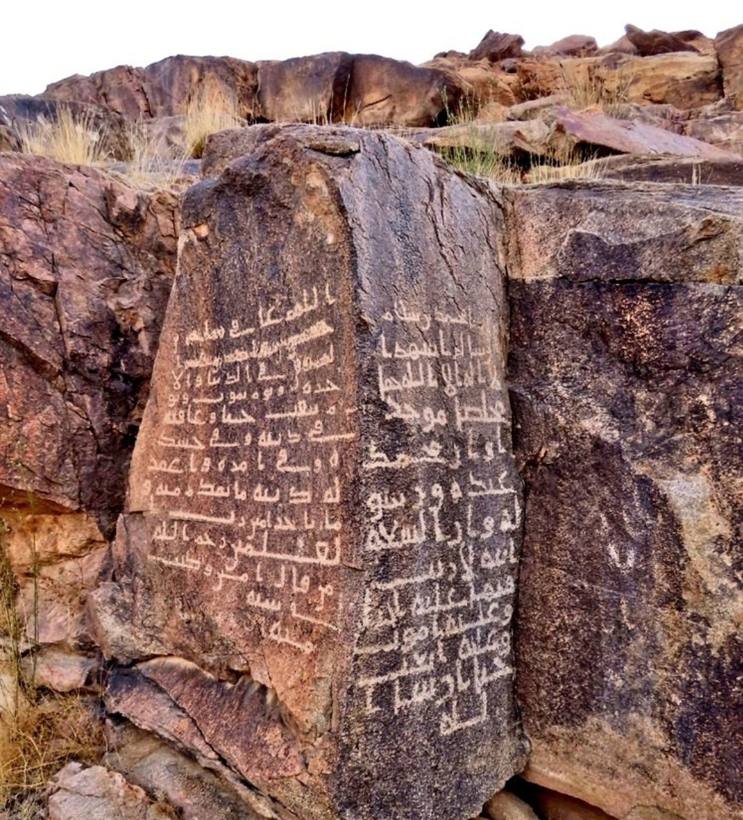
100 AH QMI-INS-053

Inscription of Abū Salamah

نقش أبو سلمة

SiteRawāwah
Writing surfaceSouthwest-facing rock
Lines4
DimensionsUnrecorded
ScriptḤijāzī
SubjectBelief in God the Almighty
ReadingClear · nothing restored
Grade 1 of 5. The text is complete; nothing is restored.

Original text (Arabic)

  1. آمن أبو سلمة بن عبد
  2. الله بن عبد الله بن عمر
  3. بالله العظيم
  4. وكتب سنة مائة

Translation

  1. Abū Salamah ibn ʿAbd-
  2. allāh ibn ʿAbdallāh ibn ʿUmar believed
  3. in God the Almighty,
  4. and he wrote [this] [in] the year one hundred.

Commentary

A three-generation genealogy (ʿAbdallāh ibn ʿAbdallāh ibn ʿUmar) recorded alongside a simple declaration of belief, from the same Rawāwah site near Medina as several other inscriptions in this catalog (nos. 43–44). A declaration in the same words, “believe in God the Almighty”, was left at Rawāwah in 120 AH by ʿUthmān ibn ʿUbaydallāh, whom Alhatlani takes to be Abū Salamah's brother (QMI-INS-055kh).

Source: al-Rāshid, Saʿd ibn ʿAbd al-ʿAzīz. Kitābāt Islāmīyah ghayr manshūrah min Rawāwah al-Madīnah al-Munawwarah: Dirāsah wa-Taḥqīq. 1st ed. al-Riyāḍ: Dār al-Waṭan lil-Nashr wa-al-Iʿlām, 1413 AH / 1993. Photograph by Aḥmad Bāṣawṭayn.

How to cite

Shaker W. Ahmed. “Inscription of Abū Salamah” (Cat. No. QMI-INS-053). QMI, quranmss.com, 2026.

Second Inscription of Rabāḥ ibn Ḥafṣ ibn ʿĀṣim⤢ Click to enlarge
100 AH QMI-INS-054

Second Inscription of Rabāḥ ibn Ḥafṣ ibn ʿĀṣim

نقش رباح بن حفص بن عاصم (الثاني)

SiteWādī al-Furaysh, Shuʿayb ʿUwayr
Writing surfaceRock face
Lines13
DimensionsUnrecorded
ScriptḤijāzī
SubjectExtended prayer for well-being in this world and the next
ReadingClear · nothing restored
Grade 1 of 5. The text is complete; nothing is restored.

Original text (Arabic)

  1. اللهم عافي رباح بن
  2. حفص بن عاصم بن عمر
  3. الفاروق في الدنيا والا
  4. خرة و يوم يموت و يو
  5. م يبعث حيا وعافيه
  6. في دينه وفي جسد
  7. ه وفي أمره واغفر
  8. له ذنبه ما تقدم منه و
  9. ما تأخر آمين رب ا
  10. العلمين رحم الله
  11. من قال آمين وكتب
  12. في سنة
  13. مئة

Translation

  1. O God, grant well-being to Rabāḥ ibn
  2. Ḥafṣ ibn ʿĀṣim ibn ʿUmar
  3. al-Fārūq, in this world and the
  4. next, on the day he dies and the day
  5. he is raised alive, and grant him well-being
  6. in his religion, in his body,
  7. and in his affairs, and forgive
  8. him his sin, what came before and
  9. what came after. Āmīn, Lord of
  10. the Worlds. May God have mercy on
  11. whoever says āmīn. And it was written
  12. in the year
  13. one hundred.

Commentary

A much longer, later reprise of Rabāḥ ibn Ḥafṣ's first inscription (no. 43, dated 96 AH), naming ʿUmar ibn al-Khaṭṭāb explicitly by his epithet al-Fārūq ("the one who distinguishes truth from falsehood"). The book's author corrects three earlier readings by Dr. Muḥammad al-Thunayyān, who had read line 1 as ending in "salīm" rather than the name continuing into line 2 as "ibn Ḥafṣ," and had divided a word across lines 2–3 differently. No plate of this second inscription is reproduced in the source text.

Source: Field documentation, Wādī al-Furaysh survey; cf. reading corrections to al-Thunayyān.

How to cite

Shaker W. Ahmed. “Second Inscription of Rabāḥ ibn Ḥafṣ ibn ʿĀṣim” (Cat. No. QMI-INS-054). QMI, quranmss.com, 2026.

Inscription of ʿĀṣim ibn ʿUmar ibn Ḥafṣ⤢ Click to enlarge
100 AH QMI-INS-055

Inscription of ʿĀṣim ibn ʿUmar ibn Ḥafṣ

نقش عاصم بن عمر بن حفص

SiteWaḥy al-Ḥijārah
Writing surfaceRock face
Lines3
DimensionsUnrecorded
ScriptḤijāzī
SubjectDeclaration of trust in God
ReadingClear · nothing restored
Grade 1 of 5. The text is complete; nothing is restored.

Original text (Arabic)

  1. ثقة عاصم بن عمر
  2. بن حفص بالحي القيوم
  3. وكتب في سنة مئة

Translation

  1. The trust of ʿĀṣim ibn ʿUmar
  2. ibn Ḥafṣ is in the Ever-Living, the Self-Subsisting,
  3. and he wrote [this] in the year one hundred.

Commentary

The final dated entry in this catalog (100 AH), closing the corpus on the same divine epithets — al-Ḥayy al-Qayyūm, "the Ever-Living, the Self-Subsisting" — quoted from Āyat al-Kursī that opened the inscription of ʿAlī ibn ʿAbdallāh (no. 41) seven years earlier. ʿĀṣim's own genealogy (ibn ʿUmar ibn Ḥafṣ) closely echoes the family names seen in both inscriptions of Rabāḥ ibn Ḥafṣ ibn ʿĀṣim (nos. 43 and 54), suggesting these may be members of the same extended family leaving inscriptions across the Ḥijāz over several years. The same ʿĀṣim left a second dated prayer at Rawāwah in 121 AH (QMI-INS-055wb), and his brother Muḥammad one in 114 AH (QMI-INS-055aha).

Source: Field documentation, Waḥy al-Ḥijārah survey.

How to cite

Shaker W. Ahmed. “Inscription of ʿĀṣim ibn ʿUmar ibn Ḥafṣ” (Cat. No. QMI-INS-055). QMI, quranmss.com, 2026.

Inscription of ʿAbdallāh ibn ʿĀbid al-KhathʿamīPhotograph: Aḥmad al-Dāmigh (Al-Sahra Team)⤢ Click to enlarge
100 AH QMI-INS-055j

Inscription of ʿAbdallāh ibn ʿĀbid al-Khathʿamī

نقش عبد الله بن عابد الخثعمي

SiteḤismā, north-western Arabia
Writing surfaceRock face (sandstone)
Lines5
DimensionsUnrecorded
ScriptḤijāzī
SubjectProfession of faith by a man “of the people of Palestine”, dated 100 AH
ReadingClear · nothing restored
Grade 1 of 5. The text is complete; nothing is restored.

Original text (Arabic)

  1. أنا عبد الله بن عا
  2. بد الخثعمي من أهل
  3. فلسطين أومن
  4. بالله وحده و
  5. كتب سنة مئة

Translation

  1. I am ʿAbdallāh ibn ʿĀ-
  2. bid al-Khathʿamī, of the people of
  3. Palestine. I believe
  4. in God alone. And [this]
  5. was written in the year one hundred.

Commentary

A short profession of faith in which the writer tells us who he is and where he comes from: a man of Khathʿam, an Arabian tribe, who calls himself one “of the people of Palestine” — that is, of the military district (jund) of Filasṭīn in Bilād al-Shām. Such a statement of home region is rare in the inscriptions of this catalog, and it shows the movement of Arabian tribesmen settled in Syria along the Ḥismā route between Syria and the Ḥijāz. It is dated by year alone, 100 AH (718–719 CE), in the caliphate of ʿUmar ibn ʿAbd al-ʿAzīz. The writer carries his father’s name over the line end (ʿĀ-/bid). The incisions are faint on the patinated sandstone; the reading follows the Desert Team. Another member of Khathʿam in Palestine, Ibn Rabʿiyyah al-Khathʿamiyyah, wrote a prayer in a cave house at Bayt Jibrīn in the reign of Hishām (QMI-INS-055al).

Source: Farīq al-Ṣaḥrāʾ (the Desert Team), inscriptions of Ḥismā; photograph and reading published at alsahra.org.

How to cite

Shaker W. Ahmed. “Inscription of ʿAbdallāh ibn ʿĀbid al-Khathʿamī” (Cat. No. QMI-INS-055j). QMI, quranmss.com, 2026.

Inscription of ʿAbd al-ʿAzīz ibn al-Ḥārith ibn al-Ḥakam, Khirbat NitilPhoto: A. Musil, 1896 (WZKM 22, 1908, fig. 2)⤢ Click to enlarge
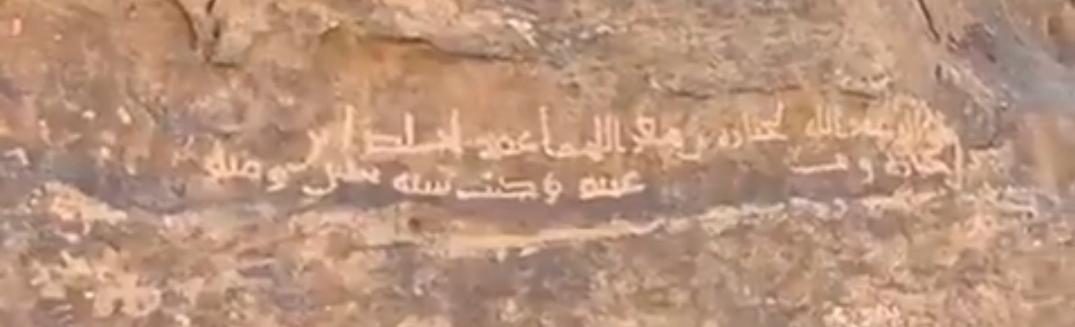
c. 100 AH QMI-INS-055ai

Inscription of ʿAbd al-ʿAzīz ibn al-Ḥārith ibn al-Ḥakam, Khirbat Nitil

نقش عبد العزيز بن الحارث بن الحكم، خربة نتل

SiteKhirbat Nitil, about 14 km south-east of Mādabā, Jordan
Writing surfaceConcave sandstone block in the west wall of a vaulted room
Lines8
Dimensions37 × 44 cm
ScriptKufic
SubjectPrayer for forgiveness and for the Basin of Muḥammad; undated, about 100 AH
ReadingLargely clear · a few letters restored
Grade 2 of 5. Nearly complete; a few letters are restored by the editor.

Original text (Arabic)

  1. اللهم اغفر لعبد
  2. العز[ي]ز بن الحرث بن ا
  3. لحكم ما تقدم من ذ
  4. نبه وما تأخر وعر
  5. ف بينه وبين ذريته
  6. في مستقر من ر
  7. حمتك وا[قـ]ـمه (؟) على
  8. حوض محمد ....

Translation

  1. O God, forgive ʿAbd
  2. al-ʿAzīz ibn al-Ḥārith ibn al-
  3. Ḥakam what has gone before of his
  4. sins and what has come after, and bring together
  5. him and his descendants
  6. in an abode of Your
  7. mercy, and set him (?) at
  8. the Basin of Muḥammad …

Commentary

A prayer cut on a concave sandstone block built into the west wall of a barrel-vaulted room at Khirbat Nitil, about 14 km south-east of Mādabā, in the Balqāʾ. Alois Musil found it on 12 July 1896 and published it in 1908 with a squeeze and the photograph shown here. The stone is well preserved except for its lower left corner, where the ends of lines 7 and 8 have broken away. The text asks forgiveness for ʿAbd al-ʿAzīz ibn al-Ḥārith ibn al-Ḥakam “for what has gone before of his sins and what has come after”, the wording of Q 48:2 used in other texts of the catalog from 64 to 110 AH (QMI-INS-010, QMI-INS-040, QMI-INS-055ag).

The prayer then turns to the hereafter. Wa-ʿarrif baynahu wa-bayna dhurriyyatihi fī mustaqarrin min raḥmatika, “bring him and his descendants together in an abode of Your mercy”, has a parallel in a prayer quoted by al-Ṭabarī, wa-ʿarrafa (Allāh) baynanā wa-baynaka fī jannatihi, which Karabacek pointed out to Musil. The last lines ask that he be brought to the Basin (ḥawḍ) of Muḥammad, from which, in the eschatology of the ḥadīth, the believers drink on the Day of Judgement; a ḥadīth in al-Tirmidhī describes the Basin as stretching “from ʿAdan to ʿAmmān al-Balqāʾ”, the district in which this stone stands. This is the only text in the catalog that names the Basin. The verb before it is damaged. Musil first proposed wa-afriṭhu, which van Berchem accepted and Goldziher did not; his second proposal, wa-aqimhu ʿalā, “set him at”, was preferred by Nöldeke and Becker. The trace that survives after the alif has a rounded head, which Musil took for qāf or fāʾ; a wāw would look the same, and a reading wa-awridhu, “bring him down to”, the verb used of the Basin in the ḥadīth, is worth testing against a better image.

No date survives on the stone. Musil offered only a guess at the man: al-Masʿūdī lists ʿAbd al-ʿAzīz ibn al-Ḥārith ibn al-Ḥakam ibn Abī al-ʿĀṣ, a nephew of Marwān ibn al-Ḥakam, among the secretaries of Sulaymān ibn ʿAbd al-Malik (96–99 AH), and the Umayyads held estates in the Balqāʾ where Sulaymān used to stay. Musil added that the letter forms point to the first half of the eighth century CE. The long prayer for the hereafter also sits best with the texts of about 100–120 AH in this catalog rather than the short signatures of the first decades; the earliest prayer here that turns to the Prophet in this way is that of Bakr ibn Abī Bakrah, 80 AH (QMI-INS-023). The date given here, about 100 AH, is therefore an estimate. The year 100 AH found in later lists is the same estimate, not a reading of the stone. A prayer for a grandson of the caliph al-Walīd and his clients, of the early second century AH, is also in the catalog (QMI-INS-055aj).

Source: Musil, Alois. “Zwei arabische Inschriften aus Arabia Petraea.” Wiener Zeitschrift für die Kunde des Morgenlandes 22 (1908): 81–85, figs. 1–2. Also Grohmann, Adolf. Arabische Paläographie II: Das Schriftwesen. Die Lapidarschrift. Vienna, 1971, pl. XV; Gruendler, Beatrice. The Development of the Arabic Scripts. Atlanta, 1993, p. 21.

How to cite

Shaker W. Ahmed. “Inscription of ʿAbd al-ʿAzīz ibn al-Ḥārith ibn al-Ḥakam, Khirbat Nitil” (Cat. No. QMI-INS-055ai). QMI, quranmss.com, 2026.

Inscription of Khālid ibn NuʿaymPhotograph: Muḥammad al-Mughadhdhawī⤢ Click to enlarge
102 AH QMI-INS-055t

Inscription of Khālid ibn Nuʿaym

نقش خالد بن نعيم

SiteTaymāʾ, Tabūk
Writing surfaceRock face (sandstone)
Lines2
DimensionsUnrecorded
SubjectPrayer for forgiveness, dated 102 AH
ReadingClear · nothing restored
Grade 1 of 5. The text is complete; nothing is restored.

Original text (Arabic)

  1. اللهم اغفر لخلد (لخالد) ابن
  2. نعيم وكتب سنة ثنتين ومية (ومائة)

Translation

  1. O God, forgive Khālid ibn
  2. Nuʿaym. And [this] was written in the year two and one hundred.

Commentary

A short prayer for forgiveness dated by year alone, 102 AH (720–721 CE), in the caliphate of Yazīd II ibn ʿAbd al-Malik. It is the third inscription from Taymāʾ in this catalog, after the prayer for Qāsim (no. 50, 98 AH) and before the prayer of Ḥafṣ ibn ʿUmar for all the people of Taymāʾ (no. 55e, 108 AH), and it adds to the evidence that the oasis was a busy stop for Muslim travellers in the first decades of the second century AH. The spelling is of its time: “Khālid” is written without its long alif (خلد), and “miʾah” takes the form “miyah” (مية), as in other inscriptions of the period. The two lines are cut along the rock in a long, even band. Khālid ibn Nuʿaym is otherwise unknown.

Source: al-Mughadhdhawī, Muḥammad (@mohammed93athar). Photograph and reading posted on X (formerly Twitter), 19 October 2020.

How to cite

Shaker W. Ahmed. “Inscription of Khālid ibn Nuʿaym” (Cat. No. QMI-INS-055t). QMI, quranmss.com, 2026.

Gravestone of Fāṭimah bint al-Ḥasan, AswānPhoto: J.-F. Gout © IFAO⤢ Click to enlarge
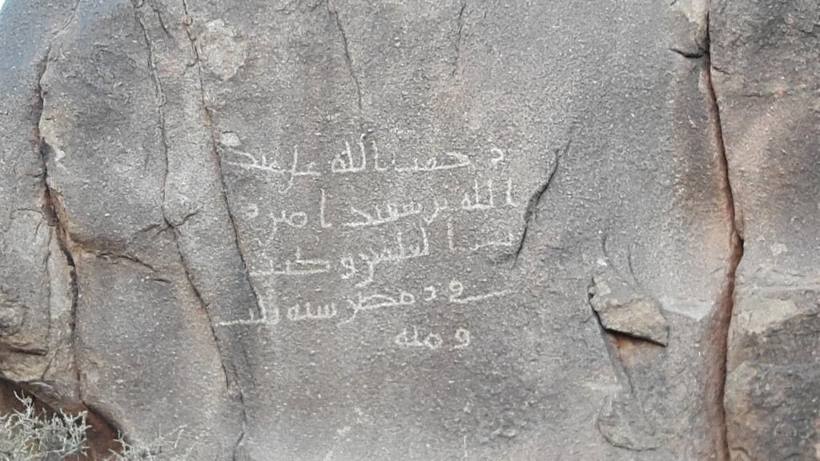
102 AH QMI-INS-055tb

Gravestone of Fāṭimah bint al-Ḥasan, Aswān

شاهد قبر فاطمة بنت الحسن، أسوان

SiteAswān cemetery, Upper Egypt
Writing surfaceSandstone gravestone
Lines8
DimensionsUnrecorded
ScriptKūfic
SubjectEpitaph of Fāṭimah bint al-Ḥasan, with Q 67:1; dated Monday, 1 Shaʿbān 102 AH
ReadingLargely clear · a few letters restored
Grade 2 of 5. Nearly complete; a few letters are restored by the editor.

Original text (Arabic)

  1. بسم الله الرحمن الرحيم
  2. تبارك الذي بيده الملك
  3. وهو على كل شيء قدير
  4. هذا قبر فاطمة ابنة
  5. الحسن بن [...] رحمة الله
  6. ومغفرته ورضوانه عليه
  7. توفي يوم الاثنين أول يوم
  8. من شعبان من سنة اثنين ومائة

Translation

  1. In the name of God, the Compassionate, the Merciful.
  2. Blessed is He in whose hand is the dominion,
  3. and He is over all things powerful [Q 67:1].
  4. This is the grave of Fāṭimah, daughter of
  5. al-Ḥasan ibn […]. The mercy of God,
  6. His forgiveness and His good pleasure be upon him (sic).
  7. He (sic) died on Monday, the first day
  8. of Shaʿbān, in the year two and one hundred.

Commentary

A sandstone gravestone from the cemetery of Aswān in Upper Egypt, dated Monday, 1 Shaʿbān 102 AH (4 February 721 CE). After the basmalah it opens with the first verse of Sūrat al-Mulk, “Blessed is He in whose hand is the dominion, and He is over all things powerful” (Q 67:1), a fitting verse at a grave, since the next verse speaks of the One “who created death and life”. It then names the dead, Fāṭimah daughter of al-Ḥasan, whose grandfather’s name is lost, and asks God’s mercy, forgiveness and good pleasure for her.

The prayer and the record of death are in the masculine, ʿalayhi, “upon him”, and tuwuffiya, “he died”, although the grave is a woman’s. The carver seems to have followed a set wording without adjusting it, a sign that the formulae of the Aswān gravestones were already fixed by the early second century. The stone belongs to the same Egyptian tradition as the gravestone of ʿAbd al-Raḥmān ibn Khayr al-Ḥajarī of 31 AH, the earliest dated Islamic gravestone in this catalog (QMI-INS-004); the date is given in full, with the weekday, the day of the month, the month and the year. Its formulae of mercy, forgiveness and good pleasure already appear on the Aswān gravestone of ʿAbbāsah, dated 71 AH as written (QMI-INS-011a).

Source: ʿAbd al-Tawab, ʿAbd al-Raḥmān M. Stèles islamiques de la nécropole d’Assouan. Cairo: Institut français d’archéologie orientale, 1977. Photograph by J.-F. Gout © Institut français d’archéologie orientale.

How to cite

Shaker W. Ahmed. “Gravestone of Fāṭimah bint al-Ḥasan, Aswān” (Cat. No. QMI-INS-055tb). QMI, quranmss.com, 2026.

Inscription of ʿAbdallāh ibn SaʿīdPhotograph: ʿAbdallāh al-Tuwayjirī⤢ Click to enlarge
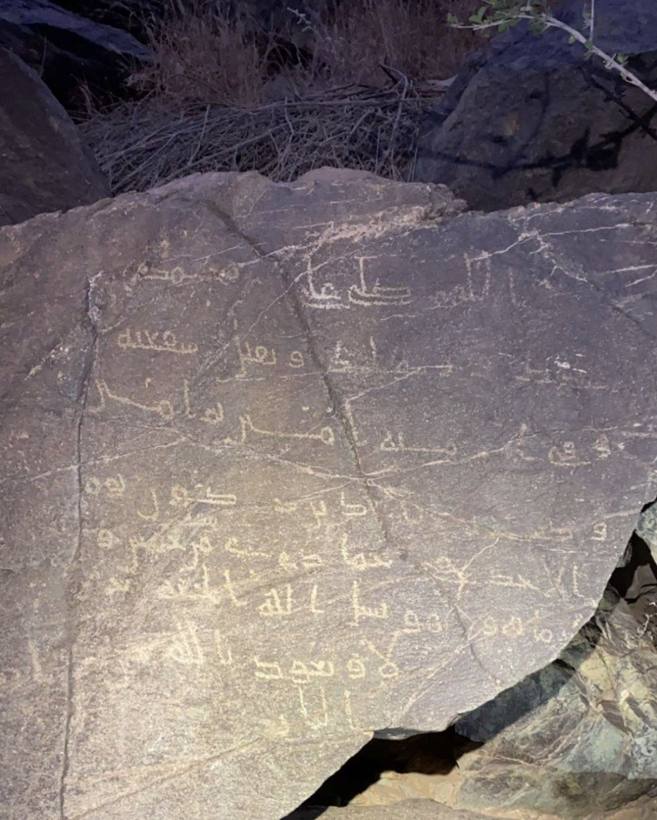
103 AH QMI-INS-055a

Inscription of ʿAbdallāh ibn Saʿīd

نقش عبد الله بن سعيد

SiteLocation unpublished
Writing surfaceRock face
Lines5
DimensionsUnrecorded
ScriptḤijāzī
SubjectPrayer for mercy, dated Ramaḍān 103 AH
ReadingClear · nothing restored
Grade 1 of 5. The text is complete; nothing is restored.

Original text (Arabic)

  1. رحمت الله على عبد
  2. الله بن سعيد آمين ر
  3. ب العلمين (العالمين) وكتب
  4. في رمضن (رمضان) سنة ثلاث
  5. ومئة

Translation

  1. The mercy of God be upon ʿAbd-
  2. allāh ibn Saʿīd. Amen, Lo-
  3. rd of the worlds. And [this] was written
  4. in Ramaḍān of the year one hundred
  5. and three.

Commentary

A prayer for mercy dated by month and year: Ramaḍān 103 AH (February–March 722 CE), in the caliphate of Yazīd II. The spelling shows the habits of the period: “raḥmat” is written with an open tāʾ, and both “al-ʿālamīn” and “Ramaḍān” are written without the long alif. As in many inscriptions of the catalog, the writer carries words over the line end (ʿAbd-/allāh, Ra-/bb). It is one of the few inscriptions in the catalog dated after 100 AH. Its location has not been published.

Source: al-Tuwayjirī, ʿAbdallāh. Photograph and reading posted on X (formerly Twitter), 9 September 2017.

How to cite

Shaker W. Ahmed. “Inscription of ʿAbdallāh ibn Saʿīd” (Cat. No. QMI-INS-055a). QMI, quranmss.com, 2026.

Inscription of Ziyād ibn DhakwānPhotograph: Mālik al-Sulaymī⤢ Click to enlarge
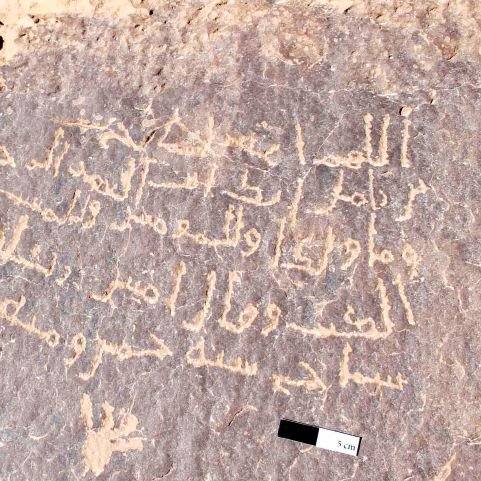
105 AH QMI-INS-055c

Inscription of Ziyād ibn Dhakwān

نقش زياد بن ذكوان

SiteTanūmah, ʿAsīr region
Writing surfaceRock face
Lines8
DimensionsUnrecorded
ScriptḤijāzī
SubjectBlessing upon the Prophet and prayer for Paradise, dated Jumādā 105 AH
ReadingLargely clear · a few letters restored
Grade 2 of 5. Nearly complete; a few letters are restored by the editor.

Original text (Arabic)

  1. اللهم صلي على محمد
  2. عبدك ورسولك وتقبّل شفاعته
  3. في أمته آمين ثم آمين
  4. وكتب [زياد] بن ذكوان يوم
  5. الأحد في جمادى من خمس و
  6. مائة وهو يسأل الله الجنة نز
  7. لا ويعوذ بالله من
  8. النار

Translation

  1. O God, bless Muḥammad,
  2. Your servant and Your messenger, and accept his intercession
  3. for his community. Amen, and again amen.
  4. [Ziyād] ibn Dhakwān wrote [this] on
  5. Sunday, in Jumādā, [in the year] one hundred
  6. and five. He asks God for Paradise as a dwel-
  7. ling, and seeks refuge in God from
  8. the Fire.

Commentary

A blessing upon the Prophet joined to a request that God accept his intercession (shafāʿah) for his community — an early dated witness to the idea of the Prophet’s intercession on the stones of Arabia. It is dated by weekday, month and year: a Sunday in Jumādā 105 AH (autumn 723 CE), in the last months of Yazīd II’s caliphate. The writer does not say which of the two months of Jumādā he means. The closing prayer asks for Paradise as a nuzul, a dwelling prepared for a guest — a Qurʾanic word (Q 18:107) — and the writer divides it across the line end (nuz-/lan). The first name is uncertain and is read here tentatively as Ziyād. The same blessing on Muḥammad as “Your servant and Your messenger”, with a prayer for an honoured nuzul, is written by Saʿīd ibn Dhakwān, client of Muʿāwiyah ibn Abī Sufyān (QMI-INS-009a).

Source: al-Sulaymī, Mālik. Photograph and reading posted on X (formerly Twitter), 21 October.

How to cite

Shaker W. Ahmed. “Inscription of Ziyād ibn Dhakwān” (Cat. No. QMI-INS-055c). QMI, quranmss.com, 2026.

Inscription of SakākāPhotograph: ʿAwwād al-Fāliḥ⤢ Click to enlarge
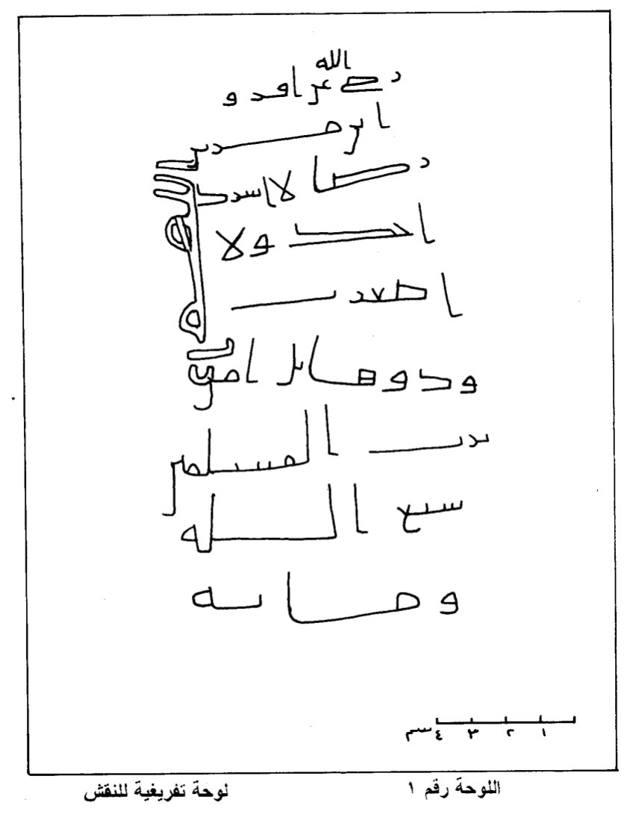
105 AH QMI-INS-055n

Inscription of Sakākā

نقش سكاكا

SiteSakākā, al-Jawf region
Writing surfaceRock face
DimensionsUnrecorded
ScriptKūfic
SubjectPrayer for forgiveness for a man and for every reader who says amen, dated 105 AH
ReadingNot yet given

Original text (Arabic)

Reading forthcoming.

Commentary

A prayer for forgiveness for a named man, which the writer extends to “whoever reads this writing and says amen” — the same appeal to the passing reader found in the inscription of Mukhlid ibn Abī Mukhlid (no. 38). It is dated 105 AH (723–724 CE), the year in which the caliphate passed from Yazīd II to Hishām ibn ʿAbd al-Malik, and comes from Sakākā in al-Jawf, on the routes linking Syria with northern Arabia. The full reading and details will be added here. A second dated prayer of 105 AH, from Wādī Salma in north-eastern Jordan, opens with the divine names of Q 40:3 (QMI-INS-055sa).

Source: Documented by ʿAwwād al-Fāliḥ, 2016.

How to cite

Shaker W. Ahmed. “Inscription of Sakākā” (Cat. No. QMI-INS-055n). QMI, quranmss.com, 2026.

Inscription of Wādī al-GharraFacsimile only: no photograph of the inscription is available⤢ Click to enlarge
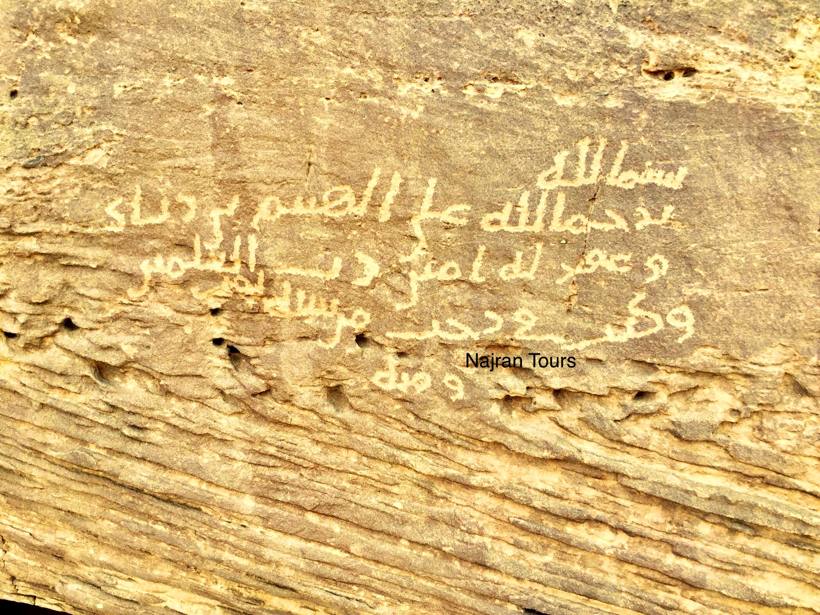
107 AH QMI-INS-055g

Inscription of Wādī al-Gharra

نقش وادي الغرة

SiteWādī al-Gharra, Jordan
Writing surfaceRock face
Lines9
DimensionsUnrecorded
ScriptḤijāzī
SubjectProfession of faith renouncing Wadd and Hubal, dated 107 AH
ReadingLargely clear · a few letters restored
Grade 2 of 5. Nearly complete; a few letters are restored by the editor.

Original text (Arabic)

  1. رضي الله عن أقرف
  2. ابن مر بن
  3. رضا لا أشرك [بالله]
  4. أحد ولا
  5. أطع رب
  6. ود وهابل آمن
  7. برب المسلمين
  8. سبع الله
  9. ومأية

Translation

  1. May God be pleased with Aqraf
  2. son of M-r son of
  3. Riḍā. I do not associate [with God]
  4. anyone, nor
  5. do I obey the lord[s]
  6. Wadd and Hubal. I believe
  7. in the Lord of the Muslims.
  8. Seven — God —
  9. and one hundred.

Commentary

A profession of faith that names what it renounces: the writer declares that he associates no one with God and will not obey Wadd and Hubal, two of the best-known gods of pre-Islamic Arabia — Wadd, worshipped by Kalb at Dūmat al-Jandal, and Hubal, the chief idol of the Kaʿbah — and that he believes in “the Lord of the Muslims”. Explicit rejection of named pre-Islamic deities is very rare in the early inscriptions, and it is striking to find it as late as 107 AH (725–726 CE), in the caliphate of Hishām ibn ʿAbd al-Malik. The inscription was recorded during a survey of Wādī al-Gharra in Jordan in May 1999 and is shown here in the editor’s facsimile. The date is read as “sabʿ … wa-miʾah” (one hundred and seven); the word between the two numerals is read by the editor as “Allāh”. Several readings remain open — the writer’s name and his father’s (Aqraf ibn M-r ibn Riḍā), and a short vertical line of writing at the left of the facsimile that is not included in the reading. An undated prayer from Najrān, in an early Ḥijāzī hand of the first century, asks God to forgive “the Muslims” (QMI-INS-055ak).

Source: Jumʿah Muḥammad Karīm, “Naqsh Kūfī yaʿūd ilā al-ʿaṣr al-Umawī min janūb sharq al-Ghurrah – qaḍāʾ al-Jafr,” Dirāsāt al-ʿUlūm al-Insāniyyah wa-al-Ijtimāʿiyyah 28, no. 2 (2001): 391–413.

How to cite

Shaker W. Ahmed. “Inscription of Wādī al-Gharra” (Cat. No. QMI-INS-055g). QMI, quranmss.com, 2026.

Inscription of al-Haytham ibn ZiyādPhotograph: Muḥammad ibn Ḥuraysh (Najran Tours)⤢ Click to enlarge
108 AH QMI-INS-055d

Inscription of al-Haytham ibn Ziyād

نقش الهيثم بن زياد

SiteShasʿā, Najrān region
Writing surfaceRock face (sandstone)
Lines5
DimensionsUnrecorded
ScriptḤijāzī
SubjectPrayer for mercy and forgiveness, dated Rajab 108 AH
ReadingClear · nothing restored
Grade 1 of 5. The text is complete; nothing is restored.

Original text (Arabic)

  1. بسم الله
  2. ترحم الله على الهيثم بن زياد
  3. وغفر له آمين رب العلمين (العالمين)
  4. وكتب في رجب من سنة ثمن (ثمان)
  5. ومئة

Translation

  1. In the name of God.
  2. May God have mercy upon al-Haytham ibn Ziyād
  3. and forgive him. Amen, Lord of the worlds.
  4. And [this] was written in Rajab of the year one hundred
  5. and eight.

Commentary

A prayer for mercy and forgiveness for al-Haytham ibn Ziyād, dated by month and year: Rajab 108 AH (November 726 CE), in the caliphate of Hishām ibn ʿAbd al-Malik. The writer does not name himself. The spelling keeps the habits of the period: both “al-ʿālamīn” and “thamān” are written without the long alif. The closing words “rabb al-ʿālamīn” are squeezed above the end of the third line, as if added once the line was already full. A second prayer for al-Haytham, asking forgiveness for him and for “whoever asks forgiveness of his Lord”, is dated Ramaḍān of the same year (QMI-INS-055da).

Source: Ibn Ḥuraysh, Muḥammad (Najran Tours). Photograph and reading posted on X (formerly Twitter), 28 May 2019.

How to cite

Shaker W. Ahmed. “Inscription of al-Haytham ibn Ziyād” (Cat. No. QMI-INS-055d). QMI, quranmss.com, 2026.

Second inscription of al-Haytham ibn Ziyād, Ramaḍān 108 AHPhoto: Mishʿal ibn ʿAbdallāh⤢ Click to enlarge
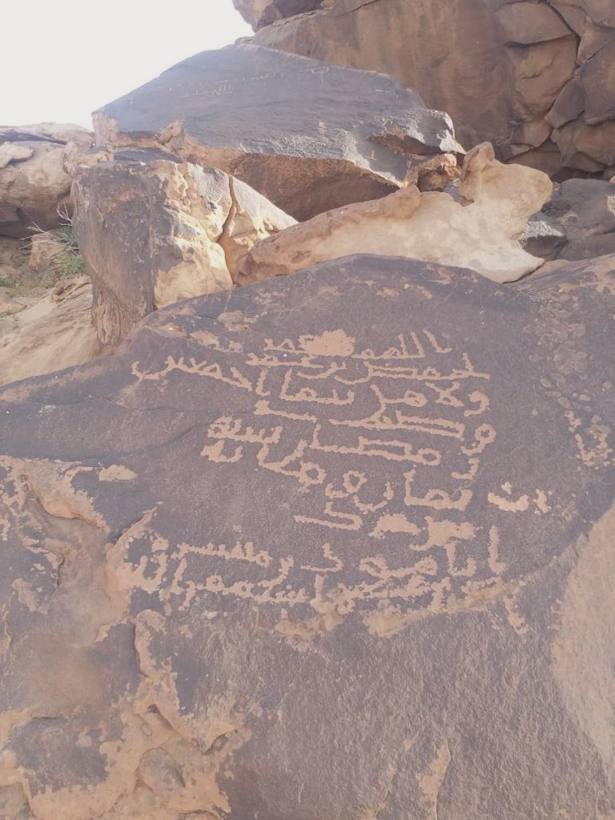
108 AH QMI-INS-055da

Second Inscription of al-Haytham ibn Ziyād, Najrān

النقش الثاني للهيثم بن زياد، نجران

SiteNajrān region
Writing surfaceSandstone rock face
Lines5
DimensionsUnrecorded
ScriptEarly Kūfic
SubjectPrayer for forgiveness for al-Haytham ibn Ziyād and for whoever asks forgiveness, dated Ramaḍān 108 AH
ReadingClear · nothing restored
Grade 1 of 5. The text is complete; nothing is restored.

Original text (Arabic)

  1. غفر الله للهيثم
  2. بن زياد ولمن استغفر ربه
  3. آمين رب العلمين (العالمين)
  4. وكتب في رمضن (رمضان) من سنة
  5. ثمن (ثمان) ومئة

Translation

  1. May God forgive al-Haytham
  2. ibn Ziyād, and whoever asks forgiveness of his Lord.
  3. Amen, Lord of the worlds.
  4. And [this] was written in Ramaḍān of the year
  5. one hundred and eight.

Commentary

A five-line prayer for forgiveness for al-Haytham ibn Ziyād, dated Ramaḍān 108 AH (January 727 CE), in the caliphate of Hishām ibn ʿAbd al-Malik. It is the second dated text for the same man from the Najrān region: an earlier prayer for mercy, dated Rajab of the same year, was written two months before (QMI-INS-055d). Neither text names its writer.

Here the prayer reaches beyond al-Haytham to “whoever asks forgiveness of his Lord”, a wider appeal that recalls prayers for the passer-by elsewhere in the catalog, such as that of Nawfal ibn Qays for “whoever passes along this road” (QMI-INS-055aka). The spelling keeps the habits of the period, with al-ʿālamīn, Ramaḍān and thamān written without the long alif, as in the Rajab text. The Arabic lines are cut on the upper part of the rock face, above earlier pre-Islamic inscriptions in the ancient scripts of Arabia.

Source: Photograph by Mishʿal ibn ʿAbdallāh (@mashalgrad), published on X, 30 October 2021.

How to cite

Shaker W. Ahmed. “Second Inscription of al-Haytham ibn Ziyād, Najrān” (Cat. No. QMI-INS-055da). QMI, quranmss.com, 2026.

Inscription of Ḥafṣ ibn ʿUmarPhotograph: Bandar al-Ghayth⤢ Click to enlarge
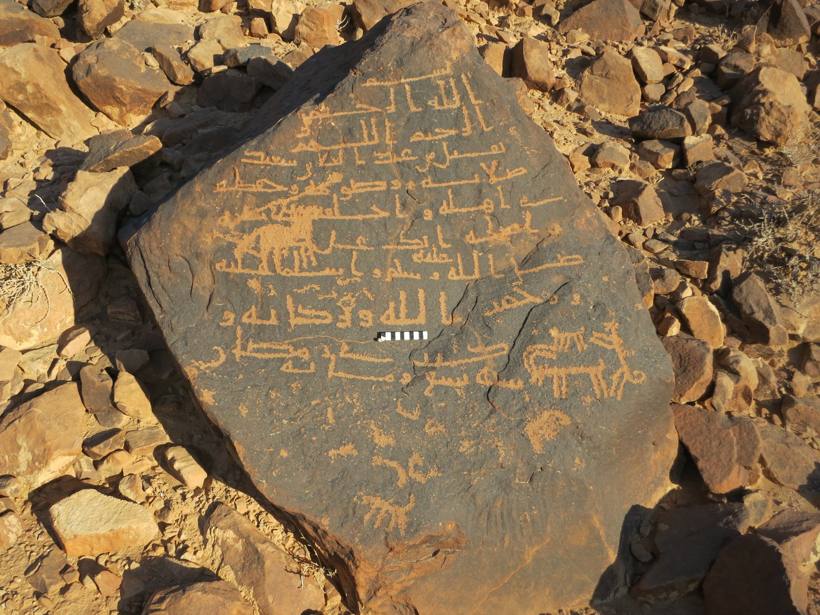
108 AH QMI-INS-055e

Inscription of Ḥafṣ ibn ʿUmar

نقش حفص بن عمر

SiteTaymāʾ, Tabūk
Writing surfaceRock face
Lines6
DimensionsUnrecorded
ScriptḤijāzī
SubjectPrayer for forgiveness for a man and the people of Taymāʾ, dated Ramaḍān 108 AH
ReadingClear · nothing restored
Grade 1 of 5. The text is complete; nothing is restored.

Original text (Arabic)

  1. اللهم اغفر
  2. لحفص بن عمر
  3. ولأهل تيماء أجمعين
  4. وكتب في
  5. رمضان سنة
  6. ثمان ومائة

Translation

  1. O God, forgive
  2. Ḥafṣ ibn ʿUmar
  3. and all the people of Taymāʾ.
  4. And [this] was written in
  5. Ramaḍān of the year
  6. one hundred and eight.

Commentary

A prayer for forgiveness dated Ramaḍān 108 AH (January 727 CE), in the caliphate of Hishām ibn ʿAbd al-Malik — two months after the inscription of al-Haytham ibn Ziyād (no. 55d). Its striking feature is the widening of the prayer: after asking forgiveness for Ḥafṣ ibn ʿUmar, the writer extends it to “all the people of Taymāʾ”, a communal prayer for a whole town that is rare among the inscriptions of this catalog. It joins the other inscription from Taymāʾ in the catalog (no. 50, 98 AH). Ḥafṣ ibn ʿUmar has not been identified. The name invites comparison with ʿĀṣim ibn ʿUmar ibn Ḥafṣ (no. 55, 100 AH), since brothers were often named after their grandfather; but this remains a possibility only, as both names were common. The inscription was discovered by Bandar al-Ghayth.

Source: al-Sulaymī, Mālik. Photograph and reading posted on X (formerly Twitter), 7 May 2019; discovered by Bandar al-Ghayth.

How to cite

Shaker W. Ahmed. “Inscription of Ḥafṣ ibn ʿUmar” (Cat. No. QMI-INS-055e). QMI, quranmss.com, 2026.

Inscription of Wādī ShīrehPhotograph: Glenn J. Corbett (ACOR)⤢ Click to enlarge
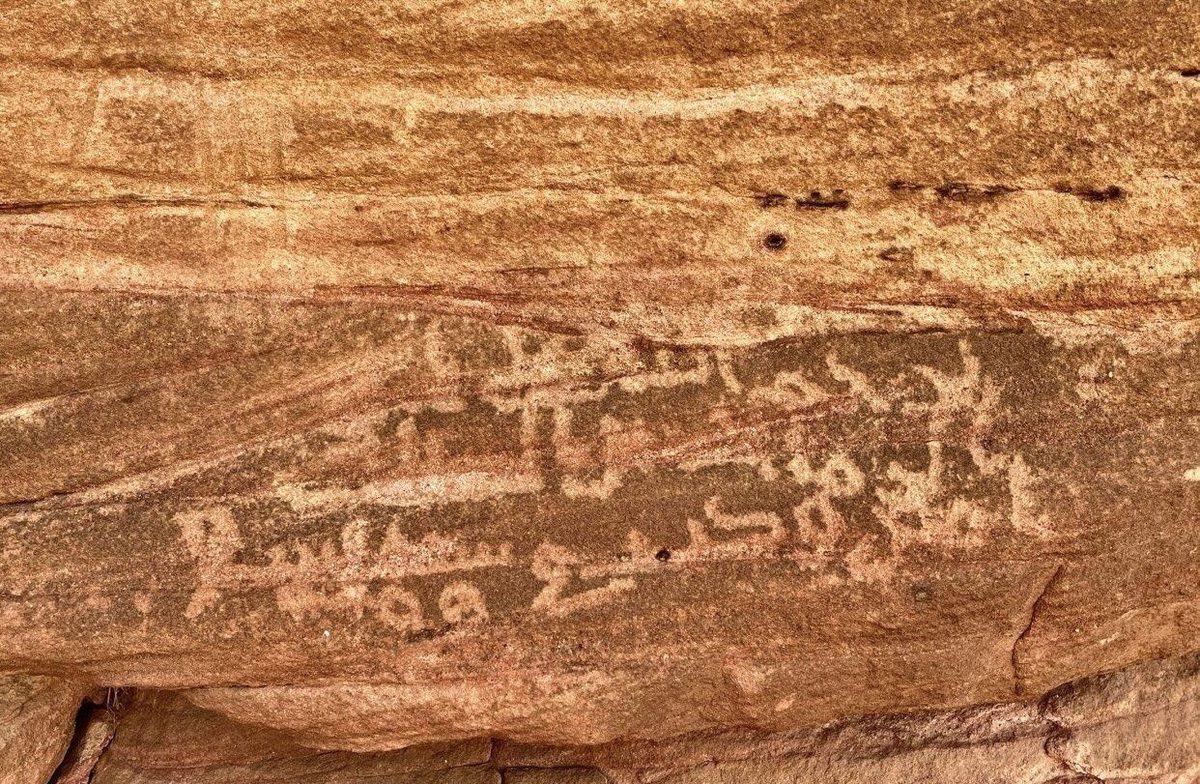
109 AH QMI-INS-055f

Inscription of Wādī Shīreh

نقش وادي الشيرة

SiteWādī Shīreh, Ḥismā (Wadi Ramm), southern Jordan
Writing surfaceRock (boulder), with animal drawings
Lines11
DimensionsUnrecorded
ScriptKūfic
SubjectTraveller’s prayer for the acceptance of prayer and fasting, dated Ramaḍān 109 AH
ReadingLargely clear · a few letters restored
Grade 2 of 5. Nearly complete; a few letters are restored by the editor.

Original text (Arabic)

  1. بسم
  2. الله الرحمن
  3. الرحيم اللهم
  4. تقبل من عبد [؟] سعيد
  5. صلاته وصومه وحفظه
  6. في أهله وأخلفه في [؟]
  7. وإصلحه إنك على [كل شي قدير]
  8. صلى الله عليه وسلم وأسلم عليه
  9. ورحمة الله وبركاته و
  10. كتب في رمضان
  11. سنة تسع وماية

Translation

  1. In the name
  2. of God, the Most Gracious,
  3. the Most Merciful. O God,
  4. accept from ʿAbd [?] Saʿīd
  5. his prayer and his fasting, and keep him
  6. among his family, and be his successor in [?],
  7. and set him right. Truly You have [power over all things].
  8. God bless him and grant him peace, and peace be upon him,
  9. and the mercy of God and His blessings. And
  10. [this] was written in Ramaḍān
  11. of the year one hundred and nine.

Commentary

A traveller’s prayer, dated Ramaḍān 109 AH (December 727 CE), in the caliphate of Hishām ibn ʿAbd al-Malik. The writer asks God to accept his prayer and his fasting — fitting for the month in which he wrote — to keep him while away from his family, and to take his place among them, the classic petition of one on a journey. It was found in the winter of 1988 by the ʿAqaba–Maʿān Archaeological and Epigraphic Survey, directed by William Jobling of the University of Sydney, in Wādī Shīreh in the Ḥismā desert, beside a rare early Islamic open-air mosque and with several other early inscriptions; it is the earliest dated of the group. The same stone carries animal drawings, camels and ibex, cut by other hands. Parts of the writer’s name and of the sixth and seventh lines remain unread or uncertain.

Source: Corbett, Glenn J., and Firas Bqain. “Traces of Early Islam in Wadi Ramm: A Desert Mosque and Waystation from the Time of the Umayyads.” Lecture, American Center of Research (ACOR), Amman, 4 March 2015. publications.acorjordan.org.

How to cite

Shaker W. Ahmed. “Inscription of Wādī Shīreh” (Cat. No. QMI-INS-055f). QMI, quranmss.com, 2026.

First Inscription of al-Rammāḥ ibn al-ṢaltPhotograph: Mishʿal ibn ʿAbdallāh⤢ Click to enlarge
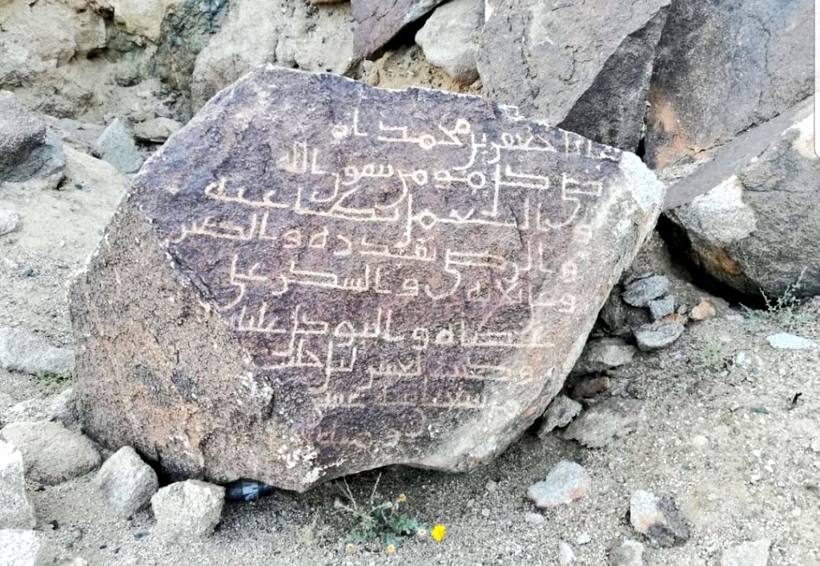
109 AH QMI-INS-055y

First Inscription of al-Rammāḥ ibn al-Ṣalt

نقش الرماح بن الصلت (الأول)

SiteNajrān region
Writing surfaceRock face (sandstone)
Lines3
DimensionsUnrecorded
SubjectPrayer for mercy, dated 109 AH
ReadingClear · nothing restored
Grade 1 of 5. The text is complete; nothing is restored.

Original text (Arabic)

  1. ترحم الله على الرماح بن الصلت
  2. آمين وكتب في سنة تسع
  3. ومئة

Translation

  1. May God have mercy on al-Rammāḥ ibn al-Ṣalt.
  2. Amen. And [this] was written in the year nine
  3. and one hundred.

Commentary

A short prayer for mercy dated by year alone, 109 AH (727–728 CE), in the caliphate of Hishām ibn ʿAbd al-Malik. It is the earlier of two inscriptions that al-Rammāḥ ibn al-Ṣalt left in the region of Najrān: a year later he returned and wrote a second prayer in almost the same words (no. 55z, 110 AH), and in that same year a man with the same father’s name, al-Mufaḍḍal ibn al-Ṣalt, wrote a prayer of his own (no. 55aa). The opening “tarraḥḥama Allāh ʿalā” (may God have mercy on) is the formula of the two other inscriptions from the Najrān region in this catalog, the inscription of Yazīd ibn ʿAbdallāh al-Sulūlī (no. 3, 29 AH) and that of al-Haytham ibn Ziyād at Shasʿā (no. 55d, 108 AH), and it seems to have been a favourite local way of opening a prayer for mercy. The letters are cut in a broad, shallow line on a weathered sandstone face, and the date runs onto a short third line (“wa-miʾah”). It is one of four inscriptions in this catalog dated 109 AH.

Source: Mishʿal ibn ʿAbdallāh (@mashalgrad). Photographs posted on X (formerly Twitter), 12 June 2026.

How to cite

Shaker W. Ahmed. “First Inscription of al-Rammāḥ ibn al-Ṣalt” (Cat. No. QMI-INS-055y). QMI, quranmss.com, 2026.

Inscription of Jaʿfar ibn MuḥammadPhotograph: Saʿd al-Tuwayjirī⤢ Click to enlarge
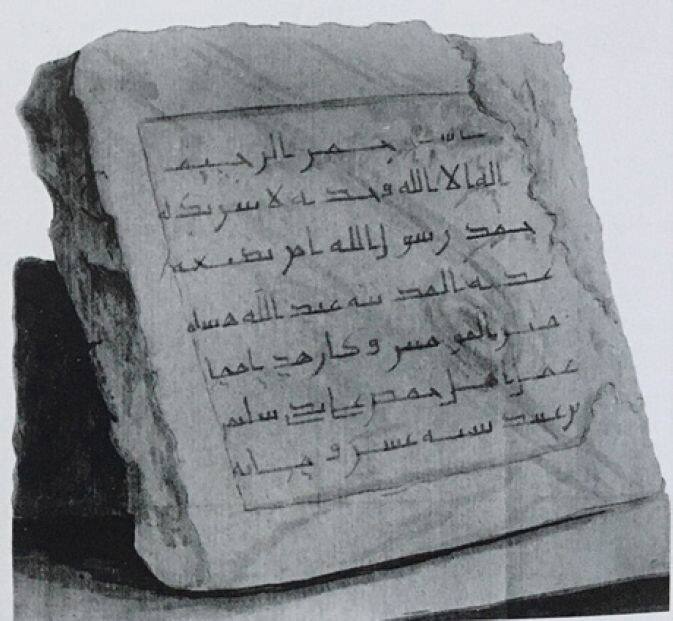
110 AH QMI-INS-055b

Inscription of Jaʿfar ibn Muḥammad

نقش جعفر بن محمد

SiteMecca region
Writing surfaceRock (detached boulder)
Lines9
DimensionsUnrecorded
ScriptḤijāzī
SubjectTestament (waṣiyyah), dated 10 Shaʿbān 110 AH
ReadingClear · nothing restored
Grade 1 of 5. The text is complete; nothing is restored.

Original text (Arabic)

  1. أنا جعفر بن محمد أو
  2. صي كل مؤمن بتقوى الله
  3. والعمل بطاعته والرضى
  4. بقدره والصبر
  5. و (كذا) على بلائه والشكر على
  6. عطاه والتوكل عليه
  7. وكتب لعشر ليال خلت
  8. من شعبان سنة عشر
  9. ومئة

Translation

  1. I am Jaʿfar ibn Muḥammad. I en-
  2. join every believer to be mindful of God,
  3. to act in obedience to Him, to be content
  4. with His decree, to be patient
  5. in His trials, to be grateful for
  6. His gifts, and to trust in Him. Written
  7. when ten nights had passed
  8. of Shaʿbān, in the year one hundred
  9. and ten.

Commentary

A testament (waṣiyyah) addressed to every believer, dated by day, month and year: ten nights into Shaʿbān 110 AH (November 728 CE), in the caliphate of Hishām ibn ʿAbd al-Malik. Its six counsels — mindfulness of God, obedience, contentment with His decree, patience in trial, gratitude for His gifts and reliance upon Him — read as a short sermon rather than a personal prayer, and set it apart from the name-and-prayer formulas of most inscriptions in this catalog. An extra wāw stands before “ʿalā balāʾihi”. The writer gives only his name and his father’s. It has been suggested that he is Jaʿfar ibn Muḥammad al-Ṣādiq (d. 148 AH), who would have been in his late twenties in 110 AH and whose recorded sayings share this vocabulary of patience, gratitude and reliance on God. The identification remains a possibility only: Jaʿfar ibn Muḥammad was a common name, and the inscription carries no nisba, kunya or further lineage that would confirm it. A rock inscription at al-Madīnah by Zayd ibn Ḥasan, probably Zayd ibn al-Ḥasan ibn ʿAlī, the brother of al-Ṣādiq’s grandmother Fāṭimah bint al-Ḥasan, is open to the same kind of identification (QMI-INS-055pza).

Source: al-Tuwayjirī, Saʿd. Photograph and reading posted on X (formerly Twitter), 30 March 2020.

How to cite

Shaker W. Ahmed. “Inscription of Jaʿfar ibn Muḥammad” (Cat. No. QMI-INS-055b). QMI, quranmss.com, 2026.

Foundation Inscription of Qaṣr al-Ḥayr al-SharqīPhotograph: as published⤢ Click to enlarge
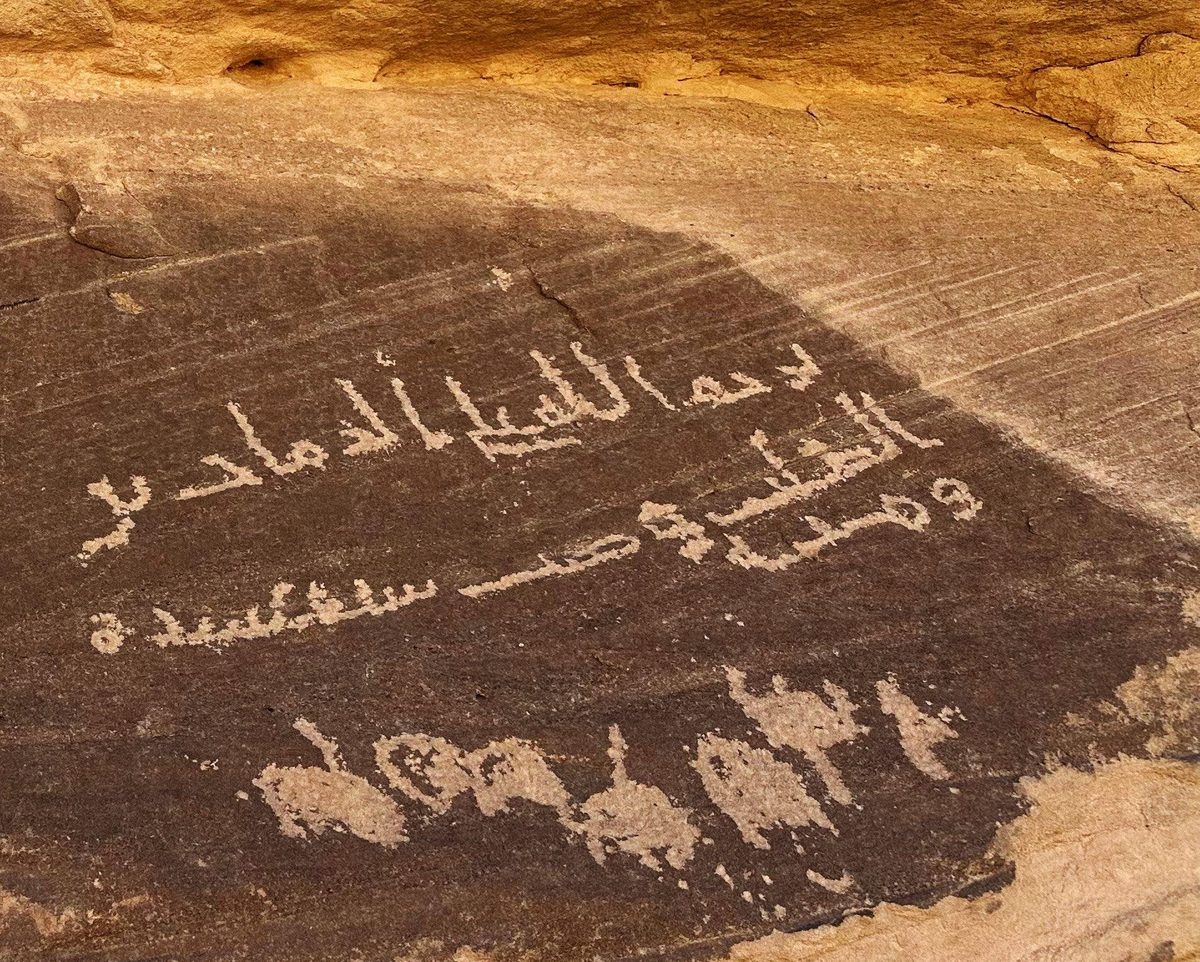
110 AH QMI-INS-055o

Foundation Inscription of Qaṣr al-Ḥayr al-Sharqī

نقش تأسيس قصر الحير الشرقي

SiteQaṣr al-Ḥayr al-Sharqī, Syrian desert (Large Enclosure)
Writing surfaceStone slab (building inscription)
Lines7
DimensionsUnrecorded
ScriptKūfic
SubjectFoundation inscription of the caliph Hishām, work of the people of Ḥimṣ, dated 110 AH
ReadingLargely clear · a few letters restored
Grade 2 of 5. Nearly complete; a few letters are restored by the editor.

Original text (Arabic)

  1. [بسم الله] الرحمن الرحيم
  2. [لا] إله إلا الله وحديه (وحده) لا شريك له
  3. [مـ]حمد رسول الله أمر بصنعة
  4. [هـ]ذيه المدينة عبد الله هشام
  5. [ا]مير المؤمنين وكان هذا
  6. مما عمل أهل حمص على يدي سليم
  7. بن عبيد سنة عشر وماية

Translation

  1. [In the name of God,] the Most Gracious, the Most Merciful.
  2. [There is no] god but God alone; He has no partner;
  3. [Mu]ḥammad is the messenger of God. The making of
  4. this city was ordered by the servant of God Hishām,
  5. Commander of the Faithful; and this was
  6. among the work done by the people of Ḥimṣ, at the hands of Sulaym
  7. ibn ʿUbayd, in the year one hundred and ten.

Commentary

The foundation inscription of the caliph Hishām ibn ʿAbd al-Malik at Qaṣr al-Ḥayr al-Sharqī, in the desert between Palmyra and the Euphrates, dated 110 AH (728–729 CE). It was found in the nineteenth century by J.-B. Rousseau in the Large Enclosure of the site and published by Charles Clermont-Ganneau as “an inscription of the caliph Hishām”. After the profession of faith, it records that Hishām ordered the work, that it was carried out by “the people of Ḥimṣ” — a levy from the jund of Ḥimṣ — and that it was supervised by Sulaym ibn ʿUbayd, a formula of order, workforce and overseer found in other Umayyad building texts. Its key word has long been disputed. Rousseau read “this city” (al-madīnah), and the inscription has often been cited as calling Qaṣr al-Ḥayr a “city”; but Clermont-Ganneau, troubled by the phrase “the making of a city”, proposed “this minaret” (al-miʾdhanah). Luke Treadwell has re-examined the question (2024), drawing on the use of the root ṣ-n-ʿ in the inscription of the khan at Qaṣr al-Ḥayr al-Gharbī (109 AH) and on an Umayyad inscription from the mosque at Bosra, which supports Clermont-Ganneau’s revised reading. If “minaret” is right, the text is among the earliest dated witnesses to the minaret in Islam. The reading given here follows the published text, with “city”. Two spellings stand out: waḥdahu is written وحديه and hādhihi is written هذيه.

A second text of Hishām with the same opening formula, ordering the making of a pool rather than a city, is the undated pool inscription of his caliphate (QMI-INS-055ab).

For Hishām’s son Muʿāwiya, who raided from Qinnasrīn and lived near Ruṣāfa, see the tax letter from Andarīn (QMI-INS-055ac).

For Hishām as judge of a land dispute rather than builder, see the meadow inscription from al-ʿUlā (QMI-INS-055ad).

Source: Treadwell, Luke. “Madīna or Miʾdhana? Revisiting the ‘Foundation Inscription’ of Qaṣr al-Ḥayr al-Sharqī.” Journal of Material Cultures in the Muslim World 5 (2024): 134–154. Earlier: C. Clermont-Ganneau, “Une inscription du calife Hichâm (an 110 de l’hégire)”, in Recueil d’archéologie orientale; first copied by J.-B. Rousseau.

How to cite

Shaker W. Ahmed. “Foundation Inscription of Qaṣr al-Ḥayr al-Sharqī” (Cat. No. QMI-INS-055o). QMI, quranmss.com, 2026.

Second Inscription of al-Rammāḥ ibn al-ṢaltPhotograph: Mishʿal ibn ʿAbdallāh⤢ Click to enlarge
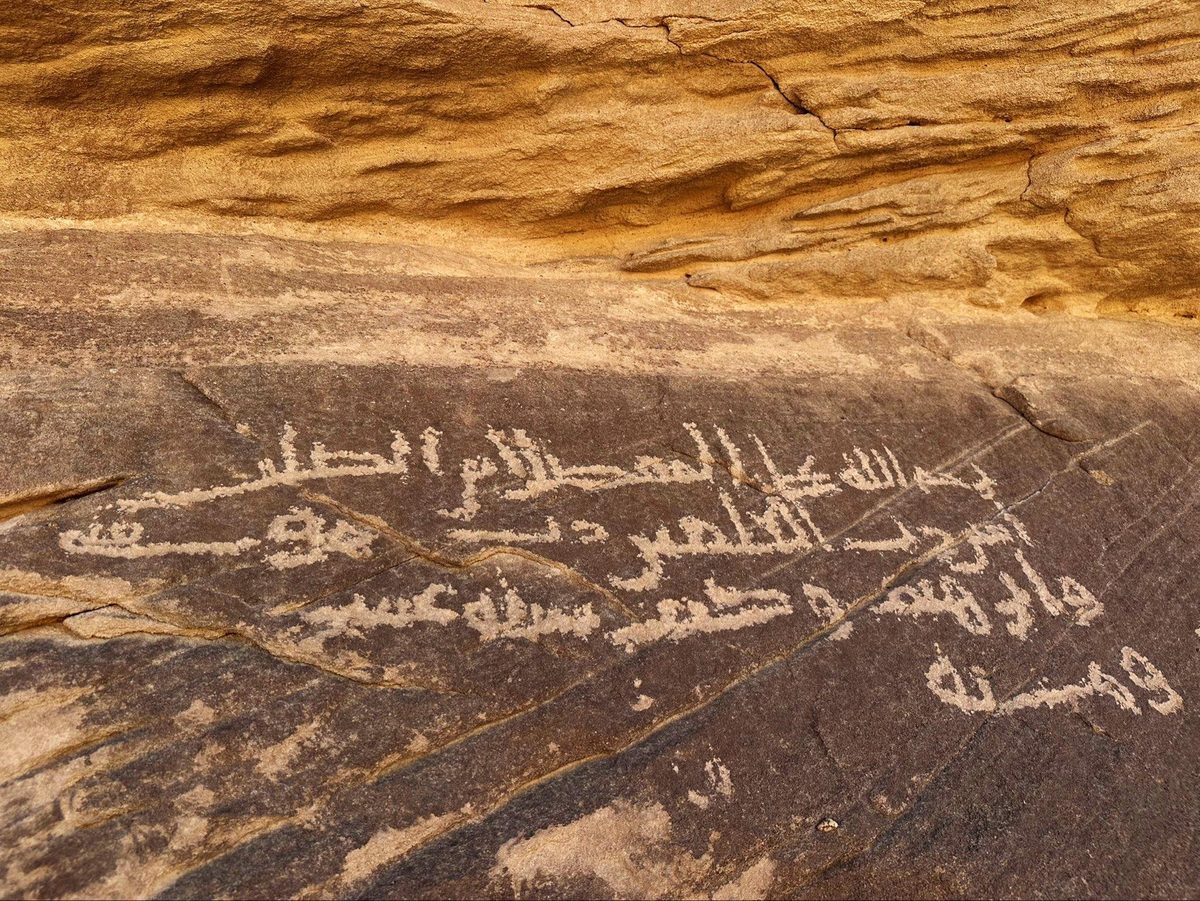
110 AH QMI-INS-055z

Second Inscription of al-Rammāḥ ibn al-Ṣalt

نقش الرماح بن الصلت (الثاني)

SiteNajrān region
Writing surfaceRock face (sandstone)
Lines3
DimensionsUnrecorded
SubjectPrayer for mercy, dated 110 AH; camel drawings below
ReadingClear · nothing restored
Grade 1 of 5. The text is complete; nothing is restored.

Original text (Arabic)

  1. ترحم الله على الرماح بن
  2. الصلت وكتب سنة عشرة
  3. ومئة

Translation

  1. May God have mercy on al-Rammāḥ ibn
  2. al-Ṣalt. And [this] was written in the year ten
  3. and one hundred.

Commentary

The second prayer for mercy of al-Rammāḥ ibn al-Ṣalt, dated by year alone, 110 AH (728–729 CE), one year after his first (no. 55y, 109 AH) and in nearly the same words; this time he leaves out the “āmīn”. It was written in the same year as the prayer of al-Mufaḍḍal ibn al-Ṣalt (no. 55aa), who may have been his brother: the two men share their father’s name, their region and their opening formula, “tarraḥḥama Allāh ʿalā”. This remains a possibility only. The number is written “ʿashrah” with a final tāʾ marbūṭah, where al-Mufaḍḍal’s inscription has “ʿashr”. The letters are cut in a light, even line on a dark patinated panel, and below the text is a row of camels drawn in the same pecked technique — whether by the same hand cannot be told from the photograph.

Source: Mishʿal ibn ʿAbdallāh (@mashalgrad). Photographs posted on X (formerly Twitter), 12 June 2026.

How to cite

Shaker W. Ahmed. “Second Inscription of al-Rammāḥ ibn al-Ṣalt” (Cat. No. QMI-INS-055z). QMI, quranmss.com, 2026.

Inscription of al-Mufaḍḍal ibn al-ṢaltPhotograph: Mishʿal ibn ʿAbdallāh⤢ Click to enlarge
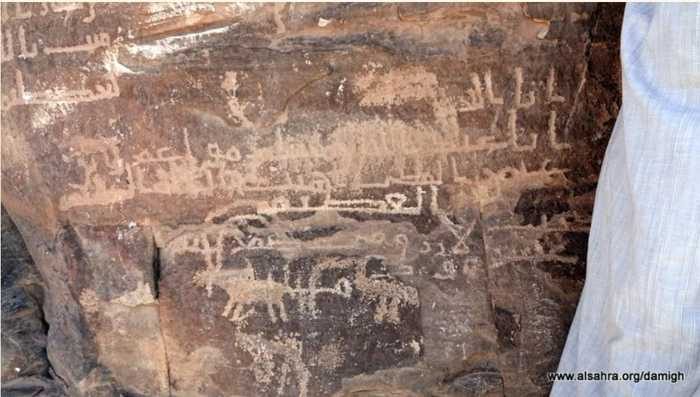
110 AH QMI-INS-055aa

Inscription of al-Mufaḍḍal ibn al-Ṣalt

نقش المفضل بن الصلت

SiteNajrān region
Writing surfaceRock face (sandstone)
Lines4
DimensionsUnrecorded
SubjectPrayer for mercy invoking the Lord of Moses and Abraham, dated 110 AH
ReadingClear · nothing restored
Grade 1 of 5. The text is complete; nothing is restored.

Original text (Arabic)

  1. ترحم الله على المفضل بن الصلت
  2. آمين رب العلمين (العالمين) رب موسى
  3. وابرهيم (وإبراهيم) وكتب سنة عشر
  4. ومئة

Translation

  1. May God have mercy on al-Mufaḍḍal ibn al-Ṣalt.
  2. Amen, Lord of the worlds, Lord of Moses
  3. and Abraham. And [this] was written in the year ten
  4. and one hundred.

Commentary

A prayer for mercy dated by year alone, 110 AH (728–729 CE), in the caliphate of Hishām ibn ʿAbd al-Malik. After the regional opening “tarraḥḥama Allāh ʿalā” (compare nos. 3, 55d and the two inscriptions of al-Rammāḥ ibn al-Ṣalt, nos. 55y and 55z), the writer seals his prayer with “āmīn, Lord of the worlds, Lord of Moses and Abraham”. The closest parallel in this catalog is the prayer of Qaṣr al-Kharrānah (no. 40, 92 AH), which ends “āmīn, Lord of the worlds, Lord of Moses and Aaron”, the pairing of the Qurʾān (Q 7:122; 26:48). Here Abraham takes the place of Aaron, recalling instead the pairing of the “scrolls of Abraham and Moses” (Q 87:19; cf. 53:36–37). The spelling is of its time: “al-ʿālamīn” and “Ibrāhīm” are both written without their long alif. al-Mufaḍḍal shares his father’s name with al-Rammāḥ ibn al-Ṣalt, who wrote in the same region in 109 and 110 AH; the two may have been brothers, though this remains a possibility only.

Source: Mishʿal ibn ʿAbdallāh (@mashalgrad). Photographs posted on X (formerly Twitter), 12 June 2026.

How to cite

Shaker W. Ahmed. “Inscription of al-Mufaḍḍal ibn al-Ṣalt” (Cat. No. QMI-INS-055aa). QMI, quranmss.com, 2026.

Inscription of ʿAbdallāh ibn Muslim, ḤismāPhotograph: Desert Team (فريق الصحراء)⤢ Click to enlarge
110 AH QMI-INS-055aaa

Inscription of ʿAbdallāh ibn Muslim, Ḥismā

نقش عبد الله بن مسلم

SiteḤismā, north-western Arabia
Writing surfaceRock face (sandstone)
Lines4
DimensionsUnrecorded
SubjectProfession of faith, dated 110 AH
ReadingLargely clear · a few letters restored
Grade 2 of 5. Nearly complete; a few letters are restored by the editor.

Original text (Arabic)

  1. أنا عبدالله بن مسلم مولى عمرو بن
  2. عثمان المكي آمنت بالله العظيم
  3. وكتب لازرق؟؟ في صفر ؟سنة
  4. عشرة ومائة

Translation

  1. I am ʿAbdallāh ibn Muslim, client (mawlā) of ʿAmr ibn ʿUthmān al-Makkī. I believed in the mighty God.
  2. And [this] was written by Lāzraq (?) in Ṣafar (?) of the year one hundred and ten.

Commentary

A profession of faith dated Ṣafar 110 AH (728 CE), in the caliphate of Hishām ibn ʿAbd al-Malik. The writer, ʿAbdallāh ibn Muslim, identifies himself as a client (mawlā) of ʿAmr ibn ʿUthmān al-Makkī and declares his belief in the mighty God. The name of the writer of the inscription and the month appear with question marks in the published reading, so those words are provisional. Ḥismā is also the site of other early professions of faith in this catalog. A month earlier, on Friday 1 al-Muḥarram 110, a pilgrim returning from the Ḥajj recorded his passage in Ḥismā (QMI-INS-055af). A dated prayer from the Medina region belongs to the same month and year (QMI-INS-055ag).

Source: Desert Team (فريق الصحراء). Photograph and reading published on alsahra.org/damigh, 12 December 2021.

How to cite

Shaker W. Ahmed. “Inscription of ʿAbdallāh ibn Muslim, Ḥismā” (Cat. No. QMI-INS-055aaa). QMI, quranmss.com, 2026.

Inscription of Rāghim ibn Mukhlid: “Returning from the Pilgrimage”⤢ Click to enlarge
110 AH QMI-INS-055af

Inscription of Rāghim ibn Mukhlid: “Returning from the Pilgrimage”

نقش راغم بن مخلد: مقبل من الحج

SiteḤismā, north-western Arabia
Writing surfaceRock face (sandstone)
Lines3
DimensionsUnrecorded
SubjectTraveller’s record on the return from the Ḥajj, dated Friday, 1 al-Muḥarram 110 AH
ReadingLargely clear · a few letters restored
Grade 2 of 5. Nearly complete; a few letters are restored by the editor.

Original text (Arabic)

  1. مر راغمـ (زاعمـ؟) ابن مخلد الفر..قدي؟
  2. الجمعة مستهل المحرم سنة
  3. عشرة و مئة مقبل من الحج

Translation

  1. Rāghim [or Zāʿim?] ibn Mukhlid al-Far…qadī (?) passed by, on Friday, the first of al-Muḥarram of the year ten and one hundred, returning from the pilgrimage.

Commentary

A traveller’s note dated to the day: the writer records that he “passed by” (marra) on Friday, the first of al-Muḥarram 110 AH (16 April 728 CE), in the caliphate of Hishām ibn ʿAbd al-Malik, “returning from the pilgrimage” (muqbil min al-ḥajj). The Ḥajj of 109 AH had ended some three weeks earlier, so the text catches a pilgrim on his way home along the Ḥismā road towards Syria. The hand is uneven and the words are scattered rather than set on clear lines, and the writer’s name and nisba remain uncertain in the published reading: the first name may be Rāghim or Zāʿim, and the nisba is only partly legible.

One point about the date deserves notice. The Desert Team first read the year as “ten and one hundred”, and then offered a rearranged layout of the words that reads “the year one hundred”. The weekday helps here. By the tabular Hijri calendar, 1 al-Muḥarram 110 fell on a Friday, while 1 al-Muḥarram 100 fell on a Wednesday. Since months in practice began with the sighting of the new moon, a difference of a day is possible, but not of two, so the weekday given on the stone agrees with the reading 110 and not with 100.

Very few texts in this catalog name the day of the week. The closest parallel is Saʿīd ibn Sālim’s note of 127 AH, which also gives a Sunday, a day of the month and the purpose of the journey, the ʿUmrah (QMI-INS-055q). Other texts tie themselves to the pilgrimage in different ways: Sahm and Mukhlid ibn Abī Mukhlid ask for their ḥajj to be accepted (QMI-INS-029, QMI-INS-038), and Muḥammad ibn Abī Ṭaybah dates his text by the pilgrimage of the caliph Sulaymān (QMI-INS-045). A month after this text, in Ṣafar 110, ʿAbdallāh ibn Muslim left a dated profession of faith in the same region (QMI-INS-055aaa). A prayer for forgiveness from the Medina region is dated a few weeks later, in Ṣafar of the same year (QMI-INS-055ag).

Source: Desert Team (فريق الصحراء), “Nuqūsh wa-ḥikāyāt min zaman al-ṣaḥābah wa-l-tābiʿīn”, alsahra.org, June 2025, no. 28. Reading by ʿAbdallāh ibn ʿAbd al-ʿAzīz al-Saʿīd. Weekday computed by the tabular Hijri calendar for this catalog.

How to cite

Shaker W. Ahmed. “Inscription of Rāghim ibn Mukhlid: “Returning from the Pilgrimage”” (Cat. No. QMI-INS-055af). QMI, quranmss.com, 2026.

Inscription of Muḥammad ibn Kathīr, Mawlā of Saʿīd ibn al-ʿĀṣPhoto: Muḥammad al-Mughadhdhawī⤢ Click to enlarge
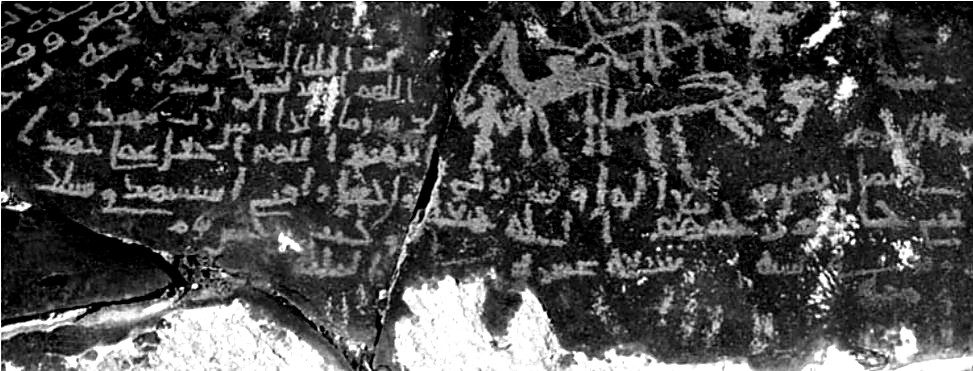
110 AH QMI-INS-055ag

Inscription of Muḥammad ibn Kathīr, Mawlā of Saʿīd ibn al-ʿĀṣ

نقش محمد بن كثير مولى سعيد بن العاص

Siteal-Madīnah region
Writing surfaceRock face
Lines12
DimensionsUnrecorded
SubjectPrayer for forgiveness, dated Wednesday, 14 Ṣafar 110 AH
ReadingClear · nothing restored
Grade 1 of 5. The text is complete; nothing is restored.

Original text (Arabic)

  1. اللهم
  2. تغفر لمحمد
  3. ابن كثير ابن
  4. أبي حكيم مو
  5. لى سعيد بن العا
  6. ص ماتقدم من
  7. ذنبه وماتأخر
  8. آمين رب العالمين
  9. وكتب يوم الأ
  10. ربعاء لأربع عشرة
  11. مضين من صفر
  12. سنة عشرة ومئة

Translation

  1. O God, forgive Muḥammad ibn Kathīr ibn Abī Ḥakīm, client (mawlā) of Saʿīd ibn al-ʿĀṣ, what has gone before of his sins and what has come after. Āmīn, Lord of the Worlds. And [this] was written on Wednesday, when fourteen [nights] had passed of Ṣafar, in the year ten and one hundred.

Commentary

A prayer for forgiveness from the Medina region, dated to the day: Wednesday, the fourteenth of Ṣafar 110 AH (May 728 CE), in the caliphate of Hishām ibn ʿAbd al-Malik. The writer, Muḥammad ibn Kathīr ibn Abī Ḥakīm, names himself as a client (mawlā) of Saʿīd ibn al-ʿĀṣ, the Qurashī governor of Kufa under ʿUthmān and of Medina under Muʿāwiyah, who died around 59 AH. Half a century after the patron’s death, the client still defines himself by that tie, which says something about how long such relationships shaped a man’s identity in Medina.

The prayer asks forgiveness for “what has gone before of his sins and what has come after”, wording drawn from Q 48:2 and found in several other texts in this catalog, from Ḥafnat al-Abyaḍ in 64 AH to Qaṣr al-Kharrānah in 92 AH (QMI-INS-010, QMI-INS-040). The verb is written taghfir (تغفر) where the imperative ighfir would be expected.

One point about the date deserves notice. By the tabular Hijri calendar, 14 Ṣafar 110 fell on a Saturday, not a Wednesday. A month that began a day early or late by sighting would move the weekday by one day, but not by three, so the weekday and the year do not agree as published. In the tabular calendar 14 Ṣafar was a Wednesday in 111 AH. The photograph is worth a careful look at the year and the day before either is taken as certain. Two other texts from the same months of 110 AH are in the catalog: a pilgrim’s note of 1 al-Muḥarram and a profession of faith of Ṣafar (QMI-INS-055af, QMI-INS-055aaa). A second inscription from the same rocky ground, the prayer of Nūḥ ibn ʿAbd al-Raḥmān al-Duʾalī, is dated 114 AH (QMI-INS-055ah). A signature in the name of Saʿīd ibn al-ʿĀṣ himself is also in the catalog (QMI-INS-000d). The same verse of Sūrat al-Fatḥ opens a prayer for a member of the Umayyad house at Khirbat Nitil in the Balqāʾ, of about 100 AH (QMI-INS-055ai).

Source: Published by Muḥammad al-Mughadhdhawī, 4 November 2017 (photograph taken 3 November 2017). Reading as published.

How to cite

Shaker W. Ahmed. “Inscription of Muḥammad ibn Kathīr, Mawlā of Saʿīd ibn al-ʿĀṣ” (Cat. No. QMI-INS-055ag). QMI, quranmss.com, 2026.

Inscription of Ḥafṣ ibn ʿAbdallāh, Jabal UsaysFacsimile: Abū al-Faraj al-ʿUsh, 1964⤢ Click to enlarge
113 AH QMI-INS-055agb

Inscription of Ḥafṣ ibn ʿAbdallāh, Jabal Usays

نقش حفص بن عبد الله، جبل أسيس

SiteJabal Usays, Syria; now in the National Museum, Damascus (inv. ʿ/15106)
Writing surfaceStone slab
Lines4
Dimensions39 × 17 cm
ScriptKūfic
SubjectPrayer for Ḥafṣ ibn ʿAbdallāh, dated Dhū al-Qaʿdah 113 AH
ReadingClear · nothing restored
Grade 1 of 5. The text is complete; nothing is restored.

Original text (Arabic)

  1. اللهم أصلح عبدك
  2. حفص بن عبد الله وكتب
  3. في ذي القعدة سنة ثلث
  4. عشرة ومائة

Translation

  1. O God, set right Your servant
  2. Ḥafṣ ibn ʿAbdallāh. And he wrote [this]
  3. in Dhū al-Qaʿdah of the year thir-
  4. teen and one hundred.

Commentary

A short prayer from Jabal Usays, asking God to “set right” (aṣliḥ) His servant Ḥafṣ ibn ʿAbdallāh, dated Dhū al-Qaʿdah 113 AH. The verb asks for more than forgiveness: it is a prayer that the man’s life and affairs be made sound. The number “three” is written thlth, without the long alif, as usual in first- and second-century dates. The slab was later taken to the National Museum in Damascus.

Six years later, in the same month of Dhū al-Qaʿdah, a man named Ḥafṣ cut a profession of faith at the same site (QMI-INS-055kb). The name, the place and the month invite the thought that both are by one hand, though the later text gives no father’s name and the identification remains open. Both come from the same publication as the inscription of ʿAlī ibn ʿAbdallāh of 93 AH (QMI-INS-041). The image is the editor’s facsimile, not a photograph.

Source: Abū al-Faraj al-ʿUsh, Muḥammad. "Kitābāt ʿArabīyah Ghayr Manshūrah fī Jabal Usays." Majallat al-Abḥāth 17, no. 3 (September 1964): 361, text no. 42, plate 26. National Museum, Damascus, inv. ʿ/15106.

How to cite

Shaker W. Ahmed. “Inscription of Ḥafṣ ibn ʿAbdallāh, Jabal Usays” (Cat. No. QMI-INS-055agb). QMI, quranmss.com, 2026.

Inscription of Nūḥ ibn ʿAbd al-Raḥmān al-DuʾalīPhoto: Muḥammad al-Mughadhdhawī⤢ Click to enlarge
114 AH QMI-INS-055ah

Inscription of Nūḥ ibn ʿAbd al-Raḥmān al-Duʾalī

نقش نوح بن عبد الرحمن الدؤلي

Siteal-Madīnah region
Writing surfaceRock face
Lines3 (as published)
DimensionsUnrecorded
SubjectPrayer for forgiveness, dated 114 AH
ReadingClear · nothing restored
Grade 1 of 5. The text is complete; nothing is restored.

Original text (Arabic)

  1. اللهم اغفر لنوح بن عبد الرحمن
  2. بن ملك الدؤلي وكتب في
  3. سنة أربع عشرة ومائة

Translation

  1. O God, forgive Nūḥ ibn ʿAbd al-Raḥmān ibn Mālik al-Duʾalī. And [this] was written in the year four-teen and one hundred.

Commentary

A short prayer for forgiveness from the Medina region, dated 114 AH (732–733 CE), in the caliphate of Hishām ibn ʿAbd al-Malik. It was published together with the prayer of Muḥammad ibn Kathīr, dated four years earlier, as the second of two texts from the same rocky ground (QMI-INS-055ag). The writer gives three generations, Nūḥ son of ʿAbd al-Raḥmān son of Mālik, and closes with the nisbah al-Duʾalī, which points to the Banū al-Duʾil of Kinānah, the clan of Abū al-Aswad al-Duʾalī.

The text follows the plain pattern of many Ḥijāzī prayers: the invocation Allāhumma ighfir, the name, and a dating clause introduced by wa-kataba fī sanat. The name Mālik is written without its long ā (ملك), the usual defective spelling of the period. The year is spelled out in words, as in nearly every dated text of the century. The nearest dated text in this catalog falls a year later: the inscription of Umm Salamah bint Hishām of 115 AH (QMI-INS-055ae).

The photograph shows the lines running across a broad face of dark stone, cut with a thin, scratched stroke and crossed by later marks. The reading is given here as published; the layout of the published reading in three lines does not necessarily follow the lines on the stone. A prayer of 130 AH from east of the city, by ʿAbd al-Raḥmān ibn Sulaymān, continues the dated series of the Medina region (QMI-INS-055mb).

Source: Published by Muḥammad al-Mughadhdhawī, 4 November 2017, as the second of two inscriptions (the first is QMI-INS-055ag). Reading as published.

How to cite

Shaker W. Ahmed. “Inscription of Nūḥ ibn ʿAbd al-Raḥmān al-Duʾalī” (Cat. No. QMI-INS-055ah). QMI, quranmss.com, 2026.

Inscription of Muḥammad ibn ʿUmar ibn Ḥafṣ, Rawāwah: photographPhoto: after Alhatlani (2021)⤢ Click to enlarge
114 AH QMI-INS-055aha

Inscription of Muḥammad ibn ʿUmar ibn Ḥafṣ, Rawāwah

نقش محمد بن عمر بن حفص، رواوة

SiteRawāwah, al-Madīnah region, Saudi Arabia
Writing surfaceRock face
Lines9
DimensionsUnrecorded
ScriptḤijāzī
SubjectPrayer for repentance and forgiveness of past and future sins, dated 114 AH (year read on site)
ReadingPartly preserved · several words restored
Grade 3 of 5. Several words are damaged and restored by the editor; the rest is legible.

Original text (Arabic)

  1. تاب الله على
  2. محمد بن عمر بن
  3. حفص بن عا
  4. [صم ما] تقدم من
  5. ذنبه وما تأخر
  6. آمين رب مو
  7. سى وهرون
  8. [وكت]ب في سنة ا
  9. [ربع عشرة] ومئة

Translation

  1. May God turn in forgiveness to
  2. Muḥammad ibn ʿUmar ibn
  3. Ḥafṣ ibn ʿĀ-
  4. [ṣim, for what] preceded
  5. of his sins and what is to come.
  6. Amen, Lord of Mo-
  7. ses and Aaron.
  8. And [this] was written in the year
  9. [four-teen] and one hundred.

Commentary

A nine-line prayer from Rawāwah near al-Madīnah asking that God “turn” to Muḥammad ibn ʿUmar ibn Ḥafṣ ibn ʿĀṣim and forgive “what preceded of his sins and what is to come”, closing with “Amen, Lord of Moses and Aaron”. The writer is a great-great-grandson of the caliph ʿUmar ibn al-Khaṭṭāb through ʿĀṣim ibn ʿUmar, and a brother of ʿĀṣim and ʿAbdallāh, sons of ʿUmar ibn Ḥafṣ, whose prayers of 121 AH come from the same site (QMI-INS-055wb, QMI-INS-055w).

The date is given by Alhatlani as 114 AH: he notes that the year was clear on the rock when he recorded it, but that it is not clear in his photograph, and the numeral in the last line is restored here in brackets on that basis. The phrase “what preceded of his sins and what is to come” echoes Q 48:2, and the invocation “Lord of Moses and Aaron” (Q 7:122, 26:48) appears again in the prayer of Ward ibn Sālim of 119 AH (QMI-INS-055ka). The descendants of ʿĀṣim ibn ʿUmar are among the best-attested families in the inscriptions around al-Madīnah (QMI-INS-043, QMI-INS-054, QMI-INS-055).

Source: Alhatlani, Abdullah Saad. Descendants and Ancestors: A Study of Arabic Inscriptions from the Arabian Peninsula (1st–4th c. AH/7th–10th c. CE). PhD thesis, Leiden University, 2021 (hdl.handle.net/1887/3217834), ch. 2, no. 57, p. 251 (first publication; photograph by the author).

How to cite

Shaker W. Ahmed. “Inscription of Muḥammad ibn ʿUmar ibn Ḥafṣ, Rawāwah” (Cat. No. QMI-INS-055aha). QMI, quranmss.com, 2026.

Inscription of the Pool of Hishām ibn ʿAbd al-MalikFacsimile drawing of the inscription⤢ Click to enlarge
105–125 AH QMI-INS-055ab

Inscription of the Pool of Hishām ibn ʿAbd al-Malik

نقش بركة هشام بن عبد الملك

SiteUnrecorded
Writing surfaceUnrecorded
Lines5
DimensionsUnrecorded
ScriptKūfic
SubjectOrder to make a pool, in the name of the caliph Hishām; dated by his reign, 105–125 AH
ReadingClear · nothing restored
Grade 1 of 5. The text is complete; nothing is restored.

Original text (Arabic)

  1. بسم الله الرحمن الرحيم
  2. لا إله إلا الله وحده لا شريك
  3. له محمد رسول الله أمر بصنعة هذ
  4. ه البركة عبد الله هشام أمير ال
  5. مؤمنين أصلحه الله على يد عمار

Translation

  1. In the name of God, the Most Gracious, the Most Merciful.
  2. There is no god but God alone; He has no partner;
  3. Muḥammad is the messenger of God. The making of
  4. this pool was ordered by the servant of God Hishām,
  5. Commander of the Faithful — may God set him right — at the hands of ʿAmmār.

Commentary

An inscription ordering the making of a pool (birka) in the name of the Umayyad caliph Hishām ibn ʿAbd al-Malik. It carries no date, but because it names Hishām as Commander of the Faithful it can belong only to his caliphate, 105–125 AH (724–743 CE). The text follows the building-inscription formula of the period: basmalah, profession of faith, then “the making of this … was ordered by the servant of God Hishām, Commander of the Faithful.” It is almost word for word the opening of the foundation text of Qaṣr al-Ḥayr al-Sharqī of 110 AH (QMI-INS-055o), where the object ordered is “this city” (or, on Treadwell’s reading, “this minaret”) and the work is done by “the people of Ḥimṣ, at the hands of Sulaym ibn ʿUbayd.” Here the object is a pool, and the responsible man is ʿAmmār, named by his given name alone.

The two other caliphal texts in this catalog use the same title: “the servant of God ʿAbd al-Malik” at ʿAqabat Fīq (QMI-INS-014a) and “the servant of God Muʿāwiyah” at Ṭāʾif (QMI-INS-009); Hishām’s market at Baysān (QMI-INS-093) is a further public work of his reign. The closing prayer aṣlaḥahu Allāh (“may God set him right”) is a common blessing on the ruler in Umayyad texts. The words are split across the line ends twice (hādhi-/hi and al-/muʾminīn). Nothing about where the pool stood, or where the stone is now, is recorded in the material available to the catalog, so the site is left open.

The same reign and the same circle: a tax letter written for Hishām’s son, the emir Muʿāwiya, in the province of Qinnasrīn, found at Andarīn (QMI-INS-055ac).

Another text naming Hishām as ruler, this time recording an award of a meadow at al-ʿUlā to a man named ʿAwsajah: QMI-INS-055ad.

His daughter Umm Salamah left a travelling prayer naming him as Commander of the Faithful (QMI-INS-055ae).

The triangular mīm of this text is compared with that of the inscription of Salamah (QMI-INS-000c). The same triangular hāʾ with an inner stroke, followed by a long dhāl, appears in hādhā in a prayer from Bayt Jibrīn in Palestine (QMI-INS-055al).

Source: Ṣalāḥ al-Dīn al-Munajjid, Dirāsāt fī tārīkh al-khaṭṭ al-ʿArabī munḏu bidāyatihi ilā nihāyat al-ʿaṣr al-Umawī (Beirut: Dār al-Kitāb al-Jadīd, 1st ed., 1972).

How to cite

Shaker W. Ahmed. “Inscription of the Pool of Hishām ibn ʿAbd al-Malik” (Cat. No. QMI-INS-055ab). QMI, quranmss.com, 2026.

Inscription of Bayt Jibrīn: Prayer for Hilāl and the Lord of the HousePhoto: Taysīr Khalaf⤢ Click to enlarge
c. 105–125 AH QMI-INS-055al

Inscription of Bayt Jibrīn: Prayer for Hilāl and the Lord of the House

نقش بيت جبرين: دعاء لهلال ولرب هذا المنزل

SiteBayt Jibrīn, Palestine, in a cave house
Writing surfacePlastered wall
Lines3
DimensionsUnrecorded
ScriptKūfic
SubjectPrayer for forgiveness for Hilāl, the owner of the house and the reader; undated; reign of Hishām by script
ReadingLargely clear · a few letters restored
Grade 2 of 5. Nearly complete; a few letters are restored by the editor.

Original text (Arabic)

  1. اللهم اغفر لهلل (لهلال) ولرب هذا المنزل
  2. ولي [؟] ولمن قرأ هذا الكتب (الكتاب) ثم قال آمين ثم آمين رب العالمين
  3. ابن ربعية الخثعمية

Translation

  1. O God, forgive Hilāl and the lord of this dwelling,
  2. and … (?), and whoever reads this writing and then says āmīn, then āmīn, Lord of the Worlds.
  3. Ibn Rabʿiyyah al-Khathʿamiyyah.

Commentary

A prayer cut into the plastered wall of one of the cave houses of Bayt Jibrīn, the ancient Eleutheropolis, in the hills west of Hebron. It asks forgiveness for Hilāl, for “the lord of this dwelling” (rabb hādhā al-manzil), that is, the owner of the house, and for anyone who reads the writing and says āmīn. The writer signs at the end as Ibn Rabʿiyyah al-Khathʿamiyyah. The feminine nisbah appears to belong to the woman named, so that he is known by his mother, a woman of Khathʿam. Two words are written without the long alif, hll for Hilāl and al-ktb for al-kitāb, as often in early texts.

Most of the prayers in this catalog were cut on rocks along roads; this one was written inside a house, and it remembers the owner of the place alongside the writer’s companion. The only other text in the catalog that prays over a dwelling is the rock inscription of Zayd ibn Ḥasan at al-Madīnah, in which the owner asks God to bless “this dwelling of ours” (manzilunā hādhā) and to ward off its harm (QMI-INS-055pza). The appeal to the reader to say āmīn has a near neighbour in al-Naqab, in the text of Ward ibn Sālim of 119 AH (QMI-INS-055ka). The tribe is also met before: ʿAbdallāh ibn ʿĀbid al-Khathʿamī, who calls himself one “of the people of Palestine”, left his name at Ḥismā in 100 AH (QMI-INS-055j). The two texts together point to men and women of Khathʿam settled in the district of Filasṭīn in the Umayyad period.

The text carries no date, and it is placed here by its script. The clearest witness is the word hādhā, written twice. Its initial hāʾ is a large triangle divided by an inner diagonal stroke, followed by a long, low dhāl along the line. The same form stands in hādh- and in the name Hishām in the inscription of the Pool of Hishām, which names the caliph and so belongs to his reign, 105–125 AH (QMI-INS-055ab). In that text, as here, the inner stroke is given only to the hāʾ that opens a word, while the final and isolated hāʾ stays a small closed triangle. On this ground the inscription is placed in the reign of Hishām, c. 105–125 AH; the comparison rests on letter forms and remains open to revision.

Source: Published on Twitter (X) by Taysīr Khalaf, 8 June 2022, with the caption Naqsh maḥfūr fī aḥad al-manāzil al-kahfiyyah fī Bayt Jibrīn, Filasṭīn (“An inscription carved in one of the cave houses of Bayt Jibrīn, Palestine”). Reading by Ahmed W. Shaker. We have not found the inscription published in the scholarly literature.

How to cite

Shaker W. Ahmed. “Inscription of Bayt Jibrīn: Prayer for Hilāl and the Lord of the House” (Cat. No. QMI-INS-055al). QMI, quranmss.com, 2026.

Tax Letter of al-Layth ibn al-Dhiyāl, AndarīnPhoto: as published in Hoyland (2018), Plate 8⤢ Click to enlarge
105–125 AH QMI-INS-055ac

Tax Letter of al-Layth ibn al-Dhiyāl, Andarīn

رسالة الليث بن الذيال في الضرائب، أندرين

SiteAndarīn (ancient Androna), north-central Syria; later bath complex
Writing surfaceMarble tablet (reused wall-facing), ink
Lines6 read (a seventh is unclear)
DimensionsUnrecorded (scale shown on the plate)
ScriptEarly Arabic script of the 2nd/8th century
SubjectDraft of a letter ordering payment of taxes in Qinnasrīn, from a governor of the emir Muʿāwiya ibn Hishām; dated by his father’s reign, 105–125 AH
ReadingClear · nothing restored
Grade 1 of 5. The text is complete; nothing is restored.

Original text (Arabic)

  1. بسم الله الرحمن الرحيم
  2. من الليث بن الذيال عامل الامير معوية
  3. بن امير المومنين على ارض قنسرين واهله
  4. تكفي مكوس من اقليم رعبان الاول
  5. من كورة قورص فاعطها غسان
  6. بن مطرف . . .

Translation

  1. In the name of God, the Merciful, the Compassionate.
  2. From al-Layth ibn al-Dhiyāl, governor for the emir Muʿāwiya,
  3. son of the Commander of the Faithful, over the province of Qinnasrīn
  4. and its people. You should pay in full the taxes of the district of Raʿbān al-Awwal
  5. of the canton of Cyrrhus (Qūruṣ) and then give them to Ghassān
  6. son of Muṭarrif . . . [the rest of the line and the following line are unclear]

Commentary

A draft of an official letter written in ink on a small marble slab, found during the excavation of the later of the two bath complexes at Andarīn (ancient Androna) in north-central Syria, by a Syrian team led by Radi al-ʿUqda. The slab is a piece of the marble wall-facing of the earlier baths, which had gone out of use; lying around the building site, it served as scrap writing material, like a potsherd, for the draft of a document before it was committed to papyrus or parchment. Marble can be washed and written on again, so traces of earlier texts obscure the latest writing and the reading is partial. The plate shows the tablet and, below it, a second fragment found with it that Hoyland thinks may be related.

The text is a letter from al-Layth ibn al-Dhiyāl, governor (ʿāmil) for the emir Muʿāwiya, son of the Commander of the Faithful, over the province of Qinnasrīn. It orders the payment in full of the taxes (mukūs) of the district of Raʿbān al-Awwal, in the canton of Cyrrhus (Qūruṣ), which are then to be handed over to Ghassān ibn Muṭarrif. The addressee is not named, perhaps an oversight in the draft. The three administrative levels it names, district (iqlīm), canton (kūra) and province (arḍ), are those of the Nessana papyri of southern Palestine, and the closing command fa-aʿṭihā (“then give them”) has parallels in the Nessana tax documents of the 660s–680s. Raʿbān is placed by Yāqūt between Aleppo and Samosata; the identification is not certain. Several letters of the names al-Layth, Ghassān and Muṭarrif are unclear.

The sender gives his master as “the emir Muʿāwiya, ibn (read) the Commander of the Faithful.” The title is faint, but since Muʿāwiya is already called emir he cannot himself be the Commander of the Faithful, and the formula “the emir X, son of the Commander of the Faithful” is the one used for the princely builder of Qaṣr al-Burquʿ (QMI-INS-028). With a script of the 2nd/8th century, the emir is Muʿāwiya, son of the caliph Hishām (r. 105–125 AH), who is tied to the province of Qinnasrīn, launched raids into Byzantine territory from it (reported in 107, 109 and 110–117 AH) and lived at Dayr Ḥanīnā’ near Ruṣāfa, where his father also had his residence and base. The tablet is therefore placed in Hishām’s caliphate, as are the pool inscription (QMI-INS-055ab) and the foundation text of Qaṣr al-Ḥayr al-Sharqī (QMI-INS-055o). Hoyland had earlier linked the text with Muʿāwiya I (r. 41–60 AH), working from a poor photograph (2006); after examining the tablet itself, with the support of Alain George, he now judges a 2nd/8th-century date most plausible. A second Arabic text from Andarīn, a graffito on a limestone block in the same excavations, is also of the 2nd/8th century.

Writing drafts and accounts in ink on marble fragments is a known practice of the period. The closest parallel in this catalog’s period is a letter to the caliph Hishām on a marble fragment from Khirbat al-Mafjar near Jericho, addressed “to ʿAbd Allāh Hishām, Commander of the Faithful,” published by Baramki (1939, p. 53 and pl. XXXIV, no. 2); Baramki published about twenty more Arabic texts in carbon ink on marble from the same site (1953), and Hoyland adds Greek examples there and an account list from a shop at Jerash.

Hishām is also named in the meadow inscription from al-ʿUlā (QMI-INS-055ad), recording an award of land. A caliphal letter of another kind, cut on a rock rather than drafted in ink, is the letter of Muʿāwiyah to Marwān ibn al-Ḥakam at al-Ḥanākiyah (QMI-INS-007b).

Source: Hoyland, Robert G. “Khanāṣira and Andarīn (Northern Syria) in the Umayyad Period and a New Arabic Tax Document.” In Power, Patronage, and Memory in Early Islam: Perspectives on Umayyad Elites, edited by Alain George and Andrew Marsham, 133–146. New York: Oxford University Press, 2018.

How to cite

Shaker W. Ahmed. “Tax Letter of al-Layth ibn al-Dhiyāl, Andarīn” (Cat. No. QMI-INS-055ac). QMI, quranmss.com, 2026.

Inscription of the Meadow of ʿAwsajah, al-ʿUlāPhoto: Sulaymān al-Mayhūbī⤢ Click to enlarge
105–125 AH QMI-INS-055ad

Inscription of the Meadow of ʿAwsajah, al-ʿUlā

نقش مرج عوسجة، العلا

Siteal-ʿUlā, Saudi Arabia (exact find-spot unrecorded)
Writing surfaceRock face
Lines3
DimensionsUnrecorded
ScriptKūfic
SubjectAward of a meadow to ʿAwsajah by the caliph Hishām; dated by his reign, 105–125 AH
ReadingClear · nothing restored
Grade 1 of 5. The text is complete; nothing is restored.

Original text (Arabic)

  1. هذا المرج لعوسجة
  2. قضا له به هشام أمير ا
  3. لمؤمنين

Translation

  1. This meadow (al-marj) is ʿAwsajah’s;
  2. Hishām, Commander of the Faithful, awarded it to him
  3. by judgment.

Commentary

A short text carved on a rock face at al-ʿUlā recording that a meadow (marj) belongs to a man named ʿAwsajah, by award of the caliph Hishām ibn ʿAbd al-Malik. It carries no date; because it names Hishām as Commander of the Faithful it belongs to his caliphate, 105–125 AH (724–743 CE). The verb qaḍā lahu bihi (“he adjudged it to him”) is a legal one, and the text reads as a record of a judgment or grant of grazing land by the caliph himself, set up where the beneficiary could point to it. The spelling qaḍā with a final alif is archaic, and the word al-muʾminīn is divided across the line end (amīr a-/l-muʾminīn).

Unlike the building texts of Hishām in this catalog, which name him as “the servant of God” (QMI-INS-055ab, QMI-INS-055o), this one gives only his name and title, in the manner of a ruler’s decision rather than a pious dedication. Hishām is also named in the Baysān market text (QMI-INS-093) and as the father of the emir Muʿāwiya in the Andarīn tax letter (QMI-INS-055ac). Nothing further about ʿAwsajah or the place of the meadow is known from the material available to the catalog; the exact find-spot is unrecorded.

Hishām appears as the father of a woman who prayed on the desert routes in QMI-INS-055ae, where she gives her father’s name and title.

Source: Sulaymān al-Mayhūbī (@alulawildlife), post on X, 21 August 2021. Reading as supplied for the catalog.

How to cite

Shaker W. Ahmed. “Inscription of the Meadow of ʿAwsajah, al-ʿUlā” (Cat. No. QMI-INS-055ad). QMI, quranmss.com, 2026.

Inscription of Umm Salamah bint Hishām⤢ Click to enlarge
105–125 AH QMI-INS-055ae

Inscription of Umm Salamah bint Hishām

نقش أم سلمة بنت هشام

SiteDesert route, north-western Arabia (exact site not named in the publication)
Writing surfaceElevated rock face
Lines4
DimensionsUnrecorded
ScriptKūfic
SubjectPrayer for a companionship by the daughter of the caliph Hishām; dated by his reign, 105–125 AH
ReadingPartly preserved · several words restored
Grade 3 of 5. Several words are damaged and restored by the editor; the rest is legible.

Original text (Arabic)

  1. اللهم اصحب أم
  2. سلمة ابنت هشام
  3. أمير المؤمنين صحبة
  4. دائمة … سهل؟ … الله …

Translation

  1. O God, accompany Umm
  2. Salama, daughter of Hishām,
  3. Commander of the Faithful, with a companionship
  4. lasting … (uncertain) … God …

Commentary

A short prayer by a woman who names herself by her father: Umm Salamah, daughter of Hishām, Commander of the Faithful. It asks God to accompany her with a lasting companionship (ṣuḥbah dāʾimah), a travelling prayer of the kind cut along the desert routes. The last line is badly eroded and is read only in part. The word “daughter” is spelled ibnat, with a final tāʾ, an archaic spelling. The text carries no date. Because it names Hishām ibn ʿAbd al-Malik as Commander of the Faithful it belongs to his caliphate, 105–125 AH (724–743 CE).

The Desert Team, who published it, suggest that the writer is Umm Salamah, daughter of the caliph, and that she carved it on the pilgrimage road in 124 or 125 AH, after the Ḥajj of 124 AH led by her husband and cousin ʿAbd al-ʿAzīz ibn al-Ḥajjāj (an account in Ibn Kathīr, citing al-Ṭabarī). That identification and date are an inference from the sources, not from the stone. The carving is shallow; the team connect this with a female hand. The text is a rare surviving woman’s inscription from the caliphal family; compare QMI-INS-011, the text of ʿĀʾishah at Umm al-Quṭayn.

Hishām is named in this catalog as the servant of God in his building texts (QMI-INS-055o, QMI-INS-055ab), as the awarder of a meadow (QMI-INS-055ad), at Baysān (QMI-INS-093) and as the father of the emir Muʿāwiya in the Andarīn tax letter (QMI-INS-055ac); here he appears as the father of the writer. A prayer from the Medina region is dated a year earlier, 114 AH (QMI-INS-055ah). Her father’s death in 125 AH is itself the date of another inscription in this catalog, the prayer of Jābir ibn Abī al-Khaṭṭāb (QMI-INS-055h).

Source: Desert Team (Farīq al-Ṣaḥrāʾ), “Nuqūsh nisāʾiyyah ʿalā ṭuruq al-qawāfil”, alsahra.org, 5 September 2016 (updated). Reading by Muḥammad Shafīq al-Bayṭār.

How to cite

Shaker W. Ahmed. “Inscription of Umm Salamah bint Hishām” (Cat. No. QMI-INS-055ae). QMI, quranmss.com, 2026.

Inscription of ʿUmar ibn RabīʿahPhotograph: Muḥammad al-Mughadhdhawī⤢ Click to enlarge
117 AH QMI-INS-055v

Inscription of ʿUmar ibn Rabīʿah

نقش عمر بن ربيعة

SiteDesert of al-Madīnah (Bādiyat al-Madīnah)
Writing surfaceRock (basalt)
Lines7
DimensionsUnrecorded
SubjectProfession of faith rejecting al-ṭāghūt, dated Ṣafar 117 AH
ReadingClear · nothing restored
Grade 1 of 5. The text is complete; nothing is restored.

Original text (Arabic)

  1. كفر عمر بن ربيعة
  2. بالطغوت (بالطاغوت) وآمن
  3. بالله العظيم ا
  4. لكريم الروف (الرؤوف)
  5. الرحمن الرحيم و
  6. كتب في صفر سنة
  7. سبع عشرة وماية (ومائة)

Translation

  1. ʿUmar ibn Rabīʿah has disbelieved
  2. in al-ṭāghūt and has believed
  3. in God, the Mighty, the
  4. Generous, the Kind,
  5. the Most Gracious, the Most Merciful. And
  6. [this] was written in Ṣafar of the year
  7. one hundred and seventeen.

Commentary

A profession of faith dated Ṣafar 117 AH (March–April 735 CE), in the caliphate of Hishām ibn ʿAbd al-Malik. ʿUmar ibn Rabīʿah opens not with belief but with rejection: he “has disbelieved in al-ṭāghūt” — the false gods, or whatever is worshipped besides God — “and has believed in God”. The wording echoes the Qurʾān, “whoever disbelieves in al-ṭāghūt and believes in God has grasped the firmest handhold” (Q 2:256). Such an explicit renunciation is rare in the early inscriptions; the closest parallel in this catalog is the inscription of Wādī al-Gharra (no. 55g, 107 AH), whose writer refuses to obey Wadd and Hubal. The profession is followed by a string of five divine names — al-ʿAẓīm, al-Karīm, al-Raʾūf, al-Raḥmān, al-Raḥīm. The spelling is of its time: “al-ṭāghūt” is written without its long alif (الطغوت), “al-Raʾūf” without a seat for the hamzah (الروف), and “miʾah” as “māyah” (ماية); the writer divides “al-Karīm” (a-/l-Karīm) and “wa-kataba” (wa-/kataba) across the line ends.

A longer profession of faith, with belief in the Hour and the resurrection (Q 22:7), is dated Ramaḍān 88 AH (QMI-INS-036a).

Source: al-Mughadhdhawī, Muḥammad (@mohammed93athar). Photograph and reading posted on X (formerly Twitter), 9 August 2020.

How to cite

Shaker W. Ahmed. “Inscription of ʿUmar ibn Rabīʿah” (Cat. No. QMI-INS-055v). QMI, quranmss.com, 2026.

Inscription of Ḥasan ibn Maysarah, al-Naqab, 117 AHPhotograph: Sharon, Corpus Inscriptionum Arabicarum Palaestinae⤢ Click to enlarge
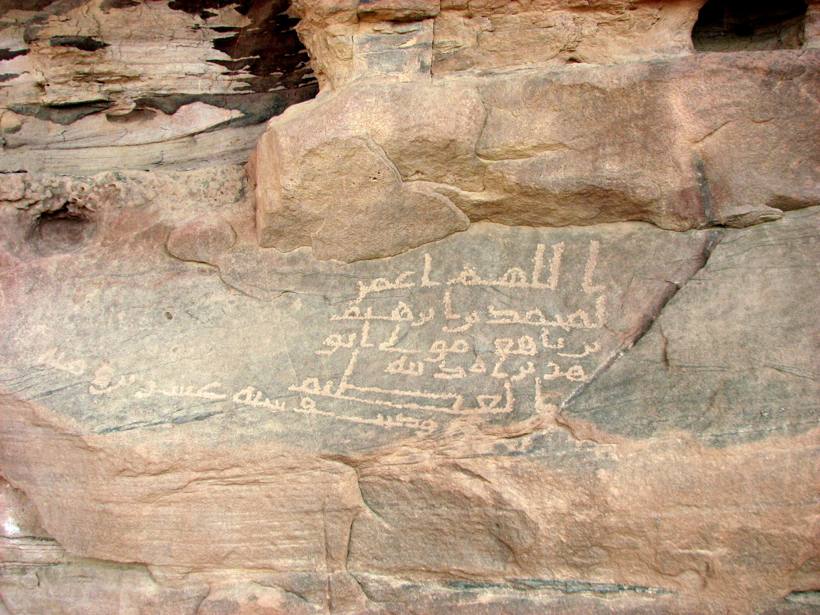
117 AH QMI-INS-055va

Inscription of Ḥasan ibn Maysarah, al-Naqab, 117 AH

نقش حسن بن ميسرة

Siteal-Naqab (recorded in the literature as ʿEin Marzev)
Writing surfaceRock face
LinesPending
DimensionsUnrecorded
SubjectPrayer for forgiveness and martyrdom, dated 117 AH
ReadingLargely clear · a few letters restored
Grade 2 of 5. Nearly complete; a few letters are restored by the editor.

Original text (Arabic)

  1. بسم الله الرحمن الرحيم
  2. اللهم اغفر لحسن بن ميسرة (؟) ولو لديه (!) وما ولدا أمين رب محمد وإبراهيم
  3. اللهم اجعل عملي جهدا واجبا وافيا (؟) استشهد في سبيلك
  4. وكتب حسن يوم الثلثا في ثمان بقين من ربيع الول (!) وفيه توفوا بني (!) حاتم يرحمهم الله جميعا وهو في سنة سبعة عشر (!) ومئة سنة (?)

Translation

  1. Basmalah. O Allah, have mercy on Ḥasan b. Maysarah and on his two parents and on their descendants. Amen, O Lord of Muḥammad and Ibrāhīm.
  2. O Allah, cause my deeds to be regarded an act of obligatory Jihād, and grant me martyrdom in thy path.
  3. Ḥasan wrote (it) on Tuesday 23 Rabīʿ I, and in it died Banū Ḥātim, may Allah have mercy on them all.
  4. It is in the year seventeen and one hundred.

Commentary

An inscription from al-Naqab dated 117 AH (735–736 CE). The text is recorded in Sharon’s corpus, Plate 54, page 179. The inscription is a prayer for forgiveness and martyrdom by Ḥasan ibn Maysarah, asking God to forgive him and his two parents and to grant him martyrdom in His path. It also records the date of writing and the death of Banū Ḥātim on the same day. Several letters are uncertain in the published text, marked by the editor with (!) and (?). The reading follows Sharon’s corpus, pp. 179–180. The photograph is reproduced from the published plate at low resolution; it has been adjusted for contrast only, without retouching the carved letters.

For another prayer from al-Naqab of the same kind, cut in a church atrium at Ruḥeibe and ending “Amen, Lord of Moses,” see QMI-INS-010a.

Source: Sharon, Moshe. Corpus Inscriptionum Arabicarum Palaestinae, vol. 3: D–F. Handbuch der Orientalistik. Pl. 54, pp. 179–180.

How to cite

Shaker W. Ahmed. “Inscription of Ḥasan ibn Maysarah, al-Naqab, 117 AH” (Cat. No. QMI-INS-055va). QMI, quranmss.com, 2026.

Inscription of Muḥammad ibn Ibrāhīm ibn NāfiʿPhotograph: Al-Sahra Team⤢ Click to enlarge
120 AH QMI-INS-055k

Inscription of Muḥammad ibn Ibrāhīm ibn Nāfiʿ

نقش محمد بن إبراهيم بن نافع

SiteḤismā, north-western Arabia
Writing surfaceRock face (sandstone)
Lines5
DimensionsUnrecorded
ScriptḤijāzī
SubjectPrayer for forgiveness by a client of Abū Hurayrah, dated 120 AH
ReadingClear · nothing restored
Grade 1 of 5. The text is complete; nothing is restored.

Original text (Arabic)

  1. اللهم اغفر
  2. لمحمد بن ابرهيم
  3. بن نافع مولى أبو (أبي)
  4. هريرة ذنبه
  5. العظيم وكتب سنة عشرين ومئة

Translation

  1. O God, forgive
  2. Muḥammad ibn Ibrāhīm
  3. ibn Nāfiʿ, client of Abū
  4. Hurayrah, his
  5. great sin. And [this] was written in the year one hundred and twenty.

Commentary

A prayer for forgiveness by a client (mawlā) of Abū Hurayrah — the Companion best known as the most prolific narrator of ḥadīth — or of his family, written some sixty years after Abū Hurayrah’s death. Like many writers in this catalog, Muḥammad ibn Ibrāhīm names his patron with pride: clientage tied non-Arab Muslims to an Arab house and was a mark of standing. He asks forgiveness for “his great sin”, a penitential phrasing that stands out among the more general prayers for forgiveness. It is dated by year alone, 120 AH (737–738 CE), in the caliphate of Hishām ibn ʿAbd al-Malik. The spelling is of its time: “Ibrāhīm” is written without its long alif, and the kunyah keeps the form “Abū” after “mawlā”, as it often does in early texts.

Source: al-Saʿīd, ʿAbdallāh ibn ʿAbd al-ʿAzīz. “Nuqūsh Muʾarrakhah Mubakkirah min Ṣadr al-Islām.” Farīq al-Ṣaḥrāʾ (alsahra.org), 26 May 2018, updated Ramaḍān 1443 AH.

How to cite

Shaker W. Ahmed. “Inscription of Muḥammad ibn Ibrāhīm ibn Nāfiʿ” (Cat. No. QMI-INS-055k). QMI, quranmss.com, 2026.

Inscription of ʿUthmān ibn ʿUbaydallāh, Rawāwah: photographPhoto: after Alhatlani (2021)⤢ Click to enlarge

120 AH QMI-INS-055kh

Inscription of ʿUthmān ibn ʿUbaydallāh, Rawāwah

نقش عثمان بن عبيد الله، رواوة

SiteRawāwah, al-Madīnah region, Saudi Arabia
Writing surfaceRock face
Lines5
DimensionsUnrecorded
ScriptḤijāzī
SubjectDeclaration of faith in God the Almighty, dated 120 AH
ReadingPartly preserved · several words restored
Grade 3 of 5. Several words are damaged and restored by the editor; the rest is legible.

Original text (Arabic)

  1. [أنا] عثمن (عثمان) بن عبيد [الله]
  2. [آ]منت بالله ا
  3. لعظيم و…
  4. [و]كتب [في سنة]
  5. ع[ش]رين ومائة

Translation

  1. [I,] ʿUthmān ibn ʿUbayd[allāh],
  2. believe in God the Al-
  3. mighty, and …
  4. and [this] was written [in the year]
  5. twenty and one hundred.

Commentary

A short declaration of faith from Rawāwah, written in the first person: “[I,] ʿUthmān ibn ʿUbaydallāh, believe in God the Almighty”, dated 120 AH (737–738 CE), in the caliphate of Hishām ibn ʿAbd al-Malik. The surface is worn in lines 1, 3, 4 and 5, and the bracketed letters are restored by the editor. Other texts at Rawāwah and nearby give the writer's full lineage, ʿUthmān ibn ʿUbaydallāh ibn ʿAbdallāh ibn ʿUmar: a great-grandson of the caliph ʿUmar ibn al-Khaṭṭāb through his son ʿAbdallāh.

The formula āmana bi-llāh al-ʿaẓīm, “believed in God the Almighty”, is the one used at the same site by Abū Salamah in 100 AH (QMI-INS-053). Alhatlani reads Abū Salamah's father as ʿUbaydallāh, which would make the two writers brothers. ʿUthmān spells his own name without the long alif (عثمن), as is usual in this period.

Source: Alhatlani, Abdullah Saad. Descendants and Ancestors: A Study of Arabic Inscriptions from the Arabian Peninsula (1st–4th c. AH/7th–10th c. CE). PhD thesis, Leiden University, 2021 (hdl.handle.net/1887/3217834), ch. 2, no. 6, p. 223 (first publication; photograph by the author).

How to cite

Shaker W. Ahmed. “Inscription of ʿUthmān ibn ʿUbaydallāh, Rawāwah” (Cat. No. QMI-INS-055kh). QMI, quranmss.com, 2026.

Inscription of Ward ibn Sālim, al-NaqabPhotograph: Sharon, Corpus Inscriptionum Arabicarum Palaestinae⤢ Click to enlarge
119 AH QMI-INS-055ka

Inscription of Ward ibn Sālim, al-Naqab

نقش ورد بن سالم

Siteal-Naqab
Writing surfaceRock face
Lines4
DimensionsUnrecorded
SubjectPrayer for forgiveness, dated 119 AH
ReadingLargely clear · a few letters restored
Grade 2 of 5. Nearly complete; a few letters are restored by the editor.

Original text (Arabic)

  1. اللهم اغفر لورد بن سالم ما تقدم من ذنبه وما تأخر
  2. واتم نعمتك عليه واهده صرطا مستقيما أمين رب
  3. العلمين رب موسى وهرون ولمن قرى(!) ولمن قا[ل] آمين كتب في
  4. سنة تسع عشرة ومئة على خلفة هشام

Translation

  1. O Allah, forgive Ward ibn Sālim his earlier and later sins,
  2. and complete your grace to him and guide him in the right path (cf. Q 48:2). Āmīn, Lord of the worlds,
  3. the Lord of Moses and Aaron; and [forgive] whoever reads [this writing] and says “Āmīn!”
  4. It was written in the year one hundred and nineteen during the caliphate of Hishām.

Commentary

A prayer for forgiveness dated 119 AH (737 CE), in the caliphate of Hishām ibn ʿAbd al-Malik. The writer asks God to forgive Ward ibn Sālim his sins and to complete His grace upon him, a phrase that echoes Qurʾān 48:2. The inscription is one of the few dated early Islamic texts recorded from al-Naqab. The reading follows the published text in Sharon’s corpus, which gives the line divisions and the translation used here. The photograph is reproduced from the published plate at low resolution; it has been adjusted for contrast only, without retouching the carved letters.

For an earlier prayer from al-Naqab ending “Amen, Lord of Moses,” by a client of ʿAbdallāh ibn ʿAmr ibn al-ʿĀṣ, from the Northern Church at Ruḥeibe, see QMI-INS-010a. The invocation “Lord of Moses and Aaron” also closes the prayer of Muḥammad ibn ʿUmar ibn Ḥafṣ at Rawāwah, dated 114 AH (QMI-INS-055aha).

Source: Sharon, Moshe. Corpus Inscriptionum Arabicarum Palaestinae, vol. 3: D–F. Handbuch der Orientalistik. Pl. 53.

How to cite

Shaker W. Ahmed. “Inscription of Ward ibn Sālim, al-Naqab” (Cat. No. QMI-INS-055ka). QMI, quranmss.com, 2026.

Inscription of Ḥafṣ, Jabal UsaysFacsimile: Abū al-Faraj al-ʿUsh, 1964⤢ Click to enlarge
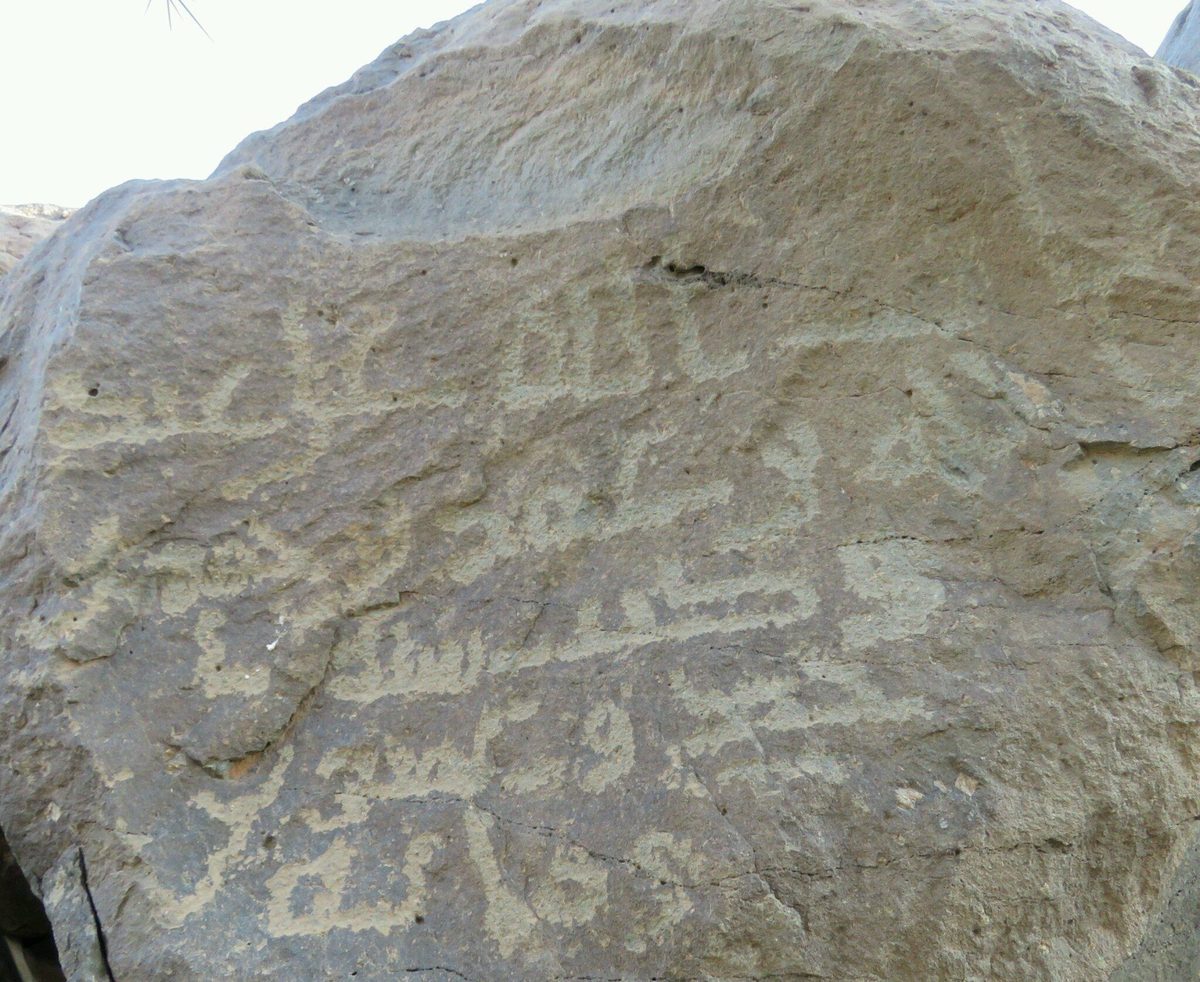
119 AH QMI-INS-055kb

Inscription of Ḥafṣ, Jabal Usays

نقش حفص، جبل أسيس

SiteJabal Usays, Syria
Writing surfaceRock
Lines10
Dimensions57 × 59 cm
ScriptKūfic
SubjectProfession of faith with Qurʾanic phrasing; signed by Ḥafṣ; warning against effacing the text
ReadingClear · nothing restored
Grade 1 of 5. The text is complete; nothing is restored.

Original text (Arabic)

  1. ربي الله وديني
  2. الاسلام عليه توكلت
  3. واليه انيب واليه ا
  4. لمصير وكتب حفص في
  5. ذي العقدة (كذا) سنة تسع
  6. عشرة ومائة
  7. من محاه وا
  8. خزاه الله
  9. في الآخر
  10. ة آمين

Translation

  1. My Lord is God, and my religion
  2. is Islam. In Him I trust,
  3. and to Him I turn, and to Him is
  4. the return. And Ḥafṣ wrote [this] in
  5. Dhū al-Qaʿdah (sic) of the year nine-
  6. teen and one hundred.
  7. Whoever erases it, may
  8. God disgrace him
  9. in the hereaf-
  10. ter. Amen.

Commentary

A profession of faith cut at Jabal Usays, in the basalt country south-east of Damascus, by one Ḥafṣ in Dhū al-Qaʿdah 119 AH. Its opening joins a short creed, “my Lord is God and my religion is Islam”, to Qurʾānic wording: ʿalayhi tawakkaltu wa-ilayhi unību recalls Q 42:10, “That is God, my Lord; in Him I trust and to Him I turn”, and wa-ilayhi l-maṣīr, “and to Him is the return”, closes several verses (as Q 40:3 and 64:3). The word al-maṣīr is divided across the line end after the alif of the article (a-/lmṣyr), and al-ākhirah is broken before its final letter (al-ākhir-/ah).

The opening is notable for naming the religion outright. Outside quotations of the Qurʾān, such as Q 3:19, “the religion with God is Islam”, on the Dome of the Rock (QMI-INS-012), this is the only text in the catalog in which a writer calls his own faith al-islām; it stands beside the undated prayer from Najrān that asks forgiveness for “the Muslims” as a community (QMI-INS-055ak). The month is written dhī al-ʿaqdah, which the editor marks (sic) against the usual al-qaʿdah. The text closes with a warning against anyone who effaces it, “whoever erases it, may God disgrace him in the hereafter, amen”; the editor reads wa-ajzāhu, “may He requite him”, but in undotted script jīm and khāʾ share one form, and wa-akhzāhu, “may God disgrace him”, gives the familiar wording of such curses, akhzāhu Allāh. The inscription comes from the same site and the same publication as the inscription of ʿAlī ibn ʿAbdallāh of 93 AH, which quotes the opening of Āyat al-Kursī (QMI-INS-041). The image is the editor’s facsimile, not a photograph. A prayer for Ḥafṣ ibn ʿAbdallāh from the same site is dated Dhū al-Qaʿdah 113 AH (QMI-INS-055agb).

Source: Abū al-Faraj al-ʿUsh, Muḥammad. "Kitābāt ʿArabīyah Ghayr Manshūrah fī Jabal Usays." Majallat al-Abḥāth 17, no. 3 (September 1964): 290–291, text no. 87.

How to cite

Shaker W. Ahmed. “Inscription of Ḥafṣ, Jabal Usays” (Cat. No. QMI-INS-055kb). QMI, quranmss.com, 2026.

Inscription of ʿAbdallāh ibn ʿUmar ibn ḤafṣPhotograph: Muḥammad al-Mughadhdhawī⤢ Click to enlarge
121 AH QMI-INS-055w

Inscription of ʿAbdallāh ibn ʿUmar ibn Ḥafṣ

نقش عبد الله بن عمر بن حفص

SiteLocation unpublished
Writing surfaceRock (boulder)
Lines5
DimensionsUnrecorded
SubjectPrayer for repentance, dated 121 AH
ReadingClear · nothing restored
Grade 1 of 5. The text is complete; nothing is restored.

Original text (Arabic)

  1. تاب الله على عبد
  2. الله بن عمر بن حفص
  3. وكتب سنة إ
  4. حدى وعشرين
  5. ومائة

Translation

  1. May God turn in forgiveness to ʿAbd-
  2. allāh ibn ʿUmar ibn Ḥafṣ.
  3. And [this] was written in the year o-
  4. ne and twenty
  5. and one hundred.

Commentary

A prayer that God may “turn” (tāba) to ʿAbdallāh ibn ʿUmar ibn Ḥafṣ — that is, accept his repentance and forgive him — dated by year alone, 121 AH (738–739 CE), in the caliphate of Hishām ibn ʿAbd al-Malik. The letters are large and boldly cut across the face of a boulder, and the writer divides both his own name (ʿAbd-/allāh) and the numeral (i-/ḥdā) across the line ends. The name invites comparison with two other inscriptions of this catalog: ʿĀṣim ibn ʿUmar ibn Ḥafṣ (no. 55, 100 AH) and Ḥafṣ ibn ʿUmar (no. 55e, 108 AH). The sources on the descendants of ʿUmar ibn al-Khaṭṭāb name a Medinan family in which ʿAbdallāh and ʿĀṣim were both sons of ʿUmar ibn Ḥafṣ ibn ʿĀṣim ibn ʿUmar ibn al-Khaṭṭāb; ʿAbdallāh ibn ʿUmar al-ʿUmarī was a known transmitter of ḥadīth in al-Madīnah. If the writers of no. 55 and of this inscription are those two brothers, the family of Rabāḥ ibn Ḥafṣ ibn ʿĀṣim (nos. 43 and 54) would be represented by several hands across the first quarter of the second century AH. This remains a possibility only, as all of these names were common. His brother ʿĀṣim left a prayer with the same wording in the same year, 121 AH (QMI-INS-055wb), and the thesis of Alhatlani (2021, ch. 2, no. 89) places this text at Rawāwah, near al-Madīnah, measuring 41 × 53 cm.

Source: al-Mughadhdhawī, Muḥammad (@mohammed93athar). Photograph and reading posted on X (formerly Twitter), 29 October 2015.

How to cite

Shaker W. Ahmed. “Inscription of ʿAbdallāh ibn ʿUmar ibn Ḥafṣ” (Cat. No. QMI-INS-055w). QMI, quranmss.com, 2026.

Inscription of ʿĀṣim ibn ʿUmar ibn Ḥafṣ, Rawāwah, 121 AH: photographPhoto: after Alhatlani (2021)⤢ Click to enlarge
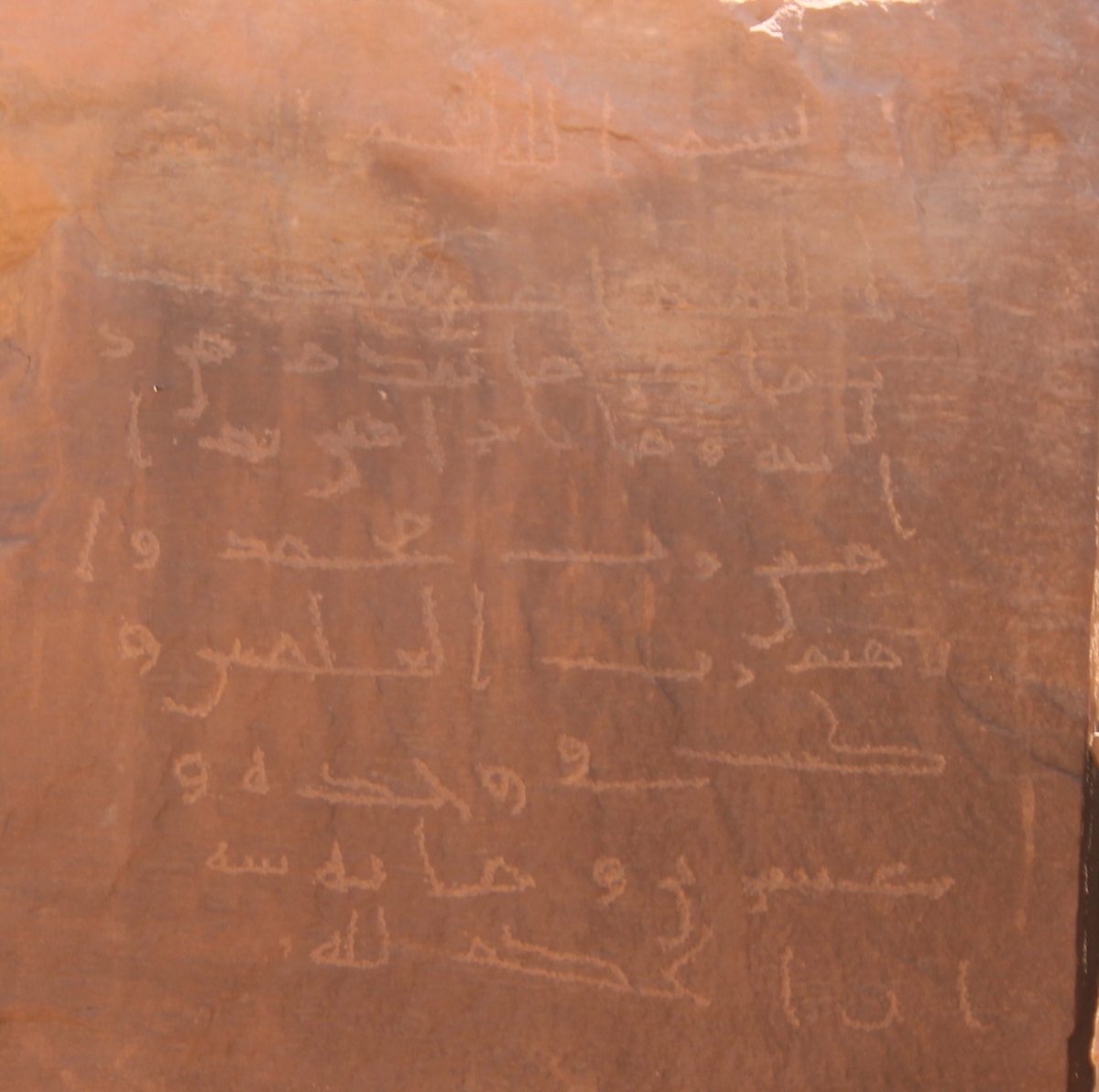
121 AH QMI-INS-055wb

Inscription of ʿĀṣim ibn ʿUmar ibn Ḥafṣ, Rawāwah, 121 AH

نقش عاصم بن عمر بن حفص، رواوة، ١٢١ هـ

SiteRawāwah, al-Madīnah region, Saudi Arabia
Writing surfaceRock face
Lines5
Dimensions75 × 50 cm
ScriptḤijāzī
SubjectPrayer for repentance, dated 121 AH
ReadingLargely clear · a few letters restored
Grade 2 of 5. Nearly complete; a few letters are restored by the editor.

Original text (Arabic)

  1. تاب الله على عا
  2. صم بن عمر بن حفص
  3. وكتب في سنة [إ]
  4. حدى وعشرين و[ما]
  5. ئة

Translation

  1. May God turn in forgiveness to ʿĀ-
  2. ṣim ibn ʿUmar ibn Ḥafṣ.
  3. And [this] was written in the year o-
  4. ne and twenty and one hun-
  5. dred.

Commentary

A five-line prayer that God “turn” to ʿĀṣim ibn ʿUmar ibn Ḥafṣ, dated 121 AH (738–739 CE). The wording and the year are the same as in the prayer of his brother ʿAbdallāh ibn ʿUmar ibn Ḥafṣ (QMI-INS-055w): both begin tāba Allāh ʿalā and both divide the numeral iḥdā across two lines. The two texts were probably cut on the same visit.

ʿĀṣim had already left a dated text in 100 AH, declaring his trust in “the Ever-Living, the Self-Subsisting” (QMI-INS-055). This second text is dated 21 years later. A third brother, Muḥammad, asks for the same divine “turning” in 114 AH (QMI-INS-055aha).

Source: Alhatlani, Abdullah Saad. Descendants and Ancestors: A Study of Arabic Inscriptions from the Arabian Peninsula (1st–4th c. AH/7th–10th c. CE). PhD thesis, Leiden University, 2021 (hdl.handle.net/1887/3217834), ch. 2, no. 67, p. 256 (photograph). First published in al-Rāshid, Saʿd ibn ʿAbd al-ʿAzīz. Kitābāt Islāmīyah ghayr manshūrah min Rawāwah al-Madīnah al-Munawwarah: Dirāsah wa-Taḥqīq. 1st ed. al-Riyāḍ: Dār al-Waṭan lil-Nashr wa-al-Iʿlām, 1413 AH / 1993, pp. 93–95.

How to cite

Shaker W. Ahmed. “Inscription of ʿĀṣim ibn ʿUmar ibn Ḥafṣ, Rawāwah, 121 AH” (Cat. No. QMI-INS-055wb). QMI, quranmss.com, 2026.

Inscription of al-Ḥārith ibn ṢāghirPhotograph: Mālik al-Sulaymī⤢ Click to enlarge
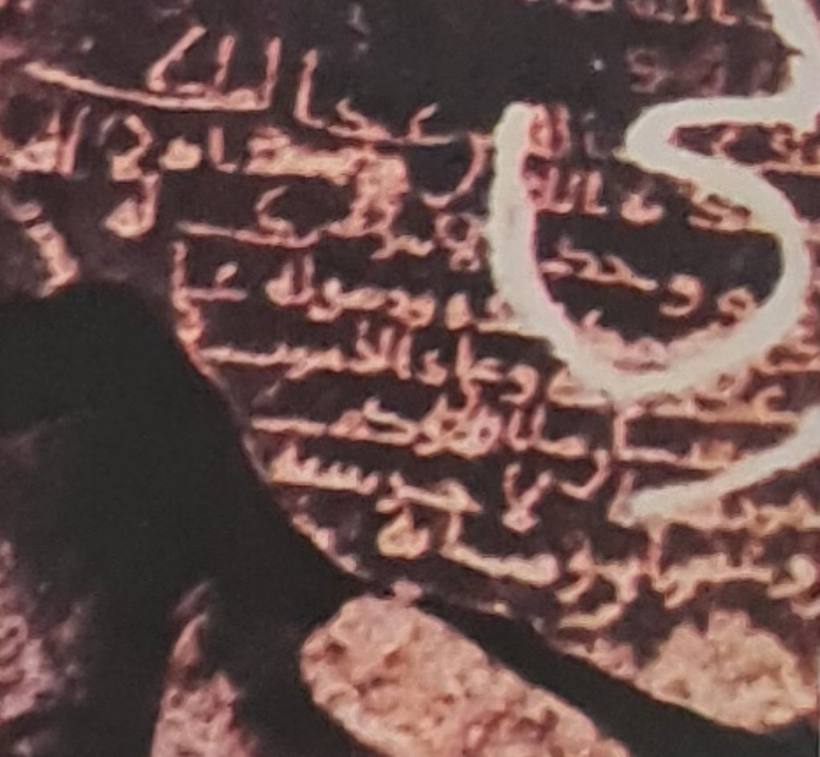
121 AH QMI-INS-055wa

Inscription of al-Ḥārith ibn Ṣāghir

نقش الحارث بن صاغر

SiteQārat al-Nayṣah, east of Dūmat al-Jandal, al-Jawf
Writing surfaceRock face
Lines8
DimensionsUnrecorded
SubjectPrayer for forgiveness, dated 121 AH
ReadingClear · nothing restored
Grade 1 of 5. The text is complete; nothing is restored.

Original text (Arabic)

  1. بسم الله الرحمن الرحيم
  2. اللهم أغفر للحارث
  3. بن صاغر ما تقدم من ذ
  4. نبه وما تأخر آمين ثم آ
  5. آمين رب محمد وإ
  6. براهيم رب العالمين و
  7. كتب في واحدة و
  8. عشرين ومائة سنة

Translation

  1. In the name of God, the Compassionate, the Merciful.
  2. O God, forgive al-Ḥārith
  3. ibn Ṣāghir what he has done before
  4. and what he has left after. Āmīn. Then ā[…]
  5. Āmīn, Lord of Muḥammad and […]
  6. [Ibrā]hīm, Lord of the worlds, and […]
  7. [this] was written in the year one
  8. hundred and twenty-one.

Commentary

A prayer for forgiveness dated 121 AH (739 CE), in the caliphate of Hishām ibn ʿAbd al-Malik. The inscription records a petition for God to forgive al-Ḥārith ibn Ṣāghir his past and future sins, followed by a formula of invocation (“Āmīn, Lord of Muḥammad and Ibrāhīm, Lord of the worlds”). It is the earliest dated Islamic inscription known in the al-Jawf region, and the inscriptions that follow it there are dated 144 AH (Yaʿlā ibn Yazīd), 184 AH (Mudrik ibn al-ʿAlāʾ), 186 AH (al-Ḥakam ibn al-Ashʿak), and 518 AH (the founding inscription of Qaṣr Qadīr). The reading follows the published text, with the lacunae of the photograph left as in the source.

Source: al-Sulaymī, Mālik. Published 18 August 2023. Field information supplied by the author.

How to cite

Shaker W. Ahmed. “Inscription of al-Ḥārith ibn Ṣāghir” (Cat. No. QMI-INS-055wa). QMI, quranmss.com, 2026.

Inscription of Muḥammad ibn ʿAbdallāh ibn ʿAbd al-MalikPhotograph: after the published edition⤢ Click to enlarge
122 AH QMI-INS-055i

Inscription of Muḥammad ibn ʿAbdallāh ibn ʿAbd al-Malik

نقش محمد بن عبد الله بن عبد الملك

SiteJabal Thawr, Mecca
Writing surfaceRock face
Lines8
DimensionsUnrecorded
ScriptḤijāzī
SubjectProfession of faith with two witnesses, dated Jumādā al-Ākhirah 122 AH
ReadingLargely clear · a few letters restored
Grade 2 of 5. Nearly complete; a few letters are restored by the editor.

Original text (Arabic)

  1. أنا محمد بن عبد الله بن عبد الملك
  2. أشهد أن الله وحده لا إله
  3. إلا هو وحده لا شريك له
  4. وأن محمدًا عبده ورسوله على
  5. ذلك يشهد عبد الله وعلى ذلك يشهد
  6. محمد بن سيار [...] وكتب
  7. في شهر جماد الآخر سنة
  8. اثنين وعشرين ومائة

Translation

  1. I am Muḥammad ibn ʿAbdallāh ibn ʿAbd al-Malik.
  2. I bear witness that God alone — there is no god
  3. but He, alone, without partner —
  4. and that Muḥammad is His servant and His messenger. To
  5. this ʿAbdallāh bears witness, and to this bears witness
  6. Muḥammad ibn Sayyār [...]. And [this] was written
  7. in the month of Jumādā al-Ākhirah of the year
  8. one hundred and twenty-two.

Commentary

A profession of faith set down like a sworn statement: after the writer declares the oneness of God and the prophethood of Muḥammad, two witnesses are named — ʿAbdallāh and Muḥammad ibn Sayyār — who “bear witness to this”, a legal form of attestation rarely seen on the rocks. It is dated Jumādā al-Ākhirah 122 AH (May 740 CE), in the caliphate of Hishām ibn ʿAbd al-Malik, and comes from Jabal Thawr outside Mecca, the mountain of the cave in which the Prophet and Abū Bakr sheltered during the Hijrah. The writer’s name, Muḥammad ibn ʿAbdallāh ibn ʿAbd al-Malik, invites comparison with the Umayyad house — ʿAbdallāh ibn ʿAbd al-Malik was a son of the caliph — but the names were common and the identification remains a possibility only. Part of the sixth line is lost.

Source: al-Rāshid, Saʿd ibn ʿAbd al-ʿAzīz. Darb Zubaydah: Ṭarīq al-Ḥajj min al-Kūfah ilā Makkah al-Mukarramah. al-Riyāḍ.

How to cite

Shaker W. Ahmed. “Inscription of Muḥammad ibn ʿAbdallāh ibn ʿAbd al-Malik” (Cat. No. QMI-INS-055i). QMI, quranmss.com, 2026.

Inscription of ʿAnjarFacsimile drawing of the inscription⤢ Click to enlarge
123 AH QMI-INS-055l

Inscription of ʿAnjar

نقش عنجر

SiteʿAnjar, Biqāʿ valley, Lebanon
Writing surfaceUnrecorded
Lines6
DimensionsUnrecorded
ScriptUnrecorded
SubjectPrayer for mercy and for the generality of the Muslims, dated Rajab 123 AH
ReadingLargely clear · a few letters restored
Grade 2 of 5. Nearly complete; a few letters are restored by the editor.

Original text (Arabic)

  1. ترحم الله على القاسم بن هلال المج[...]
  2. ورضي عنه وعافاه من شر يوم ا
  3. لحساب وصلى الله على عامة ا
  4. لمسلمين وأدخلهم جنات ا
  5. لنعيم وكتب في رجب سنة ثلاث
  6. وعشرين ومائة

Translation

  1. May God have mercy upon al-Qāsim ibn Hilāl al-Muj[...]
  2. and be pleased with him, and keep him from the evil of the Day of
  3. Reckoning. And may God bless the generality of
  4. the Muslims and bring them into the Gardens of
  5. Bliss. And [this] was written in Rajab of the year one hundred
  6. and twenty-three.

Commentary

An inscription from ʿAnjar, the Umayyad palace-city in the Biqāʿ valley of Lebanon begun under al-Walīd ibn ʿAbd al-Malik. It is dated Rajab 123 AH (May 741 CE), in the caliphate of Hishām ibn ʿAbd al-Malik, and shows the town still in use under the later Umayyads. After a prayer for mercy for al-Qāsim ibn Hilāl, whose nisbah is only partly preserved, the writer widens his prayer to “the generality of the Muslims” and asks that they enter the Gardens of Bliss (jannāt al-naʿīm, a Qurʾanic phrase) — a communal prayer like that for the people of Taymāʾ (no. 55e). The writer carries words over the line end four times (ā-/l-ḥisāb, ā-/l-muslimīn, ā-/l-naʿīm). A prayer for al-Yamān, grandson of al-Walīd, the builder of ʿAnjar, was cut on a Ḥijāzī route, probably in the early second century AH (QMI-INS-055aj). An undated early prayer from Najrān also names the community as “the Muslims” (QMI-INS-055ak).

Source: Ṣalāḥ al-Dīn al-Munajjid, Dirāsāt fī tārīkh al-khaṭṭ al-ʿArabī munḏu bidāyatihi ilā nihāyat al-ʿaṣr al-Umawī (Beirut: Dār al-Kitāb al-Jadīd, 1st ed., 1972). Reading and facsimile drawing as published there.

How to cite

Shaker W. Ahmed. “Inscription of ʿAnjar” (Cat. No. QMI-INS-055l). QMI, quranmss.com, 2026.

Inscription of Khālid ibn Ghannām, NajrānPhoto: @hamad_najran⤢ Click to enlarge
123 AH QMI-INS-055la

Inscription of Khālid ibn Ghannām, Najrān

نقش خالد بن غنام، نجران

SiteNajrān region, Saudi Arabia
Writing surfaceSandstone rock face
Lines5
DimensionsUnrecorded
ScriptKūfic
SubjectPrayer for mercy for Khālid ibn Ghannām, cut by Shihr; dated 123 AH
ReadingClear · nothing restored
Grade 1 of 5. The text is complete; nothing is restored.

Original text (Arabic)

  1. رحم الله خالد
  2. بن غنم (غنام) أمين و
  3. كتب شِهر سنة
  4. ثلاث وعشرين
  5. ومئة

Translation

  1. May God have mercy on Khālid
  2. ibn Ghannām. Āmīn. And
  3. Shihr wrote [this], in the year
  4. three and twenty
  5. and one hundred.

Commentary

A short prayer for mercy from the Najrān region, dated 123 AH, in the last years of the caliph Hishām ibn ʿAbd al-Malik. It asks God’s mercy for Khālid and closes his name with āmīn before the record of writing. The father’s name, Ghannām, is written ghnm without the long alif, as usual in this hand. In line 3 the writer names himself, wa-kataba Shihr, “and Shihr wrote [this]”, so the text keeps apart the man prayed for and the man who cut the stone; the date gives the year alone, without a month. The hand is broad and pecked into the dark patina, with tall alifs and long joining strokes.

Najrān has yielded several early Islamic texts in this catalog: the second inscription of Yazīd ibn ʿAbdallāh al-Sulūlī, placed at about 29 AH (QMI-INS-003b), the two inscriptions of the brothers al-Rammāḥ and al-Mufaḍḍal ibn al-Ṣalt of 110 AH (QMI-INS-055z, QMI-INS-055aa), and the undated prayer for “the Muslims” (QMI-INS-055ak). The present text adds a dated witness from the end of the Umayyad period.

Source: Published by Mālik al-Sulaymī (Āthārī) on X (formerly Twitter), 23 May; discovered by @hamad_najran. Reading as published.

How to cite

Shaker W. Ahmed. “Inscription of Khālid ibn Ghannām, Najrān” (Cat. No. QMI-INS-055la). QMI, quranmss.com, 2026.

Inscription of Wādī ash-ShuwayṭīPhotograph: Ali Al-Manaser⤢ Click to enlarge
125 AH QMI-INS-055h

Inscription of Wādī ash-Shuwayṭī

نقش وادي الشويطي

SiteWādī ash-Shuwayṭī, Ḥarrah (Black Desert), north-eastern Jordan
Writing surfaceBasalt boulder
DatingBy event: the death of Hishām ibn ʿAbd al-Malik (Rabīʿ II 125 AH)
Lines18, written vertically, one word to a line
DimensionsUnrecorded
ScriptEarly Kūfic
SubjectPrayer for forgiveness
ReadingClear · nothing restored
Grade 1 of 5. The text is complete; nothing is restored.

Original text (Arabic)

  1. اللهم
  2. اغفر
  3. لجابر
  4. بن
  5. أبي
  6. الخطاب
  7. الخرجي
  8. آمين
  9. آمين
  10. رب
  11. العلمين (العالمين)
  12. رب
  13. موسى
  14. وهرون (وهارون)
  15. وكتب
  16. سنة
  17. مات
  18. هشام

Translation

Given by sense, not line by line.

  1. O God, forgive Jābir ibn Abī al-Khaṭṭāb al-Kharajī.
  2. Amen, amen, Lord of the worlds,
  3. Lord of Moses and Aaron.
  4. And [this] was written in the year Hishām died.

Commentary

A prayer for forgiveness from the basalt desert of north-eastern Jordan, laid out in an unusual vertical form: each line holds a single word, so that the eighteen words of the text run down the rock as eighteen short lines. The writer, Jābir ibn Abī al-Khaṭṭāb al-Kharajī, asks forgiveness for himself, repeats “Amen” twice, and calls on God as “Lord of the worlds” and “Lord of Moses and Aaron”.

The text gives no numbered year. It is dated by an event: “the year Hishām died”. The caliph Hishām ibn ʿAbd al-Malik (r. 105–125 AH) died at al-Ruṣāfah in Rabīʿ II 125 AH (February 743 CE), and the inscription is placed in that year. It is the only text in this catalog dated by the death of an Umayyad caliph. The practice is old: Zuhayr wrote in the year ʿUmar died (QMI-INS-001), and al-Ḥārith ibn Būlī dated his graffiti by public events, such as the time the Commander of the Faithful was killed (QMI-INS-002a) and the rebellion of Egypt (QMI-INS-004b). Others named the year of Ifrīqiyah (QMI-INS-002b) or the conquest of the sea (QMI-INS-002c). This text shows the custom still in use a century later, at the close of Hishām’s long reign. Hishām himself appears elsewhere in the catalog in the foundation text of Qaṣr al-Ḥayr al-Sharqī (QMI-INS-055o), and his daughter Umm Salamah left a travelling prayer (QMI-INS-055ae).

“Lord of Moses and Aaron” (rabb Mūsā wa-Hārūn, Q 7:122, 26:48) is found in other early graffiti: the prayer at Qaṣr al-Kharrānah of 92 AH (QMI-INS-040), that of Muḥammad ibn ʿUmar ibn Ḥafṣ at Rawāwah, 114 AH (QMI-INS-055aha), and, with Moses alone or with Abraham, the prayers of Ḥakīm (QMI-INS-010a) and al-Mufaḍḍal ibn al-Ṣalt (QMI-INS-055aa).

Source: Alhatlani, Abdullah Saad, and Ali Al-Manaser. “The Ḥarrah’s epigraphic heritage: Arabic graffito from the Black Desert in north-eastern Jordan referring to the Umayyad caliph Hishām b. ʿAbd al-Malik.” Arabian Archaeology and Epigraphy (published online August 2022).

How to cite

Shaker W. Ahmed. “Inscription of Wādī ash-Shuwayṭī” (Cat. No. QMI-INS-055h). QMI, quranmss.com, 2026.

Drawing of the bronze weight of Saʿīd ibn ʿAbd al-Malik from BaysānDrawing: after Khamis (2002)⤢ Click to enlarge
c. 125–126 AH QMI-INS-055ha

Bronze Weight of Saʿīd ibn ʿAbd al-Malik, Baysān

صنجة سعيد بن عبد الملك البرونزية، بيسان

SiteBaysān, Palestine; found in 1990 in the Hebrew University excavations
Writing surfaceBronze weight (highly leaded copper alloy), disc of Byzantine type; half preserved
LinesMarginal band and 3 central lines (surviving)
DimensionsDiameter 5.0 cm; thickness 1.3 cm; present weight 83.78 g
ScriptKūfic
SubjectOfficial weight ordered by the governor Saʿīd ibn ʿAbd al-Malik; dated by his governorship of Palestine, c. 125–126 AH
ReadingPartly preserved · several words restored
Grade 3 of 5. Several words are damaged and restored by the editor; the rest is legible.

Original text (Arabic)

  1. الإطار: بسم الله الرحمن الرحيم [لا إله إلا الله وحده لا شريك له] محمد رسول الله
  2. الوسط: أمر الأمير
  3. سعيد بن عبد
  4. الملك على يد[ي ...]

Translation

  1. Margin: In the name of God, the Merciful, the Compassionate; [there is no god but God alone, He has no partner;] Muḥammad is the messenger of God.
  2. Centre: Ordered by the Amīr
  3. Saʿīd ibn ʿAbd
  4. al-Malik, at the hands of [...]

Commentary

Half of a bronze weight, found in 1990 in the excavations of the Institute of Archaeology of the Hebrew University at Baysān. It is a disc of highly leaded copper alloy, 5 cm across and 1.3 cm thick, of the type used for weights under Byzantine rule; the surviving half weighs 83.78 g. Its Arabic legend is set in two fields: a margin between two raised circles, carrying the basmalah and the profession of faith, and a central field naming the official who ordered the weight. The lower half, which probably carried the name of the maker and perhaps the date, the place of manufacture and the weight, is lost.

The weight was ordered by “the Amīr Saʿīd ibn ʿAbd al-Malik”, a son of the caliph ʿAbd al-Malik who governed the province of Palestine (Jund Filasṭīn) for a short time under al-Walīd II, about 125–126 AH (743–744 CE); the weight is dated by his governorship. The formula amara … ʿalā yaday, “ordered by … at the hands of …”, is the language of the official texts of the Umayyad state, as on the milestones of Fīq and the market of Baysān (QMI-INS-034b, QMI-INS-093). The market inscription, from the same city and published by the same editor, was set up some years earlier under Hishām.

The weight shows the Umayyad administration taking over the Byzantine system of weights in its form while giving it a new, Arabic and Islamic legend. Its editor places it among a group of weights of Byzantine shape that sometimes keep Byzantine symbols or Greek inscriptions beside the Arabic. The image is the editor’s drawing, with the lost half outlined. A glass pound weight of 126 AH, made under the caliph Yazīd III, is also in the catalog (QMI-INS-055hb).

Source: Khamis, Elias. “A Bronze Weight of Saʿīd b. ʿAbd al-Malik from Bet Shean/Baysān.” Journal of the Royal Asiatic Society, 3rd series, 12, no. 2 (2002): 143–154.

How to cite

Shaker W. Ahmed. “Bronze Weight of Saʿīd ibn ʿAbd al-Malik, Baysān” (Cat. No. QMI-INS-055ha). QMI, quranmss.com, 2026.

Glass raṭl weight of Yazīd III, 126 AHPhoto: The Walters Art Museum (CC0)⤢ Click to enlarge
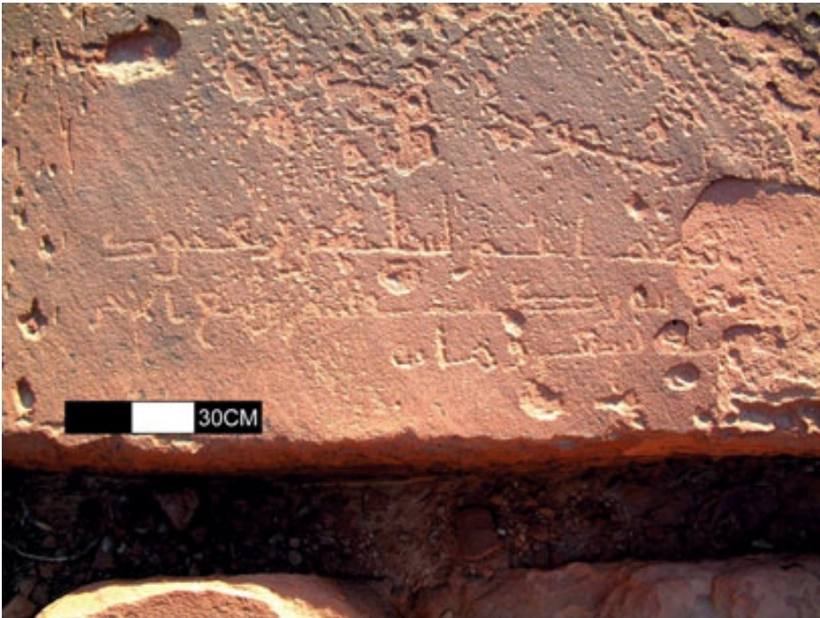
126 AH QMI-INS-055hb

Glass Raṭl Weight of Yazīd III

رطل زجاجي باسم يزيد بن الوليد

SiteFound at Damascus, Syria
Writing surfaceGreen glass weight, stamped
Lines8
DimensionsH 4.2 cm; diam. 7.5 cm
ScriptKūfic
SubjectOfficial pound weight in the name of the caliph Yazīd III, made by al-Walīd ibn ʿAbd al-Raḥmān, dated 126 AH
Present locationThe Walters Art Museum, Baltimore (47.6)
ReadingClear · nothing restored
Grade 1 of 5. The text is complete; nothing is restored.

Original text (Arabic)

  1. بسم الله أمر
  2. بالوفا (بالوفاء)
  3. عبد الله يزيد أ
  4. مير المومنين (المؤمنين) عل (على) يدي
  5. الوليد بن عبد الر
  6. حمن سنة ست [و]عشر
  7. ين ومية (ومائة) رطل
  8. واف

Translation

  1. In the name of God. He commanded
  2. full measure:
  3. the servant of God Yazīd, Com-
  4. mander of the Faithful; by the hand of
  5. al-Walīd ibn ʿAbd al-Ra-
  6. ḥmān, in the year six [and] twen-
  7. ty and one hundred. A raṭl,
  8. full.

Commentary

A pound (raṭl) weight of green glass, stamped while the glass was still semi-molten with a disc carrying the official legend; a small rosette is set beside the last word. It measures 4.2 cm in height and 7.5 cm in diameter and was found at Damascus. It names the servant of God Yazīd, Commander of the Faithful, that is, the Umayyad caliph Yazīd III ibn al-Walīd, who reigned for some six months in 126 AH, and the official by whose hand it was made, al-Walīd ibn ʿAbd al-Raḥmān, together with the year 126. The legend closes by declaring the weight a “full raṭl”. Its opening, that God “commands honesty” (literally, full measure), suits an object used to weigh coins of gold, silver and copper.

Glass weights and stamps were issued under the Umayyads as official measures, bearing the names of caliphs, governors and the officials responsible for them. The Walters Art Museum describes this piece as among the earliest dated Islamic objects, other than coins, in any American museum. Another official weight in the catalog, of bronze, names Saʿīd ibn ʿAbd al-Malik as governor of Palestine in the same years (QMI-INS-055ha). The stamp divides words freely across its short lines (a-mīr, ʿAbd al-Ra-ḥmān, ʿishr-īn), and writes ʿalā as ʿl. The wa- of sitt wa-ʿishrīn is not written on the stamp and is supplied in brackets.

Source: Reading by Ahmed W. Shaker from the museum’s photograph. The Walters Art Museum, Baltimore, acc. no. 47.6 (“Inscribed Pound Weight”), with the museum’s translation of the inscription. Provenance: Dikran Kelekian, New York and Paris; Henry Walters, 1914; bequest to the Walters Art Museum, 1931. Photograph: The Walters Art Museum, CC0.

How to cite

Shaker W. Ahmed. “Glass Raṭl Weight of Yazīd III” (Cat. No. QMI-INS-055hb). QMI, quranmss.com, 2026.

Inscription of Sulaymān ibn MaḥmūdPhotograph: after al-Salameen (2010), fig. 4⤢ Click to enlarge
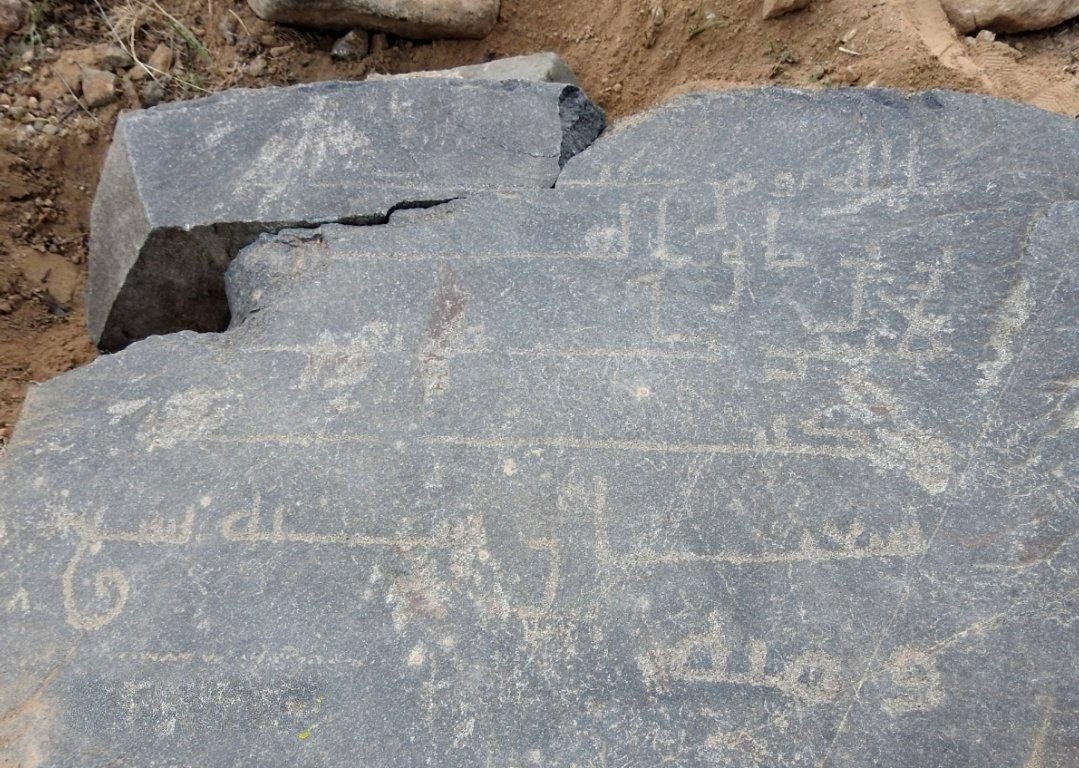
109 AH QMI-INS-055r

Inscription of Sulaymān ibn Maḥmūd

نقش سليمان بن محمود

SiteDanqūr al-Khaznah, Petra, southern Jordan
Writing surfaceSandstone rock face in an ancient quarry
Lines3
Dimensions80 × 25 cm
ScriptKūfic
SubjectPrayer for forgiveness, dated Rabīʿ al-Ākhir 109 AH
ReadingLargely clear · a few letters restored
Grade 2 of 5. Nearly complete; a few letters are restored by the editor.

Original text (Arabic)

  1. [الل]هم اغفر لسليمن (لسليمان) بن محمود
  2. ذنبه وكتب في شهر ربيع الاخر (الآخر)
  3. [س]ن[ت] (سنة) تسع وماية

Translation

  1. [O God], forgive Sulaymān ibn Maḥmūd
  2. his sin. And he wrote [this] in the month of Rabīʿ al-Ākhir,
  3. [in the] year one hundred and nine.

Commentary

A prayer for forgiveness dated Rabīʿ al-Ākhir 109 AH (July–August 727 CE), in the caliphate of Hishām ibn ʿAbd al-Malik. Sulaymān ibn Maḥmūd, a man otherwise unknown, asks God to forgive his sin and records the month and year in which he wrote. It is one of seven early Islamic inscriptions recorded by Zeyad al-Salameen in 2005 at Danqūr al-Khaznah, an ancient quarrying area at the northern edge of al-Madras, south-east of the Treasury (al-Khaznah) in Petra, and it is the earliest dated Islamic inscription yet known from Petra; two others at the same spot are dated 173 and 193 AH. The three lines are cut neatly in a plain Kūfic without diacritical dots, and the broken right edge of the stone has taken some of the opening letters. The name Sulaymān is written without its medial alif (سليمن), as is usual in inscriptions of the period, and the final yāʾ of “fī” takes a form that recalls Nabataean. It was cut in the same year as the inscription of Wādī Shīreh (no. 55f), further south in the Ḥismā, some five months before it.

Source: al-Salameen, Zeyad. “Early Islamic Inscriptions from Danqūr al-Khaznah at Petra.” Arabian Archaeology and Epigraphy 21 (2010): 71–79, at 73–74, figs 3–4.

How to cite

Shaker W. Ahmed. “Inscription of Sulaymān ibn Maḥmūd” (Cat. No. QMI-INS-055r). QMI, quranmss.com, 2026.

Inscription of Bilād ThumālahPhotograph: ʿAbdallāh Muṣliḥ al-Thumālī⤢ Click to enlarge
109 AH QMI-INS-055u

Inscription of Bilād Thumālah

نقش بلاد ثمالة

SiteBilād Thumālah, south of al-Ṭāʾif
Writing surfaceLoose rock (basalt), broken
DimensionsUnrecorded
SubjectProfession of faith, dated Shaʿbān 109 AH
ReadingPartly preserved · several words restored
Grade 3 of 5. Several words are damaged and restored by the editor; the rest is legible.

Original text (Arabic)

  1. بالله يؤمن عبد [العزيز] بن أبي [العـ..]
  2. لا يشرك به ...
  3. وكتب في شعبان سنة تسع ومئة

Translation

  1. In God believes ʿAbd [al-ʿAzīz] ibn Abī [al-ʿ…];
  2. he associates nothing with Him …
  3. And [this] was written in Shaʿbān of the year one hundred and nine.

Commentary

A profession of faith dated Shaʿbān 109 AH (November–December 727 CE), in the caliphate of Hishām ibn ʿAbd al-Malik. The writer declares that he believes in God and associates nothing with Him — the negation of shirk that recurs in the professions of faith of this catalog. The stone lies loose in an abandoned farm in Bilād Thumālah, south of al-Ṭāʾif, and several of its edges are broken, perhaps because of a nearby road; its first publisher found a broken fragment and tried to fit it back in place. The breaks have taken parts of the writer’s name and of his father’s, which are restored here only tentatively (ʿAbd [al-ʿAzīz] ibn Abī [al-ʿ…]), and part of the middle of the text. The reading and the line division given here follow the first publication and should be treated as provisional. Four inscriptions of this catalog are dated to 109 AH; of the three that give a month, this one falls between the prayer of Sulaymān ibn Maḥmūd at Petra (no. 55r, Rabīʿ al-Ākhir) and the inscription of Wādī Shīreh (no. 55f, Ramaḍān).

Source: al-Thumālī, ʿAbdallāh Muṣliḥ (@thoomaly11). Photograph and reading posted on X (formerly Twitter), 23 June 2020 (first publication; the inscription was pointed out to him by @bnasd123).

How to cite

Shaker W. Ahmed. “Inscription of Bilād Thumālah” (Cat. No. QMI-INS-055u). QMI, quranmss.com, 2026.

Inscription of the Muwaqqar CapitalPhotograph: Haupt & Binder⤢ Click to enlarge
105 AH QMI-INS-055s

Inscription of the Muwaqqar Capital

نقش تاج الموقر

SiteQaṣr al-Muwaqqar, south-east of Amman, Jordan
Writing surfaceLimestone column capital with acanthus leaves, from the water-gauge column of the reservoir
Lines10
DimensionsHeight 60 cm, width 41 cm
ScriptKūfic
SubjectFoundation text of the reservoir built by order of Caliph Yazīd II
ReadingClear · nothing restored
Grade 1 of 5. The text is complete; nothing is restored.

Original text (Arabic)

  1. بسم الله الرحمن الر
  2. حيم امر ببنيان
  3. هـذه البركة
  4. عبدالله يزيد أمير
  5. المؤمنين اصلحه الله
  6. وحفظه ومد له
  7. في العمر واليسر وأتم عليه
  8. نعمته وكرامته في الدنيا
  9. والآخرة بنيت على يدي
  10. عبدالله بن سليم

Translation

  1. In the name of God, the Most Gracious, the Most Mer-
  2. ciful. Ordered the building
  3. of this pool
  4. the servant of God Yazīd, Commander
  5. of the Faithful — may God set him right
  6. and keep him, and extend for him
  7. in life and in ease, and complete upon him
  8. His favour and His honour in this world
  9. and the next. It was built at the hands of
  10. ʿAbdallāh ibn Sulaym.

Commentary

A foundation inscription of the caliph Yazīd ibn ʿAbd al-Malik (Yazīd II, r. 101–105 AH), cut on a limestone capital decorated with acanthus leaves. The capital crowned the water-gauge column that stood in the reservoir of his palace at al-Muwaqqar, south-east of Amman, one of eighteen capitals in the reservoir. The text records that “the servant of God Yazīd, Commander of the Faithful” ordered the building of the pool (al-birkah), prays that God set him right, keep him, lengthen his life and ease and complete His favour and honour upon him in this world and the next, and names the builder, ʿAbdallāh ibn Sulaym. Like Muʿāwiyah at the Ṭāʾif Dam (no. 9), the caliph is styled “ʿAbdallāh”, the servant of God, before his name. The column was marked in cubits so that the depth of the water could be read, and the highest mark, “fifteen cubits” (khamsat ʿashar dhirāʿ), is cut in small letters on the capital itself, between the last lines of the text. One earlier Arabic reading restored these words as a year, “fifteen and [a hundred]”, but 115 AH falls ten years after Yazīd’s death in Shaʿbān 105 AH, and the words belong to the gauge rather than to the date. The text names no year of its own; it is placed here at 105 AH (723 CE), the last year of Yazīd’s reign. According to the Jordan Museum, a further line on the capital asks God to bless His servant Muḥammad, the Messenger of God. The capital is kept in Amman under no. J.5055 and is now displayed in the Jordan Museum.

Source: The Jordan Museum, Amman, gallery label for the al-Muwaqqar capital (inv. J.5055).

How to cite

Shaker W. Ahmed. “Inscription of the Muwaqqar Capital” (Cat. No. QMI-INS-055s). QMI, quranmss.com, 2026.

Facsimile of the inscription of Thawābah ibn ʿUthmān al-Ṣarmī, Wādī SalmaFacsimile: K. S. al-Jbour (2001)⤢ Click to enlarge
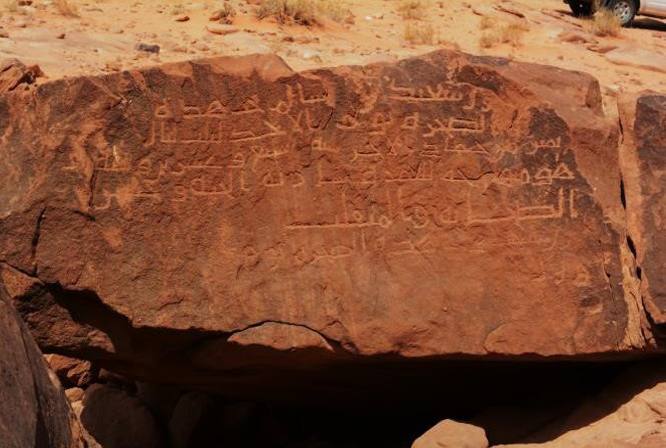
105 AH QMI-INS-055sa

Inscription of Thawābah ibn ʿUthmān al-Ṣarmī, Wādī Salma

نقش ثوابة بن عثمان الصرمي، وادي سلمى

SiteWādī Salma, about 30 km north-east of al-Ṣafāwī, north-eastern Jordan
Writing surfaceBasalt
Lines14
DimensionsUnrecorded
ScriptEarly Kūfic
SubjectPrayer for forgiveness opening with Q 40:3, dated Friday, Jumādā al-Ākhirah 105 AH
ReadingClear · nothing restored
Grade 1 of 5. The text is complete; nothing is restored.

Original text (Arabic)

  1. اللهم غافر الذنب
  2. وقابل التوبة شديد العقاب
  3. ذو الطول لا إله إلا أنت اغفر
  4. لثوابه بن عثمان الصرمي ذنبه
  5. ما تقدم منه وما تأخر
  6. واجعل الجنة مآبه والمؤمنين
  7. أصحابه إنك أنت السميع العليم
  8. غفر الله لمن قرأ
  9. هذا الكتاب ثم
  10. قال آمين رب العالمين
  11. وكتب يوم الجمعة
  12. في جمادى الآخر
  13. سنة خمسة
  14. ومايه

Translation

  1. O God, Forgiver of sin
  2. and Accepter of repentance, severe in punishment,
  3. Possessor of bounty, there is no god but You: forgive
  4. Thawābah ibn ʿUthmān al-Ṣarmī his sin,
  5. what is past of it and what is to come,
  6. and make Paradise his place of return, and the believers
  7. his companions. You are the All-Hearing, the All-Knowing.
  8. May God forgive whoever reads
  9. this writing, then
  10. says: Āmīn, Lord of the Worlds.
  11. And he wrote [this] on Friday,
  12. in Jumādā al-Ākhirah,
  13. the year five
  14. and one hundred.

Commentary

A prayer of fourteen lines cut on basalt at Wādī Salma, in the desert of north-eastern Jordan, about 30 km north-east of al-Ṣafāwī. The valley lay on the route of caravans and pilgrims making for Wādī al-Sirḥān and Arabia, and Khaled al-Jbour recorded hundreds of Arabic inscriptions there, many beside small open-air mosques and cairns. This one is dated to a Friday in Jumādā al-Ākhirah of 105 AH (November–December 723 CE), in the last months of the caliph Yazīd II, and is among the longest dated prayers of its decade.

The writer opens with the divine names of the third verse of Sūrat Ghāfir, ghāfir al-dhanb wa-qābil al-tawb shadīd al-ʿiqāb dhī al-ṭawl lā ilāha illā huwa (Q 40:3), and turns them into an address to God, “there is no god but You”. The wording moves freely with the verse: al-tawbah stands for the Qurʾānic al-tawb, and dhū al-ṭawl keeps the nominative where the verse has dhī. It closes the prayer with innaka anta al-samīʿ al-ʿalīm, the words of Abraham and Ishmael at the Kaʿbah (Q 2:127). The request for forgiveness of sins “past and to come” echoes Q 48:2 and is shared with the Ḥafnat al-Abyaḍ inscription of 64 AH (QMI-INS-010).

Two phrases widen the prayer beyond the writer. He asks that “the believers” (al-muʾminīn) be his companions in Paradise, and he asks forgiveness for whoever reads the stone and answers āmīn, a request found from the late first century onward, as in the inscription of Mukhlid of 91 AH (QMI-INS-038). The year is written sanat khamsah wa-miʾah, with the feminine form of the numeral, and the day is named, as in the Friday inscription of 76 AH at al-Madīnah (QMI-INS-016b). From the same year comes the prayer of Sakākā in al-Jawf, on the routes that joined Syria to northern Arabia (QMI-INS-055n). An undated prayer at al-ʿUlā likewise names the community as believers, praying for every believing traveller on the road (QMI-INS-055aka).

Source: Al-Jbour, Khaled Suleman. “Arabic Inscriptions from Wādī Salma.” Studies in the History and Archaeology of Jordan 7 (2001): 673–679, inscription no. 2, p. 674, fig. 2 (facsimile reproduced here). See also Lindstedt, “Early Muslim identity through epigraphy and theory,” Appendix, no. 61.

How to cite

Shaker W. Ahmed. “Inscription of Thawābah ibn ʿUthmān al-Ṣarmī, Wādī Salma” (Cat. No. QMI-INS-055sa). QMI, quranmss.com, 2026.

Inscription of Saʿīd ibn SālimPhotograph: after al-ʿAbbūdī, al-ʿĀmir and al-Ghānim (2017)⤢ Click to enlarge
127 AH QMI-INS-055q

Inscription of Saʿīd ibn Sālim

نقش سعيد بن سالم

SiteJabal al-Aqraʿ, north of al-ʿUlā, al-Madīnah region
Writing surfaceRock face (sandstone boulder)
Lines5
DimensionsUnrecorded
ScriptKūfic
SubjectTraveller’s record on the way to the ʿUmrah, dated Sunday, 27 Jumādā al-Ākhirah 127 AH
ReadingClear · nothing restored
Grade 1 of 5. The text is complete; nothing is restored.

Original text (Arabic)

  1. نزل سعيد بن سالم تحت هذه
  2. الصخرة يوم الأحد لثلث ليال
  3. بقين من جمادى الآخر سنة سبع وعشرين ومئة و
  4. هو متوجه للعمرة يسل ربه الجنة وحسن
  5. الصحابة والمنقلب

Translation

  1. Saʿīd ibn Sālim alighted beneath this
  2. rock on Sunday, with three nights
  3. remaining of Jumādā al-Ākhir, in the year one hundred and twenty-seven, and
  4. he was on his way to the ʿUmrah. He asks his Lord for Paradise, and for good
  5. companionship and a good return.

Commentary

A traveller’s note of rare precision: Saʿīd ibn Sālim records that he “alighted beneath this rock” — camped in its shade — on a Sunday, three nights before the end of Jumādā al-Ākhirah 127 AH (late March 745 CE), while on his way to perform the ʿUmrah. Few inscriptions give the weekday, the day of the month, the month and the year together, and fewer still tell us where the writer was going. His prayer asks for Paradise and for “good companionship and a good return” (ḥusn al-ṣaḥābah wa-l-munqalab), words that echo the traveller’s supplication in which God is called upon as the companion on the journey and refuge is sought from an evil return. It was written in the first months of the caliphate of Marwān ibn Muḥammad, during the turmoil of the third civil war, and comes from the same site at Jabal al-Aqraʿ, north of al-ʿUlā, as the inscription of 132 AH (no. 55p). The verb “yasʾal” is written without its hamzah seat (يسل), as in other inscriptions of the period. Compare the pilgrim’s note of Friday, 1 al-Muḥarram 110 AH, which likewise names the day of the week (QMI-INS-055af). In Dhū al-Qaʿdah of the same year a Rāfiʿ ibn Sālim cut a prayer for himself, his parents and his siblings in the same region; the two may have been brothers (QMI-INS-055qa).

Source: al-ʿAbbūdī, Aḥmad ibn Muḥammad, Fuʾād ibn Ḥasan al-ʿĀmir, and Kāmil ibn ʿAlī al-Ghānim. “Nuqūsh Islāmiyyah muʾarrakhah min Jabal al-Aqraʿ shamāl muḥāfaẓat al-ʿUlā bi-minṭaqat al-Madīnah al-Munawwarah.” Majallat al-Siyāḥah wa-l-Āthār 29, no. 1 (Riyadh: King Saud University, 2017/1438 AH): 25–58, at 50, pl. 5.

How to cite

Shaker W. Ahmed. “Inscription of Saʿīd ibn Sālim” (Cat. No. QMI-INS-055q). QMI, quranmss.com, 2026.

Inscription of Rāfiʿ ibn SālimPhoto: Muḥammad ibn ʿAbdallāh al-Shāwī⤢ Click to enlarge
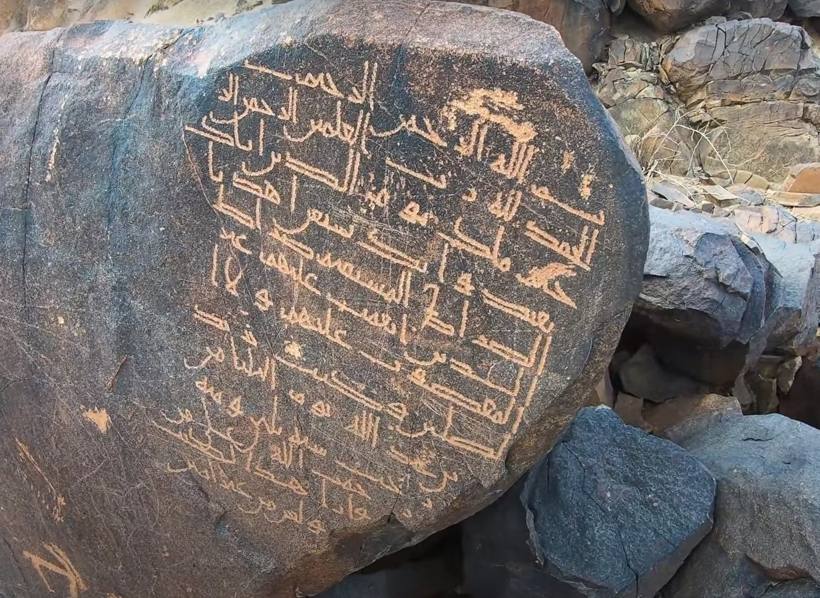
127 AH QMI-INS-055qa

Inscription of Rāfiʿ ibn Sālim

نقش رافع بن سالم

SiteNorth-western Arabia (exact site unpublished)
Writing surfaceSandstone rock face
Lines2
DimensionsUnrecorded
ScriptKūfic
SubjectPrayer for forgiveness for Rāfiʿ ibn Sālim, his parents and his siblings; dated with eight nights remaining of Dhū al-Qaʿdah 127 AH
ReadingClear · nothing restored
Grade 1 of 5. The text is complete; nothing is restored.

Original text (Arabic)

  1. اللهم اغفر لرافع بن سالم ولوالديه ولما ولدا وقهم عذاب النار إنك حميد مجيد
  2. آمين رب العالمين وكتب بثماني ليال بقين من ذي القعدة سنة سبع وعشرين ومئة

Translation

  1. O God, forgive Rāfiʿ ibn Sālim and his parents and those they begot, and guard them from the punishment of the Fire; You are Praiseworthy, Glorious.
  2. Āmīn, Lord of the Worlds. And it was written with eight nights remaining of Dhū al-Qaʿdah, in the year one hundred and twenty-seven.

Commentary

A two-line prayer cut along a smooth band of dark sandstone in north-western Arabia, dated with eight nights remaining of Dhū al-Qaʿdah 127 AH. Rāfiʿ ibn Sālim asks forgiveness for himself, for his parents and for “those they begot” (wa-li-mā waladā), that is, his brothers and sisters, so that the prayer reaches the whole household. Its wording is built from Qurʾānic phrases: wa-qihim ʿadhāb al-nār follows the prayer of the angels for the believers, “and guard them from the punishment of Hell” (Q 40:7; compare Q 2:201), and innaka ḥamīdun majīd repeats Q 11:73. The date is reckoned by the nights still to come in the month, as in other second-century texts.

Five months earlier, in Jumādā al-Ākhirah of the same year, a Saʿīd ibn Sālim recorded that he camped beneath a rock at Jabal al-Aqraʿ, north of al-ʿUlā, on his way to the ʿUmrah (QMI-INS-055q). The shared father’s name, the same year and the same region invite the thought that the two were brothers, though Sālim is a common name and the exact site of the present text is not published. A second, shorter inscription beside it reads «الله ثقة موسى بن بلال وكتب وهو يسأل الله الجنة», “God is the trust of Mūsā ibn Bilāl; he wrote [this] asking God for Paradise”; it carries no date.

Source: Published by Muḥammad ibn ʿAbdallāh al-Shāwī on X (formerly Twitter), 2 April. Reading as published; checked against the photograph by Ahmed W. Shaker.

How to cite

Shaker W. Ahmed. “Inscription of Rāfiʿ ibn Sālim” (Cat. No. QMI-INS-055qa). QMI, quranmss.com, 2026.

Inscription of Yazīd ibn ʿAbdallāh (Sūrat al-Fātiḥah)Photograph: Fayṣal al-Jarbūʿī⤢ Click to enlarge
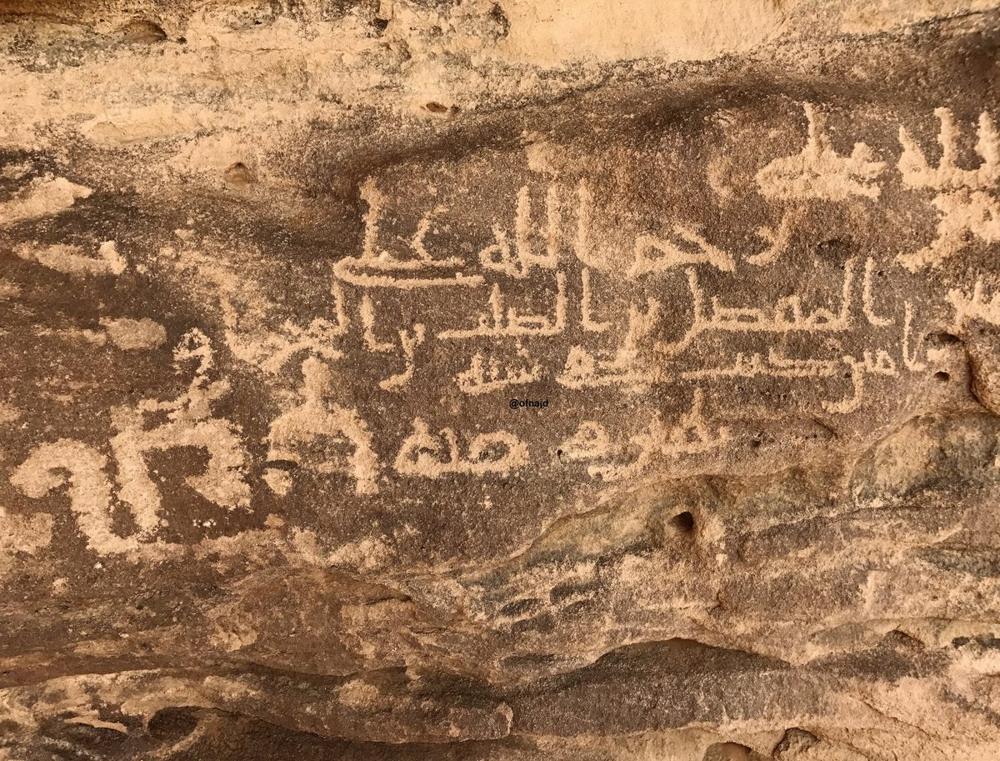
130 AH QMI-INS-055m

Inscription of Yazīd ibn ʿAbdallāh (Sūrat al-Fātiḥah)

نقش يزيد بن عبد الله (سورة الفاتحة)

SiteEast of al-Namāṣ, Bilād Rijāl al-Ḥajr, ʿAsīr region
Writing surfaceRock (boulder)
DimensionsUnrecorded
ScriptKūfic
SubjectComplete Sūrat al-Fātiḥah, signed and dated Rajab 130 AH, with a blessing on the reader and a curse on whoever alters it
ReadingClear · nothing restored
Grade 1 of 5. The text is complete; nothing is restored.

Original text (Arabic)

  1. بسم الله الرحمن الرحيم
  2. الحمد لله رب العلمين (العالمين) الرحمن الر
  3. حيم ملك يوم الدين إياك
  4. نعبد وإياك نستعين اهدنا
  5. الصراط المستقيم صراط
  6. الذين أنعمت عليهم غير
  7. المغضوب عليهم ولا ا
  8. لضلين (لضالين) وكتب يزيد
  9. بن عبد الله يوم الثلثا (الثلاثاء) من
  10. رجب سنة ثلثين (ثلاثين) ومئة
  11. رحمت (رحمة) الله على من
  12. قرأ هذ (هذا) الكتب (الكتاب)
  13. ولعن من غيره آمين

Translation

  1. In the name of God, the Merciful, the Compassionate.
  2. Praise be to God, Lord of the worlds, the Merciful, the Com-
  3. passionate, Master of the Day of Judgement. You
  4. we worship and You we ask for help. Guide us
  5. on the straight path, the path
  6. of those whom You have blessed, not
  7. of those who incur wrath, nor of tho-
  8. se who go astray. And Yazīd
  9. ibn ʿAbd Allāh wrote [this] on Tuesday in
  10. Rajab of the year one hundred and thirty.
  11. The mercy of God be on whoever
  12. reads this writing,
  13. and [God] curse whoever alters it. Amen.

Commentary

A rock inscription carrying the whole of Sūrat al-Fātiḥah, followed by the writer’s name and an exact date: Yazīd ibn ʿAbd Allāh wrote it on a Tuesday in Rajab of the year 130 AH (March 748 CE), in the caliphate of Marwān ibn Muḥammad, the last Umayyad caliph, on the eve of the ʿAbbāsid revolution. Its documenter suggests that it may be the earliest dated complete text of al-Fātiḥah on stone. The text is laid out in long lines within incised frame lines on a dark boulder.

The sūrah is written as one continuous text, with no mark between its verses, and with the spellings of the early script: al-ʿālamīn and al-ḍāllīn without the long ā. Yazīd then adds two closing formulas addressed to the passer-by: a blessing on whoever reads the writing, and a curse on whoever alters it. The appeal to the reader is old; it appears in the gravestone of ʿAbd al-Raḥmān ibn Khayr al-Ḥajarī of 31 AH (QMI-INS-004), in the prayers of Mukhlid ibn Abī Mukhlid, 91 AH (QMI-INS-038), of Qaṣr al-Kharrānah, 92 AH (QMI-INS-040) and of Thawābah al-Ṣarmī, 105 AH (QMI-INS-055sa). The curse on whoever alters the text, protecting the inscription itself, is rare in this catalog. Dating by the day of the week, here Tuesday, is found in other texts of the period, such as the prayer of Ḥasan ibn Maysarah of 117 AH (QMI-INS-055va).

Source: Documented by Muḥammad al-Duḥaymī; photograph by Fayṣal al-Jarbūʿī. Reading as published by @alshehry661 on X.

How to cite

Shaker W. Ahmed. “Inscription of Yazīd ibn ʿAbdallāh (Sūrat al-Fātiḥah)” (Cat. No. QMI-INS-055m). QMI, quranmss.com, 2026.

Inscription of al-Mufaḍḍal ibn al-Ṣalt, second prayerPhotograph: Saʿd al-Tuwayjirī⤢ Click to enlarge
130 AH QMI-INS-055ma

Inscription of al-Mufaḍḍal ibn al-Ṣalt, second prayer

نقش المفضل بن الصلت

SiteNajrān
Writing surfaceUnrecorded
Lines3
DimensionsUnrecorded
SubjectPrayer for mercy, dated 130 AH
ReadingClear · nothing restored
Grade 1 of 5. The text is complete; nothing is restored.

Original text (Arabic)

  1. ترحم الله على
  2. المفضل بن الصلت بن المخراق آمين
  3. كتب في سنة ثلثين (ثلاثين) و مئة

Translation

  1. May God have mercy upon
  2. al-Mufaḍḍal ibn al-Ṣalt ibn al-Mukhāriq. Āmīn.
  3. And [this] was written in the year one hundred and thirty.

Commentary

A prayer for mercy (taraḥḥum) upon al-Mufaḍḍal ibn al-Ṣalt ibn al-Mukhāriq, dated 130 AH (747–748 CE), in the last years of the Umayyad caliphate. The same man is named in inscription no. 55aa, dated 110 AH, twenty years earlier, where he invokes the Lord of Moses and Abraham. The two inscriptions therefore document the same person across two decades in Najrān. The reading follows the text as published; the photograph does not allow the lacunae to be checked. The writing is compact and the spelling of the numeral follows the common pattern of the period (thalāthīn written as thalthīn).

Source: Saʿd al-Tuwayjirī, photograph and reading posted on X (@ofNajd), 8 April 2020.

How to cite

Shaker W. Ahmed. “Inscription of al-Mufaḍḍal ibn al-Ṣalt, second prayer” (Cat. No. QMI-INS-055ma). QMI, quranmss.com, 2026.

Inscription of ʿAbd al-Raḥmān ibn Sulaymān, east of al-MadīnahPhoto: Fayṣal Dhaʿār al-ʿAwfī⤢ Click to enlarge
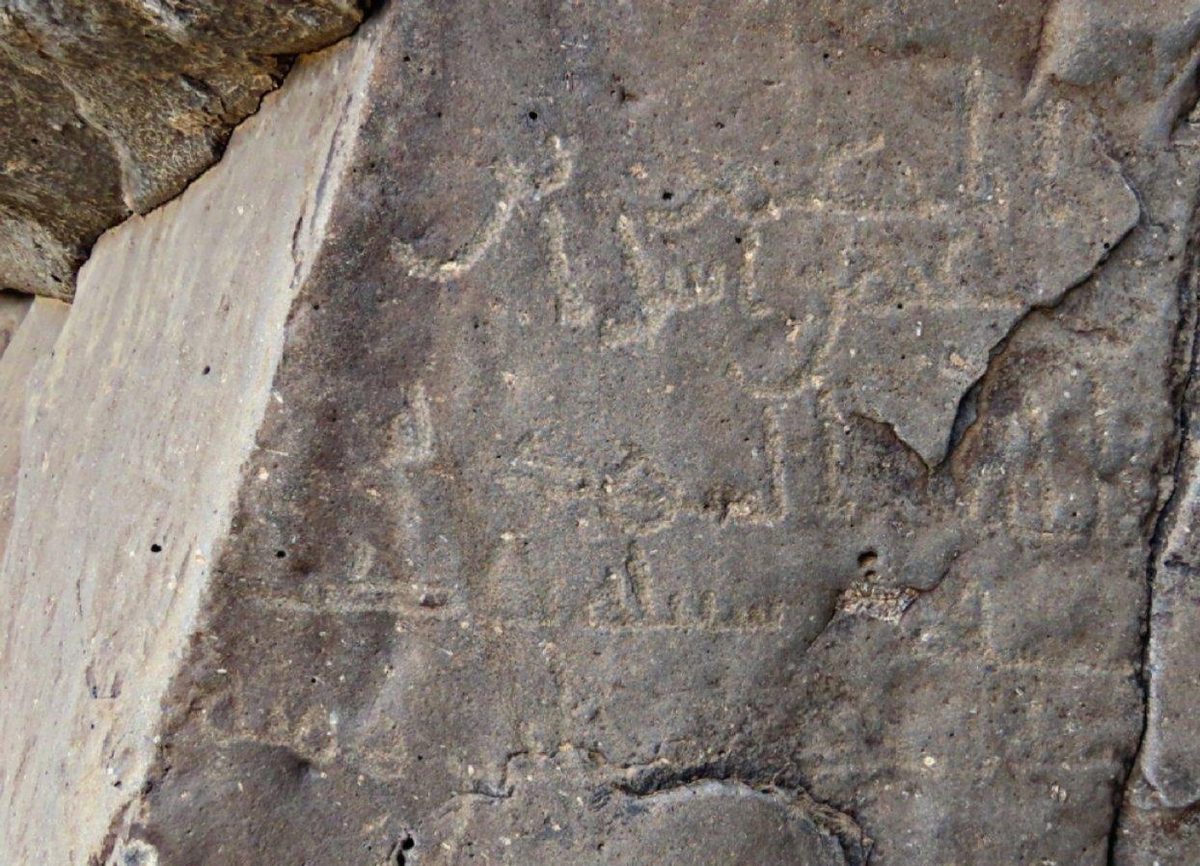
130 AH QMI-INS-055mb

Inscription of ʿAbd al-Raḥmān ibn Sulaymān, east of al-Madīnah

نقش عبد الرحمن بن سليمان، شرق المدينة

SiteEast of al-Madīnah
Writing surfaceRock face
Lines5 as published
DimensionsUnrecorded
ScriptKūfic
SubjectPrayer for refuge from what follows death, by ʿAbd al-Raḥmān ibn Sulaymān; dated Shaʿbān 130 AH
ReadingClear · nothing restored
Grade 1 of 5. The text is complete; nothing is restored.

Original text (Arabic)

  1. اللهم إن عبد الرحمن بن سليمان
  2. يعوذ بك ويعظمك ويسألك نجاة
  3. من شر ما بعد الموت وهول المطلع
  4. وكتب لثلث خلون من شعبان سنة
  5. ثلثين ومائة

Translation

  1. O God, ʿAbd al-Raḥmān ibn Sulaymān
  2. seeks refuge in You and magnifies You, and asks You for deliverance
  3. from the evil of what comes after death and the terror of the place of rising.
  4. And it was written with three nights elapsed of Shaʿbān, in the year
  5. one hundred and thirty.

Commentary

A prayer from the country east of al-Madīnah, dated in Shaʿbān 130 AH, two years before the fall of the Umayyad caliphate. It is framed in the third person: “O God, ʿAbd al-Raḥmān ibn Sulaymān seeks refuge in You and magnifies You”, the writer presenting himself before God by name. What he asks for is deliverance “from the evil of what comes after death and the terror of the place of rising” (hawl al-muṭṭalaʿ), the moment of standing before God at the resurrection; the phrase is known from early pious literature, where it is put in the mouth of ʿUmar ibn al-Khaṭṭāb on his deathbed. Few dated inscriptions look so directly beyond the grave.

The text is cut in a careful hand across a dark rock face, with the date in its usual late Umayyad form: the day counted by the nights that have passed (li-thalāth khalawna), the month named, and the year written out with thalāthīn spelled thlthyn, without the long alif. It joins the dated inscriptions of the Medina region in this catalog, among them those of 76, 110 and 114 AH (QMI-INS-016b, QMI-INS-055ag, QMI-INS-055ah). The line division follows the published reading. Two years later, in 132 AH, ʿAbd al-Raḥmān ibn Khaṭṭāb cut a profession of faith north of the city (QMI-INS-055pb).

Source: Published by ʿAbd al-Razzāq al-Rumayḥī (@alrromehi) on X (formerly Twitter), 16 Muḥarram 1442 AH. Photograph by Fayṣal Dhaʿār al-ʿAwfī. Reading as published.

How to cite

Shaker W. Ahmed. “Inscription of ʿAbd al-Raḥmān ibn Sulaymān, east of al-Madīnah” (Cat. No. QMI-INS-055mb). QMI, quranmss.com, 2026.

Inscription of ʿUmar ibn ʿUthmānPhotograph: Muḥammad al-Mughadhdhawī⤢ Click to enlarge
131 AH QMI-INS-055x

Inscription of ʿUmar ibn ʿUthmān

نقش عمر بن عثمان

SiteGhadīr Rawāwah, al-Madīnah region
Writing surfaceRock face
Lines5
DimensionsUnrecorded
SubjectPrayer for martyrdom, dated 131 AH
ReadingClear · nothing restored
Grade 1 of 5. The text is complete; nothing is restored.

Original text (Arabic)

  1. أنا عمر بن
  2. عثمن (عثمان) اسل (أسأل) ا
  3. لله الشهدة (الشهادة)
  4. في سبيله وكتب
  5. سنة إحدى وثلين (وثلاثين) ومئة

Translation

  1. I am ʿUmar ibn
  2. ʿUthmān. I ask Go-
  3. d for martyrdom
  4. in His path. And [this] was written
  5. in the year one and thirty and one hundred.

Commentary

A prayer for martyrdom “in His path” (fī sabīlihi), dated by year alone, 131 AH (748–749 CE), in the caliphate of Marwān ibn Muḥammad, the last Umayyad caliph, as the ʿAbbāsid revolution was advancing from Khurāsān towards Iraq. ʿUmar ibn ʿUthmān introduces himself in the first person (“I am …”) and asks God for shahādah — a petition not met elsewhere in this catalog, whose writers more often ask for mercy, forgiveness or paradise. The phrase is a standard one in early Muslim piety and need not point to any particular campaign. The spelling is of its time: “ʿUthmān”, “shahādah” and “thalāthīn” are all written without their long alif (عثمن، الشهدة، ثلين), and “asʾalu” is written “asl” without a seat for the hamzah (اسل), as in the inscription of ʿAbdallāh ibn Mundhqān a year later (no. 55p, 132 AH); the writer also divides the name of God across the line end (a-/llāh), as does the writer of no. 55p. The inscription was documented by Muḥammad al-Mughadhdhawī at Ghadīr Rawāwah in the region of al-Madīnah on 12 December 2019.

Source: al-Mughadhdhawī, Muḥammad (@mohammed93athar). Photograph and reading documented at Ghadīr Rawāwah, al-Madīnah region, 12 December 2019; posted on X (formerly Twitter).

How to cite

Shaker W. Ahmed. “Inscription of ʿUmar ibn ʿUthmān” (Cat. No. QMI-INS-055x). QMI, quranmss.com, 2026.

Inscription of al-Yamān ibn Ṣadaqah, Grandson of the Caliph al-WalīdPhoto: Desert Team (alsahra.org)⤢ Click to enlarge
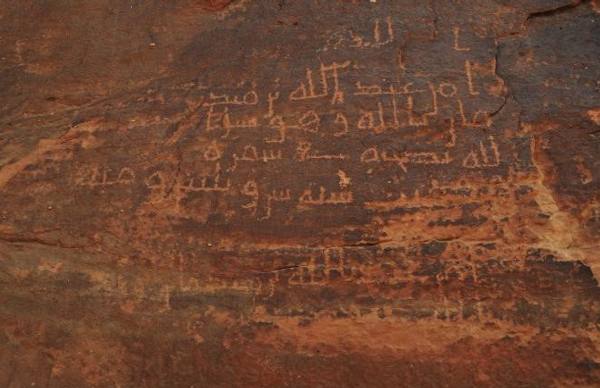
c. 100–132 AH QMI-INS-055aj

Inscription of al-Yamān ibn Ṣadaqah, Grandson of the Caliph al-Walīd

نقش اليمان بن صدقة بن الوليد بن عبد الملك

SiteNorthern Ḥijāz, on a travel route (site unpublished)
Writing surfaceRock face
Lines5
DimensionsUnrecorded
ScriptKufic
SubjectPrayer for an Umayyad prince and his clients; undated, dated here by the writer’s generation
ReadingLargely clear · a few letters restored
Grade 2 of 5. Nearly complete; a few letters are restored by the editor.

Original text (Arabic)

  1. اللهم اغفر لليمان
  2. بن صدقة بن الوليد بن عبد
  3. الملك ومواليه : الحجاج
  4. وداود وسعيد ومن
  5. انتسب الى غير الوليد [.؟.] بالوم

Translation

  1. O God, forgive al-Yamān
  2. ibn Ṣadaqah ibn al-Walīd ibn ʿAbd
  3. al-Malik and his clients: al-Ḥajjāj,
  4. Dāwūd and Saʿīd, and whoever
  5. is attached, other than to al-Walīd, […] bi-l-wm (?)

Commentary

A prayer for a young member of the Umayyad house: al-Yamān, son of Ṣadaqah, son of the caliph al-Walīd ibn ʿAbd al-Malik (r. 86–96 AH), cut on one of the travel routes of the northern Ḥijāz. Ṣadaqah is listed among the sons of al-Walīd born to concubines (umm walad). The prayer does not stop at the prince. It names three of his clients (mawālī), al-Ḥajjāj, Dāwūd and Saʿīd, so that the stone records a small Umayyad household on the road, the patron and the men who travelled with him.

The last line is not clear. It begins wa-man intasaba ilā ghayr al-Walīd and ends, after a damaged word, with the word bi-l-wm (بالوم), whose sense is not yet established. It is most likely a continuation of the prayer, extending it beyond the three named clients to those attached to al-Walīd’s house, so that the text asks forgiveness for the prince, his own clients and the wider circle of the house’s dependants.

The text carries no date, and the date given here is a broad estimate from the writer’s generation. His grandfather al-Walīd was born about 54 AH and died in 96 AH, so al-Walīd’s sons, Ṣadaqah among them, were born in the last decades of the first century, and a grandson travelling with his own clients is unlikely to be much earlier than about 100 AH. Two of al-Yamān’s uncles, Yazīd III and Ibrāhīm, sons of al-Walīd, held the caliphate in 126–127 AH. The prayer is placed before the fall of the dynasty in 132 AH, as a text of the Umayyad house written while that house still held power; a later date cannot be ruled out, since some of al-Walīd’s descendants survived it. The first publication reports that al-Yamān was among the Umayyads killed by ʿAbdallāh ibn ʿAlī at Nahr Abī Fuṭrus, near al-Ramlah, in 132 AH, when some seventy to eighty members of the house were put to death after being offered safe conduct (al-Ṭabarī, Tārīkh VII, 443; Khalīfah ibn Khayyāṭ, Tārīkh, 404; Ibn Ḥabīb, al-Muḥabbar, 485). His name has not been found in the lists of the dead consulted for this entry, so the report is not used here to fix the date. The prayer is set beside the late Umayyad texts of the catalog, among them the inscription of ʿAnjar of 123 AH, the town built in his grandfather’s reign (QMI-INS-055l), and another prayer for a member of the house of Marwān at Khirbat Nitil (QMI-INS-055ai).

Source: al-Saʿīd, ʿAbdallāh ibn ʿAbd al-ʿAzīz. “Nuqūsh wa-ḥikāyāt: aʿlām min al-ʿaṣr al-umawī wa-l-ʿabbāsī.” Farīq al-Ṣaḥrāʾ (alsahra.org), 18 July 2020, image 6. Photographs by the Desert Team (Aḥmad al-Dāmigh, Saʿd al-Sulaymān al-Saʿīd, Sāmī al-ʿAbd al-Muḥsin, Aḥmad ibn Ghānim al-Ayda). Reading as published.

How to cite

Shaker W. Ahmed. “Inscription of al-Yamān ibn Ṣadaqah, Grandson of the Caliph al-Walīd” (Cat. No. QMI-INS-055aj). QMI, quranmss.com, 2026.

Inscription of ʿAbdallāh ibn MundhqānPhotograph: after al-ʿAbbūdī, al-ʿĀmir and al-Ghānim (2017)⤢ Click to enlarge
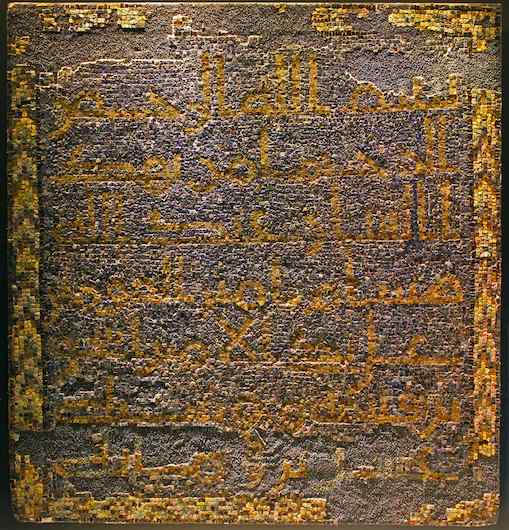
132 AH QMI-INS-055p

Inscription of ʿAbdallāh ibn Mundhqān

نقش عبد الله بن منذقان

SiteJabal al-Aqraʿ, north of al-ʿUlā, al-Madīnah region
Writing surfaceRock face (sandstone)
Lines5
DimensionsUnrecorded
ScriptKūfic
SubjectProfession of faith and prayer for God’s companionship on a journey, dated 132 AH
ReadingClear · nothing restored
Grade 1 of 5. The text is complete; nothing is restored.

Original text (Arabic)

  1. اللهم
  2. آمن عبدالله بن منذ
  3. قان بالله وهو يسل ا
  4. لله بصحبة في سفره
  5. وكتب سنة ثنين وثلثين ومئة

Translation

  1. O God,
  2. ʿAbdallāh ibn Mundh-
  3. qān believes in God, and he asks
  4. God for companionship on his journey.
  5. And [this] was written in the year one hundred and thirty-two.

Commentary

A traveller’s declaration of faith and prayer: ʿAbdallāh ibn Mundhqān affirms his belief in God and asks Him for companionship (ṣuḥbah) on his journey — the guardianship of God over the traveller, a theme met again and again in the inscriptions written along the routes of Arabia. It is dated 132 AH (749–750 CE), the year in which the Umayyad caliphate fell to the ʿAbbāsids: Abū l-ʿAbbās al-Saffāḥ was proclaimed caliph in Kūfah in Rabīʿ I, and Marwān ibn Muḥammad was killed in Egypt in Dhū l-Ḥijjah. As the writer gives no month, the inscription stands at the very turn of the two dynasties, and it closes the chronological range of this catalog. The spelling is of its time: “ithnayn” is written without its initial alif and “thalāthīn” without its long alif, and the writer divides both his father’s name (Mundh-/qān) and the name of God (A-/llāh) across the line end. It is one of the dated Islamic inscriptions published from Jabal al-Aqraʿ, north of al-ʿUlā.

Source: al-ʿAbbūdī, Aḥmad ibn Muḥammad, Fuʾād ibn Ḥasan al-ʿĀmir, and Kāmil ibn ʿAlī al-Ghānim. “Nuqūsh Islāmiyyah muʾarrakhah min Jabal al-Aqraʿ shamāl muḥāfaẓat al-ʿUlā bi-minṭaqat al-Madīnah al-Munawwarah.” Majallat al-Siyāḥah wa-l-Āthār 29, no. 1 (Riyadh: King Saud University, 2017/1438 AH): 25–58, at 52, inscription 2, pl. 6.

How to cite

Shaker W. Ahmed. “Inscription of ʿAbdallāh ibn Mundhqān” (Cat. No. QMI-INS-055p). QMI, quranmss.com, 2026.

Inscription of the Umayyad Market, BaysānPhotograph of the mosaic inscription⤢ Click to enlarge
120 AH QMI-INS-093

Inscription of the Umayyad Market, Baysān

نقش سوق الأمويين ببيسان

SiteBaysān, Jordan Valley, entrance gate of the Umayyad market
Writing surfaceWall mosaic of gilded tesserae on a blue ground, on the left pier of the gate
Lines7
Dimensionsc. 135 × 120 cm
ScriptKūfī (square Kufic)
SubjectCommemoration of the market's construction under Hishām ibn ʿAbd al-Malik; date restored as 120 AH
ReadingLargely clear · a few letters restored
Grade 2 of 5. Nearly complete; a few letters are restored by the editor.

Original text (Arabic)

  1. بسم الله الرحمن
  2. الرحيم أمر بهذ[ا]
  3. البنيان عبد الله
  4. هشام امير المؤمنين
  5. على يد الامير اسحق
  6. بن قبيصة وفي؟ سنة
  7. [ ] ومئة

Translation

  1. In the name of Allāh, the Compassionate,
  2. the Merciful. Ordered this
  3. building the servant of Allāh (ʿAbd Allāh)
  4. Hishām, Commander of the Faithful,
  5. [to be built] by the governor Isḥāq
  6. bin Qabīṣa (completed in ? the year)
  7. [ ] and one hundred.

Commentary

The entrance gate of the Umayyad market at Baysān had two stone piers. Each bore a decorated stone frame and a gilded mosaic inscription. The second inscription, attached to the left pier, was uncovered in 1996. It measures about 135 cm in length and 120 cm in width. Its letters are the same size as those of the first inscription, and the spacing matches, so the two were planned together. The first inscription survives in four lines of prayer: the Basmala, the shahāda (“there is no god but Allāh, one, without associate”), and “Muḥammad is the messenger of Allāh”. Its lower part is lost. Khamis suggests the three missing lines held Qur’ān 9:33 (the verse on the religion of truth).

The second inscription has seven lines in square Kufic. It opens with the Basmala and continues: “Ordered this building the servant of Allāh (ʿAbd Allāh) Hishām, Commander of the Faithful, [to be built] by the governor Isḥāq bin Qabīṣa.” The governor was in charge of jund al-Urdunn. The seventh and last line held the date of construction, but it is largely destroyed. Only the words “and one hundred” survive, and they begin in the middle of the line. In the Arabic and English readings, brackets mark restored or lost words and the question mark marks an uncertain word.

The date is a restoration. Khamis argues that since the inscription was carefully planned, down to the spacing of letters and words, room for only one word before “and one hundred” makes sense. Taking the years 118–125 (the reign of Hishām runs from 105 to 125 AH), the only plausible solution is twenty. That gives 120 AH (December 737 to December 738 CE). He takes this as the year the new market was completed, with the stoa and its portal along the south-facing front.

The inscription names the caliph, the governor, and the construction in one text, which is why Khamis reads it as a foundation record of the market. Eleven years after its completion, the market collapsed in the earthquake of 749 CE that devastated Baysān and large parts of Palestine.

For another public work ordered in Hishām’s name, with the same formula of command, see the pool inscription (QMI-INS-055ab), dated only to his reign (105–125 AH).

For another text of Hishām’s reign recording a decision of the caliph about land, see the meadow inscription from al-ʿUlā (QMI-INS-055ad). A bronze weight from Baysān, ordered by the governor Saʿīd ibn ʿAbd al-Malik some years later, uses the same official formula (QMI-INS-055ha).

Source: Elias Khamis, “Two Wall Mosaic Inscriptions from the Umayyad Market Place in Baysān,” Bulletin of the School of Oriental and African Studies 64, no. 2 (2001): 159–176.

How to cite

Shaker W. Ahmed. “Inscription of the Umayyad Market, Baysān” (Cat. No. QMI-INS-093). QMI, quranmss.com, 2026.

Inscription of al-Walīd b. Yazīd, Quṣayr ʿAmraPhoto: Imbert⤢ Click to enlarge
c. 105–125 AH QMI-INS-094

Inscription of al-Walīd b. Yazīd, Quṣayr ʿAmra

نقش الوليد بن يزيد في قصير عمرة

SiteQuṣayr ʿAmra, Jordan
Writing surfacePainted wall; 64 × 14 cm
Lines3
ScriptArchaic Umayyad Kūfī, painted
SubjectInvocation for the prince al-Walīd b. Yazīd
ReadingPartly preserved · several words restored
Grade 3 of 5. Several words are damaged and restored by the editor; the rest is legible.

Original text (Arabic)

  1. اللهم أصلح الوليد بن يزيد بالصلاحية عبا[د …]
  2. لحق الصالحين وأحطه ببرد [الرحم] يا ولي العالمين
  3. ولأمته خلد […] الملة يوم […] جميع ع[…]

Translation

  1. O God, make al-Walīd b. Yazīd virtuous through [...] [his] servants ...
  2. [Join him to] the righteous. Surround him with the tenderness of kinship, O Protector of the worlds!
  3. For his community, eternal ... the religion on the day of ... the whole of ...

Commentary

Quṣayr ʿAmra is a bathhouse of the Umayyad period in the Jordanian badiya, with painted scenes on its walls. Its inscriptions were studied by Jaussen and Savignac in 1909 and by Imbert from 1989. Only a fragment of the first line was read before 2012, when the restoration of the western aisle showed the first line clearly, and the inscription was re-read in May 2012 during the removal of a later restoration. The earlier restorers had changed the lettering in places, so Imbert bases his reading on the state of the paint before that restoration.

Imbert reads the first line as an invocation (“O God, make al-Walīd b. Yazīd virtuous”), where the name is given with its patronymic and without any title. The second line seems to ask God to join the prince to the righteous and to surround him with the tenderness of kinship (bard al-raḥm), ending with the vocative “O Protector of the worlds” (yā walī al-ʿālamīn). The third line is almost entirely lost. The readings of the second and third lines are tentative, and Imbert warns that the restored paint cannot be used to verify letter forms.

Date. The inscription names al-Walīd without the title of caliph, and Imbert reads it as the prince's invocation. al-Walīd was designated heir under his uncle Hishām (reigned 105–125 AH, 724–743 CE), became caliph in 125 AH (743 CE), and died in 126 AH (744 CE). The inscription therefore falls between about 105 and 125 AH (c. 724–743 CE).

This is the only known text that names al-Walīd b. Yazīd, according to Imbert. It is one of five painted Arabic inscriptions at Quṣayr ʿAmra, which also include the basmala in a tabula ansata, a text on the baldaquin over the throne naming the “heir presumptive of the Muslims and Muslim women”, a text naming Abraham in the eastern lunette, and bilingual Greek and Arabic names of rulers in the scene of the kings. Taken together, the texts suggest a private programme of invocations, not an official inscription. The prince's name is the reason the bath is linked to his household.

Source: Frédéric Imbert, “Le prince al-Walīd et son bain: itinéraires épigraphiques à Quṣayr ʿAmra,” in memoriam Oleg Grabar, pp. 322–356 (journal and year to be confirmed).

How to cite

Shaker W. Ahmed. “Inscription of al-Walīd b. Yazīd, Quṣayr ʿAmra” (Cat. No. QMI-INS-094). QMI, quranmss.com, 2026.

Inscription of the Verse on Blessing the ProphetDocumentation: Muḥammad al-Mughadhdhawī⤢ Click to enlarge
132 AH QMI-INS-055pa

Inscription of the Verse on Blessing the Prophet

نقش آية الصلاة على النبي

Siteal-Madīnah al-Munawwarah
Writing surfaceRock face (dark basalt)
Lines11
DimensionsUnrecorded
SubjectQurʾān 33:56; written by ʿAbd al-Raḥmān ibn Muʿammar, dated 132 AH
ReadingClear · nothing restored
Grade 1 of 5. The text is complete; nothing is restored.

Original text (Arabic)

  1. إن الله وا
  2. ملئكته (ملائكته) يصلون
  3. على النبي يايها (يا أيها) الذ
  4. ين آمنوا صلوا
  5. عليه وسلموا
  6. تسليموا (تسليما) وكتب
  7. عبد الرحمن
  8. ابن معمار
  9. سنة ثنتين
  10. وثلثين
  11. ومية (ومائة)

Translation

  1. Indeed, God and [His] a-
  2. ngels send blessings
  3. upon the Prophet. O you who be-
  4. lieve, invoke blessings
  5. upon him and greet him with
  6. peace (Q 33:56). And wrote [this]
  7. ʿAbd al-Raḥmān
  8. ibn Muʿammar,
  9. in the year two
  10. and thirty
  11. and one hundred.

Commentary

An eleven-line carved quotation of Qurʾān 33:56, the verse on God and His angels sending blessings upon the Prophet, followed by the name of the writer, ʿAbd al-Raḥmān ibn Muʿammar, and the date 132 AH (749–750 CE), at the end of the Umayyad period. It is one of the few dated inscriptions in the catalog that quote the Qurʾān directly rather than a personal prayer.

The orthography preserves several early features: malāʾikah is written without the medial alif, ملئكته; yā ayyuhā appears as a single word يايها; taslīman is given as تسليموا with wāw for the long vowel and a final alif; and miʾah is spelled مية without the hamzah. The word واملئكته is split across lines 1–2.

Source: al-Mughadhdhawī, Muḥammad (@mohammed93athar). Photograph and reading posted on X (formerly Twitter).

How to cite

Shaker W. Ahmed. “Inscription of the Verse on Blessing the Prophet” (Cat. No. QMI-INS-055pa). QMI, quranmss.com, 2026.

Rock inscription from al-Mahd naming ʿUmar ibn al-KhaṭṭābPhoto: Heritage Commission (MOCHeritage)⤢ Click to enlarge
2nd c. AH QMI-INS-055pz

Inscription of al-Mahd: “God is the Protector of ʿUmar ibn al-Khaṭṭāb”

نقش المهد: «الله ولي عمر بن الخطاب»

Siteal-Mahd governorate, al-Madīnah region, Saudi Arabia
Writing surfaceRock face
Lines5
DimensionsUnrecorded
ScriptEarly Kūfic
SubjectInvocation of God’s protection for ʿUmar ibn al-Khaṭṭāb, with “There is no god but God”; undated
ReadingClear · nothing restored
Grade 1 of 5. The text is complete; nothing is restored.

Original text (Arabic)

  1. الله ولي عمر
  2. بن الخطاب
  3. في الدنيا و
  4. الآخر
  5. ة لا إله إلا الله

Translation

  1. God is the protector of ʿUmar
  2. ibn al-Khaṭṭāb
  3. in this world and
  4. the Hereaf-
  5. ter. There is no god but God.

Commentary

A five-line rock inscription from al-Mahd governorate, in the region of al-Madīnah, recorded by the Saudi Heritage Commission during the second season of its archaeological survey of al-Mahd, which documented 461 Islamic inscriptions among more than 1,700 finds; the Commission announced it in June 2026. It asks that God be the walī, the protector and patron, of ʿUmar ibn al-Khaṭṭāb “in this world and the Hereafter”, and closes with the first half of the profession of faith, “There is no god but God”. The writer does not give his name, and the text carries no date.

The first reports placed the inscription in ʿUmar’s own lifetime, on the evidence of its letterforms; features cited in support were the division of a word across two lines and the alif written in al-Khaṭṭāb. QMI places it in the second century AH. The script points that way. Final yāʾ is turned back to the right beneath the line (al-yāʾ al-rājiʿah), as in ولي and في, a form that becomes common in second-century hands. The word al-ākhirah is drawn out with a long horizontal extension (mashq), الآخــــــرة, a deliberate stretching of the baseline that belongs to the developed Kūfic of the second century rather than to the compact Ḥijāzī writing of the first. The content agrees. The text is not a graffito of ʿUmar or of a companion who signs beside him: it is an invocation for him, made by an unnamed writer, and asks God’s patronage for him in the Hereafter as well as in this world, the language of a later prayer for a revered figure rather than of a contemporary record. A text is most securely tied to the person it names when he signs it himself, in the form “I am so-and-so” (anā fulān), as Khālid ibn al-ʿĀṣ does at al-Bāḥah (QMI-INS-004c) and al-Ḥārith ibn Būlī in Ḥismā (QMI-INS-002a). Here ʿUmar is named in the third person, by another hand, and the inscription tells us about the writer’s regard for him, not about ʿUmar himself.

The wording recalls Q 2:257, “God is the protector of those who believe” (Allāhu waliyyu alladhīna āmanū). ʿUmar is named in the catalog’s earliest dated Islamic text, written “in the year ʿUmar died”, 24 AH (QMI-INS-001), and his descendants left their own prayers in the region of al-Madīnah a century later: Abū Salamah ibn ʿAbd Allāh ibn ʿAbd Allāh ibn ʿUmar in 100 AH (QMI-INS-053), and the sons of ʿUmar ibn Ḥafṣ in 114 and 121 AH (QMI-INS-055aha, QMI-INS-055w, QMI-INS-055wb).

Source: Saudi Heritage Commission (@MOCHeritage), announcement of the second season of the archaeological survey of al-Mahd governorate, June 2026; reported by the Saudi Press Agency and by Asharq, 12 June 2026. Photograph: Heritage Commission. Reading by Ahmed W. Shaker from the published photograph.

How to cite

Shaker W. Ahmed. “Inscription of al-Mahd: “God is the Protector of ʿUmar ibn al-Khaṭṭāb”” (Cat. No. QMI-INS-055pz). QMI, quranmss.com, 2026.

Rock inscription of Zayd ibn Ḥasan, al-MadīnahPhoto: [credit pending]⤢ Click to enlarge
c. 50–120 AH QMI-INS-055pza

Inscription of Zayd ibn Ḥasan: “Bless Us in This Dwelling of Ours”

نقش زيد بن حسن: «اللهم بارك لنا في منزلنا هذا»

Siteal-Madīnah, Saudi Arabia
Writing surfaceRock face
Lines9
DimensionsUnrecorded
ScriptKūfic
SubjectProfession of faith by Zayd ibn Ḥasan, a prayer to be near the Prophet in the Hereafter, and a prayer for his dwelling; probably Zayd ibn al-Ḥasan ibn ʿAlī ibn Abī Ṭālib (d. 120 AH); undated, placed c. 50–120 AH by the writer’s lifetime
ReadingLargely clear · one word uncertain
Grade 2 of 5. The text is complete and clear; only the reading of the last-but-one word, مر مرا (مرارا?), is uncertain.

Original text (Arabic)

  1. آمن زيد بن حسن بالله وحده لا شريك له وشهد
  2. ألا إله إلا الله وأن محمدا عبده
  3. ورسوله على ذلك يحيى (يحيا) ما حي (حيي) وعليه يموت
  4. إذا مات وهو يسل (يسأل) الله أن يقربه من
  5. محمد في الآخرة كما قربه منه في
  6. بالدنيا (الدنيا) وأن يجعله من أحباه (أحبائه) وأصفيه (أصفيائه)
  7. ونجبه (ونجبائه) اللهم بارك لنا في منزلنا هذا وأد
  8. رأ عنا شره وشر كل ذي شر وأرددنا
  9. إليه مر مرا (مرارا؟) كثيرة

Translation

  1. Zayd ibn Ḥasan has believed in God alone, who has no partner, and has testified
  2. that there is no god but God and that Muḥammad is His servant
  3. and His messenger. On this he lives as long as he lives, and on it he will die
  4. when he dies. He asks God to bring him close to
  5. Muḥammad in the Hereafter, as He brought him close to him in
  6. this world, and to make him one of His beloved and His chosen
  7. and His elect. O God, bless us in this dwelling of ours, and wa-
  8. rd off from us its evil and the evil of every evil one, and bring us back
  9. to it many times over.

Commentary

A nine-line text cut into a rock face at al-Madīnah. It falls into two parts. The first is a creed in the third person: Zayd ibn Ḥasan has believed in God alone and testified that there is no god but God and that Muḥammad is His servant and messenger; he lives by this and will die by it; and he asks God to bring him close to Muḥammad in the Hereafter “as He brought him close to him in this world”, and to count him among God’s beloved, chosen and elect. The second part turns to direct address, and from “he” to “we”: “O God, bless us in this dwelling of ours (manzilunā hādhā), ward off from us its evil and the evil of every evil one, and bring us back to it many times over.”

The writer gives his name only as Zayd ibn Ḥasan. The name, the place and the wording agree with Zayd ibn al-Ḥasan ibn ʿAlī ibn Abī Ṭālib, eldest son of al-Ḥasan and great-grandson of the Prophet through Fāṭimah. He was born in al-Madīnah around 30 AH and lived there; the biographical tradition reports that he had charge of the ṣadaqāt, the endowed properties, at al-Madīnah, and the common report places his death in 120 AH at al-Ḥājir, on the road between Makkah and al-Madīnah, at about ninety years of age, with burial in al-Baqīʿ. On this identification, the phrase “as He brought him close to him in this world” refers to the writer’s descent from the Prophet, the closeness of kinship; it may refer as well to life in the Prophet’s city, beside his mosque and his grave. The prayer to be brought back to “this dwelling of ours” many times suits a man whose home was in al-Madīnah and who expected to leave it and return.The name Zayd ibn Ḥasan was not unique, and the text gives no nisbah, no grandfather and no date, so the identification is probable rather than certain. The text carries no date. If the identification holds, it was cut in Zayd’s adult life at al-Madīnah: he was born around 30 AH and died in 120 AH, and QMI places the inscription c. 50–120 AH. The estimate rests on the identification of the writer, not on a date in the text, and would fall away if he is another Zayd ibn Ḥasan.

A second text in the catalog may come from the same family. In the region of Makkah a writer signs “I am Jaʿfar ibn Muḥammad” and leaves a testament to every believer, enjoining mindfulness of God, patience in trial, gratitude and reliance on Him, dated ten nights into Shaʿbān 110 AH; it has been suggested that he is Jaʿfar ibn Muḥammad al-Ṣādiq (d. 148 AH) (QMI-INS-055b). If both identifications hold, the two writers were close kin and contemporaries. Jaʿfar’s grandmother Fāṭimah bint al-Ḥasan, mother of Muḥammad al-Bāqir, was a daughter of al-Ḥasan ibn ʿAlī and so Zayd’s sister, which makes Jaʿfar Zayd’s great-nephew; both lived in al-Madīnah, and Jaʿfar’s text was written ten years before Zayd’s death. The two texts differ in form: Jaʿfar speaks in the first person and addresses the reader, while Zayd’s creed is set in the third person and turns to prayer for himself and his household. Each writer gives only his own name and his father’s, and neither identification can be confirmed from the stone alone.

Only one other text in the catalog prays over a house. In a cave house at Bayt Jibrīn in Palestine a visitor wrote on the plastered wall, “O God, forgive Hilāl and the lord of this dwelling” (rabb hādhā al-manzil), a text placed by its script in the reign of Hishām, c. 105–125 AH (QMI-INS-055al). Both texts use manzil for the home and both are written at it. At Bayt Jibrīn a guest prays for the owner; here the owner, or his household, prays for the house itself, for blessing, for protection from its harm and for return. Most prayers in the catalog are cut along roads and at stopping places; these two belong to a home.

The spelling has several early features. The hamzah is not written in يسل for yasʾalu, nor in أحباه, أصفيه and نجبه for aḥibbāʾihi, aṣfiyāʾihi and nujabāʾihi. Final alif is written as yāʾ in يحيى for yaḥyā, and حي stands for ḥayiya. The word al-dunyā is written with a preposition, بالدنيا, after the في that ends line 5, a doubling of “in”. The verb وأدرأ, “and ward off”, is divided between lines 7 and 8, and the last-but-one word, مر مرا, is read with reserve as mirāran, “many times”.

Source and photograph: [pending]. Reading by Ahmed W. Shaker. On Zayd ibn al-Ḥasan: Ibn Saʿd, al-Ṭabaqāt al-kabīr; al-Mizzī, Tahdhīb al-Kamāl, s.v. Zayd ibn al-Ḥasan ibn ʿAlī; al-Dhahabī, Siyar aʿlām al-nubalāʾ, s.v. Zayd ibn al-Ḥasan.

How to cite

Shaker W. Ahmed. “Inscription of Zayd ibn Ḥasan: “Bless Us in This Dwelling of Ours”” (Cat. No. QMI-INS-055pza). QMI, quranmss.com, 2026.

Inscription of ʿAbd al-Raḥmān ibn Khaṭṭāb, north of al-MadīnahPhoto: Muḥammad al-Mughadhdhawī⤢ Click to enlarge
132 AH QMI-INS-055pb

Inscription of ʿAbd al-Raḥmān ibn Khaṭṭāb, north of al-Madīnah

نقش عبد الرحمن بن خطاب، شمال المدينة

SiteNorth of al-Madīnah
Writing surfaceGranite rock face
Lines5
DimensionsUnrecorded
ScriptKūfic
SubjectProfession of faith by ʿAbd al-Raḥmān ibn Khaṭṭāb, of the family of Kaʿb ibn Mālik al-Anṣārī (per the publisher); dated 132 AH
ReadingClear · nothing restored
Grade 1 of 5. The text is complete; nothing is restored.

Original text (Arabic)

  1. آمن عبد الرحمن
  2. بن خطاب بالله ا
  3. لعظيم
  4. وكتبت سنة ثنتين و
  5. ثلاثين ومائة

Translation

  1. ʿAbd al-Raḥmān
  2. ibn Khaṭṭāb believes in God the
  3. Almighty.
  4. And it was written in the year two and
  5. thirty and one hundred.

Commentary

A short profession of faith from the country north of al-Madīnah, dated 132 AH, the year in which the Umayyad caliphate fell to the ʿAbbāsids. ʿAbd al-Raḥmān ibn Khaṭṭāb declares that he “believes in God the Almighty” (āmana … bi-llāh al-ʿaẓīm), and the record of writing uses the feminine passive, wa-kutibat, “and it was written”, with the inscription itself as its subject. The article of al-ʿaẓīm is divided across the line end (a-/lʿẓym), a habit seen in other texts of the region.

Its publisher, Muḥammad al-Mughadhdhawī, identifies the writer as ʿAbd al-Raḥmān ibn Khaṭṭāb ibn Nuʿmān ibn ʿAbdallāh ibn Kaʿb ibn Mālik al-Anṣārī, a descendant of the Companion and poet Kaʿb ibn Mālik, and reports further inscriptions of the same family on their lands north of the city: one of his paternal uncle ʿAbd al-Raḥmān ibn Nuʿmān of the same year, and a later text of his own dated 179 AH, which falls outside the range of this catalog. The stone itself gives only “ibn Khaṭṭāb”, so the longer lineage rests on the publisher’s study. With the prayer of ʿAbd al-Raḥmān ibn Sulaymān of 130 AH east of the city, it closes the dated series of the Medina region in this catalog (QMI-INS-055mb).

Source: al-Mughadhdhawī, Muḥammad (@mohammed93athar), Nawādir al-āthār wa-l-nuqūsh, X (formerly Twitter), 31 July 2022 (“the seventh inscription”). Photograph and reading by the publisher.

How to cite

Shaker W. Ahmed. “Inscription of ʿAbd al-Raḥmān ibn Khaṭṭāb, north of al-Madīnah” (Cat. No. QMI-INS-055pb). QMI, quranmss.com, 2026.

العربيةmachine translation